Transseptal Needle Market Size, Share & Demand Report By Product Type (Mechanical Transseptal Needles, Radiofrequency Transseptal Needles), By Application (Electrophysiology Procedures, Structural Heart Disease Procedures), By End-Use (Hospitals, Ambulatory Surgical Centers, Specialty Clinics) By Region & Segment Forecasts, 2025–2034
USD 3950
Market Overview
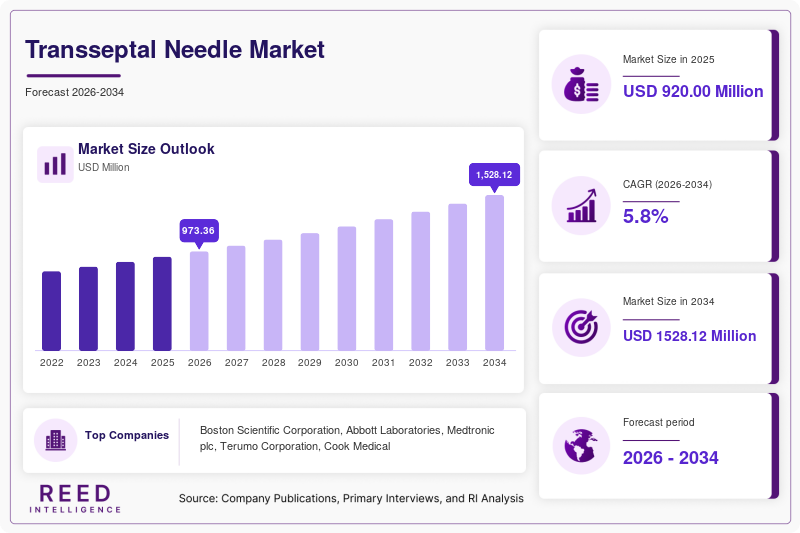
The Transseptal Needle Market size is witnessing steady expansion, driven by the increasing prevalence of cardiovascular disorders and the growing adoption of minimally invasive cardiac procedures. In 2025, the global market size is estimated at approximately USD 920 million, with a projected increase to USD 975 million in 2026. By 2034, the market is forecasted to reach USD 1620 million, registering a compound annual growth rate (CAGR) of 5.8% during the forecast period from 2025 to 2034.
Transseptal needles play a critical role in electrophysiology procedures, particularly in accessing the left atrium for interventions such as atrial fibrillation ablation and structural heart disease treatment. The market’s growth is primarily supported by the rising global burden of arrhythmias, advancements in catheter-based procedures, and increasing procedural volumes in cardiac catheterization labs. Additionally, favorable reimbursement scenarios in developed regions and the growing availability of skilled interventional cardiologists are contributing to broader adoption.
Key Highlights
- Market size estimated at USD 920 million in 2025
- Expected to reach USD 1.62 billion by 2034
- CAGR of 5.8% during 2025–2034
- Rising adoption of minimally invasive cardiac procedures
- Technological advancements improving procedural safety and efficiency
Market Trends
Increasing Adoption of Radiofrequency Transseptal Needles
One of the most notable trends in the Transseptal Needle Market is the growing adoption of radiofrequency (RF) transseptal needles. These devices use controlled energy to facilitate septal puncture, improving precision and reducing the force required during the procedure. As clinicians increasingly prioritize patient safety and procedural efficiency, RF-enabled needles are gaining traction across electrophysiology labs. Hospitals are investing in advanced equipment that minimizes complications such as cardiac perforation or tamponade. Furthermore, training programs are incorporating RF technologies, increasing familiarity among healthcare professionals. This trend is expected to continue as healthcare providers seek tools that enhance procedural success rates and reduce intervention time.
Integration of Imaging and Navigation Technologies
Another emerging trend is the integration of transseptal procedures with advanced imaging and navigation systems. Real-time imaging modalities such as intracardiac echocardiography and 3D mapping systems are being used alongside transseptal needles to improve procedural accuracy. This integration allows clinicians to visualize anatomical structures more clearly, thereby reducing procedural risks. The combination of imaging and precision tools is particularly beneficial in complex cases involving structural heart disease. As healthcare systems increasingly adopt digital and imaging technologies, the demand for compatible transseptal devices is rising. This trend reflects a broader shift toward precision medicine and data-guided interventions in cardiology.
Market Drivers
Rising Prevalence of Cardiovascular Diseases
The increasing prevalence of cardiovascular diseases globally is a primary driver for the Transseptal Needle Market. Conditions such as atrial fibrillation, heart failure, and structural heart defects are becoming more common due to aging populations and lifestyle-related risk factors. These conditions often require catheter-based interventions, which rely on transseptal access. As healthcare systems focus on early intervention and disease management, the demand for transseptal procedures is rising. Additionally, improved diagnostic capabilities are leading to higher detection rates, further increasing the volume of procedures. This growing patient pool is expected to sustain long-term demand for transseptal needles across hospitals and specialty clinics.
Growth in Minimally Invasive Cardiac Procedures
The shift toward minimally invasive procedures is significantly driving market growth. Patients and healthcare providers prefer minimally invasive techniques due to reduced recovery times, lower complication rates, and shorter hospital stays. Transseptal needles are essential tools in these procedures, enabling access to the left atrium without open-heart surgery. Advances in catheter-based technologies have expanded the range of treatable conditions, further boosting demand. Healthcare systems are also promoting minimally invasive approaches to reduce costs and improve patient outcomes. As a result, the increasing number of electrophysiology and structural heart procedures is directly contributing to market expansion.
Market Restraint
Risk of Procedural Complications and Skill Dependency
Despite its growth, the Transseptal Needle Market faces challenges related to procedural risks and the high level of expertise required. Transseptal puncture is a complex procedure that demands precision and experience. Complications such as cardiac perforation, stroke, or pericardial effusion can occur if the procedure is not performed correctly. This risk limits adoption in healthcare settings with limited expertise or inadequate training. Additionally, the learning curve associated with advanced transseptal techniques can slow the adoption of newer technologies. For example, smaller hospitals in developing regions may hesitate to invest in advanced transseptal equipment due to concerns about procedural safety and lack of trained personnel. These factors can restrict market growth, particularly in emerging economies.
Market Opportunities
Expansion in Emerging Markets
Emerging economies present significant growth opportunities for the Transseptal Needle Market. Countries in Asia Pacific, Latin America, and parts of the Middle East are investing in healthcare infrastructure and expanding access to advanced medical procedures. As awareness of cardiovascular diseases increases, more patients are seeking treatment, leading to higher procedural volumes. Governments are also implementing initiatives to improve healthcare access and affordability. This creates a favorable environment for medical device manufacturers to expand their presence. Companies that offer cost-effective and reliable transseptal solutions are likely to gain a competitive advantage in these regions.
Development of Next-Generation Devices
The development of next-generation transseptal needles offers another key opportunity. Manufacturers are focusing on improving device design to enhance safety, ease of use, and compatibility with imaging systems. Innovations such as steerable needles, enhanced tip visibility, and integrated safety mechanisms are gaining attention. These advancements can reduce procedural complications and improve outcomes, making them attractive to healthcare providers. Additionally, the integration of smart technologies and data analytics into medical devices is expected to drive future growth. Companies that invest in research and development are well-positioned to capitalize on this opportunity and strengthen their market position.
Segmental Analysis
By Type
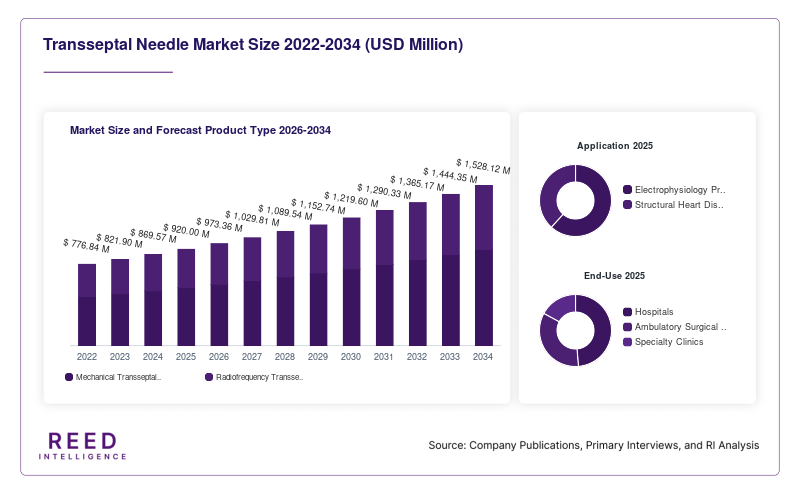
The mechanical transseptal needles segment dominated the market in 2024, accounting for approximately 62% of the total share. These needles are widely used due to their cost-effectiveness, ease of use, and established clinical reliability. Healthcare providers in both developed and developing regions continue to rely on mechanical needles for standard procedures. Their widespread availability and compatibility with existing equipment make them a preferred choice in many hospitals. Additionally, the lower cost compared to advanced alternatives supports their adoption in cost-sensitive markets. The segment’s dominance is also supported by the large volume of routine procedures performed globally.
The radiofrequency transseptal needles segment is the fastest-growing, with a projected CAGR of 6.8% during the forecast period. The growth is driven by increasing demand for precision and safety in complex procedures. RF needles offer enhanced control and reduce the risk of complications, making them attractive for advanced interventions. Healthcare providers are increasingly adopting these devices to improve procedural outcomes. The integration of RF technology with imaging systems further enhances their effectiveness, supporting their rapid growth in the market.
By Application
Electrophysiology procedures dominated the application segment in 2024, accounting for around 58% of the market share. The high prevalence of arrhythmias and the increasing number of ablation procedures are key factors driving this segment. Transseptal needles are essential for accessing the left atrium during these procedures, making them a critical component of electrophysiology interventions. The growing adoption of advanced mapping and ablation technologies is further supporting segment growth. Additionally, increasing awareness and early diagnosis of arrhythmias are contributing to higher procedural volumes.
Structural heart disease procedures are the fastest-growing application segment, with a CAGR of 6.5%. The growth is driven by the increasing adoption of minimally invasive techniques for treating conditions such as mitral valve disorders. Advances in device technology and improved procedural outcomes are encouraging more healthcare providers to adopt these interventions. The aging population and rising incidence of structural heart conditions are also contributing to segment growth. As technology continues to evolve, the demand for transseptal needles in this segment is expected to increase significantly.
By End-Use
Hospitals dominated the end-use segment in 2024, accounting for approximately 65% of the market share. Hospitals have the necessary infrastructure, skilled personnel, and equipment to perform complex cardiac procedures. The high volume of procedures performed in hospitals contributes to their dominant position. Additionally, hospitals are more likely to adopt advanced technologies, including RF transseptal needles. The presence of specialized cardiac centers within hospitals further supports segment growth. Government funding and reimbursement policies also play a role in sustaining demand in this segment.
Ambulatory surgical centers (ASCs) are the fastest-growing end-use segment, with a CAGR of 6.9%. The growth is driven by the increasing shift toward outpatient procedures and cost-effective healthcare delivery. ASCs offer shorter wait times and lower costs compared to hospitals, making them an attractive option for patients. Advances in minimally invasive techniques have made it possible to perform certain cardiac procedures in outpatient settings. This trend is expected to drive demand for transseptal needles in ASCs, supporting their rapid growth.
Regional Analysis
North America
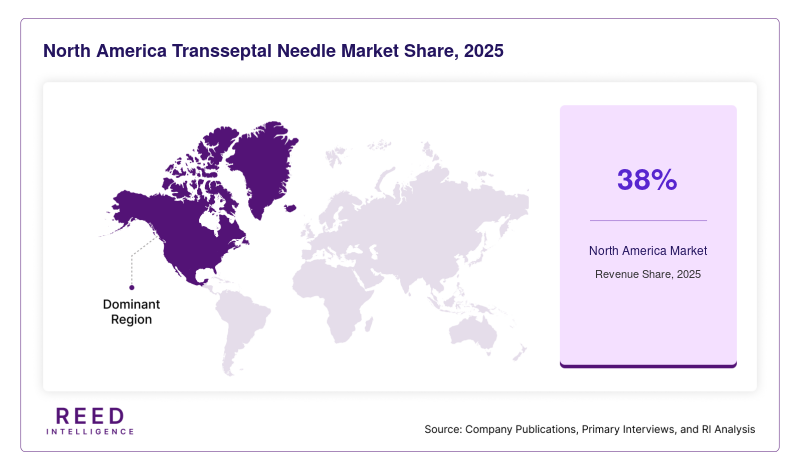
North America accounted for approximately 38% of the Transseptal Needle Market share in 2025 and is expected to grow at a CAGR of 5.4% through 2034. The region benefits from advanced healthcare infrastructure, high adoption of minimally invasive procedures, and strong reimbursement frameworks. The presence of leading medical device companies and ongoing technological innovation further support market growth. Additionally, the high prevalence of cardiovascular diseases contributes to sustained demand for transseptal procedures.
The United States dominates the North American market, driven by a well-established healthcare system and a large patient population. A unique growth factor in this region is the rapid adoption of advanced electrophysiology technologies. Hospitals and specialty centers are investing in state-of-the-art equipment to improve patient outcomes, which is driving demand for advanced transseptal needles.
Europe
Europe held around 27% of the market share in 2025 and is projected to grow at a CAGR of 5.2% during the forecast period. The region’s growth is supported by increasing healthcare expenditure, rising awareness of cardiovascular diseases, and the adoption of innovative medical technologies. Countries such as Germany, France, and the UK are leading contributors to market growth.
Germany is the dominant country in the European market, benefiting from a strong healthcare infrastructure and a high number of cardiac procedures. A unique growth factor in this region is the emphasis on clinical research and innovation. European institutions are actively involved in developing and testing new medical devices, which supports the adoption of advanced transseptal needles.
Asia Pacific
Asia Pacific accounted for approximately 20% of the market share in 2025 and is expected to grow at the highest CAGR of 6.6% through 2034. The region’s growth is driven by improving healthcare infrastructure, increasing patient awareness, and a growing burden of cardiovascular diseases. Rapid urbanization and lifestyle changes are also contributing to higher disease prevalence.
China leads the Asia Pacific market, supported by government initiatives to expand healthcare access and modernize medical facilities. A unique growth factor in this region is the increasing investment in healthcare technology. Local manufacturers are also entering the market, offering cost-effective solutions that cater to regional needs, further boosting market growth.
Middle East & Africa
The Middle East & Africa region held about 8% of the market share in 2025 and is projected to grow at a CAGR of 5.9%. Growth in this region is supported by improving healthcare infrastructure and increasing investments in medical technology. Governments are focusing on enhancing healthcare services to meet the needs of growing populations.
Saudi Arabia dominates the regional market, driven by significant healthcare investments and the expansion of specialized medical centers. A unique growth factor in this region is the rising focus on medical tourism. Countries are positioning themselves as healthcare hubs, which is increasing the demand for advanced cardiac procedures and related devices.
Latin America
Latin America accounted for approximately 7% of the market share in 2025 and is expected to grow at a CAGR of 5.7% through 2034. The region’s growth is driven by increasing healthcare expenditure and rising awareness of cardiovascular diseases. Governments are implementing policies to improve healthcare access and quality.
Brazil is the leading market in Latin America, supported by a large population and a growing number of healthcare facilities. A unique growth factor in this region is the expansion of private healthcare providers. These institutions are investing in advanced medical technologies, which is driving demand for transseptal needles.
Competitive Landscape
The Transseptal Needle Market is moderately competitive, with several global and regional players focusing on product innovation and strategic partnerships. The market is characterized by continuous advancements in device design and technology. Companies are investing in research and development to introduce safer and more efficient products. Strategic collaborations with healthcare providers and research institutions are also common, enabling companies to expand their market presence.
A leading player in the market is Boston Scientific Corporation, known for its comprehensive portfolio of cardiovascular devices. The company has recently introduced advanced transseptal solutions with improved safety features, strengthening its market position. Other key players are focusing on expanding their product offerings and entering emerging markets. Competitive strategies include mergers, acquisitions, and product launches aimed at enhancing market share and addressing evolving customer needs.
Key Players List
- Boston Scientific Corporation
- Abbott Laboratories
- Medtronic plc
- Terumo Corporation
- Cook Medical
- Teleflex Incorporated
- Merit Medical Systems
- B. Braun Melsungen AG
- MicroPort Scientific Corporation
- Cardinal Health
- Oscor Inc.
- Baylis Medical Company
- Edwards Lifesciences Corporation
- Nipro Corporation
- Lepu Medical Technology
Recent Developments
- A leading medical device manufacturer launched a next-generation radiofrequency transseptal needle with enhanced tip visibility and improved safety features.
- A strategic partnership between a device company and a healthcare provider aimed at expanding access to advanced electrophysiology procedures in emerging markets.
- Introduction of a new training program focused on improving clinician expertise in transseptal procedures, supporting safer adoption of advanced technologies.
Transseptal Needle Market Segments
Product Type
- Mechanical Transseptal Needles
- Radiofrequency Transseptal Needles
Application
- Electrophysiology Procedures
- Structural Heart Disease Procedures
End-Use
- Hospitals
- Ambulatory Surgical Centers
- Specialty Clinics
By Region
- North America
- Europe
- APAC
- Middle East and Africa
- LATAM