Travel Metasearch Engine Market Size, Share & Trends Analysis Report By Platform Type (Flight Metasearch, Hotel Metasearch, Car Rental Metasearch, Multi-Product Travel Metasearch), By Device (Desktop, Mobile), By Booking Type (Direct Booking, Referral-Based Booking), By End User (Leisure Travelers, Business Travelers, Group & Family Travelers) and By Region (North America, Europe, APAC, Middle East and Africa, LATAM) Forecasts, 2026–2034
USD 3950
Travel Metasearch Engine Market Size
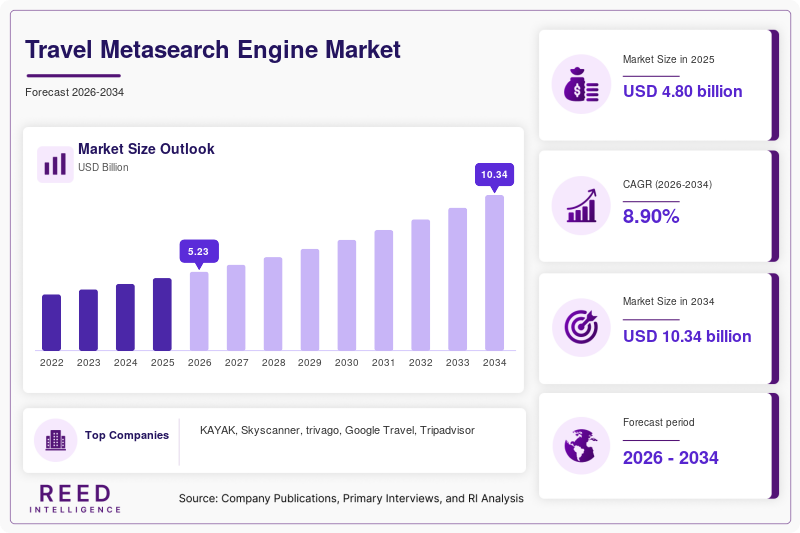
The global Travel Metasearch Engine Market size was valued at USD 4.80 billion in 2025 and is projected to grow from USD 5.23 billion in 2026 to USD 10.34 billion by 2034, registering a CAGR of 8.90% during the forecast period from 2026 to 2034.
Travel metasearch engines are becoming more than price-comparison websites. Platforms such as KAYAK, Skyscanner and trivago aggregate fares, accommodation rates and other travel options from airlines, hotels, online travel agencies and other suppliers, allowing users to compare alternatives before being redirected to a booking provider. Google operates a similar comparison layer across Flights and Hotels, where users can compare prices and booking links from airlines, hotels, OTAs, metasearch engines and other travel providers.
The underlying travel market remains supportive. IATA reported that global passenger demand increased 5.3% in 2025, with international demand rising 7.1%. Asia-Pacific international traffic increased 10.9%, while Latin America rose 8.6%.
At the same time, comparison behavior is becoming more important because travelers remain highly price-sensitive. Skyscanner's 2026 research found that 58% of surveyed travelers considered flight cost a major factor in destination choice and 57% cited accommodation cost. The same research found that 32% would use AI to compare flights or hotels.
The competitive model is consequently shifting toward real-time pricing, broader inventory, mobile discovery, AI-assisted search and higher-quality referral traffic. Skyscanner said in July 2026 that it served more than 160 million travelers monthly and compared flights, accommodation and car-hire options.
Travel Metasearch Engine Market Drivers
Travelers Are Increasingly Comparing Prices Before Booking
Price comparison remains the fundamental reason travelers use metasearch platforms. Airfare and accommodation can vary substantially by supplier, booking date, inventory availability, cancellation conditions and included fees. Metasearch engines consolidate these options into a single interface, reducing the time required to compare multiple suppliers.
Skyscanner's 2026 planning research found that flight cost was cited by 58% of travelers as an important destination-choice factor, while accommodation cost was cited by 57%. Its data also showed that 51% of respondents use Skyscanner's "Everywhere" feature for travel inspiration.
This creates a direct commercial mechanism: greater price sensitivity increases comparison activity, comparison activity creates qualified referral traffic, and higher-intent traffic generates commissions or advertising revenue for metasearch platforms.
KAYAK's 2026 trend research reinforces the role of price discovery. The company reported that 44% of categorized prompts in its AI Mode were related to finding deals or budget travel options.
The counterbalance is that metasearch engines must maintain accurate pricing and availability. Google requires hotel partners to provide prices that include taxes and fees and match the final booking price, illustrating the importance of price accuracy to the comparison model.
Air Travel and Accommodation Demand Are Expanding the Search Funnel
Metasearch demand is directly connected to the volume of travel searches. IATA reported that full-year international passenger demand grew 7.1% in 2025, while Asia-Pacific airlines recorded 10.9% growth in international traffic.
The broader travel-search funnel is also supported by rising traveler intent. Skyscanner's 2026 survey of 22,000 travelers found that 84% planned to travel the same amount or more in 2026 compared with 2025, while 39% planned to travel more. Its search data showed a 10% year-over-year increase across its 160 million-plus monthly global travelers.
For metasearch platforms, this matters because they do not need to own aircraft, hotels or rental fleets. Their value lies in directing demand toward suppliers. When the number of travelers, destinations and booking choices increases, the number of possible comparison events also expands.
Booking Holdings reported USD 186.1 billion in gross travel bookings and 1.2 billion room nights in 2025, illustrating the scale of the underlying online travel ecosystem.
AI Is Changing How Travelers Enter Search Queries
AI is changing metasearch from a form-based process into a conversational discovery process. Traditional search requires travelers to enter destinations, dates and traveler counts. AI interfaces allow users to describe preferences such as budget, weather, trip purpose, flexibility or preferred activities and then translate those requirements into structured travel searches.
KAYAK launched AI Mode in October 2025, allowing travelers to search using natural language, and launched Ask AI in May 2026 with live flight, hotel and rental-car results updating alongside the conversation.
Google expanded AI Mode for travel in August 2026 by bringing flight-price tracking into conversational search and providing access to flight information from more than 300 partner airlines and travel sites.
Skyscanner's July 2026 AI discovery release provides another example. Its Explore with AI tool allows travelers to describe desired trips in natural language and compare flight prices, weather, duration and destination characteristics. Early testing showed 60% of participating travelers clicked through to view generated flight options.
This changes competition from simply owning a search interface to owning the decision layer between inspiration and booking.
Travel Metasearch Engine Market Restraints
Search-Engine and AI Platforms Are Compressing the Traditional Metasearch Interface
Travel metasearch engines face competition from general-purpose search and AI platforms that increasingly provide travel comparisons directly within their own interfaces. Google already provides flight and hotel comparison, while its 2026 AI Mode upgrades allow users to track prices and compare travel options without relying on a traditional metasearch homepage.
This creates a structural challenge. A traveler who receives a useful comparison directly from Google or an AI assistant may not visit a dedicated metasearch website.
The response from specialist platforms has been to add proprietary data, price alerts, destination discovery, personalization and booking tools. Skyscanner's AI discovery, KAYAK's conversational search and trivago's AI-enhanced hotel search illustrate this strategy. Trivago reported that AI-related product improvements enhanced hotel search and contributed to an all-time-high booking conversion rate in Q4 2025.
Customer-Acquisition Costs and Referral Economics Can Pressure Profitability
Metasearch platforms depend heavily on traffic acquisition, brand marketing and supplier monetization. The economics can become difficult when the cost of acquiring a searcher rises faster than referral revenue.
Trivago's 2025 results illustrate this dynamic. Full-year referral revenue increased 17% to €532.9 million, but advertising expenditure also increased as the company invested in branded traffic. Trivago reported that its return on advertising spend declined from 132.1% to 128.4% for the full year.
The platform therefore has to balance brand investment, direct traffic, organic discovery, paid acquisition and conversion optimization.
This issue is particularly important as search engines and social platforms compete for travel-intent traffic. Metasearch companies with strong direct brands, proprietary travel data and repeat users can reduce dependence on paid acquisition, while smaller platforms may face greater customer-acquisition pressure.
Travel Metasearch Engine Market Opportunities
Conversational and Agentic Travel Search
AI creates an opportunity to transform metasearch into a conversational decision engine. Instead of simply showing the lowest fare, platforms can combine price, duration, baggage, airport location, hotel amenities, cancellation terms, loyalty benefits and destination characteristics.
KAYAK's Ask AI already combines conversational interaction with live travel results, while Skyscanner's Explore with AI translates natural-language preferences into flight comparisons.
The commercial opportunity lies in increasing conversion and expanding the number of travel decisions handled by a platform. A traveler who begins with "Where can I go for a beach holiday under my budget?" creates a broader discovery opportunity than someone searching for a specific flight.
Expansion Beyond Flights and Hotels
Metasearch platforms are increasingly adding cars, trains, vacation rentals and other travel components. Skyscanner's 2026 product release expanded its Stays offering to more than five million properties and continued to integrate flight and car-hire discovery.
Broader inventory increases the number of monetizable searches per user. It also creates opportunities for cross-selling: a flight search can lead to hotel, car-hire or activity comparisons.
The same strategy can support higher customer retention because users do not need separate comparison sites for different parts of a trip.
Mobile Price Tracking and Personalized Deals
Mobile travel search is particularly suitable for price alerts because users can monitor changing fares without repeatedly checking websites. Skyscanner expanded its DROPS product in 2026 to identify flight prices that had fallen by at least 20%, while its Flight Tracker added real-time flight information.
Personalized alerts create a recurring relationship rather than a one-time search session. They can also increase conversion because users return when a price meets a predefined threshold.
Segmental Analysis
By Platform Type
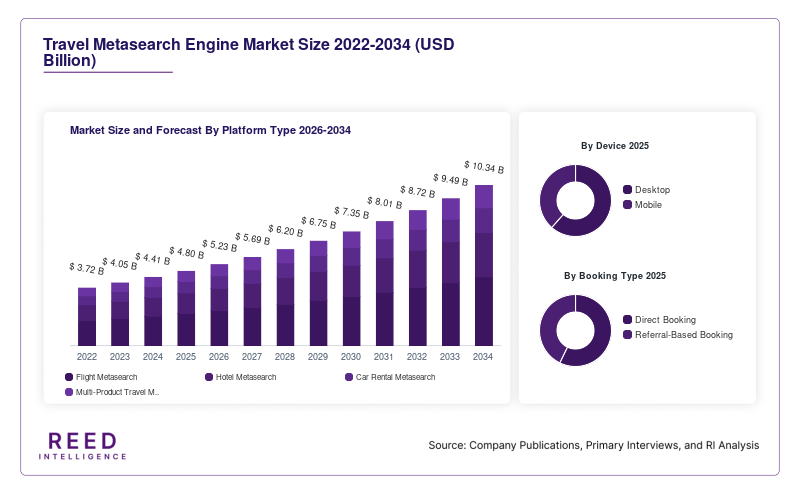
Flight Metasearch represents approximately 43% of the global market in 2025, making it the largest platform category. Flight shopping involves substantial price variation, multiple routing combinations, baggage differences and frequent fare changes, creating a strong use case for comparison engines. IATA's 2025 data showed international passenger demand rising 7.1%, providing a larger base of flight searches.
Hotel Metasearch represents approximately 37% and remains highly competitive because room rates vary by OTA, hotel website, cancellation terms and inventory.
Car Rental Metasearch accounts for approximately 11%, while Multi-Product Travel Metasearch represents 9%.
Multi-Product Travel Metasearch is the fastest-growing platform category, with approximately 11.8% CAGR. Travelers increasingly want a single interface covering flights, accommodation and ground transportation, while platforms such as Skyscanner are expanding their product coverage across flights, stays and cars.
By Device
Mobile represents approximately 64% of the global market in 2025 and is the fastest-growing device segment, with approximately 10.7% CAGR.
Mobile usage is supported by price alerts, location-based discovery, app notifications and increasingly conversational interfaces. Skyscanner reported more than 160 million monthly travelers across its app and website, while its 2026 product development includes mobile-oriented price-drop and discovery features.
Desktop represents approximately 36% and remains relevant for complex searches, corporate travel, multi-city trips and travelers comparing multiple booking conditions.
By Booking Type
Referral-Based Booking represents approximately 72% of the market in 2025. The model is central to traditional metasearch because platforms send qualified traffic to airlines, hotels, OTAs and other booking providers and receive payment through referral or advertising arrangements.
Trivago provides a clear example: referral revenue reached €532.9 million in 2025, representing the overwhelming majority of its €548.9 million total revenue.
Direct Booking represents approximately 28% but is the faster-growing model, with approximately 12.1% CAGR. Platforms are increasingly seeking to retain more of the booking journey through integrated checkout, booking panels, loyalty features and direct supplier relationships.
Google's hotel ecosystem illustrates this evolution: booking links can send users directly to partner websites, while paid hotel links can generate compensation for Google when users click or complete bookings.
By End User
Leisure Travelers account for approximately 67% of the market in 2025. They typically have greater flexibility around destinations and dates and therefore benefit strongly from price discovery and flexible search features.
Business Travelers represent approximately 19%, supported by demand for schedule optimization, airport flexibility, fare rules and corporate travel policies.
Group & Family Travelers account for approximately 14% and are the fastest-growing end-user segment, with approximately 10.4% CAGR. Group travelers often face more complex accommodation and transportation requirements, making comparison tools useful for evaluating room configurations, flight availability and total trip costs.
Regional Analysis
North America Travel Metasearch Engine Market
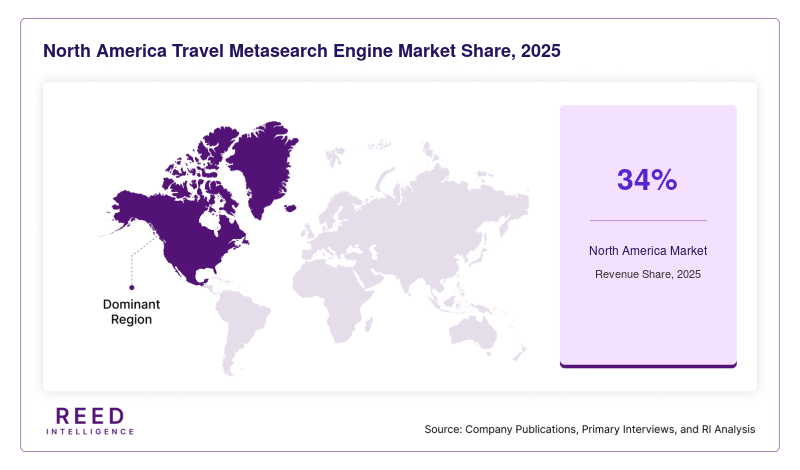
North America represents approximately 34% of the global Travel Metasearch Engine Market in 2025. The region benefits from a mature online travel ecosystem, high digital adoption, extensive airline networks and strong penetration of hotel and travel comparison services.
The U.S. market includes major metasearch brands such as KAYAK, which operates within Booking Holdings. Booking Holdings reported 2025 gross travel bookings of USD 186.1 billion and 1.2 billion room nights across its broader portfolio, providing an indication of the scale of the digital travel ecosystem in which metasearch operates.
KAYAK is also expanding its role beyond conventional search. Its October 2025 AI Mode introduced natural-language travel search, followed by Ask AI in May 2026, where flight, hotel and rental-car results update in real time alongside conversational queries.
North America is projected to grow at approximately 7.7% CAGR through 2034. The region's mature customer base creates strong monetization opportunities, although competition from Google and direct airline and hotel booking channels limits the amount of traffic available to independent metasearch platforms.
Europe Travel Metasearch Engine Market
Europe accounts for approximately 28% of the global market in 2025. The region has high cross-border travel activity, extensive airline competition and a large hotel market, making price comparison particularly useful.
Skyscanner is a major European-origin metasearch platform and reported more than 160 million monthly travelers globally in 2026. Its 2026 research found strong consumer interest in price comparison, with flight and accommodation costs among the leading factors affecting destination decisions.
European travelers also face fragmented airline markets, multiple currencies and varied booking conditions across countries. These factors increase the usefulness of aggregation.
Europe is expected to record approximately 8.1% CAGR through 2034. AI-based search and mobile comparison are likely to become more important as consumers move from traditional destination-and-date searches toward flexible, intent-driven queries.
The main constraints include strong OTA brands, airline direct-booking strategies and increasing competition from general search platforms.
APAC Travel Metasearch Engine Market
APAC represents approximately 23% of the global market in 2025 and is the fastest-growing region, with approximately 11.4% CAGR.
The region benefits from expanding air travel, rising digital adoption and large populations of mobile-first travelers. IATA reported that Asia-Pacific airlines recorded 10.9% growth in international traffic in 2025, the fastest regional growth among major international markets.
Skyscanner's 2026 planning research also found particularly strong confidence in AI-assisted travel planning in India, where 86% of respondents expressed confidence, followed by Brazil at 81%, UAE at 81% and Singapore at 63%.
This creates an important pathway for conversational metasearch because travelers can use natural-language interfaces while still requiring real-time price and availability information.
India, China, Japan, Australia, South Korea and Southeast Asia provide distinct travel ecosystems, creating demand for localized language, payment, airline and accommodation inventory.
APAC's main constraint is market fragmentation. Metasearch providers need local inventory relationships, localized pricing and payment integration to compete effectively across different countries.
Middle East and Africa Travel Metasearch Engine Market
Middle East and Africa represents approximately 7% of the global market in 2025 and is expected to expand at approximately 9.8% CAGR.
The Middle East is particularly important because of its international airline hubs, rapidly developing tourism destinations and high cross-border travel intensity. IATA reported that Middle Eastern airlines recorded 6.7% growth in international traffic during 2025. Africa's international traffic increased 7.8%.
The region's travel-search market is also becoming more digitally sophisticated. UAE and Saudi Arabia show high levels of traveler confidence in AI-assisted planning in Skyscanner's 2026 research, with 81% and 80% respectively reporting confidence in AI for travel planning.
Metasearch platforms can benefit by aggregating international airlines, hotels, resorts and emerging tourism destinations.
The main constraint is uneven digital infrastructure and travel-distribution maturity across individual markets. Providers therefore need localized inventory and strong supplier relationships.
LATAM Travel Metasearch Engine Market
LATAM accounts for approximately 8% of the global market in 2025 and is projected to grow at approximately 10.2% CAGR.
The region has a large and increasingly international travel base. IATA reported that Latin American airlines' international traffic increased 8.6% in 2025, while premium international passengers increased 22.1% to 4.0 million.
Brazil and Mexico are important markets because of their population size, airline networks and growing digital commerce. Metasearch can address price-sensitive consumers by aggregating multiple airlines, OTAs and hotel suppliers.
Skyscanner's 2026 research found that Brazil was among the markets with the highest confidence in AI-assisted travel planning, at 81%.
LATAM is therefore well positioned for AI-assisted metasearch expansion, although currency volatility, cross-border payment complexity and differences in airline distribution systems can complicate monetization.
Competitive Landscape
The Travel Metasearch Engine Market combines specialist metasearch companies with large travel platforms and general-purpose search providers.
KAYAK operates within Booking Holdings alongside Booking.com, Priceline and Agoda. Its strategic direction is moving from conventional comparison toward conversational discovery. AI Mode was launched in 2025 and Ask AI followed in May 2026, integrating live flight, hotel and car results into conversational searches.
Skyscanner competes through large-scale flight and accommodation comparison, mobile discovery and proprietary travel data. The company said it serves more than 160 million travelers monthly and compares billions of prices. Its July 2026 product release added AI discovery, road-trip planning, flight tracking and expanded accommodation inventory.
trivago remains heavily focused on hotel comparison. Its 2025 results showed total revenue rising 19% to €548.9 million and referral revenue increasing 17% to €532.9 million. AI product improvements contributed to an all-time-high booking conversion rate during Q4 2025.
Key Market Players
- KAYAK
- Skyscanner
- trivago
- Google Travel
- Tripadvisor
- Booking.com
- Expedia
- Wego
- HotelsCombined
- Momondo
- Cheapflights
- Traveloka
- Kayak for Business
- Hopper
- Liligo
Recent Market Developments
- September 2026 – Google expanded AI Mode travel capabilities. Google added flight-price tracking, points and miles information and hotel booking capabilities to AI Mode. Users can compare flight options from more than 300 partner airlines and travel sites within the conversational interface.
- May 2026 – KAYAK launched Ask AI. The service allows travelers to plan trips conversationally while flight, hotel and rental-car results update live alongside the conversation. This moves metasearch closer to an integrated travel-planning interface.
Travel Metasearch Engine Market Segments
By Platform Type
- Flight Metasearch
- Hotel Metasearch
- Car Rental Metasearch
- Multi-Product Travel Metasearch
By Device
- Desktop
- Mobile
By Booking Type
- Direct Booking
- Referral-Based Booking
By End User
- Leisure Travelers
- Business Travelers
- Group & Family Travelers
By Region
- North America
- Europe
- APAC
- Middle East and Africa
- LATAM