Tray Dispenser Market Size, Share & Demand Report By Type (Mobile Tray Dispensers, Built-in Tray Dispensers, Automated Tray Dispensers), By Material (Stainless Steel, Plastic, Aluminum), By End-Use (Healthcare, Hospitality, Educational Institutions, Corporate Cafeterias), By Distribution Channel (Direct Sales, Distributors, Online Channels) & Segment Forecasts, 2025–2034
USD 3950
Market Overview
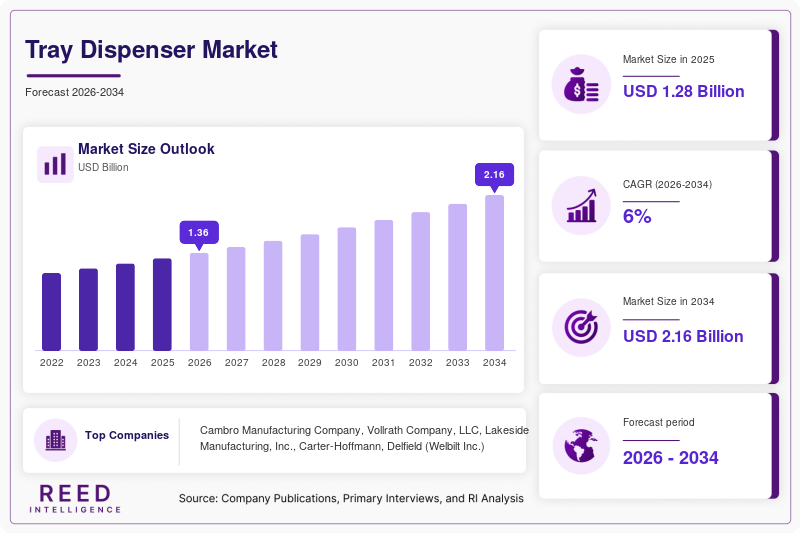
The global Tray Dispenser Market size was valued at approximately USD 1.28 billion in 2025 and is projected to reach USD 2.15 billion by 2034, expanding at a CAGR of 6.0% during the forecast period (2025–2034). The market has demonstrated consistent growth due to increasing demand for efficient foodservice operations, particularly across institutional kitchens, healthcare facilities, and hospitality sectors. Tray dispensers play a vital role in streamlining meal service, improving hygiene standards, and optimizing labor efficiency.
One of the key global factors supporting the growth of the Tray Dispenser Market is the rising emphasis on automation and operational efficiency in foodservice infrastructure. As commercial kitchens and institutional cafeterias aim to reduce service time and enhance customer experience, the adoption of advanced tray dispensing systems has accelerated. Additionally, the expansion of quick-service restaurants and large-scale catering facilities has further contributed to market growth.
Key Highlights:
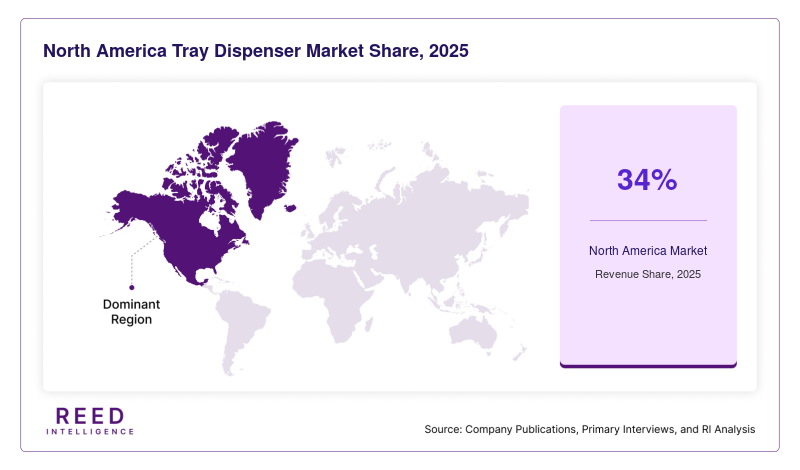
- North America dominated the market with a share of 34% in 2025, while Asia Pacific is expected to register the fastest CAGR of 7.2% during the forecast period.
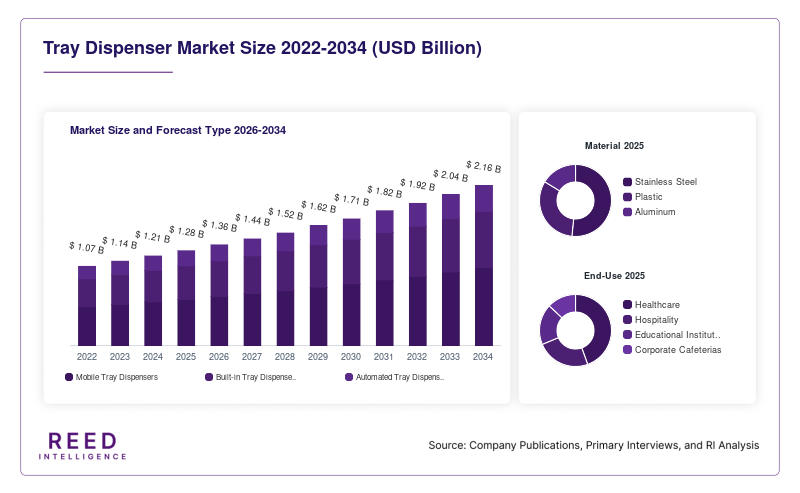
- In the product segment, mobile tray dispensers led with a 58% share, while automated tray dispensers are projected to grow fastest at a CAGR of 7.5%.
- The healthcare end-use segment accounted for the largest share at 41%, whereas the hospitality segment is expected to grow fastest at a CAGR of 6.8%.
- The United States remained the dominant country, with a market value of USD 390 million in 2024, increasing to USD 415 million in 2025.
Market Trends
Integration of Automated and Smart Dispensing Systems
The Tray Dispenser Market is witnessing a shift toward automation, driven by the need for precision and reduced manual intervention. Smart tray dispensers equipped with sensors, adjustable height mechanisms, and temperature control features are becoming increasingly popular. These systems enhance operational efficiency while ensuring consistency in tray handling, making them suitable for high-volume foodservice environments such as hospitals and large cafeterias.
Rising Demand for Customization and Modular Designs
Customization is emerging as a notable trend in the Tray Dispenser Market. End users are seeking modular and flexible designs that can be adapted to specific operational needs. Manufacturers are offering tray dispensers in various sizes, materials, and configurations to cater to diverse applications. This trend is particularly prominent in hospitality and institutional sectors, where space optimization and aesthetic integration are critical considerations.
Market Drivers
Expansion of Institutional Foodservice Infrastructure
The rapid expansion of institutional foodservice facilities, including hospitals, schools, and corporate cafeterias, is a key driver of the Tray Dispenser Market. These facilities require efficient systems to manage high volumes of meal distribution. Tray dispensers help reduce service time and improve workflow, making them an essential component in large-scale operations.
Increasing Focus on Hygiene and Food Safety
Growing awareness regarding hygiene and food safety standards has significantly influenced the Tray Dispenser Market. Modern tray dispensers are designed to minimize human contact, thereby reducing contamination risks. This is particularly important in healthcare and foodservice environments where maintaining strict hygiene protocols is critical. The adoption of stainless steel and antimicrobial materials further supports this trend.
Market Restraint
High Initial Investment and Maintenance Costs
The Tray Dispenser Market faces challenges related to the high initial cost of advanced dispensing systems. Automated and smart tray dispensers require significant capital investment, which may limit adoption among small and medium-sized enterprises. Additionally, maintenance and repair costs associated with these systems can be substantial, further discouraging potential buyers.
The complexity of installation and the need for skilled personnel to operate and maintain these systems also add to the overall cost burden. In developing regions, where budget constraints are more pronounced, these factors can hinder market growth. While long-term efficiency gains may offset initial costs, the upfront investment remains a key barrier for many end users.
Market Opportunities
Growth in Emerging Economies
Emerging economies present significant growth opportunities for the Tray Dispenser Market. Rapid urbanization, increasing disposable income, and the expansion of the hospitality sector are driving demand for modern foodservice equipment. Governments and private investors are also investing in healthcare and educational infrastructure, further boosting the need for efficient tray dispensing solutions.
Adoption of Eco-Friendly Materials
Sustainability is becoming an important consideration in the Tray Dispenser Market. Manufacturers are exploring the use of eco-friendly and recyclable materials to meet environmental regulations and consumer preferences. The development of energy-efficient and sustainable tray dispensers is expected to create new growth avenues, particularly in regions with stringent environmental policies.
Segmental Analysis
By Type
Mobile tray dispensers accounted for the largest share of the Tray Dispenser Market in 2024, capturing approximately 58% of the total market. These dispensers have been widely adopted due to their flexibility and ease of movement, making them suitable for dynamic foodservice environments. Their ability to accommodate varying tray sizes and adapt to different layouts has contributed to their dominance.
Automated tray dispensers are expected to be the fastest-growing subsegment, with a projected CAGR of 7.5% during the forecast period. The growth of this segment will be driven by increasing demand for automation and efficiency in large-scale operations. Advanced features such as sensor-based dispensing and adjustable mechanisms will enhance their adoption in high-volume facilities.
By Material
Stainless steel tray dispensers dominated the Tray Dispenser Market in 2024, accounting for 64% of the market share. The material’s durability, corrosion resistance, and ease of cleaning have made it a preferred choice across various end-use sectors. Stainless steel also meets stringent hygiene standards, making it suitable for healthcare and foodservice applications.
Plastic-based tray dispensers are expected to grow at the fastest CAGR of 6.9% during the forecast period. The lightweight nature and cost-effectiveness of plastic materials will drive their adoption, particularly in small and medium-sized establishments. Innovations in high-quality and durable plastics will further support this growth.
By End-Use
The healthcare segment held the largest share of the Tray Dispenser Market in 2024, accounting for 41% of the market. Hospitals and healthcare facilities require efficient systems to manage meal distribution for patients, making tray dispensers an essential component. The need for maintaining hygiene and minimizing contamination has further driven adoption in this segment.
The hospitality segment is projected to grow at the fastest CAGR of 6.8% during the forecast period. The expansion of hotels, resorts, and restaurants will drive demand for tray dispensers. The focus on enhancing customer experience and operational efficiency will further support growth in this segment.
By Distribution Channel
Direct sales accounted for the largest share of the Tray Dispenser Market in 2024, capturing 55% of the market. Manufacturers have preferred direct sales channels to maintain strong relationships with end users and provide customized solutions. This approach has been particularly effective in large-scale institutional projects.
Online distribution channels are expected to grow at the fastest CAGR of 7.1% during the forecast period. The increasing adoption of e-commerce platforms and the convenience of online purchasing will drive growth in this segment. Small and medium-sized businesses are increasingly turning to online channels for cost-effective procurement solutions.
Regional Analysis
North America
North America accounted for 34% of the Tray Dispenser Market share in 2025 and is expected to grow at a CAGR of 5.5% during the forecast period. The region has a well-established foodservice industry, supported by advanced infrastructure and high adoption of automated solutions. The presence of large-scale institutional kitchens and a strong focus on operational efficiency have contributed to market growth.
The United States dominated the regional market due to its extensive network of healthcare facilities and quick-service restaurants. The increasing adoption of automation in foodservice operations and the emphasis on maintaining hygiene standards have driven demand for advanced tray dispensers. Additionally, ongoing investments in healthcare infrastructure continue to support market expansion.
Europe
Europe held a significant share of the Tray Dispenser Market in 2025 and is projected to grow at a CAGR of 5.7% through 2034. The region's growth is driven by stringent food safety regulations and the increasing adoption of modern kitchen equipment in commercial establishments. Countries such as Germany, France, and the UK have been key contributors to market growth.
Germany emerged as the dominant country in the region, supported by its strong manufacturing base and focus on technological innovation. The demand for high-quality and durable tray dispensers has been driven by the region’s emphasis on efficiency and sustainability in foodservice operations.
Asia Pacific
Asia Pacific captured 26% of the Tray Dispenser Market share in 2025 and is expected to register the fastest CAGR of 7.2% during the forecast period. Rapid urbanization, population growth, and the expansion of the hospitality and healthcare sectors have significantly contributed to market growth.
China dominated the regional market due to its large population and increasing investments in healthcare and educational infrastructure. The growing number of hotels, restaurants, and institutional kitchens has created a strong demand for tray dispensers. Additionally, rising awareness about hygiene and efficiency has further accelerated adoption.
Middle East & Africa
The Middle East & Africa region accounted for a moderate share of the Tray Dispenser Market in 2025 and is projected to grow at a CAGR of 6.1% during the forecast period. The region’s growth is supported by the expansion of the hospitality sector, particularly in the Gulf countries.
The United Arab Emirates emerged as the dominant country, driven by its thriving tourism industry and the presence of large-scale hotels and resorts. The increasing demand for efficient foodservice solutions in luxury hospitality establishments has contributed to market growth.
Latin America
Latin America held a smaller share of the Tray Dispenser Market in 2025 but is expected to grow at a CAGR of 5.9% through 2034. The region’s growth is driven by the gradual expansion of the foodservice industry and increasing investments in healthcare infrastructure.
Brazil dominated the regional market due to its large population and growing hospitality sector. The demand for tray dispensers has been supported by the need for efficient meal service in hospitals, schools, and corporate cafeterias. Additionally, the adoption of modern kitchen equipment is gradually increasing across the region.
Competitive Landscape
The Tray Dispenser Market is characterized by the presence of several established players focusing on product innovation and strategic expansion. Companies are investing in advanced technologies and sustainable materials to strengthen their market position.
A leading player in the market is Cambro Manufacturing Company, which has consistently focused on developing durable and efficient tray dispensing solutions. The company recently introduced a new range of automated tray dispensers designed to enhance operational efficiency and reduce manual handling.
Other key players are emphasizing partnerships, product customization, and geographic expansion to gain a competitive edge. The market remains moderately fragmented, with both global and regional players competing to meet diverse customer requirements.
Key Players List
- Cambro Manufacturing Company
- Vollrath Company, LLC
- Lakeside Manufacturing, Inc.
- Carter-Hoffmann
- Delfield (Welbilt Inc.)
- Metro (InterMetro Industries Corporation)
- Winco
- Advance Tabco
- Eagle Group
- Continental Refrigerator
- Hatco Corporation
- Server Products
- APW Wyott
- Nemco Food Equipment
- Duke Manufacturing Co.
Recent Developments
- In 2024, Cambro Manufacturing Company launched a new line of energy-efficient automated tray dispensers.
- Vollrath Company expanded its product portfolio with modular tray dispenser systems.
- Lakeside Manufacturing introduced lightweight plastic tray dispensers targeting small-scale foodservice operators.
- Metro enhanced its distribution network to strengthen its presence in Asia Pacific.
- Hatco Corporation developed tray dispensers with improved temperature retention features.
Tray Dispenser Market Segments
Type
- Mobile Tray Dispensers
- Built-in Tray Dispensers
- Automated Tray Dispensers
Material
- Stainless Steel
- Plastic
- Aluminum
End-Use
- Healthcare
- Hospitality
- Educational Institutions
- Corporate Cafeterias
Distribution Channel
- Direct Sales
- Distributors
- Online Channels
By Region
- North America
- Europe
- APAC
- Middle East and Africa
- LATAM