Tree Milling Machine Market Size, Share & Demand Report By Type (Hydraulic, Electric, Mechanical), By Application (Forestry, Construction, Agriculture, Landscaping), By End-Use Industry (Commercial Forestry, Construction Companies, Municipal Authorities, Agricultural Sector), By Sales Channel (Direct Sales, Distributors, Online Platforms), By Region & Segment Forecasts, 2026–2034
USD 3950
Market Overview
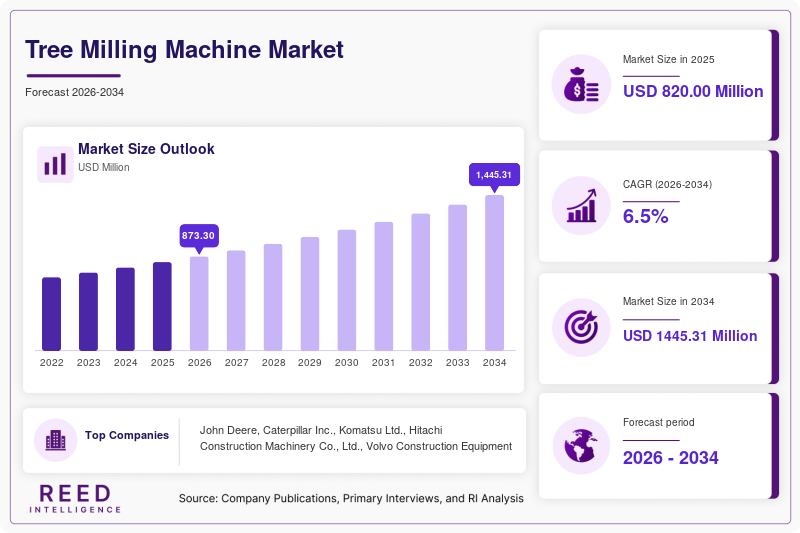
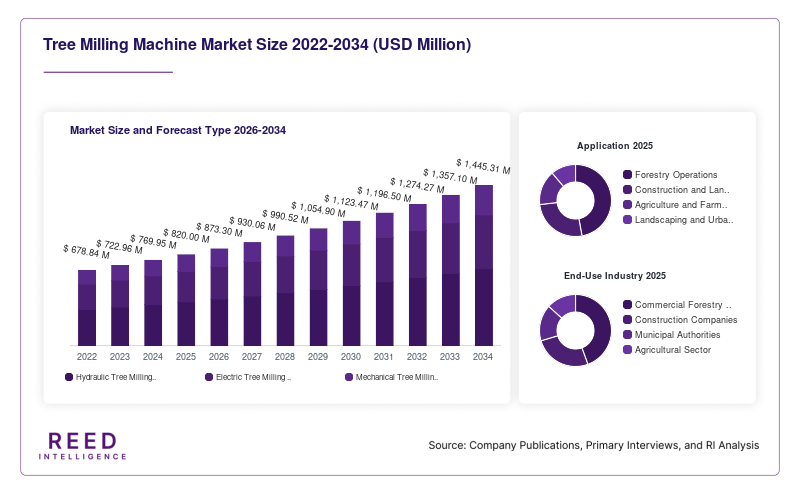
The global Tree Milling Machine Market size was valued at approximately USD 820 million in 2026 and is projected to reach USD 1360 million by 2034, expanding at a CAGR of 6.5% during the forecast period (2026–2034). The steady expansion of mechanized forestry operations and increasing investments in land clearing and infrastructure development have contributed significantly to the market’s growth trajectory. As forestry management practices evolve toward efficiency and sustainability, demand for advanced tree milling machines is rising across both developed and emerging economies.
One of the primary global factors supporting market growth is the increasing adoption of precision forestry technologies. Governments and private organizations are prioritizing efficient timber harvesting while minimizing environmental impact. This has led to higher demand for automated and high-performance milling machines capable of handling diverse tree densities and terrains.
Key Highlights
- North America dominated the market with 34.2% share in 2025, while Asia Pacific is projected to grow at a CAGR of 7.8%.
- Hydraulic tree milling machines led the type segment with 52.6% share, while electric variants are expected to grow at a CAGR of 8.1%.
- Forestry application accounted for the largest share at 47.3%, while construction applications are projected to grow at 7.2% CAGR.
- The United States remained the dominant country, with market values of USD 248 million in 2024 and USD 262 million in 2025.
Market Trends
Integration of Smart Forestry Technologies
The Tree Milling Machine Market is witnessing a gradual shift toward smart and connected machinery. Manufacturers are incorporating IoT-enabled systems, telematics, and remote diagnostics into tree milling equipment. These technologies enable operators to monitor machine performance, fuel efficiency, and maintenance requirements in real time. As forestry operations become more data-driven, smart machines are improving operational efficiency and reducing downtime, making them increasingly preferred among large-scale operators.
Shift Toward Electric and Low-Emission Equipment
Environmental regulations and sustainability goals are encouraging the adoption of electric and hybrid tree milling machines. Traditional diesel-powered machines are being gradually replaced with low-emission alternatives that reduce carbon footprints. Electric variants are gaining traction, particularly in urban landscaping and regulated forestry zones where noise and emissions are critical concerns. This trend is expected to reshape product innovation and influence purchasing decisions across global markets.
Market Drivers
Expansion of Commercial Forestry Operations
The growing demand for timber, pulp, and paper products is driving large-scale commercial forestry operations. Tree milling machines play a crucial role in efficient tree processing, enabling faster and more precise cutting. As global demand for wood-based products increases, forestry companies are investing in advanced machinery to enhance productivity and reduce labor dependency.
Rising Infrastructure and Land Development Projects
Rapid urbanization and infrastructure expansion are increasing the need for land clearing activities. Tree milling machines are widely used in road construction, residential development, and industrial projects to remove trees and prepare land efficiently. The surge in construction activities across developing regions is creating a consistent demand for high-performance milling equipment, thereby driving market growth.
Market Restraint
High Initial Investment and Maintenance Costs
The Tree Milling Machine Market faces a significant restraint in the form of high capital investment and maintenance expenses. Advanced machines equipped with hydraulic systems, automation features, and durable components require substantial upfront costs, making them less accessible for small and medium-sized enterprises.
In addition, maintenance and repair costs can be considerable due to the complexity of components and the need for skilled technicians. Regular servicing, replacement of wear parts, and operational downtime can impact profitability for end users. These factors limit adoption in cost-sensitive markets and may slow overall market penetration, particularly in emerging economies where budget constraints are more pronounced.
Market Opportunities
Growth in Emerging Markets
Developing regions such as Asia Pacific and Latin America present significant opportunities for the Tree Milling Machine Market. Increasing investments in forestry management, infrastructure development, and agricultural land expansion are driving demand for efficient tree processing equipment. Governments in these regions are also promoting mechanization to improve productivity, creating favorable conditions for market growth.
Technological Advancements in Machine Design
Continuous innovation in machine design and functionality is opening new growth avenues. Manufacturers are focusing on developing compact, lightweight, and energy-efficient machines that offer higher precision and ease of operation. Features such as automated controls, enhanced safety mechanisms, and improved durability are attracting new customers. These advancements are expected to expand the application scope of tree milling machines and support long-term market growth.
Segmental Analysis
By Type
Hydraulic tree milling machines dominated the market, accounting for 52.6% of the share in 2025. These machines are widely preferred due to their high power output, efficiency, and ability to handle heavy-duty operations. Their versatility in different terrains and tree densities makes them suitable for large-scale forestry and land clearing applications.
Electric tree milling machines are expected to be the fastest-growing subsegment, with a projected CAGR of 8.1%. The growth of this segment will be driven by increasing environmental regulations and the demand for low-emission equipment. Electric machines offer reduced noise levels and lower operational costs, making them ideal for urban and environmentally sensitive areas.
By Application
Forestry applications held the largest share at 47.3% in 2025, driven by the extensive use of tree milling machines in timber harvesting and forest management. The need for efficient tree processing and increasing demand for wood products have supported the dominance of this segment.
Construction applications are projected to grow at the fastest rate, with a CAGR of 7.2%. The expansion of infrastructure projects and urban development will drive demand for land clearing equipment. Tree milling machines are increasingly being used in construction sites to remove obstacles and prepare land efficiently.
By End-Use Industry
The commercial forestry sector dominated the market with a 49.8% share in 2025. Large-scale forestry operations require advanced machinery to enhance productivity and reduce labor costs. Tree milling machines are essential for efficient timber processing in this sector.
The landscaping and municipal sector is expected to witness the fastest growth, with a CAGR of 7.5%. Increasing investments in urban landscaping and green space development will drive demand for compact and efficient tree milling machines. Municipal authorities are adopting these machines for maintenance and environmental management purposes.
By Sales Channel
Direct sales accounted for 61.2% of the market share in 2025, as large enterprises prefer direct procurement from manufacturers to ensure product quality and after-sales support. This channel allows customization and better pricing for bulk purchases.
Online and distributor-based sales channels are expected to grow at a CAGR of 6.8%. The expansion of digital platforms and dealer networks will make tree milling machines more accessible to smaller businesses. Improved availability and competitive pricing will support the growth of this segment.
Regional Analysis
North America
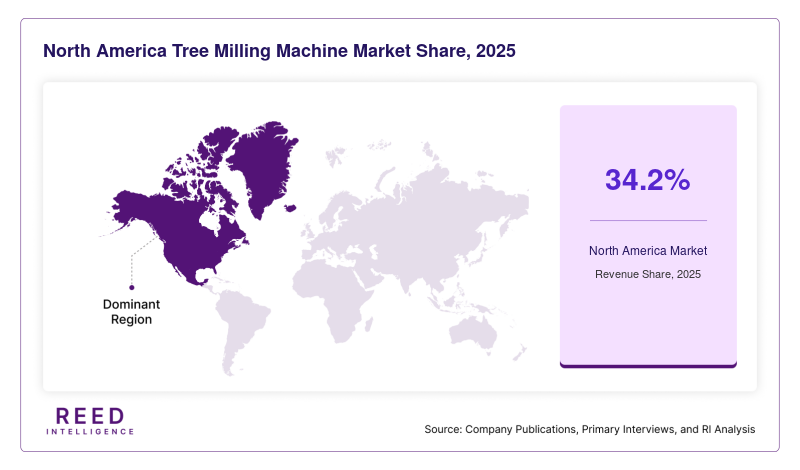
North America accounted for 34.2% of the Tree Milling Machine Market share in 2025 and is expected to grow at a CAGR of 6.1% during 2026–2034. The region’s mature forestry industry and strong adoption of advanced machinery supported its leading position. High mechanization levels and consistent demand for timber products contributed to stable market performance.
The United States dominated the regional market due to its well-established forestry infrastructure and extensive land clearing activities. The presence of large-scale timber companies and continuous investments in equipment modernization have driven demand for tree milling machines. Additionally, regulatory emphasis on efficient forest management practices has encouraged the adoption of technologically advanced equipment.
Europe
Europe held 26.8% of the market share in 2025 and is projected to grow at a CAGR of 5.9% over the forecast period. The region’s focus on sustainable forestry practices and environmental conservation has influenced the adoption of efficient and low-emission machinery.
Germany emerged as the dominant country in Europe, driven by its advanced manufacturing capabilities and emphasis on sustainable forestry management. The country’s strong industrial base supports the production and adoption of high-quality tree milling machines. Additionally, government initiatives promoting eco-friendly practices have accelerated the shift toward electric and hybrid equipment.
Asia Pacific
Asia Pacific captured 22.5% of the market share in 2025 and is anticipated to grow at the fastest CAGR of 7.8% during the forecast period. Rapid urbanization, infrastructure development, and increasing forestry activities have contributed to the region’s growth.
China dominated the regional market due to its large-scale construction projects and expanding forestry sector. The country’s focus on land development and agricultural expansion has increased demand for tree milling machines. Additionally, government investments in infrastructure and industrial growth are expected to further drive market expansion.
Middle East & Africa
The Middle East & Africa region accounted for 9.1% of the market share in 2025 and is projected to grow at a CAGR of 6.7%. Increasing infrastructure projects and land development activities have supported market growth in this region.
The United Arab Emirates emerged as a key country due to its ongoing construction and urban development initiatives. The need for efficient land clearing in large-scale projects has driven demand for tree milling machines. Furthermore, investments in landscaping and environmental management have contributed to market growth.
Latin America
Latin America held 7.4% of the market share in 2025 and is expected to grow at a CAGR of 6.9% during the forecast period. The region’s expanding agricultural and forestry sectors have created demand for advanced machinery.
Brazil dominated the regional market, supported by its vast forest resources and growing timber industry. The country’s focus on improving forestry productivity and efficiency has driven the adoption of tree milling machines. Additionally, increasing exports of wood products have contributed to market growth.
Competitive Landscape
The Tree Milling Machine Market is moderately fragmented, with several global and regional players competing based on product innovation, performance, and pricing. Key companies are focusing on expanding their product portfolios and integrating advanced technologies to gain a competitive edge.
One leading player in the market is John Deere, known for its strong product portfolio and global presence. The company has recently introduced advanced forestry equipment with improved efficiency and smart features, strengthening its market position. Other players are also investing in research and development to enhance machine capabilities and meet evolving customer demands.
Strategic partnerships, mergers, and acquisitions are common in the market as companies aim to expand their geographic reach and technological expertise. Continuous innovation and customer-focused solutions remain critical for sustaining competitiveness.
Key Players List
- John Deere
- Caterpillar Inc.
- Komatsu Ltd.
- Hitachi Construction Machinery Co., Ltd.
- Volvo Construction Equipment
- Tigercat International Inc.
- Bandit Industries, Inc.
- Vermeer Corporation
- Morbark, LLC
- Peterson Pacific Corp.
- Prinoth GmbH
- Rotochopper, Inc.
- FAE Group S.p.A.
- Rayco Manufacturing, Inc.
- Fecon, Inc.
Recent Developments
- In 2025, several manufacturers introduced electric tree milling machines with enhanced battery efficiency and reduced emissions.
- A major industry player expanded its production capacity to meet increasing global demand.
- Strategic collaborations between equipment manufacturers and technology providers led to the integration of smart monitoring systems.
- Companies invested in research and development to improve machine durability and operational efficiency.
- New product launches focused on compact and versatile machines suitable for urban applications.
Tree Milling Machine Market Segments
Type
- Hydraulic Tree Milling Machines
- Electric Tree Milling Machines
- Mechanical Tree Milling Machines
Application
- Forestry Operations
- Construction and Land Clearing
- Agriculture and Farm Management
- Landscaping and Urban Maintenance
End-Use Industry
- Commercial Forestry Sector
- Construction Companies
- Municipal Authorities
- Agricultural Sector
Distribution Channel
- Direct Sales
- Authorized Distributors
- Online Platforms
By Region
- North America
- Europe
- APAC
- Middle East and Africa
- LATAM