Trichomonas Rapid Testing Market Size, Share Demand Report By Product Type (Lateral Flow Assays, Molecular Rapid Tests, Immunoassay-Based Tests), By Sample Type (Vaginal Swab, Urine, Other Sample Types), By End-Use (Hospitals, Diagnostic Laboratories, Home Care Settings), By Distribution Channel (Hospital Pharmacies, Retail Pharmacies, Online Platforms), By Region & Segment Forecasts, 2025–2034
USD 3950
Market Overview
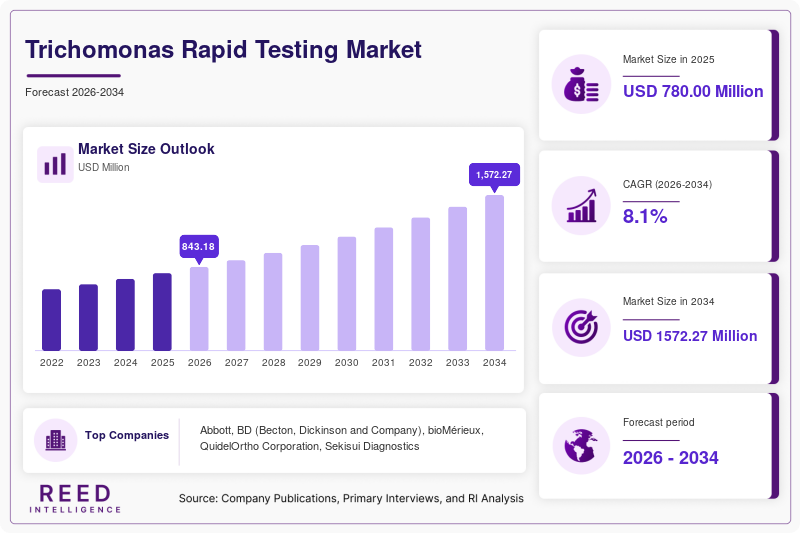
The Trichomonas Rapid Testing Market size was valued at approximately USD 780 million in 2025 and is projected to reach USD 1.58 billion by 2034, expanding at a CAGR of 8.1% during 2025–2034. The market growth is being supported by the increasing global burden of sexually transmitted infections (STIs), particularly in low- and middle-income countries where early diagnosis remains a public health priority.
A major global factor contributing to the growth of the Trichomonas Rapid Testing Market is the rising emphasis on point-of-care (POC) diagnostics. Healthcare systems are increasingly adopting rapid diagnostic tools that provide quick and reliable results without the need for advanced laboratory infrastructure. This shift is improving early detection rates and reducing transmission, especially in remote and resource-constrained settings.
Key Highlights
- North America dominated the market with 38.4% share in 2025, while Asia Pacific is expected to register the fastest CAGR of 9.3% during the forecast period.
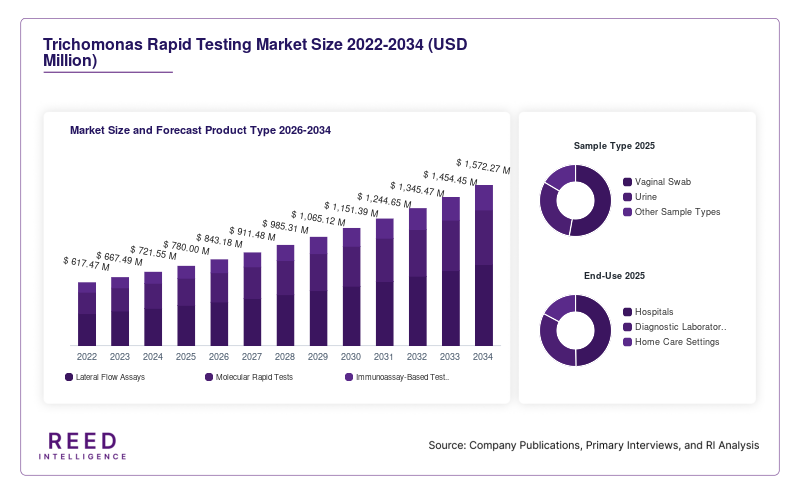
- By product type, lateral flow assays accounted for 46.2% share, while molecular rapid tests are projected to grow at a CAGR of 9.8%.
- By end-use, hospitals led with 42.7% share, whereas home care settings are expected to grow at a CAGR of 10.1%.
- The United States remained the dominant country with USD 265 million in 2025 and is expected to reach USD 285 million in 2026.
Market Trends
Expansion of Point-of-Care Diagnostics
The Trichomonas Rapid Testing Market is experiencing a strong shift toward decentralized testing solutions. Point-of-care diagnostics are becoming increasingly preferred due to their ability to deliver results within minutes, enabling immediate clinical decisions. Healthcare providers are integrating these tests into outpatient clinics, emergency departments, and mobile health units. This trend is particularly relevant in regions with limited laboratory infrastructure, where rapid testing improves access and reduces diagnostic delays.
Integration of Digital Health and Connected Diagnostics
Another notable trend shaping the Trichomonas Rapid Testing Market is the incorporation of digital technologies into diagnostic platforms. Manufacturers are developing rapid tests that can sync with mobile applications and cloud-based systems, allowing for real-time data tracking and reporting. This enhances disease surveillance, supports public health interventions, and enables better patient follow-up. Additionally, digital integration is improving accuracy through automated result interpretation, reducing human error and enhancing clinical outcomes.
Market Drivers
Rising Prevalence of Sexually Transmitted Infections
The increasing incidence of sexually transmitted infections globally is a primary driver of the Trichomonas Rapid Testing Market. Trichomoniasis remains one of the most common non-viral STIs, often undiagnosed due to asymptomatic cases. Growing awareness campaigns and routine screening programs are boosting demand for rapid diagnostic tools that enable early detection and timely treatment.
Growing Demand for Rapid and Accurate Diagnostics
Healthcare providers are increasingly prioritizing diagnostic solutions that offer speed and reliability. Rapid testing kits for trichomoniasis provide results within a short timeframe, reducing the need for multiple patient visits. This is particularly beneficial in high-volume clinical settings and resource-limited environments. The demand for efficient diagnostics is further supported by advancements in assay sensitivity and specificity, making rapid tests a preferred option over conventional laboratory methods.
Market Restraint
Limited Accuracy Compared to Laboratory-Based Tests
Despite advancements, some rapid testing methods still face challenges in achieving the same level of sensitivity and specificity as laboratory-based diagnostic techniques such as nucleic acid amplification tests (NAATs). This limitation can lead to false negatives or false positives, impacting clinical decision-making. In critical cases, healthcare providers may rely on confirmatory tests, which reduces the standalone utility of rapid kits.
Additionally, variability in test performance across different brands and settings creates concerns regarding standardization. Regulatory approvals and quality control requirements also add complexity to market entry for new products. These factors can slow down adoption in regions with stringent healthcare regulations.
Market Opportunities
Expansion in Emerging Markets
Emerging economies present significant growth opportunities for the Trichomonas Rapid Testing Market. Increasing healthcare investments, expanding diagnostic infrastructure, and rising awareness of reproductive health are driving demand in regions such as Asia Pacific and Africa. Government-led initiatives aimed at controlling STIs are further supporting the adoption of rapid testing solutions.
Growth of At-Home Testing Solutions
The increasing preference for privacy and convenience is fueling the demand for home-based diagnostic kits. At-home testing for trichomoniasis allows individuals to conduct tests discreetly and obtain results without visiting healthcare facilities. This trend is expected to gain traction with advancements in user-friendly designs and digital reporting tools. Companies investing in direct-to-consumer distribution channels are likely to benefit from this growing segment.
Segmental Analysis
By Product Type
Lateral flow assays dominated the Trichomonas Rapid Testing Market with a 46.2% share in 2025. These tests are widely used due to their simplicity, affordability, and rapid turnaround time. Healthcare providers prefer lateral flow assays for point-of-care settings where quick decision-making is essential.
Molecular rapid tests are expected to be the fastest-growing subsegment, with a projected CAGR of 9.8%. These tests offer higher sensitivity and specificity compared to conventional rapid tests. The increasing demand for accurate diagnostics and advancements in molecular technologies are expected to drive growth in this segment.
By Sample Type
Vaginal swab samples accounted for the largest share of 51.4% in 2025. These samples are commonly used due to their reliability and ease of collection in clinical settings. The high prevalence of trichomoniasis among women has further contributed to the dominance of this subsegment.
Urine-based testing is anticipated to grow at a CAGR of 9.1% during the forecast period. The non-invasive nature of urine tests makes them highly suitable for home-based and point-of-care diagnostics. Increasing patient preference for convenient testing methods is expected to support growth.
By End-Use
Hospitals held the largest share of 42.7% in 2025, driven by high patient volumes and access to advanced diagnostic facilities. Hospitals are primary centers for STI screening and treatment, making them key contributors to market revenue.
Home care settings are expected to witness the fastest growth, with a CAGR of 10.1%. The increasing adoption of self-testing kits and rising demand for privacy are key factors driving this segment. Technological advancements enabling easy-to-use test kits are further supporting expansion.
By Distribution Channel
Hospital pharmacies dominated the market with a 39.5% share in 2025. These channels ensure easy availability of diagnostic kits within healthcare facilities, supporting timely testing and treatment.
Online distribution channels are projected to grow at a CAGR of 10.4%. The increasing penetration of e-commerce platforms and direct-to-consumer sales strategies are driving this segment. Consumers are increasingly purchasing diagnostic kits online due to convenience and accessibility.
Regional Analysis
North America
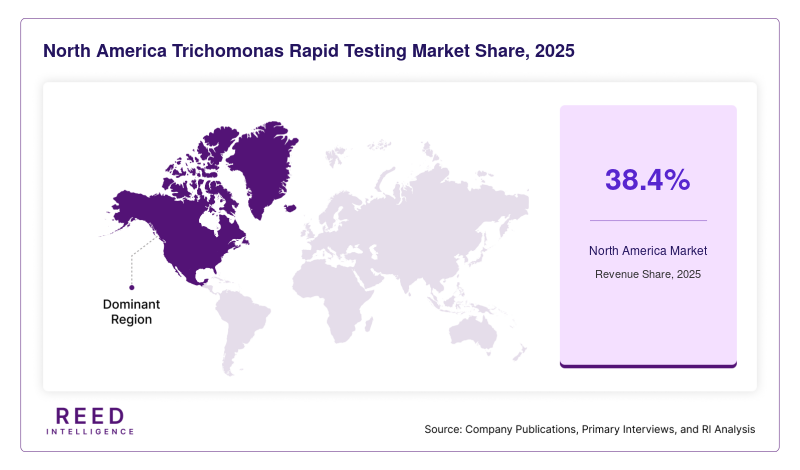
North America accounted for 38.4% of the Trichomonas Rapid Testing Market share in 2025 and is expected to grow at a CAGR of 7.5% through 2034. The region has a well-established healthcare infrastructure and high awareness levels regarding sexually transmitted infections. The presence of advanced diagnostic technologies and strong reimbursement frameworks has supported widespread adoption of rapid testing solutions.
The United States dominated the regional market due to its extensive screening programs and emphasis on early diagnosis. Public health initiatives targeting STI prevention, along with strong funding for reproductive health services, have contributed to market growth. Increasing adoption of point-of-care diagnostics in outpatient settings is further supporting expansion.
Europe
Europe held 27.1% of the market share in 2025 and is projected to grow at a CAGR of 7.2% during the forecast period. The region benefits from robust healthcare systems and increasing awareness of STI screening. Government policies promoting preventive healthcare are encouraging the use of rapid diagnostic tools.
Germany emerged as the dominant country, driven by its advanced healthcare infrastructure and strong focus on diagnostic accuracy. The country’s emphasis on early detection and integration of rapid testing into clinical workflows has contributed to steady market growth.
Asia Pacific
Asia Pacific captured 19.6% of the market share in 2025 and is expected to grow at the fastest CAGR of 9.3%. The region is witnessing rapid expansion due to increasing healthcare investments, rising population, and growing awareness of sexually transmitted infections.
China dominated the regional market, supported by large-scale public health initiatives and expanding diagnostic infrastructure. The increasing focus on rural healthcare access and the adoption of point-of-care testing solutions are key growth drivers in the country.
Middle East & Africa
The Middle East & Africa region accounted for 8.3% of the market share in 2025 and is projected to grow at a CAGR of 8.7%. The region is gradually improving its healthcare infrastructure, with increased investments in diagnostic services and disease prevention programs.
South Africa led the market in this region due to its high prevalence of STIs and strong public health initiatives. Government efforts to improve screening and access to diagnostic tools have significantly contributed to market growth.
Latin America
Latin America held 6.6% of the market share in 2025 and is expected to grow at a CAGR of 8.0% during the forecast period. The region is experiencing steady growth due to increasing awareness and expanding healthcare services.
Brazil dominated the regional market, driven by its large population and growing focus on public health programs. The adoption of rapid diagnostic kits in primary healthcare settings is supporting market expansion.
Competitive Landscape
The Trichomonas Rapid Testing Market is moderately competitive, with several global and regional players focusing on product innovation and strategic partnerships. Companies are investing in research and development to enhance test accuracy and expand their product portfolios.
A leading player in the market is Abbott, which has strengthened its position through continuous innovation in point-of-care diagnostics. The company recently introduced an advanced rapid testing platform with improved sensitivity, supporting faster and more accurate detection.
Other key players are focusing on expanding their geographic presence and collaborating with healthcare providers to increase product adoption. Strategic mergers, acquisitions, and product launches are common approaches used to gain competitive advantage in the market.
Key Players List
- Abbott
- BD (Becton, Dickinson and Company)
- bioMérieux
- QuidelOrtho Corporation
- Sekisui Diagnostics
- Trinity Biotech
- Hologic, Inc.
- Danaher Corporation
- F. Hoffmann-La Roche Ltd
- Siemens Healthineers
- OraSure Technologies
- Chembio Diagnostics
- EKF Diagnostics
- GenMark Diagnostics
- SD Biosensor
Recent Developments
- 2024: Abbott launched a next-generation rapid STI diagnostic platform with enhanced detection capabilities.
- 2024: BD expanded its rapid testing portfolio through a strategic acquisition of a diagnostics startup.
- 2023: Hologic introduced a new molecular rapid test for trichomoniasis with improved turnaround time.
- 2023: QuidelOrtho enhanced its point-of-care testing solutions with digital integration features.
- 2023: SD Biosensor expanded its presence in emerging markets through distribution partnerships.
Trichomonas Rapid Testing Market Segments
Product Type
- Lateral Flow Assays
- Molecular Rapid Tests
- Immunoassay-Based Tests
Sample Type
- Vaginal Swab
- Urine
- Other Sample Types
End-Use
- Hospitals
- Diagnostic Laboratories
- Home Care Settings
Distribution Channel
- Hospital Pharmacies
- Retail Pharmacies
- Online Platforms
By Region
- North America
- Europe
- APAC
- Middle East and Africa
- LATAM