Trichomoniasis Drug Market Size, Share & Demand Report By Drug Class (Nitroimidazoles, Combination Therapies, Others), By Route of Administration (Oral, Topical, Injectable), By Distribution Channel (Hospital Pharmacies, Retail Pharmacies, Online Pharmacies), By Patient Demographics (Adult Women, Adult Men, Adolescents) & Regional Forecasts, 2025–2034
USD 3950
Market Overview
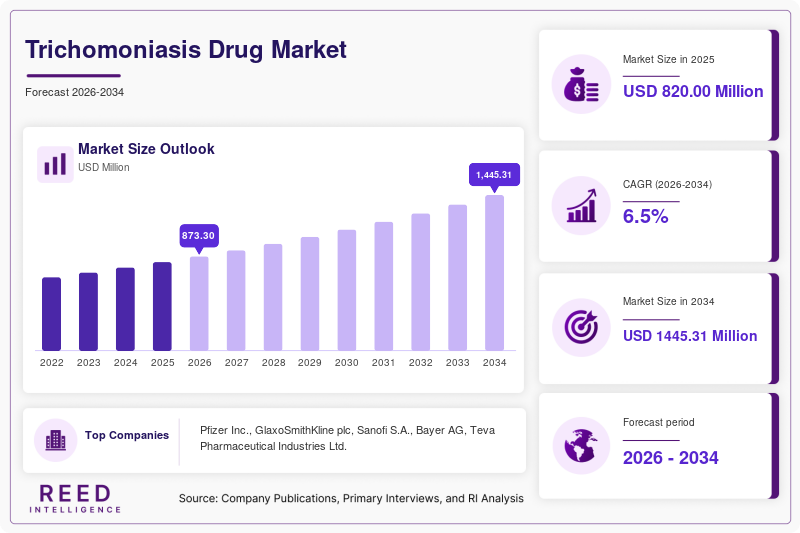
The Trichomoniasis Drug Market was valued at approximately USD 820 million in 2025 and is projected to reach USD 1.46 billion by 2034, expanding at a CAGR of 6.5% during the forecast period (2025–2034). The market continues to evolve as healthcare systems prioritize the treatment of sexually transmitted infections (STIs), with trichomoniasis remaining one of the most prevalent non-viral STIs globally. Increasing screening programs and improved access to diagnostic tools have contributed to early detection, thereby driving demand for effective pharmacological treatments.
A major global factor supporting the growth of the Trichomoniasis Drug Market is the expansion of public health initiatives targeting STI awareness and treatment compliance. Governments and non-governmental organizations have intensified efforts to reduce STI-related complications through early intervention programs, particularly in emerging economies. This has led to higher diagnosis rates and increased prescription volumes of antiprotozoal drugs.
Key Highlights:
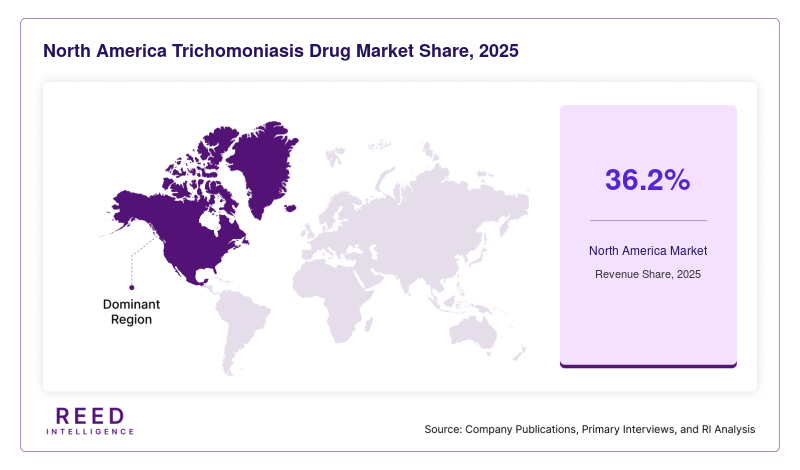
- North America dominated the market with a 36.2% share in 2025, while Asia Pacific is expected to grow at the fastest CAGR of 7.8%.
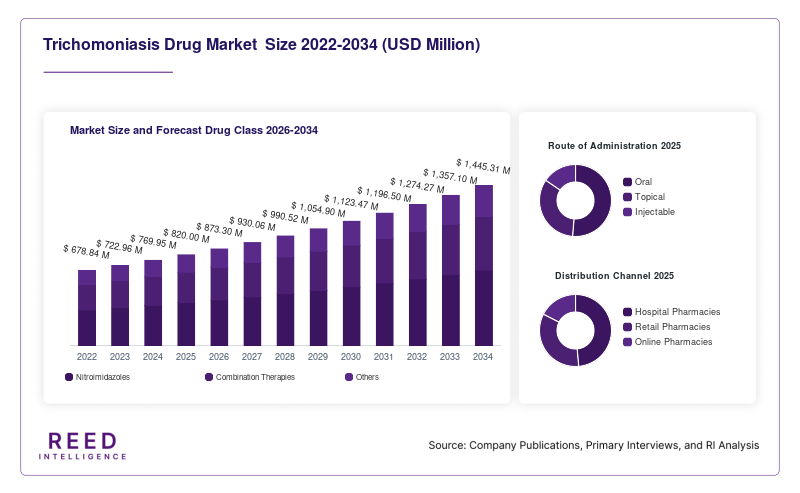
- By drug class, Nitroimidazoles held the largest share (68.5% in 2024), whereas combination therapies are projected to grow at a CAGR of 7.2%.
- By distribution channel, hospital pharmacies dominated, while online pharmacies are the fastest-growing segment with a CAGR of 8.1%.
- The United States led the market, with values of USD 245 million in 2024 and USD 258 million in 2025.
Market Trends
Increasing Adoption of Single-Dose Therapies
A significant trend in the Trichomoniasis Drug Market is the rising preference for single-dose oral therapies, particularly in outpatient settings. These regimens improve patient compliance compared to multi-dose alternatives, reducing the likelihood of incomplete treatment and recurrence. Healthcare providers are increasingly recommending simplified treatment protocols, especially in regions with limited follow-up care. Pharmaceutical companies are responding by optimizing formulations that deliver high efficacy with minimal dosing frequency.
Integration of Digital Health Platforms for STI Management
Another emerging trend is the integration of digital health platforms and telemedicine services for STI diagnosis and treatment. Patients are increasingly accessing remote consultations, receiving prescriptions, and purchasing medications through digital channels. This shift is particularly notable among younger populations and urban users. The Trichomoniasis Drug Market is benefiting from this trend as online pharmacies and telehealth platforms streamline access to medications, reduce stigma, and enable discreet treatment pathways.
Market Drivers
Rising Prevalence of Sexually Transmitted Infections
The increasing global incidence of STIs has significantly contributed to the growth of the Trichomoniasis Drug Market. Changing sexual behaviors, lack of awareness, and inconsistent use of protection have led to higher infection rates. Public health surveillance programs continue to report a steady rise in trichomoniasis cases, particularly among women of reproductive age. This has increased demand for effective and accessible treatment options.
Expansion of Screening and Diagnostic Programs
Enhanced screening initiatives have played a crucial role in driving market growth. Governments and healthcare organizations are investing in routine STI testing programs, especially in primary care and reproductive health clinics. Early detection of trichomoniasis enables timely treatment, thereby increasing drug utilization rates. Additionally, advancements in point-of-care diagnostic technologies have made testing more accessible, further supporting the expansion of the Trichomoniasis Drug Market.
Market Restraint
Emergence of Drug Resistance
One of the primary challenges affecting the Trichomoniasis Drug Market is the growing concern over antimicrobial resistance, particularly resistance to commonly used nitroimidazole drugs such as metronidazole. Although these drugs remain the standard of care, cases of treatment failure are being increasingly reported. This reduces the overall effectiveness of existing therapies and necessitates the development of alternative treatment options.
The limited availability of novel drug classes for trichomoniasis further exacerbates this issue. Pharmaceutical innovation in this segment has been relatively slow due to lower commercial incentives compared to other therapeutic areas. Additionally, resistance-related complications may require prolonged or combination therapies, increasing treatment costs and affecting patient adherence. These factors collectively pose a restraint on the growth trajectory of the Trichomoniasis Drug Market.
Market Opportunities
Development of Novel Therapeutic Agents
The growing concern over drug resistance presents an opportunity for pharmaceutical companies to invest in the development of new drug classes and advanced formulations. Research into alternative mechanisms of action and improved efficacy profiles is gaining traction. Companies focusing on innovative therapies can address unmet clinical needs and capture a larger share of the Trichomoniasis Drug Market.
Expansion in Emerging Markets
Emerging economies present a significant growth opportunity due to increasing healthcare investments and rising awareness of STIs. Countries in Asia Pacific, Latin America, and Africa are witnessing improvements in healthcare infrastructure and access to medications. Expanding distribution networks and localized manufacturing can help companies tap into these high-growth regions. The Trichomoniasis Drug Market is expected to benefit from increased penetration in these underserved areas.
Segmental Analysis
By Drug Class
Nitroimidazoles dominated the Trichomoniasis Drug Market, accounting for 68.5% of the market share in 2024. These drugs, including metronidazole and tinidazole, have been widely used due to their proven efficacy and cost-effectiveness.
Combination therapies are expected to grow at the fastest CAGR of 7.2%, driven by the need to address drug resistance. These therapies will gain traction as they offer improved treatment outcomes and reduced recurrence rates.
By Route of Administration
Oral administration held the largest share at 74.3% in 2024, as oral drugs are convenient and widely prescribed in outpatient settings.
Topical formulations will grow at a CAGR of 6.9%, supported by increasing demand for localized treatment options with fewer systemic side effects.
By Distribution Channel
Hospital pharmacies dominated with a 52.6% share in 2024, as most prescriptions are dispensed through healthcare facilities.
Online pharmacies are projected to grow at a CAGR of 8.1%, driven by the rise of digital health platforms and increased consumer preference for convenience and privacy.
By Patient Demographics
Adult women represented the largest segment, accounting for 61.8% of the market in 2024, due to higher diagnosis rates and screening frequency.
The male patient segment is expected to grow at a CAGR of 6.8%, as awareness and testing among men increase.
Regional Analysis
North America
North America accounted for 36.2% of the Trichomoniasis Drug Market share in 2025 and maintained a leading position due to well-established healthcare infrastructure and high awareness levels. The region will continue to grow at a CAGR of 5.9% during the forecast period.
The United States dominated the regional market, driven by advanced diagnostic capabilities and widespread screening programs. A key growth factor is the integration of STI testing into routine healthcare services, which has increased detection rates and treatment uptake.
Europe
Europe held a 24.8% share in 2025 and will expand at a CAGR of 6.1% through 2034. The region benefited from strong public healthcare systems and regulatory support for STI prevention.
Germany emerged as the dominant country due to its robust healthcare infrastructure and increasing investment in sexual health awareness campaigns. Government-supported screening initiatives have significantly contributed to market expansion.
Asia Pacific
Asia Pacific captured 21.5% of the market in 2025 and is projected to grow at the fastest CAGR of 7.8%. Rapid urbanization and increasing healthcare access are key contributors to growth.
India led the regional market, supported by expanding healthcare programs and rising awareness of STIs. Government initiatives aimed at improving reproductive health services have played a crucial role in boosting drug demand.
Middle East & Africa
The Middle East & Africa accounted for 9.3% of the market in 2025 and will grow at a CAGR of 6.7%. Limited access to healthcare services has historically constrained the market, but improvements are underway.
South Africa dominated the region due to increasing government efforts to combat STIs. Public health campaigns and international funding have enhanced access to diagnosis and treatment.
Latin America
Latin America held 8.2% of the market share in 2025 and is expected to grow at a CAGR of 6.4%. Rising awareness and improving healthcare infrastructure are key growth drivers.
Brazil led the regional market, supported by national healthcare programs focusing on STI prevention and treatment. Increased funding for public health initiatives has boosted the availability of medications.
Competitive Landscape
The Trichomoniasis Drug Market is moderately competitive, with several established pharmaceutical companies focusing on generic and branded formulations. The market leader is Pfizer Inc., which maintains a strong presence through its extensive distribution network and established product portfolio. The company recently expanded its antimicrobial product line to strengthen its position in the STI treatment segment.
Other key players are investing in research and partnerships to enhance their market presence. Companies are focusing on improving drug formulations, expanding into emerging markets, and leveraging digital platforms for distribution. Strategic collaborations and product launches remain key approaches for sustaining competitiveness in the evolving Trichomoniasis Drug Market.
Key Players List
- Pfizer Inc.
- GlaxoSmithKline plc
- Sanofi S.A.
- Bayer AG
- Teva Pharmaceutical Industries Ltd.
- Sun Pharmaceutical Industries Ltd.
- Lupin Limited
- Cipla Inc.
- Aurobindo Pharma Limited
- Dr. Reddy’s Laboratories Ltd.
- Zydus Lifesciences Ltd.
- Hikma Pharmaceuticals PLC
- Mylan N.V.
- Abbott Laboratories
- Merck & Co., Inc.
Recent Developments
- In 2024, leading pharmaceutical companies increased investments in combination therapy research to address drug resistance challenges.
- In 2025, several firms expanded their presence in Asia Pacific through strategic distribution partnerships.
- Digital pharmacy platforms introduced STI-specific treatment packages, improving accessibility.
- Companies initiated clinical trials for next-generation antiprotozoal drugs.
- Increased collaborations between public health organizations and pharmaceutical firms enhanced drug availability in emerging regions.
Trichomoniasis Drug Market Segments
Drug Class
- Nitroimidazoles
- Combination Therapies
- Others
Route of Administration
- Oral
- Topical
- Injectable
Distribution Channel
- Hospital Pharmacies
- Retail Pharmacies
- Online Pharmacies
Patient Demographics
- Adult Women
- Adult Men
- Adolescents
By Region
- North America
- Europe
- APAC
- Middle East and Africa
- LATAM