Trichuriasis Treatment Market Size, Share & Demand Report By Drug Class (Benzimidazole-Based Therapies, Combination Therapies), By Treatment Setting (Hospital and Clinic Treatment, Community-Based Treatment Programs), By Distribution Channel (Hospital Pharmacies, Retail Pharmacies, Online Pharmacies), By Region & Segment Forecasts, 2026–2034
USD 3950
Market Overview
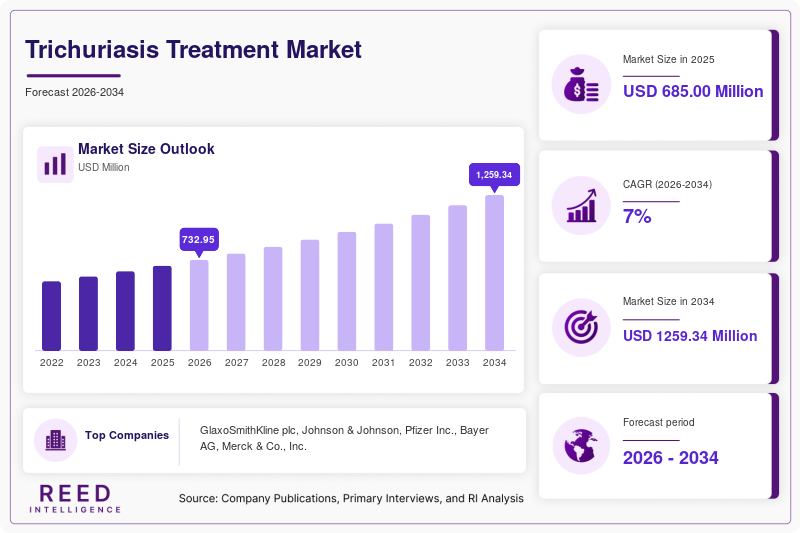
The global Trichuriasis Treatment Market size was valued at approximately USD 685 million in 2026 and is projected to reach USD 1180 million by 2034, expanding at a CAGR of 7.0% during 2026–2034. The market is experiencing steady growth due to the continued prevalence of soil-transmitted helminth infections across developing and emerging economies. Trichuriasis, caused by Trichuris trichiura infection, remains a significant public health concern in regions with inadequate sanitation infrastructure and limited healthcare accessibility. Increased government-supported deworming initiatives, improved disease surveillance programs, and wider access to antiparasitic medications continue to support market expansion.
Growing awareness regarding neglected tropical diseases has encouraged international health organizations and national governments to increase investments in diagnosis, treatment, and prevention programs. The integration of community-based treatment campaigns and school-centered deworming programs has improved treatment coverage in high-burden populations. In addition, pharmaceutical companies are expanding research activities to improve treatment efficacy and reduce reinfection rates, supporting long-term market development.
Key Highlights
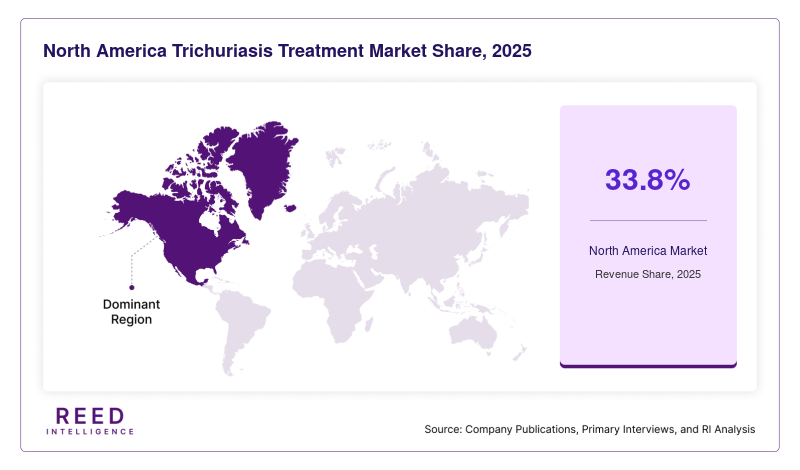
- North America dominated the market with a 33.8% share in 2025.
- Asia Pacific is expected to grow at the fastest CAGR of 8.9% during 2026–2034.
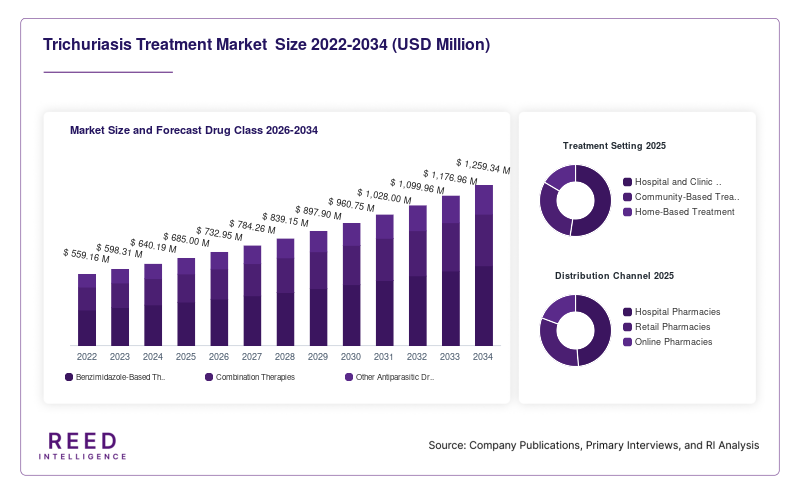
- By drug class, Benzimidazole-based therapies accounted for the largest share of 54.6%.
- while combination therapies are projected to grow at a CAGR of 9.8%.
- By treatment setting, hospital and clinic treatment led with a 61.4% share.
- whereas community-based treatment programs are expected to expand at a CAGR of 9.2%.
- By distribution channel, hospital pharmacies held a 43.7% share.
- while online pharmacies are anticipated to grow at a CAGR of 10.1%.
- The United States remained the dominant country, with market values of USD 184 million in 2024 and USD 197 million in 2025.
Market Trends
Expansion of Mass Drug Administration Programs
One of the most influential trends shaping the Trichuriasis Treatment Market is the expansion of large-scale mass drug administration programs. Governments and international healthcare organizations are increasingly implementing periodic deworming campaigns targeting school-age children and vulnerable populations. These programs are improving treatment accessibility and increasing demand for antiparasitic medicines. Many countries in Asia, Africa, and Latin America have incorporated deworming initiatives into broader public health strategies. The consistent procurement of treatment drugs through public health channels is creating predictable demand patterns. As healthcare authorities seek to reduce disease prevalence and transmission rates, large-scale treatment campaigns are expected to remain a major market trend throughout the forecast period.
Rising Adoption of Combination Therapy Approaches
Another notable trend is the growing use of combination therapies to improve treatment outcomes. Conventional single-drug treatments may show varying efficacy levels in regions with high parasite burdens. Healthcare providers are increasingly evaluating treatment regimens that combine multiple antiparasitic agents to enhance parasite clearance and reduce recurrence. Pharmaceutical manufacturers are investing in clinical research to validate the effectiveness of combination-based approaches. Growing scientific evidence supporting improved outcomes is encouraging healthcare systems to consider alternative treatment protocols. This trend is expected to stimulate innovation within the market and create opportunities for new product development, particularly in regions where treatment resistance and reinfection remain significant challenges.
Market Drivers
Growing Burden of Soil-Transmitted Helminth Infections
The persistent prevalence of soil-transmitted helminth infections continues to drive the Trichuriasis Treatment Market. Millions of individuals worldwide remain at risk due to poor sanitation, inadequate hygiene practices, and limited access to clean water. Children represent one of the most vulnerable demographic groups, increasing the need for routine treatment programs. Governments are prioritizing parasite control measures to improve educational outcomes, nutritional status, and public health indicators. As disease monitoring systems improve, more cases are being identified and treated. This expanding patient pool is generating sustained demand for antiparasitic medications and supporting long-term market growth across both developed and developing healthcare systems.
Increasing Investments in Neglected Tropical Disease Control
Public and private investments aimed at controlling neglected tropical diseases are significantly contributing to market expansion. International organizations, healthcare foundations, and national governments are allocating funding toward disease prevention and treatment initiatives. These investments support medicine procurement, healthcare worker training, diagnostic improvements, and community outreach programs. Enhanced financial support has increased treatment coverage rates in previously underserved regions. Pharmaceutical companies are also collaborating with health agencies to improve medicine accessibility through donation and affordability programs. The resulting expansion of treatment infrastructure and awareness campaigns is strengthening demand for trichuriasis therapies and improving overall market penetration across emerging economies.
Market Restraint
High Reinfection Rates and Limited Sanitation Infrastructure
A significant challenge affecting the Trichuriasis Treatment Market is the continued prevalence of reinfection in endemic regions. Although available medications can effectively eliminate existing infections, individuals often remain exposed to contaminated environments after treatment. In many low-income communities, inadequate sanitation systems, poor waste management practices, and insufficient access to clean water contribute to recurring infections. This cycle reduces the long-term effectiveness of treatment initiatives and increases the burden on healthcare systems. For example, communities receiving annual deworming treatments may still experience persistent infection rates if environmental conditions remain unchanged. Additionally, healthcare providers may face difficulties monitoring treatment outcomes in remote areas. The need for repeated treatment interventions increases healthcare expenditures and can strain public health budgets. These challenges highlight the importance of integrating treatment programs with sanitation improvement efforts. Until broader environmental and infrastructure issues are addressed, market participants may encounter limitations in achieving sustained disease reduction despite growing treatment availability.
Market Opportunities
Expansion of Healthcare Access in Emerging Economies
Emerging economies present substantial growth opportunities for the Trichuriasis Treatment Market. Many countries across Asia Pacific, Africa, and Latin America are investing in healthcare infrastructure, expanding medical facilities, and increasing healthcare spending. These developments are improving patient access to diagnosis and treatment services. Governments are also integrating parasite control initiatives into primary healthcare programs, increasing treatment adoption. Rising awareness among healthcare professionals and community workers is supporting earlier intervention and broader disease management efforts. As healthcare systems continue to mature, demand for affordable and effective antiparasitic therapies is expected to increase significantly, creating favorable opportunities for pharmaceutical manufacturers and healthcare service providers.
Development of Improved Therapeutic Formulations
The development of advanced therapeutic formulations represents another promising opportunity. Pharmaceutical companies are focusing on improving treatment efficacy, reducing dosing requirements, and enhancing patient compliance. Novel drug combinations, pediatric formulations, and extended-release therapies are gaining attention within the industry. These innovations can help address limitations associated with conventional treatment approaches while improving outcomes in high-burden populations. Research initiatives aimed at minimizing reinfection risk and enhancing parasite eradication rates may create new revenue streams for market participants. As regulatory approvals increase and clinical evidence expands, advanced treatment options are expected to strengthen product differentiation and contribute to overall market growth.
Segmental Analysis
By Drug Class
Benzimidazole-based therapies represented the dominant subsegment, accounting for approximately 54.6% of market revenue in 2024. These therapies, including widely prescribed antiparasitic medications, remain the preferred treatment option due to established efficacy, affordability, and broad availability. Healthcare providers frequently rely on benzimidazole treatments for routine parasite management programs because of their proven clinical performance. Government-sponsored deworming campaigns also contribute significantly to demand, as these medications are often included in national treatment protocols. Their widespread acceptance among healthcare professionals and public health authorities has enabled the segment to maintain a leading position across both developed and developing regions.
Combination therapies constitute the fastest-growing subsegment and are projected to expand at a CAGR of 9.8% through 2034. Increasing concerns regarding variable treatment outcomes and persistent infection burdens are encouraging healthcare providers to adopt multi-drug approaches. Clinical studies suggest that combination therapies may improve parasite clearance rates in certain patient populations. Pharmaceutical companies are actively investing in research programs aimed at validating these treatment strategies. Growing awareness of enhanced therapeutic effectiveness and rising demand for improved disease management solutions are expected to accelerate adoption. These factors collectively position combination therapies as a significant growth area within the market.
By Treatment Setting
Hospital and clinic treatment emerged as the dominant treatment setting, accounting for approximately 61.4% of market revenue in 2024. Healthcare facilities remain the primary point of care for diagnosis, prescription management, and treatment monitoring. Physicians often prefer clinical settings for managing symptomatic infections and evaluating treatment effectiveness. Hospitals also play an important role in public health campaigns by supporting patient education and disease surveillance activities. The availability of trained healthcare professionals and diagnostic resources contributes to strong segment performance. As healthcare systems continue to strengthen globally, hospitals and clinics are expected to maintain their central role in trichuriasis management.
Community-based treatment programs represent the fastest-growing subsegment and are anticipated to register a CAGR of 9.2% during the forecast period. Governments and international organizations are increasingly utilizing community outreach initiatives to improve treatment coverage in underserved populations. These programs help overcome barriers related to healthcare access and geographic isolation. Mobile healthcare teams, school-based treatment campaigns, and local health worker networks are expanding treatment delivery capabilities. The ability to reach large populations efficiently and cost-effectively makes community-based interventions an attractive strategy for disease control. Continued support from public health agencies is expected to drive substantial growth within this segment.
By Distribution Channel
Hospital pharmacies accounted for the largest share of the Trichuriasis Treatment Market in 2024, representing approximately 43.7% of total revenue. These pharmacies serve as critical distribution points for prescription medications and support treatment continuity within healthcare facilities. Physicians often coordinate directly with hospital pharmacies to ensure appropriate medicine availability and dosage management. Large-scale procurement contracts associated with public health programs also contribute to strong segment performance. The reliability of supply chains and established relationships with healthcare providers have reinforced the dominant position of hospital pharmacies within the market.
Online pharmacies are expected to be the fastest-growing distribution channel, advancing at a CAGR of 10.1% through 2034. Increasing internet penetration, digital healthcare adoption, and consumer preference for convenient medicine access are driving growth. Online platforms provide broader product availability and facilitate treatment access in regions where physical pharmacy networks may be limited. Telemedicine expansion is also supporting digital prescription fulfillment and medication delivery services. As regulatory frameworks continue to evolve and digital healthcare infrastructure improves, online pharmacies are expected to capture a growing share of market revenue.
Regional Analysis
North America
North America accounted for approximately 33.8% of the global Trichuriasis Treatment Market in 2025 and continues to represent the largest regional market. The region is projected to expand at a CAGR of 5.8% through 2034. Strong healthcare infrastructure, extensive disease surveillance capabilities, and widespread access to treatment contribute to market leadership. Although disease prevalence is lower than in developing regions, consistent investment in infectious disease management and imported case monitoring supports stable market demand.
The United States remains the dominant country within North America. A key growth factor is the presence of advanced research institutions and pharmaceutical companies involved in antiparasitic drug development. Increased migration from endemic regions and enhanced diagnostic capabilities have improved disease identification rates. Continuous investment in public health preparedness further supports market expansion and treatment accessibility across the country.
Europe
Europe represented around 24.6% of the global market in 2025 and is anticipated to register a CAGR of 5.6% during the forecast period. The regional market benefits from well-established healthcare systems, strong regulatory oversight, and increasing attention toward neglected infectious diseases. Public health organizations across the region are strengthening disease surveillance programs and supporting research activities focused on parasitic infections.
Germany remains the leading country in the European market. A unique growth factor is the country's emphasis on infectious disease research and international healthcare collaboration. Universities, medical institutions, and research organizations are actively involved in developing improved diagnostic and treatment approaches. This research-driven environment supports continued market development and promotes innovation within the trichuriasis treatment landscape.
Asia Pacific
Asia Pacific held approximately 22.9% of the global Trichuriasis Treatment Market in 2025 and is forecast to grow at the fastest CAGR of 8.9% through 2034. The region experiences a relatively high disease burden due to large populations, sanitation challenges, and favorable transmission conditions in several countries. Expanding healthcare infrastructure and increasing government support for deworming campaigns are contributing to significant market growth.
China remains the dominant country in Asia Pacific. A major growth factor is the large-scale implementation of public health programs targeting parasitic diseases. Government-led screening initiatives, improved healthcare access in rural areas, and expanded pharmaceutical manufacturing capabilities support treatment availability. These developments are helping improve disease control efforts and strengthening the regional market outlook.
Middle East & Africa
The Middle East & Africa region accounted for nearly 10.2% of global revenue in 2025 and is expected to grow at a CAGR of 7.7% during the forecast period. Several countries continue to face substantial challenges related to sanitation and infectious disease management, creating ongoing demand for treatment solutions. International health organizations remain actively involved in supporting disease control and treatment accessibility initiatives.
South Africa serves as the dominant market within the region. One unique growth factor is the increasing integration of parasite management programs into broader public healthcare strategies. Investments in community health services and disease awareness campaigns are improving treatment coverage. Enhanced collaboration between governments and international organizations is also contributing to market development and healthcare capacity building.
Latin America
Latin America captured approximately 8.5% of the global market in 2025 and is projected to expand at a CAGR of 7.1% through 2034. The region benefits from ongoing improvements in healthcare access and growing awareness regarding neglected tropical diseases. Several countries are strengthening preventive healthcare measures while expanding treatment programs aimed at reducing parasite-related health burdens.
Brazil dominates the Latin American market. A key growth factor is the country's extensive public health network and commitment to disease control initiatives. Government-sponsored deworming campaigns, improved healthcare outreach in rural communities, and growing investments in infectious disease management support treatment adoption. These efforts are expected to contribute to sustained market growth throughout the forecast period.
Competitive Landscape
The Trichuriasis Treatment Market remains moderately consolidated, with several multinational pharmaceutical companies competing alongside regional manufacturers and generic drug producers. Market participants focus on expanding product portfolios, improving treatment accessibility, and strengthening partnerships with public health organizations. Competitive strategies include research collaborations, geographic expansion, and participation in large-scale deworming initiatives.
Among leading companies, GlaxoSmithKline plc maintains a strong market position due to its extensive experience in infectious disease treatment and global healthcare outreach programs. The company continues to support disease control efforts through strategic partnerships and medicine accessibility initiatives. A notable recent development within the industry involves increased investment in combination therapy research aimed at improving treatment outcomes in high-burden regions. Several companies are conducting clinical evaluations focused on enhanced efficacy and reduced reinfection risks. The competitive environment is expected to remain dynamic as manufacturers pursue innovation, affordability, and broader distribution capabilities to strengthen market presence.
Key Players
- GlaxoSmithKline plc
- Johnson & Johnson
- Pfizer Inc.
- Bayer AG
- Merck & Co., Inc.
- Sanofi
- Novartis AG
- Cipla Limited
- Sun Pharmaceutical Industries Ltd.
- Lupin Limited
- Dr. Reddy's Laboratories Ltd.
- Alkem Laboratories Ltd.
- Hikma Pharmaceuticals PLC
- Teva Pharmaceutical Industries Ltd.
- Viatris Inc.
Recent Developments
- A major pharmaceutical manufacturer expanded clinical research activities focused on combination antiparasitic therapies for improved parasite clearance rates in endemic regions.
- Several public health agencies introduced expanded school-based deworming programs, increasing treatment coverage among pediatric populations across Asia and Africa.
- Multiple healthcare organizations partnered with pharmaceutical suppliers to strengthen medicine distribution networks and improve access to trichuriasis treatment in underserved communities.
- Digital health providers enhanced telemedicine-supported prescription services, supporting greater utilization of online pharmacy channels for antiparasitic medications.
Trichuriasis Treatment Market Segments
Drug Class
- Benzimidazole-Based Therapies
- Combination Therapies
- Other Antiparasitic Drugs
Treatment Setting
- Hospital and Clinic Treatment
- Community-Based Treatment Programs
- Home-Based Treatment
Distribution Channel
- Hospital Pharmacies
- Retail Pharmacies
- Online Pharmacies
By Region
- North America
- Europe
- APAC
- Middle East and Africa
- LATAM