Triethyl Phosphate Market Size, Share & Demand Report By Grade (Industrial Grade, Electronic Grade, Pharmaceutical Grade), By Application (Flame Retardants, Plasticizers, Catalysts, Solvents, Chemical Intermediates), By End-Use Industry (Chemicals and Materials, Electronics and Semiconductors, Automotive and Transportation, Construction, Pharmaceuticals, Others) By Region & Segment Forecasts, 2026–2034
USD 3950
Market Overview
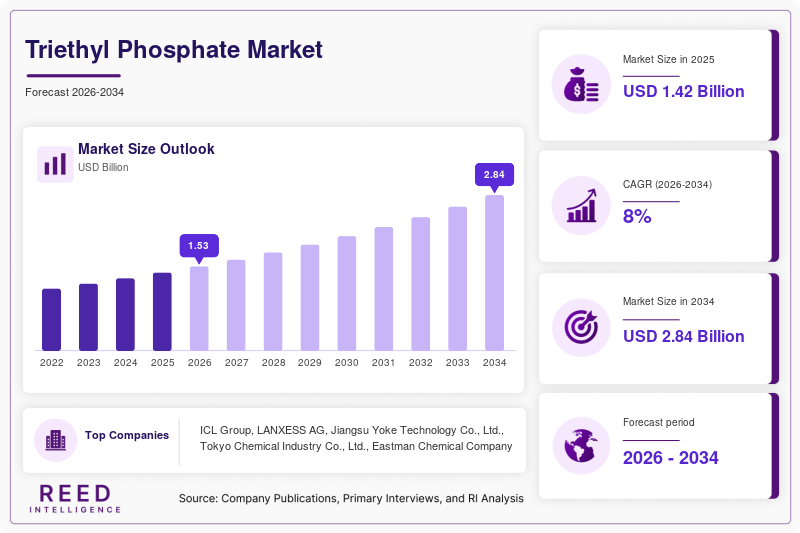
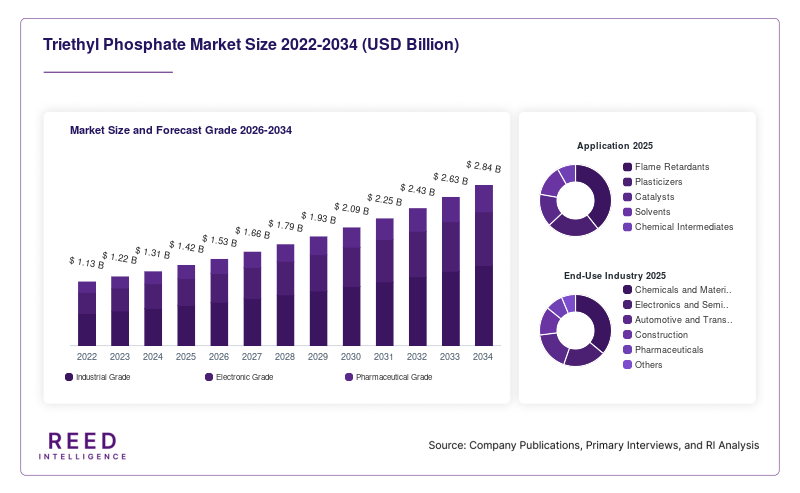
The global Triethyl Phosphate Market size was valued at USD 1.42 billion in 2026 and is projected to reach USD 2.63 billion by 2034, expanding at a CAGR of 8.0% during the forecast period from 2026 to 2034. The market is experiencing stable growth due to rising demand for flame retardants, plasticizers, catalysts, and chemical intermediates across several industrial sectors. Triethyl phosphate is widely used in polymers, resins, coatings, and electronics manufacturing because of its flame-retardant and solvent properties. Increasing industrial production in emerging economies and the expansion of the electronics and construction industries are supporting broader adoption of triethyl phosphate in industrial applications.
One of the major global factors supporting market expansion is the growing emphasis on fire safety standards in manufacturing and infrastructure development. Governments and regulatory agencies across major economies are introducing stricter building safety codes and electrical safety regulations. This trend is increasing the use of flame-retardant additives in plastics, textiles, cables, and electronic devices. Triethyl phosphate has gained traction because it provides effective flame resistance while maintaining material flexibility and thermal stability. In addition, growing investments in automotive electronics, semiconductor production, and specialty chemical manufacturing are creating long-term opportunities for suppliers operating in the market.
Key Highlights
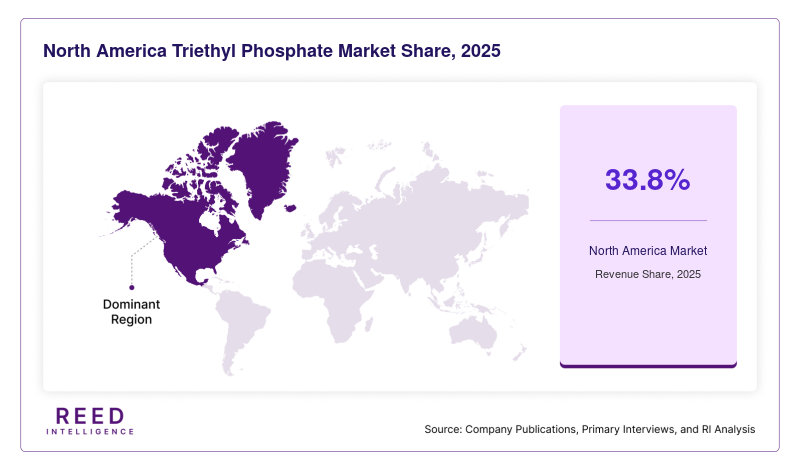
- North America dominated the market with a 33.8% share in 2025, while Asia Pacific is expected to grow at the fastest CAGR of 10.9% during 2026–2034.
- By grade, industrial grade accounted for the largest share of 47.6%, while electronic grade is projected to grow at a CAGR of 11.8%.
- By application, flame retardants led with a 44.1% share, whereas plasticizers are expected to expand at a CAGR of 10.7%.
- By end-use industry, chemicals and materials held the largest share of 39.4%, while electronics and semiconductors are anticipated to grow at a CAGR of 12.1%.
- The United States remained the dominant country, with market values of USD 420 million in 2024 and USD 458 million in 2025.
Market Trends
Increasing Adoption of Flame-Retardant Chemicals in Electronics Manufacturing
The growing use of electronic devices and advanced electrical systems is creating stronger demand for flame-retardant chemicals, including triethyl phosphate. Consumer electronics manufacturers are focusing on improving product safety standards as compact devices generate higher thermal loads during operation. Triethyl phosphate is increasingly incorporated into electronic components, connectors, circuit boards, and insulating materials to improve heat resistance and reduce fire risks. The expansion of electric vehicle production and smart infrastructure projects is also contributing to higher consumption of flame-retardant materials. Manufacturers are investing in specialty chemical formulations that provide both thermal stability and material durability, which is supporting long-term market expansion.
In addition, the semiconductor industry is witnessing significant capital investments in Asia Pacific and North America. The construction of new fabrication facilities and data centers is increasing demand for specialty solvents and phosphorus-based chemicals. Triethyl phosphate is gaining preference because of its compatibility with polymer processing applications and its ability to maintain performance under high temperatures.
Shift Toward High-Purity and Specialty Chemical Grades
The market is witnessing a gradual transition from conventional industrial-grade products toward high-purity and specialty grades of triethyl phosphate. Industries such as semiconductors, pharmaceuticals, and specialty coatings require consistent chemical composition and low impurity levels for precision manufacturing processes. This trend is encouraging manufacturers to invest in purification technologies, automated quality control systems, and advanced processing equipment. High-purity grades are gaining traction because they improve production efficiency and reduce contamination risks in sensitive applications.
Chemical producers are also expanding research activities to develop customized formulations that align with industry-specific performance requirements. The rise of advanced materials, lightweight composites, and next-generation polymers is creating additional demand for specialty-grade triethyl phosphate products. Companies are entering long-term partnerships with electronics and chemical manufacturers to ensure supply stability and product consistency. This shift toward premium-grade materials is expected to improve profit margins and create opportunities for differentiated product offerings in the market.
Market Drivers
Expansion of Construction and Infrastructure Development Activities
The rapid growth of infrastructure projects and commercial construction activities is driving demand for flame-retardant materials worldwide. Governments are investing heavily in transportation systems, industrial facilities, residential buildings, and energy infrastructure to support urbanization and economic development. Triethyl phosphate is used as a flame-retardant additive in coatings, plastics, insulation materials, and construction-related chemical formulations. Increasing awareness regarding fire safety standards in public infrastructure projects is further accelerating product demand.
Construction companies and material manufacturers are focusing on improving durability, thermal resistance, and safety performance in modern building materials. The increasing use of polymers and engineered plastics in construction applications is supporting wider adoption of phosphorus-based flame retardants. Emerging economies in Asia Pacific, the Middle East, and Latin America are experiencing strong industrial growth, which is contributing to rising consumption of specialty chemicals. This combination of industrialization and infrastructure development is expected to sustain market expansion during the forecast period.
Rising Demand from the Automotive and Transportation Sector
The automotive industry is becoming an important consumer of triethyl phosphate due to the growing use of lightweight materials and advanced electronic systems in vehicles. Automotive manufacturers are increasingly incorporating flame-retardant polymers and specialty coatings into vehicle interiors, battery systems, wiring components, and electronic modules. Electric vehicle production is creating additional demand because battery systems require materials with improved thermal stability and fire resistance.
The shift toward electric mobility and connected transportation systems is encouraging automakers to use advanced materials that meet evolving safety and performance standards. Triethyl phosphate is gaining traction in automotive applications because it helps improve flame resistance without significantly affecting material flexibility. Rising investments in electric vehicle manufacturing facilities, charging infrastructure, and battery production plants are supporting long-term demand growth. In addition, stricter transportation safety regulations in developed economies are encouraging the use of high-performance flame-retardant additives in automotive production processes.
Market Restraint
Environmental and Regulatory Concerns Related to Chemical Handling
Environmental regulations and concerns regarding the handling and disposal of phosphorus-based chemicals remain significant challenges for the Triethyl Phosphate Market. Regulatory authorities in North America and Europe are implementing stricter chemical safety guidelines to minimize environmental contamination and workplace exposure risks. Compliance with evolving environmental standards often increases operational costs for manufacturers because companies must invest in waste management systems, emission control technologies, and worker safety measures.
In addition, fluctuations in raw material prices and transportation costs can affect profit margins for producers operating in competitive markets. Some end-use industries are also exploring alternative flame-retardant materials that offer lower environmental impact profiles. Smaller manufacturers may face difficulties in meeting stringent regulatory requirements due to limited capital resources and technological capabilities. Delays in obtaining approvals for chemical processing facilities and environmental permits can also restrict production expansion plans. These factors may slow market penetration in certain regions and create pricing pressure for suppliers competing in cost-sensitive industrial segments.
Market Opportunities
Growth of Electric Vehicle Battery Manufacturing
The rapid expansion of electric vehicle battery manufacturing is creating favorable opportunities for triethyl phosphate suppliers. Battery systems require advanced thermal management materials and flame-retardant components to improve operational safety and reduce fire risks. Triethyl phosphate is increasingly used in electrolyte formulations, polymer separators, and battery insulation materials because of its thermal stability and chemical compatibility. Governments in major economies are supporting electric mobility initiatives through incentives, infrastructure investments, and emission reduction policies, which is accelerating battery production capacity.
Battery manufacturers are expanding facilities across Asia Pacific, Europe, and North America to meet rising demand for electric vehicles. This growth is expected to create long-term opportunities for specialty chemical suppliers. Companies producing high-purity grades of triethyl phosphate are likely to benefit from increased adoption in advanced battery technologies and energy storage systems.
Increasing Use in Specialty Chemical and Pharmaceutical Applications
The expanding specialty chemicals and pharmaceutical sectors are creating new application areas for triethyl phosphate. The compound is used as a catalyst, solvent, and intermediate in various chemical synthesis processes. Pharmaceutical manufacturers are focusing on high-purity ingredients and efficient production methods, which is increasing demand for specialty chemical compounds with stable performance characteristics.
Research activities in advanced materials and specialty formulations are also supporting broader utilization of triethyl phosphate in niche industrial applications. The development of customized chemical solutions for coatings, adhesives, and laboratory processing is creating opportunities for manufacturers to diversify their product portfolios. Emerging biotechnology and pharmaceutical manufacturing hubs in Asia Pacific and Europe are expected to contribute to future market demand. Companies investing in product innovation and sustainable chemical production technologies may gain competitive advantages in these expanding application areas.
Segmental Analysis
By Grade
Industrial grade triethyl phosphate accounted for the largest market share of 47.6% in 2024 due to its extensive use across flame retardants, coatings, resins, and industrial processing applications. This grade is widely preferred because it offers cost efficiency and reliable performance for large-scale manufacturing operations. Construction material producers, chemical processors, and plastics manufacturers continue to rely on industrial-grade products for routine industrial applications. The increasing use of engineered plastics and polymer compounds in infrastructure development and automotive manufacturing is supporting stable demand for this segment. In addition, industrial-grade triethyl phosphate is commonly used in lubricants and chemical synthesis processes because of its thermal stability and solvent properties. Manufacturers are also improving production technologies to enhance product consistency and reduce processing costs, which is helping maintain widespread adoption across industrial sectors.
By Application
Flame retardants represented the largest application segment with a 44.1% share in 2024. The segment continues to dominate because triethyl phosphate is widely used to improve fire resistance in plastics, textiles, coatings, and electrical components. Rising awareness regarding industrial safety and stricter fire protection regulations are increasing adoption across construction, transportation, and consumer electronics industries. Manufacturers are incorporating flame-retardant additives into advanced polymer materials to improve product durability and thermal performance. The increasing use of lightweight plastics in automotive production is also supporting segment growth. In addition, rapid urbanization and infrastructure expansion in emerging economies are creating higher demand for flame-resistant construction materials. Chemical producers are developing enhanced formulations that provide better compatibility with modern polymer systems and industrial processing technologies.
By End-Use Industry
The chemicals and materials industry held the largest market share of 39.4% in 2024 because triethyl phosphate is widely used in chemical synthesis, flame-retardant formulations, industrial coatings, and polymer processing applications. The segment benefits from strong demand across construction, automotive, and manufacturing industries where specialty chemicals are essential for production efficiency and material performance. Rising industrialization in developing economies is increasing consumption of advanced chemical compounds and additives. In addition, expanding investments in industrial infrastructure and manufacturing automation are supporting long-term demand growth. Chemical manufacturers are continuously developing customized formulations to improve compatibility with modern industrial applications. The growing emphasis on product safety, thermal resistance, and high-performance materials is encouraging broader adoption of triethyl phosphate across multiple industrial production processes.
Regional Analysis
North America
North America accounted for 33.8% of the global Triethyl Phosphate Market in 2025 and is projected to register a CAGR of 7.4% during the forecast period. The region benefits from strong demand across flame retardants, industrial chemicals, electronics manufacturing, and automotive applications. The presence of advanced manufacturing infrastructure and strict fire safety regulations is supporting widespread use of triethyl phosphate in plastics, coatings, and specialty materials. Investments in semiconductor fabrication facilities and electric vehicle production are also contributing to market expansion.
The United States remained the dominant country in North America due to strong industrial production and advanced research capabilities in specialty chemicals. A major growth factor in the country is the rising investment in electric vehicle battery manufacturing and semiconductor facilities. Federal funding programs supporting clean energy infrastructure and domestic manufacturing are encouraging chemical producers to expand production capacities. In addition, growing demand for advanced flame-retardant materials in aerospace and transportation industries is supporting stable long-term market development.
Europe
Europe represented 26.4% of the global market in 2025 and is expected to grow at a CAGR of 7.1% through 2034. The region is characterized by strict environmental regulations and advanced industrial safety standards, which are encouraging adoption of high-performance flame-retardant chemicals. Countries across Europe are investing in sustainable construction materials, advanced coatings, and lightweight automotive components. The growing use of engineered plastics and specialty polymers in industrial manufacturing is also supporting regional demand for triethyl phosphate.
Germany remained the leading country in the European market because of its strong automotive, chemical, and industrial manufacturing sectors. One unique growth factor driving the market in Germany is the country’s focus on industrial automation and advanced manufacturing technologies. The expansion of electric vehicle production and investments in battery innovation are increasing demand for specialty chemicals used in thermal management systems. Additionally, European chemical manufacturers are focusing on sustainable production processes and product innovation to strengthen competitiveness in international markets.
Asia Pacific
Asia Pacific held 24.7% of the global Triethyl Phosphate Market in 2025 and is anticipated to expand at the fastest CAGR of 10.9% during the forecast period. Rapid industrialization, urban development, and electronics manufacturing growth are driving strong demand across the region. Countries including China, India, Japan, and South Korea are experiencing rising consumption of specialty chemicals in construction, automotive, and semiconductor industries. Expanding manufacturing capacity and favorable industrial policies are encouraging both domestic and international companies to invest in chemical production facilities.
China remained the dominant country in Asia Pacific due to its extensive electronics manufacturing ecosystem and large-scale chemical production infrastructure. A unique factor supporting growth in China is the rapid expansion of semiconductor fabrication and electric vehicle battery manufacturing industries. Government initiatives focused on technological self-sufficiency and industrial modernization are increasing investments in advanced materials and specialty chemicals. Rising exports of consumer electronics and industrial products are also contributing to higher demand for flame-retardant additives and high-purity chemical compounds.
Middle East & Africa
The Middle East & Africa accounted for 8.1% of the global market in 2025 and is projected to grow at a CAGR of 6.8% through 2034. Infrastructure expansion, industrial diversification, and rising investments in manufacturing sectors are supporting regional demand for triethyl phosphate. Several countries are increasing investments in petrochemicals, construction materials, and industrial processing industries to reduce dependence on oil revenues. Demand for flame-retardant chemicals is rising due to growing awareness regarding industrial safety standards and fire protection measures.
Saudi Arabia emerged as the leading country in the regional market because of its large petrochemical industry and industrial development initiatives. A unique growth factor in the country is the expansion of large-scale infrastructure and industrial city projects under economic diversification programs. These projects are increasing demand for advanced construction materials, specialty chemicals, and industrial coatings. The establishment of new manufacturing facilities and logistics hubs is also supporting chemical consumption across multiple industrial sectors.
Latin America
Latin America represented 7.0% of the global Triethyl Phosphate Market in 2025 and is expected to register a CAGR of 6.5% during the forecast period. The region is witnessing moderate industrial growth supported by expanding construction activities and increasing demand for specialty chemicals in manufacturing applications. Countries across Latin America are focusing on improving industrial productivity and modernizing transportation infrastructure, which is supporting consumption of flame-retardant materials and polymer additives.
Brazil remained the dominant country in the Latin American market due to its large manufacturing base and growing automotive production sector. One unique factor driving growth in Brazil is the increasing use of industrial coatings and engineered plastics in infrastructure modernization projects. The expansion of local chemical manufacturing capacity and rising foreign investment in industrial production facilities are supporting broader adoption of specialty chemicals. Growing consumer demand for electronics and durable goods is also contributing to market expansion in the country.
Competitive Landscape
The global Triethyl Phosphate Market is moderately consolidated, with several international and regional manufacturers competing through product quality, pricing strategies, production capacity expansion, and technological innovation. Leading companies are investing in advanced purification systems and sustainable manufacturing technologies to strengthen their market positions. Strategic collaborations with electronics manufacturers, chemical processors, and automotive suppliers are becoming increasingly common as companies seek long-term supply agreements and market expansion opportunities.
ICL Group emerged as one of the leading companies in the market due to its extensive specialty chemicals portfolio and strong global distribution network. The company recently expanded its phosphorus-based flame-retardant production capabilities to support growing demand from electronics and industrial manufacturing sectors. Other major participants are also focusing on capacity expansion projects, regional distribution partnerships, and research initiatives related to high-purity chemical formulations. Market participants are increasingly prioritizing sustainability, regulatory compliance, and product customization to maintain competitiveness in evolving industrial markets.
Key Players
- ICL Group
- LANXESS AG
- Jiangsu Yoke Technology Co., Ltd.
- Tokyo Chemical Industry Co., Ltd.
- Eastman Chemical Company
- Merck KGaA
- Zhejiang Xinhaitian Bio-Technology Co., Ltd.
- Akzo Nobel N.V.
- BASF SE
- Solvay S.A.
- Clariant AG
- Hubei Xingfa Chemicals Group
- ADEKA Corporation
- PCC Group
- Alfa Aesar
Recent Developments
- In February 2026, ICL Group announced the expansion of its phosphorus-based specialty chemicals production facility to support increasing demand from the electronics and automotive sectors.
- In September 2025, LANXESS AG introduced a new high-purity triethyl phosphate formulation designed for semiconductor and advanced electronics manufacturing applications.
- In June 2025, Jiangsu Yoke Technology Co., Ltd. signed a strategic supply agreement with an electric vehicle battery manufacturer to strengthen its specialty chemical distribution network in Asia Pacific.
- In March 2026, BASF SE invested in process optimization technologies to improve the sustainability and energy efficiency of phosphorus-based chemical production operations.
Triethyl Phosphate Market Segments
Grade
- Industrial Grade
- Electronic Grade
- Pharmaceutical Grade
Application
- Flame Retardants
- Plasticizers
- Catalysts
- Solvents
- Chemical Intermediates
End-Use Industry
- Chemicals and Materials
- Electronics and Semiconductors
- Automotive and Transportation
- Construction
- Pharmaceuticals
- Others
By Region
- North America
- Europe
- APAC
- Middle East and Africa
- LATAM