Trifluoromethylpyridine Market Size, Share & Demand Report By Type (2-Trifluoromethylpyridine, 3-Trifluoromethylpyridine, 4-Trifluoromethylpyridine), By Application (Agrochemicals, Pharmaceuticals, Specialty Chemicals), By End-Use Industry (Chemical Manufacturing, Healthcare, Agriculture), By Purity Level (≥98%, ≥99%, ≥99.5%) & Segment Forecasts, 2026–2034
USD 3950
Market Overview
The global Trifluoromethylpyridine Market size was valued at approximately USD 485 million in 2026 and is projected to reach USD 912 million by 2034, expanding at a CAGR of 8.2% during the forecast period (2026–2034). The market is experiencing steady growth driven by increasing applications in agrochemicals, pharmaceuticals, and specialty chemical synthesis. Trifluoromethylpyridine compounds are widely recognized for their stability, lipophilicity, and strong electron-withdrawing properties, making them essential intermediates in high-performance chemical formulations.
A key global factor supporting the expansion of the Trifluoromethylpyridine Market is the rising demand for advanced crop protection chemicals. With global food demand increasing, agrochemical manufacturers are adopting fluorinated compounds to enhance pesticide efficacy and durability. This has significantly boosted the demand for trifluoromethylpyridine derivatives across emerging and developed economies.
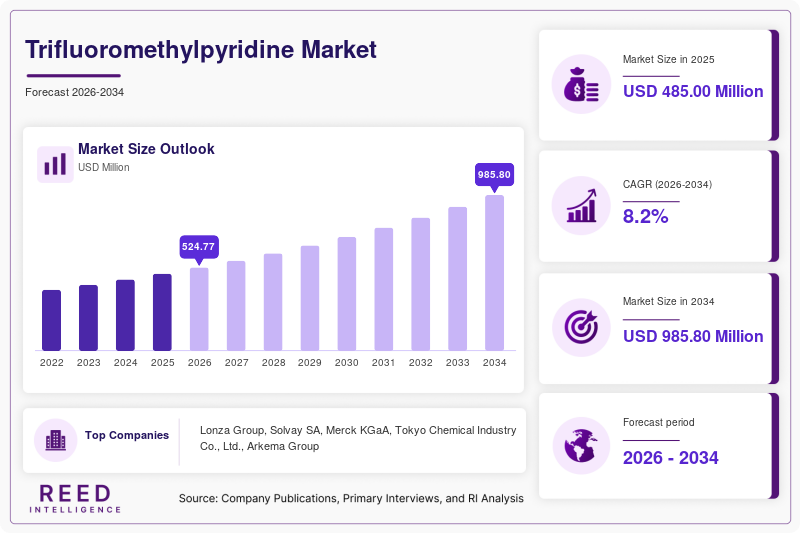
Key Highlights:
- Asia Pacific dominated the market with a 38.5% share in 2025, while North America is expected to register the fastest growth at a CAGR of 8.9%.
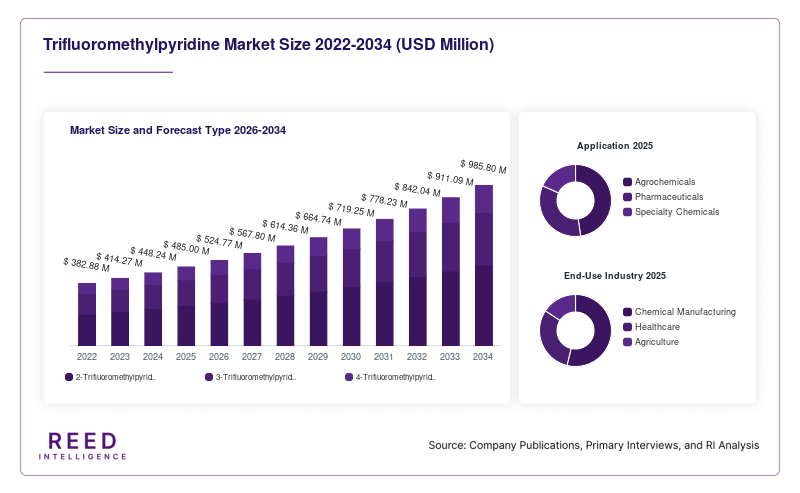
- By application, agrochemicals accounted for 42.3% share in 2025, whereas pharmaceuticals are projected to grow fastest at a CAGR of 9.1%.
- By type, 2-Trifluoromethylpyridine led with 36.7% share, while 3-Trifluoromethylpyridine is expected to grow at 8.7% CAGR.
- The United States remained the dominant country, with market values of USD 112 million in 2024 and USD 119 million in 2025.
Market Trends
Increasing Adoption in Pharmaceutical Intermediates
The Trifluoromethylpyridine Market is witnessing a shift toward pharmaceutical applications due to the compound’s role in improving drug bioavailability and metabolic stability. Drug manufacturers are increasingly incorporating fluorinated pyridine derivatives in active pharmaceutical ingredients (APIs) to enhance therapeutic performance. This trend is particularly evident in oncology and antiviral drug development, where chemical stability and absorption efficiency are critical. As pharmaceutical pipelines expand globally, the demand for high-purity trifluoromethylpyridine intermediates is rising steadily.
Expansion of Fluorinated Agrochemical Formulations
Another notable trend shaping the Trifluoromethylpyridine Market is the growing use of fluorinated compounds in next-generation agrochemicals. These compounds offer improved resistance to environmental degradation and increased effectiveness against pests. Agrochemical companies are focusing on developing innovative pesticide formulations with longer field persistence, which has accelerated the adoption of trifluoromethylpyridine derivatives. This trend is particularly strong in regions with intensive farming practices, where crop yield optimization is a priority.
Additionally, advancements in synthesis technologies are enabling cost-effective production, making these compounds more accessible across industries. The integration of sustainable chemistry practices is also influencing product innovation within the market.
Market Drivers
Growing Demand for High-Performance Agrochemicals
The increasing need for enhanced agricultural productivity is a primary driver of the Trifluoromethylpyridine Market. Farmers and agricultural producers are adopting advanced crop protection solutions to address challenges such as pest resistance and climate variability. Trifluoromethylpyridine derivatives are widely used in herbicides and fungicides due to their stability and effectiveness. This demand is particularly strong in developing economies where agricultural output is directly linked to economic growth.
Rising Investment in Pharmaceutical Research and Development
The expansion of pharmaceutical R&D activities globally is another major growth driver. Trifluoromethylpyridine compounds play a critical role in the synthesis of complex drug molecules. With increasing investments in drug discovery and development, especially in chronic disease treatment, the demand for specialized chemical intermediates has surged. Pharmaceutical companies are focusing on developing more effective and targeted therapies, which has driven the adoption of fluorinated compounds.
Furthermore, collaborations between chemical manufacturers and pharmaceutical firms are enhancing supply chain efficiency, ensuring consistent availability of high-quality intermediates.
Market Restraint
High Production Costs and Complex Synthesis Processes
One of the primary challenges facing the Trifluoromethylpyridine Market is the high cost associated with production and synthesis. The manufacturing process involves advanced fluorination techniques that require specialized equipment and stringent safety protocols. These factors contribute to increased operational costs, which can limit market growth, particularly among small and medium-scale manufacturers.
Additionally, the availability of raw materials and the complexity of chemical reactions involved in producing trifluoromethylpyridine derivatives pose challenges for large-scale production. Regulatory requirements related to chemical handling and environmental safety further increase compliance costs.
The combination of these factors can impact pricing strategies and limit market penetration in cost-sensitive regions. As a result, companies are investing in process optimization and technological innovation to reduce production costs and improve efficiency.
Market Opportunities
Emerging Applications in Specialty Chemicals
The growing use of trifluoromethylpyridine in specialty chemical applications presents significant opportunities for market expansion. Industries such as electronics, coatings, and materials science are increasingly utilizing fluorinated compounds for their unique properties. These include enhanced thermal stability, chemical resistance, and improved performance characteristics.
As demand for advanced materials continues to rise, manufacturers are exploring new applications for trifluoromethylpyridine derivatives. This diversification is expected to create new revenue streams and reduce dependency on traditional sectors such as agrochemicals and pharmaceuticals.
Expansion in Emerging Markets
Rapid industrialization and economic growth in emerging markets offer substantial opportunities for the Trifluoromethylpyridine Market. Countries in Asia Pacific, Latin America, and the Middle East are investing heavily in agriculture, healthcare, and chemical manufacturing. This has increased the demand for high-quality chemical intermediates.
Government initiatives supporting domestic production and technological advancements are further driving market growth in these regions. Companies that establish a strong presence in emerging markets are likely to benefit from increased demand and favorable regulatory environments.
Segmental Analysis
By Type
The 2-Trifluoromethylpyridine segment dominated the market with a 36.7% share in 2025, owing to its widespread use in agrochemical synthesis. Its chemical stability and effectiveness in pesticide formulations have made it the preferred choice among manufacturers.
The 3-Trifluoromethylpyridine segment is expected to grow at a CAGR of 8.7%, driven by its increasing application in pharmaceutical intermediates. Its unique molecular structure enhances drug performance, making it highly valuable in drug development.
By Application
The agrochemicals segment held the largest share of 42.3% in 2025, supported by the growing demand for efficient crop protection solutions. Trifluoromethylpyridine derivatives are widely used in herbicides and fungicides due to their durability and effectiveness.
The pharmaceuticals segment is projected to grow at a CAGR of 9.1%, driven by increasing drug development activities. The demand for high-purity intermediates is expected to rise as pharmaceutical companies focus on innovation.
By End-Use Industry
The chemical manufacturing sector dominated the market with a 48.5% share in 2025, owing to the extensive use of trifluoromethylpyridine in various chemical processes.
The healthcare industry is anticipated to grow at a CAGR of 8.8%, supported by rising investments in pharmaceutical research and development.
By Purity Level
The high-purity segment (≥98%) accounted for 54.2% of the market share in 2025, driven by its use in pharmaceutical applications where quality standards are critical.
The ultra-high purity segment (≥99.5%) is expected to grow at a CAGR of 9.0%, fueled by increasing demand for precision in drug synthesis.
Regional Analysis
North America
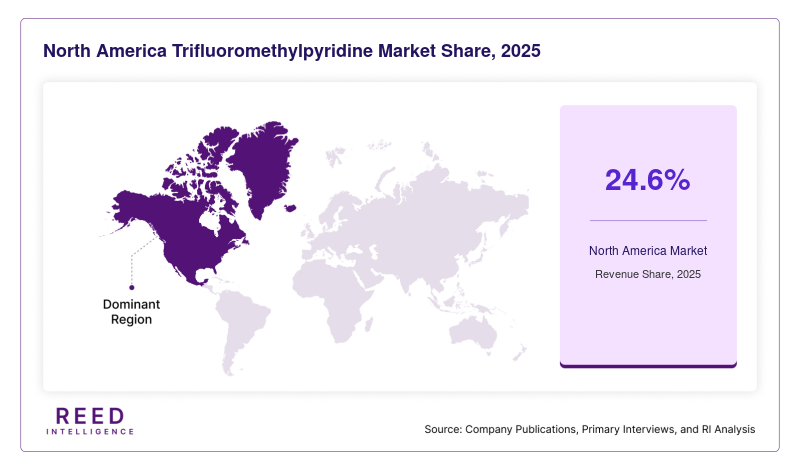
North America accounted for 24.6% of the Trifluoromethylpyridine Market share in 2025 and is projected to grow at a CAGR of 8.9% during the forecast period. The region’s growth is supported by advanced chemical manufacturing infrastructure and strong demand from the pharmaceutical sector.
The United States dominated the regional market due to its robust pharmaceutical industry and high R&D expenditure. The presence of major drug manufacturers and increasing focus on innovative therapies have driven the demand for trifluoromethylpyridine intermediates.
Europe
Europe held a 21.3% market share in 2025 and is expected to grow at a CAGR of 7.8% from 2026 to 2034. The region’s growth is driven by stringent environmental regulations and the adoption of sustainable chemical processes.
Germany emerged as the leading country in Europe, supported by its strong chemical industry and focus on specialty chemicals. The country’s emphasis on innovation and high-quality production has contributed to steady market growth.
Asia Pacific
Asia Pacific dominated the Trifluoromethylpyridine Market with a 38.5% share in 2025 and is projected to grow at a CAGR of 8.5%. The region’s growth is driven by expanding agrochemical and pharmaceutical industries.
China led the market due to its large-scale chemical production capabilities and strong demand for agrochemicals. The country’s growing population and agricultural needs have fueled the adoption of advanced crop protection solutions.
Middle East & Africa
The Middle East & Africa accounted for 8.1% of the market share in 2025 and is expected to grow at a CAGR of 7.2%. Growth in this region is supported by increasing investments in agriculture and chemical manufacturing.
Saudi Arabia dominated the regional market due to its focus on diversifying the economy and investing in industrial development. The country’s strategic initiatives have boosted demand for specialty chemicals.
Latin America
Latin America held a 7.5% share in 2025 and is projected to grow at a CAGR of 7.6%. The region’s growth is driven by expanding agricultural activities and increasing demand for crop protection chemicals.
Brazil emerged as the leading country due to its large agricultural sector and growing adoption of advanced farming techniques. The demand for high-performance agrochemicals has significantly contributed to market growth.
Competitive Landscape
The Trifluoromethylpyridine Market is moderately consolidated, with key players focusing on product innovation and capacity expansion. Leading companies are investing in advanced manufacturing technologies to improve efficiency and reduce costs.
A major market leader, Lonza Group, has strengthened its position through continuous investment in specialty chemical production and strategic collaborations with pharmaceutical companies. The company’s focus on high-purity intermediates has enabled it to maintain a competitive edge.
Other players are expanding their global presence through partnerships and acquisitions, aiming to capture emerging market opportunities. The competitive environment is characterized by technological advancements and a strong emphasis on research and development.
Key Players List
- Lonza Group
- Solvay SA
- Merck KGaA
- Tokyo Chemical Industry Co., Ltd.
- Arkema Group
- Daikin Industries Ltd.
- Shanghai Huayi Group
- Zhejiang Juhua Co., Ltd.
- Halocarbon Products Corporation
- Central Glass Co., Ltd.
- Navin Fluorine International Ltd.
- Gujarat Fluorochemicals Ltd.
- SRF Limited
- AGC Inc.
- Shandong Dongyue Chemical Co., Ltd.
Recent Developments
- In 2025, several manufacturers expanded production capacities to meet rising demand from the pharmaceutical sector.
- A leading chemical company introduced a new high-purity trifluoromethylpyridine product line for advanced drug synthesis.
- Strategic collaborations between chemical producers and agrochemical firms increased to enhance product innovation.
- Investments in sustainable fluorination technologies gained momentum to reduce environmental impact.
- Emerging market players entered the industry with cost-effective production techniques, intensifying competition.
Trifluoromethylpyridine Market Segments
Type
- 2-Trifluoromethylpyridine
- 3-Trifluoromethylpyridine
- 4-Trifluoromethylpyridine
Application
- Agrochemicals
- Pharmaceuticals
- Specialty Chemicals
End-Use Industry
- Chemical Manufacturing
- Healthcare
- Agriculture
Purity Level
- ≥98%
- ≥99%
- ≥99.5%
By Region
- North America
- Europe
- APAC
- Middle East and Africa
- LATAM