Trim Tab Market Size, Share & Demand Report By Type (Hydraulic Trim Tabs, Electric Trim Tabs), By Application (Marine Vessels, Recreational Boating), By End-Use (Commercial, Defense) By Region & Segment Forecasts, 2026–2034
USD 3950
Market Overview
The global Trim Tab Market size was valued at approximately USD 920 million in 2026 and is projected to reach around USD 1.65 billion by 2034, expanding at a CAGR of 7.5% during the forecast period (2026–2034). Trim tabs, widely used in marine vessels and aircraft for stability, control, and fuel efficiency optimization, are gaining consistent traction across commercial, recreational, and defense sectors. The market reflects steady growth driven by increasing maritime trade volumes, expansion of recreational boating activities, and technological improvements in control systems.
A key global factor supporting market growth is the rise in international seaborne trade, which has led to a higher demand for efficient vessel performance systems. Trim tabs help reduce drag, improve fuel economy, and stabilize vessels in rough water conditions. As ship operators focus on operational cost optimization and fuel efficiency, adoption of advanced trim tab systems continues to grow. Additionally, increasing investments in naval modernization programs and lightweight aircraft components are also contributing to the demand for precision control surfaces.
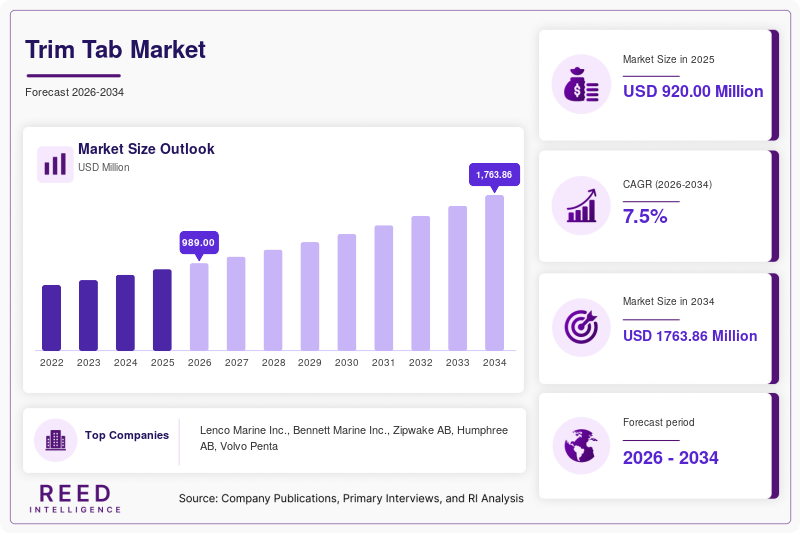
Key Highlights
- North America dominated the market with a 35.1% share in 2025.
- Asia Pacific is expected to grow at the fastest CAGR of 9.1% during 2026–2034.
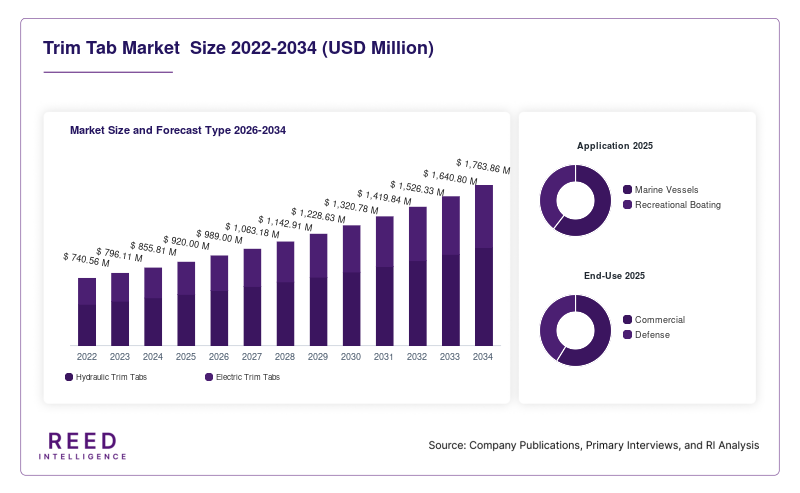
- By type, hydraulic trim tabs accounted for the largest share of 44.3%, while electric trim tabs are projected to grow at a CAGR of 8.8%.
- By application, marine vessels led with a 62.7% share, whereas recreational boating is expected to expand at a CAGR of 9.4%.
- The United States remained the dominant country, with market values of USD 310 million in 2024 and USD 335 million in 2025.
Market Trends
Increasing integration of smart and automated trim tab systems
The trim tab industry is experiencing a transition toward intelligent and automated systems that improve vessel performance without manual intervention. Modern trim tab systems are increasingly equipped with sensors, control units, and software algorithms that automatically adjust tab positions based on vessel speed, load distribution, and water conditions. This reduces the need for operator input and enhances fuel efficiency and safety. The integration of Internet of Things (IoT) technologies further enables real-time monitoring and predictive maintenance, helping operators minimize downtime and maintenance costs. Manufacturers are also developing user-friendly interfaces, including touchscreen panels and mobile app connectivity, to enhance usability. This trend is particularly strong in high-end recreational boats and commercial vessels, where performance optimization is critical. As digitalization expands across the marine sector, smart trim tab systems are expected to gain broader adoption.
Growing demand for lightweight and corrosion-resistant materials
Another notable trend in the Trim Tab Market is the increasing use of advanced materials such as composites, stainless steel alloys, and high-grade polymers. Traditional metal-based trim tabs are gradually being replaced or enhanced with lightweight materials that improve durability and resistance to harsh marine environments. These materials reduce overall vessel weight, which contributes to improved fuel efficiency and reduced emissions. Additionally, corrosion resistance is a major factor, especially in saltwater applications where equipment degradation can lead to high maintenance costs. Manufacturers are investing in research and development to create materials that offer long-term performance with minimal upkeep. The trend is also aligned with sustainability goals, as lightweight materials contribute to lower fuel consumption and reduced environmental impact. This shift is expected to continue as vessel owners prioritize durability and efficiency.
Market Drivers
Expansion of recreational boating and marine tourism
The growth of recreational boating and marine tourism is a major driver for the Trim Tab Market. Increasing disposable income and rising interest in leisure activities have led to a surge in demand for personal watercraft, yachts, and small boats. Trim tabs play a crucial role in enhancing the comfort and stability of these vessels, making them essential components in modern recreational boating. Boaters prefer smoother rides and better fuel efficiency, both of which are supported by trim tab systems. Coastal tourism development and marina infrastructure expansion in regions such as North America, Europe, and Asia Pacific are further boosting the demand. Manufacturers are also offering customized solutions for different boat sizes and types, catering to a wider customer base. As recreational boating continues to grow, the demand for advanced trim tab systems is expected to increase steadily.
Rising focus on fuel efficiency and emission reduction
Fuel efficiency has become a critical concern across marine and aviation industries, driving the adoption of trim tab systems. Trim tabs help optimize vessel trim angles, reducing drag and improving fuel consumption. This is particularly important for commercial shipping operators who aim to minimize operational costs and comply with environmental regulations. Governments and international organizations are implementing stricter emission standards, encouraging the use of technologies that enhance energy efficiency. Trim tabs contribute to lower fuel usage, thereby reducing greenhouse gas emissions. Additionally, advancements in electric and hybrid propulsion systems are creating opportunities for integrated trim tab solutions that further enhance efficiency. As sustainability becomes a priority, the demand for trim tab systems that support eco-friendly operations is expected to rise significantly.
Market Restraint
High installation and maintenance costs limiting adoption
One of the key challenges in the Trim Tab Market is the relatively high cost associated with installation and maintenance. Advanced trim tab systems, particularly those with automated and sensor-based features, require significant upfront investment. Small boat owners and operators with limited budgets may find it difficult to justify these costs, especially in price-sensitive markets. Additionally, maintenance requirements such as hydraulic fluid replacement, actuator servicing, and corrosion protection can add to the overall lifecycle cost. In regions with limited technical expertise, servicing these systems can also be challenging, leading to potential downtime. For example, smaller fishing fleets in developing economies often rely on manual or basic systems due to cost constraints. This limits the penetration of advanced trim tab technologies in certain segments. Addressing cost concerns through affordable solutions and simplified designs will be crucial for broader market adoption.
Market Opportunities
Increasing adoption in emerging maritime economies
Emerging economies present significant growth opportunities for the Trim Tab Market, driven by expanding maritime infrastructure and increasing trade activities. Countries in Asia Pacific, Latin America, and Africa are investing heavily in port development, shipbuilding, and logistics networks. This creates a strong demand for efficient vessel components, including trim tabs. As these regions modernize their fleets, there is a growing need for technologies that enhance performance and reduce operational costs. Local manufacturers are also entering the market, offering cost-effective solutions tailored to regional needs. Government initiatives supporting marine industry development further boost adoption. The increasing focus on improving vessel efficiency and safety standards in these regions is expected to drive the demand for trim tab systems over the coming years.
Technological advancements in electric and hybrid systems
The shift toward electric and hybrid propulsion systems in marine and aviation sectors is opening new avenues for trim tab manufacturers. Electric trim tabs, which eliminate the need for hydraulic systems, offer advantages such as lower maintenance, reduced weight, and improved energy efficiency. These systems are particularly suitable for smaller vessels and environmentally conscious operators. Integration with digital control systems and onboard electronics enhances performance and ease of use. Manufacturers are investing in research and development to create innovative solutions that align with the evolving needs of the industry. The growing adoption of electric boats and sustainable marine technologies is expected to drive the demand for advanced trim tab systems, creating long-term growth opportunities for market players.
Segmental Analysis
By Type
Hydraulic trim tabs dominated the market in 2024, accounting for a share of 44.3%. These systems are widely used in commercial and large vessels due to their high power and reliability. Hydraulic systems provide precise control and are capable of handling heavy loads, making them suitable for demanding applications. Their ability to operate effectively in harsh marine environments further supports their dominance. Additionally, the availability of advanced hydraulic systems with improved efficiency and reduced maintenance requirements has strengthened their position in the market.
Electric trim tabs are the fastest-growing subsegment, expected to expand at a CAGR of 8.8% during the forecast period. The growth is driven by their ease of installation, lower maintenance requirements, and compatibility with modern electronic systems. Electric trim tabs are particularly popular in small to medium-sized vessels, where simplicity and efficiency are key considerations. The increasing adoption of electric propulsion systems further supports their growth, as they integrate seamlessly with onboard electronics.
By Application
Marine vessels accounted for the largest share of 62.7% in 2024, driven by the widespread use of trim tabs in commercial shipping, naval vessels, and fishing boats. These systems play a critical role in improving vessel stability, reducing fuel consumption, and enhancing overall performance. The growing demand for efficient marine operations and the expansion of global trade contribute to the dominance of this segment.
Recreational boating is the fastest-growing application segment, with a projected CAGR of 9.4%. The increasing popularity of leisure activities and rising disposable income are key factors driving growth. Trim tabs enhance the comfort and safety of recreational boats, making them an essential feature. Manufacturers are also focusing on developing user-friendly systems tailored to the needs of recreational boaters.
By End-Use
Commercial end-use dominated the market in 2024, accounting for a significant share. This segment includes shipping companies, fishing fleets, and offshore operators that rely on trim tabs for efficient operations. The need to reduce fuel costs and comply with environmental regulations drives the adoption of trim tab systems in this segment. Additionally, advancements in technology have improved the performance and reliability of these systems, further supporting their use in commercial applications.
The defense segment is expected to grow at the fastest CAGR during the forecast period. The increasing focus on naval modernization and the need for advanced vessel control systems drive growth in this segment. Trim tabs are essential for maintaining stability and performance in naval vessels, particularly in challenging conditions. Governments are investing in advanced technologies to enhance the capabilities of their naval fleets, creating opportunities for trim tab manufacturers.
Regional Analysis
North America
North America held a dominant share of 35.1% in the Trim Tab Market in 2025 and is expected to grow at a CAGR of 6.8% during the forecast period. The region benefits from a well-established marine industry, high recreational boating activity, and strong demand for advanced vessel components. The presence of leading manufacturers and technological innovation further supports market growth.
The United States is the leading country in this region, driven by its extensive coastline and strong boating culture. A unique growth factor is the increasing adoption of smart marine technologies, including automated trim tab systems, which enhance performance and user convenience.
Europe
Europe accounted for a significant market share of 27.4% in 2025 and is projected to grow at a CAGR of 7.1%. The region’s growth is supported by a strong shipbuilding industry, increasing focus on sustainability, and stringent environmental regulations that encourage fuel-efficient technologies.
Germany leads the European market, supported by its advanced engineering capabilities and focus on innovation. A unique growth factor is the region’s emphasis on eco-friendly marine solutions, driving the adoption of energy-efficient trim tab systems.
Asia Pacific
Asia Pacific is expected to register the fastest CAGR of 9.1% during the forecast period, with a market share of 21.8% in 2025. Rapid industrialization, growing maritime trade, and expanding shipbuilding activities are key contributors to market growth.
China dominates the region due to its large shipbuilding industry and increasing investments in maritime infrastructure. A unique growth factor is the government’s support for marine industry development, which boosts demand for advanced vessel components.
Middle East & Africa
The Middle East & Africa region held a market share of 8.6% in 2025 and is expected to grow at a CAGR of 6.5%. The market is driven by increasing offshore activities, oil and gas exploration, and maritime trade expansion.
The United Arab Emirates is a key country in this region, benefiting from its strategic location and growing marine tourism sector. A unique growth factor is the development of luxury marine infrastructure, which increases demand for high-performance trim tab systems.
Latin America
Latin America accounted for a market share of 7.1% in 2025 and is projected to grow at a CAGR of 6.9%. The region’s growth is supported by increasing fishing activities, coastal tourism, and investments in marine infrastructure.
Brazil leads the market in this region, driven by its extensive coastline and growing maritime industry. A unique growth factor is the expansion of recreational boating, which boosts demand for trim tab systems.

Competitive Landscape
The Trim Tab Market is moderately competitive, with several established players focusing on innovation and product development. The market is characterized by strategic partnerships, mergers, and acquisitions aimed at expanding product portfolios and geographic presence. Companies are investing in research and development to introduce advanced systems with improved efficiency and durability.
Lenco Marine is considered a leading player in the market, known for its innovative electric trim tab systems. The company recently introduced a new generation of smart trim tabs with integrated sensors and automated controls, enhancing performance and user experience. Other key players are also focusing on expanding their product offerings and strengthening their distribution networks to gain a competitive edge.
Key Players
- Lenco Marine Inc.
- Bennett Marine Inc.
- Zipwake AB
- Humphree AB
- Volvo Penta
- Mercury Marine
- Yamaha Motor Co., Ltd.
- Suzuki Marine
- Seakeeper Inc.
- Garmin Ltd.
- Navico Group
- Lectrotab
- QL Marine Systems
- Bennett Trim Tabs Europe
- Marine Tech Products
Recent Developments
- Lenco Marine launched an advanced electric trim tab system with automated leveling technology in 2025.
- Zipwake introduced a new interceptor-based trim control solution aimed at high-speed vessels.
- Volvo Penta expanded its marine control systems portfolio with integrated trim tab solutions for improved vessel performance.
Trim Tab Market Segments
Type
- Hydraulic Trim Tabs
- Electric Trim Tabs
Application
- Marine Vessels
- Recreational Boating
End-Use
- Commercial
- Defense
By Region
- North America
- Europe
- APAC
- Middle East and Africa
- LATAM