Trimethylamine Market Size, Share & Demand Report By Application (Choline Chloride Production, Pharmaceutical Intermediates, Ion Exchange Resins, Water Treatment Chemicals, Agricultural Chemicals, Others), By End-Use Industry (Animal Feed, Pharmaceuticals, Chemicals and Petrochemicals, Water Treatment, Electronics, Others), By Grade (Industrial Grade, Pharmaceutical Grade, Electronic Grade), By Region & Segment Forecasts, 2026–2034
USD 3950
Market Overview
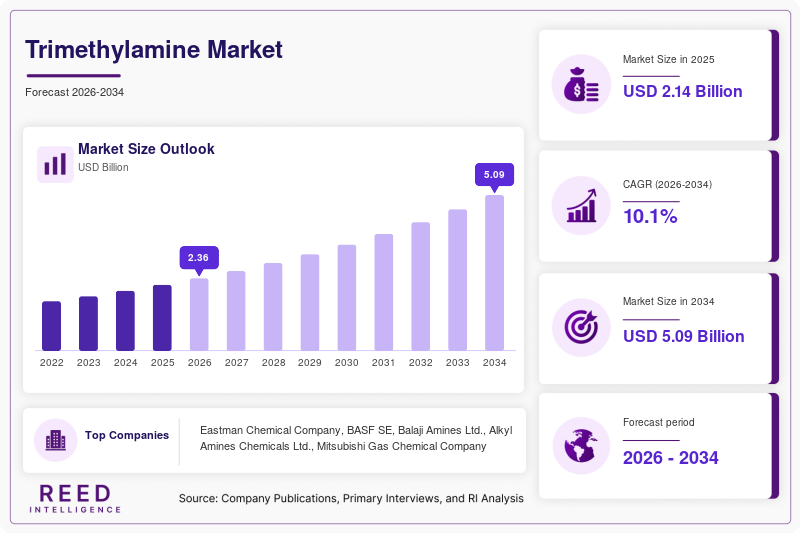
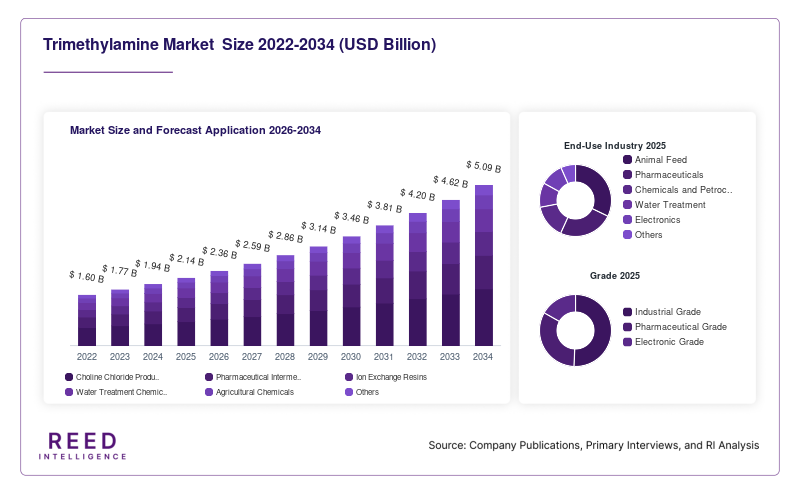
The global Trimethylamine Market size was valued at USD 2.14 billion in 2026 and is projected to reach USD 4.63 billion by 2034, expanding at a CAGR of 10.1% during the forecast period from 2026 to 2034. Trimethylamine is widely used in the production of choline chloride, ion exchange resins, pharmaceuticals, agrochemicals, and water treatment chemicals. The growing demand for animal feed additives, chemical intermediates, and industrial solvents has supported the consistent expansion of the market across both developed and emerging economies. Increasing industrialization in Asia Pacific and rising investments in specialty chemical manufacturing facilities are also contributing to market growth.
One of the primary global factors supporting the expansion of the Trimethylamine Market is the rising demand for animal nutrition products. Trimethylamine serves as a key raw material in the production of choline chloride, which is extensively used in poultry and livestock feed formulations. Growing meat consumption, rising awareness regarding animal health, and the need to improve feed efficiency have increased the use of choline-based additives across large-scale farming operations. In addition, the expansion of pharmaceutical manufacturing and water treatment infrastructure has increased the consumption of trimethylamine-based intermediates in several industrial applications.
Key Highlights
- North America dominated the market with a 35.1% share in 2025.
- Asia Pacific is expected to grow at the fastest CAGR of 11.4% during 2026–2034. By application, choline chloride production accounted for the largest share of 42.6%, while pharmaceutical intermediates are projected to grow at a CAGR of 11.9%.
- By end-use industry, animal feed led with a 39.4% share, whereas water treatment chemicals are expected to expand at a CAGR of 11.2%.
- The United States remained the dominant country, with market values of USD 470 million in 2024 and USD 515 million in 2025.
Market Trends
Expansion of Bio-Based Chemical Manufacturing
The Trimethylamine Market is experiencing increasing integration with bio-based and sustainable chemical manufacturing processes. Chemical producers are focusing on lowering carbon emissions and improving production efficiency by introducing renewable feedstocks and cleaner synthesis technologies. The shift toward sustainable industrial chemistry is encouraging the adoption of trimethylamine in formulations that support environmentally responsible manufacturing. Several companies are upgrading processing units to reduce waste generation and improve energy utilization during trimethylamine production. This transition is particularly visible in Europe and North America, where industrial regulations related to chemical emissions and environmental safety are becoming more stringent. The growing use of trimethylamine in green chemical formulations, agricultural additives, and water treatment compounds is expected to support long-term market growth.
Rising Integration in Pharmaceutical and Specialty Chemical Applications
The use of trimethylamine in pharmaceutical and specialty chemical manufacturing is increasing steadily due to the growing demand for advanced chemical intermediates. Pharmaceutical companies are utilizing trimethylamine in the synthesis of active pharmaceutical ingredients and specialty compounds used in cardiovascular, neurological, and respiratory treatments. The expansion of global pharmaceutical manufacturing hubs in Asia Pacific and Europe is strengthening the demand for high-purity trimethylamine products. Specialty chemical manufacturers are also increasing consumption for resin production, catalyst systems, and surfactant formulations. Rising investments in research and development activities are contributing to product innovation and improved purity standards. This trend is expected to create new growth avenues for manufacturers supplying industrial-grade and pharmaceutical-grade trimethylamine products.
Market Drivers
Increasing Demand for Animal Feed Additives
The rising demand for animal feed additives remains one of the strongest growth drivers for the Trimethylamine Market. Trimethylamine is extensively used in the production of choline chloride, which plays a critical role in poultry and livestock nutrition. Increasing global consumption of meat and dairy products has encouraged livestock producers to improve feed quality and nutritional efficiency. Choline chloride supports animal metabolism, growth performance, and reproductive health, leading to wider adoption across commercial farming operations. Rapid urbanization and changing dietary preferences in emerging economies are further increasing the demand for high-protein food products. As a result, feed manufacturers are expanding production capacity, which directly supports the growth of trimethylamine consumption in the agricultural sector.
Growth of Water Treatment and Industrial Chemical Applications
The expansion of water treatment infrastructure and industrial chemical manufacturing is driving the demand for trimethylamine-based compounds. Trimethylamine is used in ion exchange resins, disinfectants, corrosion inhibitors, and various treatment chemicals designed for industrial and municipal water systems. Increasing industrialization and stricter wastewater management regulations are encouraging industries to adopt advanced chemical treatment processes. Governments in several countries are investing heavily in clean water projects, which is supporting the demand for specialty chemicals derived from trimethylamine. In addition, rapid development in textile processing, electronics manufacturing, and oil refining operations is increasing the use of trimethylamine in industrial applications. This broadening application scope is creating stable long-term growth opportunities for chemical manufacturers.
Market Restraint
Safety Concerns and Stringent Handling Regulations
The Trimethylamine Market faces challenges related to safety concerns and strict handling regulations associated with chemical storage and transportation. Trimethylamine is highly flammable and has a strong odor, which requires specialized storage systems and controlled production environments. Regulatory authorities across North America and Europe have implemented strict environmental and occupational safety standards governing chemical manufacturing facilities. Compliance with these regulations often increases operational costs for manufacturers due to the need for advanced containment systems, worker safety measures, and emission control technologies. Small and medium-scale producers may face difficulties in maintaining profitability while meeting regulatory requirements. In addition, transportation restrictions for hazardous chemicals can disrupt supply chain efficiency and increase logistics expenses. For example, chemical manufacturers operating near urban industrial zones often face additional environmental inspections and storage limitations, which may slow capacity expansion projects and limit market growth potential in highly regulated regions.
Market Opportunities
Expansion of Pharmaceutical Manufacturing in Emerging Economies
The expansion of pharmaceutical manufacturing activities in emerging economies presents strong growth opportunities for the Trimethylamine Market. Countries such as India, China, Brazil, and Indonesia are increasing investments in pharmaceutical production facilities to support domestic healthcare demand and export activities. Trimethylamine is widely used in the synthesis of pharmaceutical intermediates and specialty compounds required for drug manufacturing. Government incentives supporting pharmaceutical exports and research activities are encouraging chemical suppliers to expand production capacity in these regions. The increasing focus on generic drug manufacturing and active pharmaceutical ingredient production is expected to strengthen the consumption of high-purity trimethylamine products. As pharmaceutical companies continue to diversify supply chains and increase regional manufacturing capabilities, demand for trimethylamine-based intermediates is likely to rise steadily.
Growing Use in Electronic Chemicals and Resin Production
The increasing use of trimethylamine in electronic chemicals and resin manufacturing is creating additional opportunities for market participants. The expansion of semiconductor manufacturing, electronics assembly, and advanced material production is increasing the demand for specialty chemical compounds used in cleaning agents, catalysts, and resin systems. Trimethylamine is also used in the production of ion exchange resins and surfactants that support electronic processing applications. Rising investments in data centers, consumer electronics, and renewable energy infrastructure are strengthening demand for advanced chemical materials globally. Manufacturers are focusing on developing high-purity trimethylamine formulations suitable for sensitive industrial applications. This trend is particularly important in Asia Pacific, where strong electronics manufacturing activity is supporting long-term consumption growth across the specialty chemicals industry.
Segmental Analysis
By Application
Choline chloride production dominated the application segment and accounted for 42.6% of the global market share in 2024. The strong demand for animal feed additives across poultry, swine, and aquaculture industries continues to support the widespread use of trimethylamine in choline chloride manufacturing. Feed manufacturers are increasingly focusing on improving nutritional quality and production efficiency, which has strengthened demand for choline-based formulations. The growth of commercial livestock farming in Asia Pacific and Latin America is also contributing to higher consumption levels. In addition, rising concerns regarding animal health and feed optimization are encouraging agricultural producers to adopt advanced nutritional additives, supporting the long-term expansion of the application segment.
Pharmaceutical intermediates are projected to register the fastest CAGR of 11.9% during the forecast period due to increasing investments in healthcare manufacturing and specialty chemical production. Trimethylamine is widely used in the synthesis of active pharmaceutical ingredients and chemical compounds required for drug development. The expansion of generic drug manufacturing and research activities in emerging economies is creating strong demand for high-purity trimethylamine products. Pharmaceutical companies are also focusing on improving production efficiency and diversifying supply chains to reduce operational risks. Rising healthcare spending, increasing prevalence of chronic diseases, and the growing need for advanced drug formulations are expected to strengthen demand for trimethylamine-based pharmaceutical intermediates globally.
By End-Use Industry
The animal feed industry held the largest share of 39.4% in 2024 due to the extensive use of trimethylamine in choline chloride production. Commercial livestock producers are increasingly adopting feed additives to improve animal growth performance, reproductive health, and nutritional efficiency. Rising global meat consumption and increasing investments in poultry and aquaculture farming are supporting the expansion of the segment. Developing economies are witnessing strong demand for protein-rich food products, which is encouraging feed manufacturers to expand production capacities. In addition, technological advancements in feed formulation and nutritional science are helping manufacturers develop specialized products that improve feed conversion ratios and livestock productivity.
Water treatment chemicals are anticipated to grow at the fastest CAGR of 11.2% during the forecast period owing to increasing industrial wastewater management requirements and investments in municipal treatment infrastructure. Trimethylamine-based compounds are used in ion exchange resins, corrosion inhibitors, and specialty treatment formulations designed to improve water quality and system efficiency. Rapid urbanization and industrial expansion are increasing pressure on existing water resources, encouraging governments and industries to adopt advanced treatment technologies. The growth of manufacturing sectors such as textiles, electronics, and oil refining is also increasing the need for efficient wastewater management solutions. These factors are expected to drive strong demand for trimethylamine-based water treatment chemicals.
By Grade
Industrial grade trimethylamine accounted for the largest share of 58.2% in 2024 due to its broad utilization across chemical processing, water treatment, agriculture, and resin manufacturing applications. Industrial-grade products are widely preferred because of their cost efficiency and suitability for large-scale production environments. Manufacturers operating in sectors such as textiles, petrochemicals, and specialty chemicals continue to increase procurement volumes to support industrial operations. Rising infrastructure development and expansion of manufacturing activities in emerging economies are also contributing to segment growth. In addition, industrial-grade trimethylamine plays an important role in producing surfactants, catalysts, and ion exchange materials used across several industrial applications.
Pharmaceutical grade trimethylamine is expected to expand at the fastest CAGR of 12.1% during the forecast period as pharmaceutical manufacturers continue to increase demand for high-purity chemical intermediates. The rising focus on quality standards, regulatory compliance, and advanced drug manufacturing processes is encouraging the use of pharmaceutical-grade materials in healthcare applications. Expanding investments in biotechnology, specialty drug development, and active pharmaceutical ingredient manufacturing are supporting market growth. Pharmaceutical companies are also increasing research and development activities aimed at improving production efficiency and developing new treatment formulations. The growing demand for precision manufacturing and high-performance intermediates is expected to create strong opportunities for pharmaceutical-grade trimethylamine suppliers.
Regional Analysis
North America
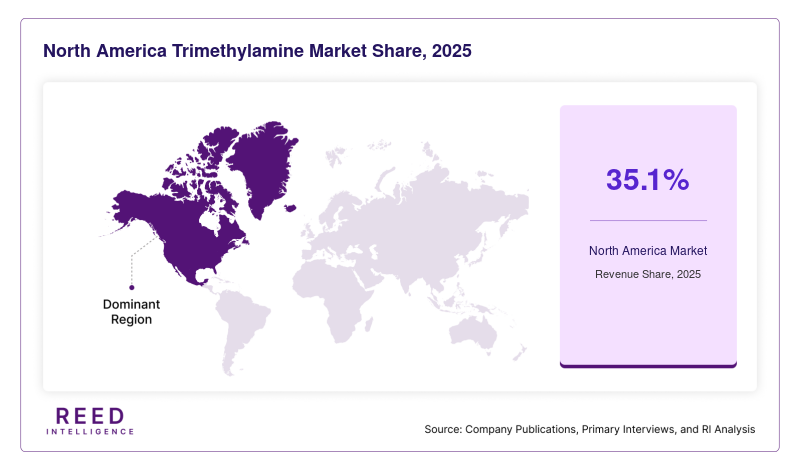
North America accounted for 35.1% of the global Trimethylamine Market share in 2025 and is expected to maintain stable growth during the forecast period at a CAGR of 9.1%. The region benefits from a strong industrial chemical manufacturing base, advanced pharmaceutical production capabilities, and significant demand from the animal feed sector. The presence of large-scale water treatment infrastructure and growing investments in specialty chemical production are contributing to consistent market expansion. In addition, rising demand for high-purity chemical intermediates from healthcare and industrial sectors continues to support regional market development.
The United States remains the dominant country in North America due to its large pharmaceutical industry and advanced chemical processing infrastructure. The country also benefits from strong research and development investments focused on specialty chemicals and industrial process efficiency. Growing demand for livestock nutrition products and increasing adoption of advanced water treatment technologies are supporting trimethylamine consumption across several industries. In addition, the expansion of chemical manufacturing facilities along the Gulf Coast region is improving production capacity and strengthening domestic supply chains.
Europe
Europe represented 24.3% of the global Trimethylamine Market share in 2025 and is projected to expand at a CAGR of 8.7% during the forecast period. The market is supported by strict environmental regulations encouraging efficient chemical processing and sustainable industrial production. Demand for trimethylamine-based compounds remains strong in pharmaceutical manufacturing, water treatment systems, and agricultural chemicals. Several European countries are also investing in advanced specialty chemical production technologies to improve product quality and reduce industrial emissions. The increasing adoption of sustainable manufacturing methods is further contributing to regional market growth.
Germany remains the leading country in the European market due to its strong chemical manufacturing industry and advanced industrial infrastructure. The country has a well-established network of specialty chemical producers supplying pharmaceutical, automotive, and water treatment sectors. Rising investments in green chemistry technologies and industrial automation are supporting the production of high-purity trimethylamine products. In addition, growing export demand for specialty chemicals from Germany is strengthening regional supply chains and encouraging manufacturers to expand production capabilities.
Asia Pacific
Asia Pacific held 28.6% of the global Trimethylamine Market share in 2025 and is expected to register the fastest CAGR of 11.4% during 2026–2034. Rapid industrialization, expanding pharmaceutical manufacturing, and increasing livestock production are key factors driving market growth across the region. Countries such as China, India, Japan, and South Korea are experiencing rising demand for trimethylamine-based products in agriculture, specialty chemicals, and industrial processing applications. The presence of cost-effective manufacturing facilities and growing export activities are also contributing to strong regional expansion.
China remains the dominant country in Asia Pacific due to its extensive chemical manufacturing ecosystem and large-scale industrial production capabilities. The country has emerged as a major supplier of specialty chemicals, pharmaceuticals, and feed additives to global markets. Rising investments in electronic chemicals, water treatment infrastructure, and industrial modernization are supporting trimethylamine demand across multiple sectors. In addition, strong government support for domestic chemical manufacturing and industrial expansion continues to attract investments in production facilities and supply chain development.
Middle East & Africa
The Middle East & Africa accounted for 6.4% of the global Trimethylamine Market share in 2025 and is projected to grow at a CAGR of 8.3% during the forecast period. The region is benefiting from expanding industrial diversification strategies and increasing investments in chemical manufacturing infrastructure. Growing water treatment requirements and rising agricultural activities are supporting the demand for trimethylamine-based products. Several countries are also increasing investments in petrochemical and specialty chemical production to reduce dependence on imports and strengthen industrial development.
Saudi Arabia remains the leading country in the regional market due to its large petrochemical sector and growing investments in downstream chemical industries. The country is focusing on expanding specialty chemical production as part of broader industrial diversification initiatives. Increasing investments in industrial water treatment projects and agricultural modernization programs are contributing to higher trimethylamine consumption. In addition, strategic partnerships between regional chemical companies and international manufacturers are supporting technology transfer and production capacity expansion.
Latin America
Latin America captured 5.6% of the global Trimethylamine Market share in 2025 and is expected to expand at a CAGR of 8.5% over the forecast period. The market is supported by rising agricultural production, expanding pharmaceutical manufacturing, and increasing demand for industrial chemicals. Countries across the region are focusing on improving water treatment systems and industrial infrastructure, which is contributing to the growing use of trimethylamine-based compounds. The expansion of livestock farming and feed production activities is also strengthening regional market demand.
Brazil remains the dominant country in Latin America due to its large agricultural economy and expanding industrial chemical sector. The country has a strong livestock and poultry industry, which supports significant demand for choline chloride and feed additives derived from trimethylamine. Increasing pharmaceutical manufacturing investments and growing industrial modernization efforts are further contributing to market growth. In addition, rising exports of agricultural and specialty chemical products are encouraging manufacturers to improve production capacity and strengthen regional supply networks.
Competitive Landscape
The Trimethylamine Market is moderately consolidated, with several global and regional manufacturers competing through production capacity expansion, product quality improvements, and strategic partnerships. Leading companies are focusing on increasing operational efficiency and strengthening supply chain networks to meet growing demand from pharmaceutical, animal feed, and specialty chemical industries. Market participants are also investing in advanced purification technologies to develop high-purity trimethylamine products suitable for healthcare and electronic chemical applications.
Eastman Chemical Company remains one of the leading participants in the market due to its broad specialty chemical portfolio and strong global distribution network. The company continues to focus on improving production efficiency and expanding specialty chemical applications across industrial sectors. Balaji Amines Ltd., BASF SE, Mitsubishi Gas Chemical Company, and Alkyl Amines Chemicals Ltd. are also actively expanding manufacturing capacities and strengthening regional market presence. In 2025, Balaji Amines Ltd. announced the expansion of its amine production facility in India to support growing pharmaceutical and feed additive demand. Several companies are additionally investing in sustainable manufacturing technologies and emission reduction systems to comply with changing environmental standards and improve operational competitiveness.
Key Players
- Eastman Chemical Company
- BASF SE
- Balaji Amines Ltd.
- Alkyl Amines Chemicals Ltd.
- Mitsubishi Gas Chemical Company
- Koei Chemical Company Ltd.
- Taminco Corporation
- Arkema S.A.
- Chemours Company
- Celanese Corporation
- Shandong Hualu-Hengsheng Chemical Co. Ltd.
- Zhejiang Jianye Chemical Co. Ltd.
- Merck KGaA
- Dow Inc.
- Sinopec Corporation
Recent Developments
- In February 2025, Balaji Amines Ltd. expanded its trimethylamine production capacity in India to address increasing pharmaceutical and feed additive demand across Asia Pacific.
- In July 2025, BASF SE introduced upgraded emission management systems at its specialty amines production facilities to improve operational sustainability and reduce environmental impact.
- In November 2024, Eastman Chemical Company announced a strategic partnership with a regional water treatment solutions provider to develop advanced trimethylamine-based treatment formulations for industrial wastewater applications.
- In March 2025, Alkyl Amines Chemicals Ltd. invested in process optimization technologies designed to improve trimethylamine purity levels for pharmaceutical-grade applications.
Trimethylamine Market Segments
Application
- Choline Chloride Production
- Pharmaceutical Intermediates
- Ion Exchange Resins
- Water Treatment Chemicals
- Agricultural Chemicals
- Others
End-Use Industry
- Animal Feed
- Pharmaceuticals
- Chemicals and Petrochemicals
- Water Treatment
- Electronics
- Others
Grade
- Industrial Grade
- Pharmaceutical Grade
- Electronic Grade
By Region
- North America
- Europe
- APAC
- Middle East and Africa
- LATAM