Tritanopia Treatment Market Size, Share & Demand Report By Treatment Type (Optical Lenses, Contact Lenses, Gene Therapy, Digital Vision Solutions), By Diagnosis Method (Color Vision Testing Kits, Digital Diagnostic Tools, Clinical Examination), By End-Use (Hospitals, Specialty Eye Clinics, Home Care Settings), By Distribution Channel (Online, Offline), By Region & Segment Forecasts, 2025–2034
USD 3950
Market Overview
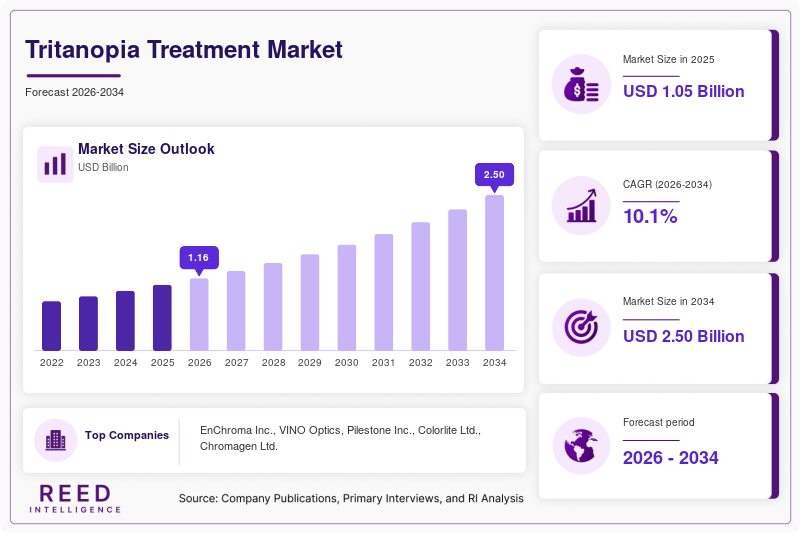
The global Tritanopia Treatment Market size was valued at approximately USD 1.05 billion in 2025 and is projected to reach USD 2.48 billion by 2034, expanding at a CAGR of 10.1% during the forecast period (2025–2034). The market growth is being shaped by increasing awareness of color vision deficiencies, particularly tritanopia (blue-yellow color blindness), alongside advancements in optical technologies, gene therapy research, and digital assistive solutions.
A key global factor supporting market expansion is the rising integration of vision-enhancing technologies into consumer products such as augmented reality (AR) devices and wearable smart glasses. These innovations are enabling improved accessibility for individuals with color perception disorders, thereby widening the potential user base and driving adoption across both healthcare and consumer segments.
Key Highlights
- North America dominated the market with a share of 38.6% in 2025, while Asia Pacific is projected to grow at the fastest CAGR of 12.4%.
- Optical correction lenses emerged as the leading subsegment with a 42.3% share, while gene therapy is expected to grow at the fastest CAGR of 13.8%.
- The United States led the market with values of USD 310 million in 2025 and is estimated to reach USD 340 million in 2026.
Market Trends
Integration of Digital Vision Enhancement Technologies
The Tritanopia Treatment Market is witnessing a notable shift toward digital solutions such as mobile applications and AI-powered visual correction tools. These technologies enhance color differentiation through real-time image processing, allowing users to adjust contrast and color mapping dynamically. This trend is particularly prominent among younger populations who prefer non-invasive and cost-effective alternatives to traditional treatments. The increasing compatibility of such applications with smartphones and wearable devices is further strengthening adoption rates.
Advancements in Gene Therapy Research
Another significant trend shaping the market is the growing focus on gene therapy as a long-term solution for tritanopia. Research institutions and biotechnology firms are investing in targeted gene editing techniques aimed at correcting cone cell deficiencies responsible for blue-yellow color blindness. Although still in early stages, clinical trials are showing promising outcomes, indicating potential commercialization in the coming years. This trend is expected to redefine treatment paradigms by shifting from symptom management to potential cures.
Market Drivers
Increasing Awareness and Diagnosis Rates
The growing awareness of color vision deficiencies has led to higher diagnosis rates globally. Educational campaigns, workplace screenings, and pediatric vision assessments are enabling early detection of tritanopia. As more individuals become aware of their condition, the demand for treatment solutions, including corrective lenses and digital tools, is increasing steadily. This awareness is also encouraging individuals to seek personalized solutions, thereby boosting market growth.
Technological Advancements in Vision Correction Devices
Technological progress in optical engineering has significantly improved the effectiveness of vision correction devices. Modern lenses are designed with advanced spectral filtering technologies that enhance color contrast and perception for tritanopia patients. Additionally, the integration of smart features into wearable devices is creating new avenues for treatment. These innovations are making treatments more accessible, efficient, and user-friendly, contributing to sustained market expansion.
Market Restraint
Limited Accessibility and High Cost of Advanced Treatments
Despite technological advancements, the Tritanopia Treatment Market faces challenges related to the high cost and limited accessibility of advanced treatment options. Gene therapies and specialized optical devices often involve significant investment, making them less accessible in low- and middle-income regions. Additionally, the lack of insurance coverage for certain vision correction solutions further restricts adoption. These cost barriers can delay treatment uptake and limit market penetration, particularly in emerging economies where healthcare infrastructure is still developing.
Market Opportunities
Expansion of Telehealth and Remote Vision Care
The expansion of telehealth services presents a significant opportunity for the Tritanopia Treatment Market. Remote diagnosis and consultation platforms are enabling individuals to access vision care services without geographical constraints. This is particularly beneficial in rural and underserved regions where specialized eye care services are limited. The integration of digital tools into telehealth platforms is expected to enhance treatment accessibility and drive market growth.
Growing Demand for Customized Vision Solutions
There is a rising demand for personalized treatment solutions tailored to individual color vision deficiencies. Customized lenses, AI-driven applications, and adaptive visual technologies are gaining traction among consumers seeking more effective outcomes. This trend is encouraging companies to invest in research and development to create targeted solutions, thereby opening new revenue streams and expanding the market scope.
Segmental Analysis
By Treatment Type
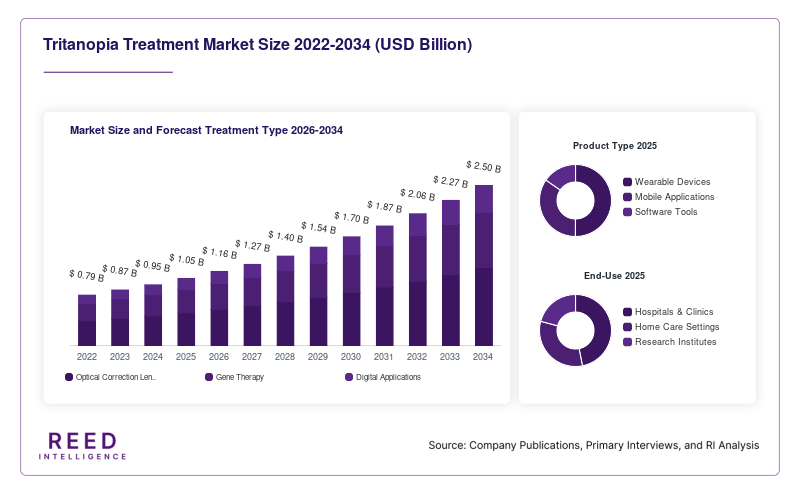
Optical correction lenses dominated the segment with a 42.3% share in 2025, driven by their widespread availability and non-invasive nature. These lenses are designed to enhance color contrast and improve visual perception for individuals with tritanopia.
Gene therapy is expected to be the fastest-growing subsegment, with a projected CAGR of 13.8%. This growth will be driven by ongoing research aimed at addressing the root cause of color vision deficiencies, offering potential long-term solutions.
By Product Type
Wearable devices held the largest share of 39.5% in 2025 due to their convenience and increasing integration with smart technologies. These devices provide real-time visual enhancement and are gaining popularity among consumers.
Mobile applications are projected to grow at the fastest CAGR of 12.9%, driven by their accessibility and cost-effectiveness. The increasing use of smartphones and advancements in AI technology will support this growth.
By End-Use
Hospitals and clinics accounted for 45.7% of the market share in 2025, as they serve as primary centers for diagnosis and treatment. The availability of specialized equipment and trained professionals supports their dominance.
Home care settings are expected to grow at the fastest CAGR of 11.6%, driven by the increasing adoption of remote healthcare solutions and user-friendly treatment devices.
By Distribution Channel
Offline channels dominated with a 61.2% share in 2025, as consumers prefer purchasing vision correction products through physical stores for personalized assistance.
Online channels are projected to grow at the fastest CAGR of 13.2%, supported by the expansion of e-commerce platforms and increasing digital literacy.
Regional Analysis
North America
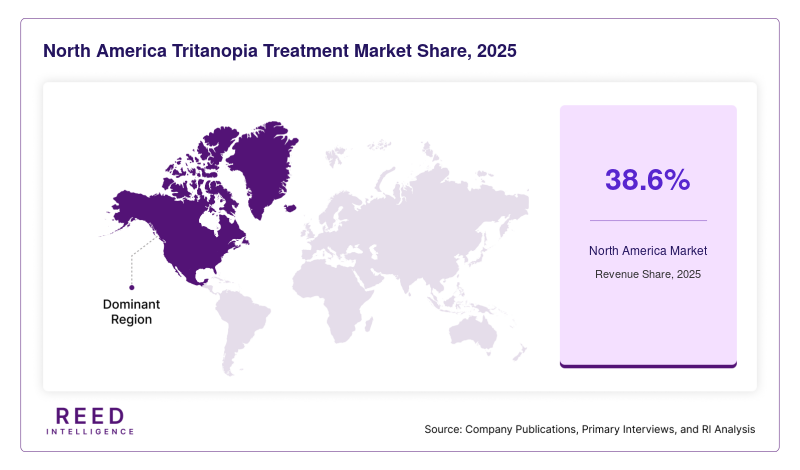
North America accounted for 38.6% of the Tritanopia Treatment Market share in 2025 and is expected to grow at a CAGR of 9.2% during the forecast period. The region’s growth will be supported by advanced healthcare infrastructure and high adoption of innovative vision technologies.
The United States dominated the regional market due to strong investment in research and development. The presence of leading vision care companies and increasing adoption of wearable vision devices are key factors driving growth.
Europe
Europe held a market share of 26.4% in 2025 and is projected to expand at a CAGR of 8.7% through 2034. The region will benefit from supportive healthcare policies and increasing awareness of vision disorders.
Germany emerged as the dominant country, driven by its strong medical technology sector. The country’s focus on precision healthcare and early diagnosis programs is contributing to market expansion.
Asia Pacific
Asia Pacific accounted for 21.8% of the market in 2025 and is expected to grow at the fastest CAGR of 12.4%. Rapid urbanization and increasing healthcare investments will drive growth in this region.
China led the regional market due to its large population base and growing awareness of vision health. Government initiatives to improve healthcare access are further supporting market growth.
Middle East & Africa
The Middle East & Africa region held a 7.2% market share in 2025 and is projected to grow at a CAGR of 8.1%. Increasing healthcare infrastructure development will contribute to market growth.
The UAE dominated the region due to its advanced healthcare facilities and adoption of modern technologies. Investments in specialized eye care services are driving demand.
Latin America
Latin America accounted for 6.0% of the market in 2025 and is expected to grow at a CAGR of 8.5%. Improving healthcare access and rising awareness will support growth.
Brazil emerged as the leading country, supported by expanding healthcare services and increasing focus on vision care. The adoption of affordable treatment solutions is contributing to market development.
Competitive Landscape
The Tritanopia Treatment Market is characterized by moderate competition, with key players focusing on innovation and product development. Companies are investing in advanced optical technologies and exploring gene therapy solutions to strengthen their market position.
A leading player in the market is EnChroma, known for its advanced color-blindness correction lenses. The company recently introduced an upgraded lens technology aimed at improving color differentiation for tritanopia patients, enhancing user experience and expanding its product portfolio.
Other companies are focusing on strategic collaborations and research initiatives to develop innovative solutions. The competitive landscape is expected to evolve further with the entry of new players and advancements in medical technologies.
Key Players List
- EnChroma Inc.
- VINO Optics
- Pilestone Inc.
- Colorlite Ltd.
- Chromagen Ltd.
- Coblis – Color Blindness Simulator
- EyecareLive
- EssilorLuxottica
- Novartis AG
- Johnson & Johnson Vision
- Google LLC (Vision AI tools)
- Microsoft Corporation (Assistive tech)
- Samsung Electronics Co., Ltd.
- Sony Group Corporation
- Toshiba Corporation
Recent Developments
- In 2025, EnChroma launched a new range of enhanced spectral lenses designed specifically for blue-yellow color blindness.
- In 2024, several biotechnology firms initiated clinical trials focused on gene therapy solutions for color vision deficiencies.
- In 2025, major technology companies expanded their accessibility features in mobile devices to include advanced color correction modes.
- In 2026, collaborations between healthcare providers and tech firms increased to develop integrated vision care platforms.
Tritanopia Treatment Market Segments
Treatment Type
- Optical Correction Lenses
- Gene Therapy
- Digital Applications
Product Type
- Wearable Devices
- Mobile Applications
- Software Tools
End-Use
- Hospitals & Clinics
- Home Care Settings
- Research Institutes
Distribution Channel
- Online Retail
- Optical Stores & Specialty Clinics
- Hospitals & Pharmacies
By Region
- North America
- Europe
- APAC
- Middle East and Africa
- LATAM