Trona Market Size, Share & Demand Report By Application (Soda Ash Production, Glass Manufacturing, Detergents, Water Treatment, Chemicals), By Mining Method (Conventional Underground Mining, Solution Mining), By End-Use Industry (Glass Industry, Chemical Industry, Detergent Industry, Water Treatment Industry), By Grade (Industrial Grade, Refined Grade), By Region & Segment Forecasts, 2025–2034
USD 3950
Market Overview
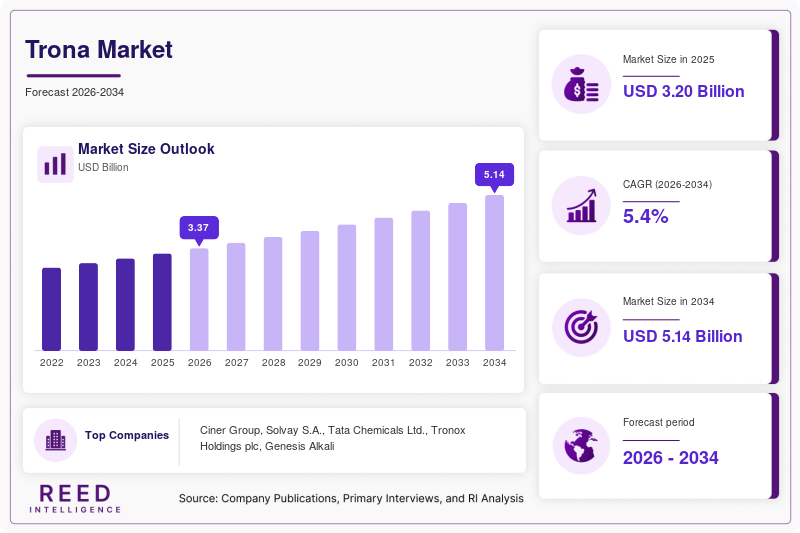
The global Trona Market size was valued at approximately USD 3.2 billion in 2025 and is projected to reach USD 5.1 billion by 2034, expanding at a CAGR of 5.4% during the forecast period (2025–2034). Trona, a naturally occurring sodium sesquicarbonate mineral, serves as a key raw material in the production of soda ash, which is widely used across glass manufacturing, detergents, chemicals, and water treatment industries.
A major global factor supporting market growth is the rising demand for glass in construction, automotive, and renewable energy sectors. Increasing installation of solar panels and growth in urban infrastructure have significantly driven soda ash consumption, thereby boosting the demand for trona extraction and processing worldwide.
Key Highlights
- North America dominated the market with a 42% share in 2025, while Asia Pacific is expected to grow at the fastest CAGR of 6.3% during the forecast period.
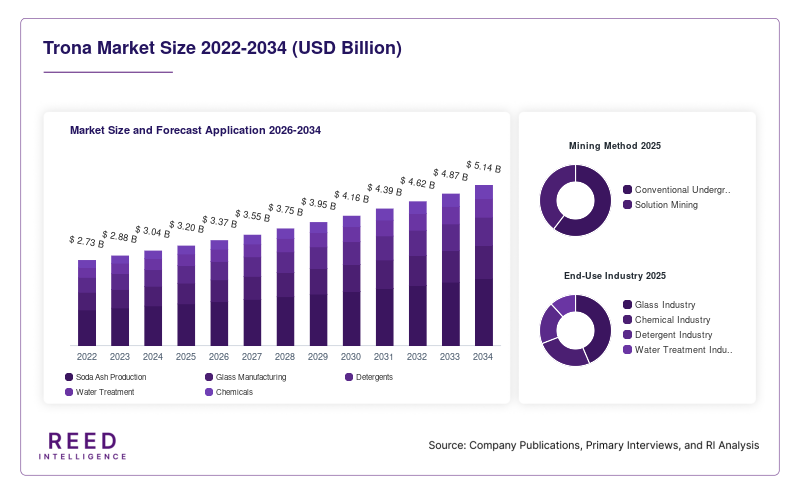
- The soda ash production segment led the application category with a 68% share in 2025, whereas water treatment applications are projected to grow at a CAGR of 6.8%.
- The natural trona mining segment held the largest share among production methods, while solution mining is expected to grow at a CAGR of 5.9%.
- The United States remained the dominant country, with a market value of USD 1.1 billion in 2025 and projected to reach USD 1.2 billion in 2026.
Market Trends
Increasing Adoption of Natural Soda Ash Production
The industry is witnessing a shift toward natural soda ash derived from trona instead of synthetic alternatives. Natural production processes are more energy-efficient and generate fewer carbon emissions compared to synthetic methods such as the Solvay process. This transition aligns with environmental regulations and sustainability goals, especially in developed regions, thereby strengthening demand for trona mining operations.
Expansion of End-Use Industries in Emerging Economies
Rapid industrialization in emerging economies has led to rising demand for glass, detergents, and chemicals. Infrastructure development and urban housing projects have boosted flat glass consumption, while increasing hygiene awareness has driven detergent demand. These trends are directly contributing to the growth of the Trona Market, as soda ash remains a critical input in these industries.
Market Drivers
Rising Demand for Glass Manufacturing
The growing use of glass in construction, automotive, and solar energy applications has significantly driven demand for soda ash. Trona, being a primary source of soda ash, benefits from this demand surge. Increasing investments in green buildings and photovoltaic installations have further strengthened the need for high-quality glass, thereby supporting trona consumption globally.
Cost Efficiency of Natural Trona-Based Soda Ash
Natural trona-based soda ash production is more cost-effective compared to synthetic alternatives due to lower energy requirements and simpler processing methods. This cost advantage encourages manufacturers to prefer trona-derived soda ash, especially in regions with abundant trona reserves. As industries seek to optimize production costs, the demand for trona continues to rise steadily.
Market Restraint
Limited Geographic Availability of Trona Reserves
One of the major challenges in the Trona Market is the limited distribution of economically viable trona deposits. Significant reserves are concentrated in a few regions, particularly in North America. This geographic limitation restricts global supply expansion and creates dependency on specific countries for raw material availability. Additionally, mining operations require substantial capital investment and regulatory approvals, which can delay project development. Environmental concerns related to mining activities also pose challenges, as strict regulations may limit extraction in certain regions. These factors collectively act as barriers to market growth, especially in regions lacking natural deposits.
Market Opportunities
Growth in Water Treatment Applications
The increasing focus on water purification and wastewater management presents significant opportunities for the Trona Market. Soda ash derived from trona is widely used in water softening and pH regulation processes. Rising concerns over water scarcity and pollution are driving investments in water treatment infrastructure, particularly in developing regions, thereby creating new growth avenues.
Expansion of Chemical Manufacturing Sector
The growing chemical industry, particularly in Asia Pacific and the Middle East, offers promising opportunities for trona utilization. Soda ash is a key ingredient in various chemical processes, including sodium-based compounds. As industrial production expands, the demand for trona as a raw material is expected to increase, supporting long-term market growth.
Segmental Analysis
By Application
The soda ash production segment dominated the Trona Market, accounting for 68% of the total share in 2025. This dominance was attributed to the widespread use of soda ash in glass manufacturing, detergents, and chemical processing. The consistent demand from these industries ensured steady consumption of trona.
The water treatment segment is expected to grow at the fastest CAGR of 6.8% during the forecast period. Increasing concerns about water quality and the need for efficient purification systems will drive demand for soda ash in municipal and industrial water treatment applications.
By Mining Method
Conventional underground mining held the largest share in 2025 due to its established infrastructure and efficiency in extracting high-purity trona deposits. This method has been widely adopted in regions with large reserves, ensuring consistent supply.
Solution mining is projected to grow at a CAGR of 5.9% during the forecast period. This method offers advantages such as reduced environmental impact and lower operational costs. The increasing adoption of advanced mining technologies will further support its growth.
By End-Use Industry
The glass manufacturing industry dominated the market with a 45% share in 2025. The extensive use of soda ash in flat glass, container glass, and specialty glass production contributed to this dominance.
The detergent industry is expected to grow at a CAGR of 5.6% during the forecast period. Rising hygiene awareness and increasing demand for cleaning products will drive the consumption of soda ash, thereby supporting trona demand.
By Grade
Industrial grade trona accounted for the largest share in 2025 due to its extensive use in bulk applications such as glass and chemical production. Its cost-effectiveness and availability made it the preferred choice for large-scale industries.
Refined grade trona is anticipated to grow at a CAGR of 5.7%, driven by increasing demand for high-purity soda ash in specialized applications such as pharmaceuticals and food processing.
Regional Analysis
North America
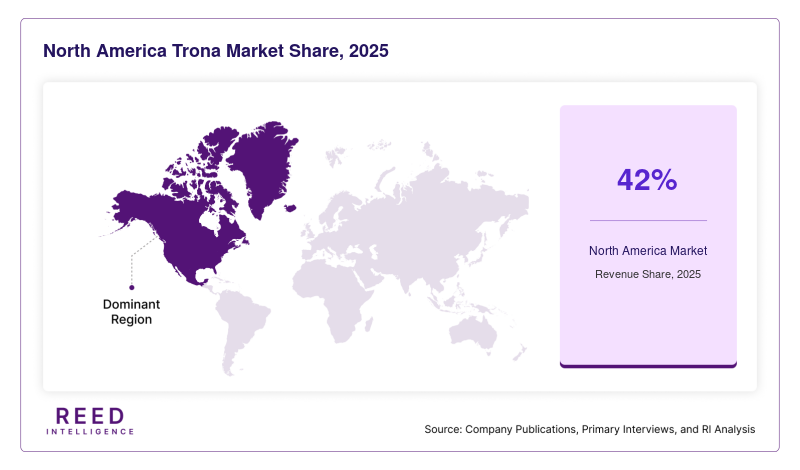
North America accounted for 42% of the global Trona Market share in 2025 and is expected to grow at a CAGR of 4.8% during the forecast period. The region’s dominance was supported by abundant natural trona reserves and well-established mining infrastructure.
The United States led the regional market due to its extensive trona deposits in Wyoming. The presence of large-scale mining operations and advanced processing technologies contributed to consistent production levels. Additionally, strong demand from the glass and detergent industries supported steady market growth.
Europe
Europe held a 21% market share in 2025 and is projected to grow at a CAGR of 4.6% through 2034. The region’s growth was influenced by environmental regulations encouraging the use of natural soda ash over synthetic alternatives.
Germany emerged as the dominant country, driven by its robust chemical and manufacturing industries. The country’s focus on sustainable production practices and high demand for glass products supported the adoption of trona-based soda ash.
Asia Pacific
Asia Pacific accounted for 18% of the market share in 2025 and is anticipated to grow at the fastest CAGR of 6.3% during the forecast period. Rapid industrialization and urbanization have driven demand across key end-use industries.
China dominated the regional market due to its expanding construction and manufacturing sectors. Increasing infrastructure projects and rising demand for flat glass and chemicals have significantly contributed to trona consumption.
Middle East & Africa
The Middle East & Africa region held a 10% share in 2025 and is expected to grow at a CAGR of 5.7%. The region’s growth was supported by increasing investments in industrial development and resource extraction.
Turkey led the market due to its large trona reserves and growing soda ash production capacity. The country’s strategic location and export capabilities have strengthened its position in the global market.
Latin America
Latin America captured approximately 9% of the market share in 2025 and is projected to grow at a CAGR of 5.1%. The region’s growth was driven by rising demand for detergents and water treatment solutions.
Brazil emerged as the dominant country, supported by expanding industrial activities and increasing focus on infrastructure development. Growing awareness of water management and sanitation further contributed to market expansion.
Competitive Landscape
The Trona Market is characterized by the presence of several established players focusing on production capacity expansion and operational efficiency. The market leader, Ciner Group, has maintained a strong position due to its extensive trona reserves and large-scale soda ash production facilities. The company has recently invested in capacity expansion projects to meet growing global demand.
Other key players are focusing on strategic partnerships, technological advancements, and geographic expansion to strengthen their market presence. Companies are also investing in sustainable mining practices to comply with environmental regulations and enhance operational efficiency. The competitive environment remains moderately consolidated, with leading players accounting for a significant share of global production.
Key Players
- Ciner Group
- Solvay S.A.
- Tata Chemicals Ltd.
- Tronox Holdings plc
- Genesis Alkali
- Nirma Limited
- Sisecam Group
- FMC Corporation
- OCI Company Ltd.
- DCW Limited
- GHCL Limited
- Shandong Haihua Group
- Inner Mongolia Yuanxing Energy
- Searles Valley Minerals
- WE Soda Ltd.
Recent Developments
- In 2024, Ciner Group announced expansion of its soda ash production capacity to meet rising global demand.
- In 2023, WE Soda Ltd. invested in advanced mining technologies to improve extraction efficiency.
- In 2024, Tata Chemicals Ltd. focused on sustainability initiatives to reduce carbon emissions in soda ash production.
- In 2023, Sisecam Group expanded its global supply network to strengthen market presence.
- In 2024, Solvay S.A. increased its focus on natural soda ash production to align with environmental regulations.
Trona Market Segments
Application
- Soda Ash Production
- Glass Manufacturing
- Detergents
- Water Treatment
- Chemicals
Mining Method
- Conventional Underground Mining
- Solution Mining
End-Use Industry
- Glass Industry
- Chemical Industry
- Detergent Industry
- Water Treatment Industry
Grade
- Industrial Grade
- Refined Grade
By Region
- North America
- Europe
- APAC
- Middle East and Africa
- LATAM