Tunable Filter Market Size, Share & Demand Report By Type (Optical Tunable Filters, Acousto-Optic Tunable Filters, Liquid Crystal Tunable Filters), By Application (Telecommunications, Healthcare, Environmental Monitoring, Industrial Applications), By End-Use Industry (Aerospace & Defense, Consumer Electronics, Industrial, Research & Academia), By Technology (MEMS-Based, Liquid Crystal-Based, Others), By Region & Segment Forecasts, 2025–2034
USD 3950
Market Overview
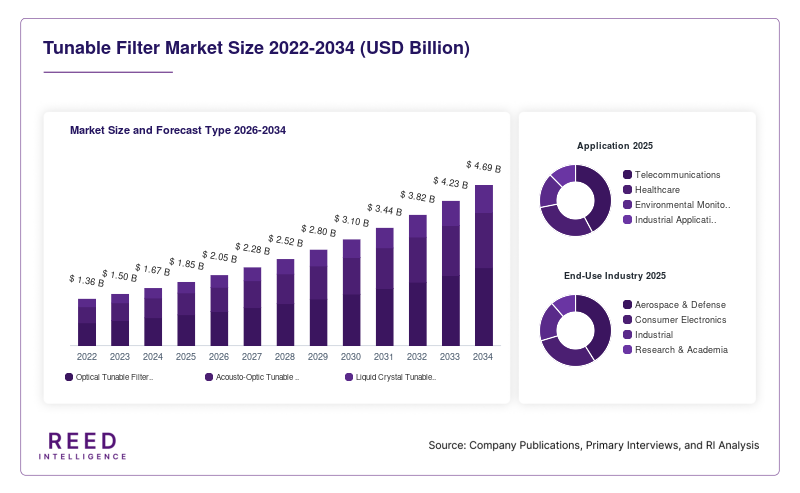
The Tunable Filter Market size was valued at approximately USD 1.85 billion in 2025 and is projected to reach USD 4.72 billion by 2034, expanding at a CAGR of 10.9% during the forecast period (2025–2034). The market has been gaining traction due to the growing demand for advanced optical communication systems, spectroscopy applications, and wireless communication technologies. Tunable filters, which allow dynamic selection of frequencies or wavelengths, are increasingly being adopted across industries requiring precision signal processing and real-time adaptability.
A key global factor supporting market growth is the rapid expansion of next-generation communication infrastructure, particularly 5G and fiber-optic networks. These technologies rely on efficient frequency management and spectral optimization, both of which are enabled by tunable filter solutions. The increasing integration of tunable filters in aerospace, defense, and medical imaging applications further contributes to steady market expansion.
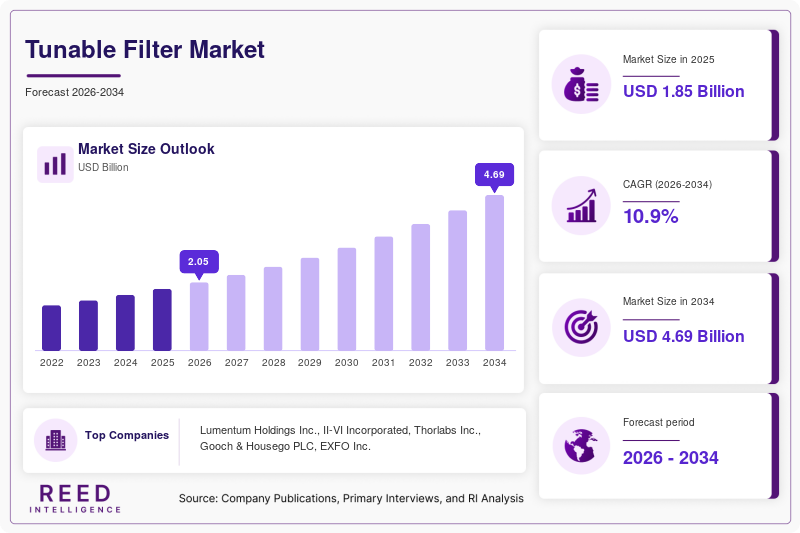
Key Highlights:
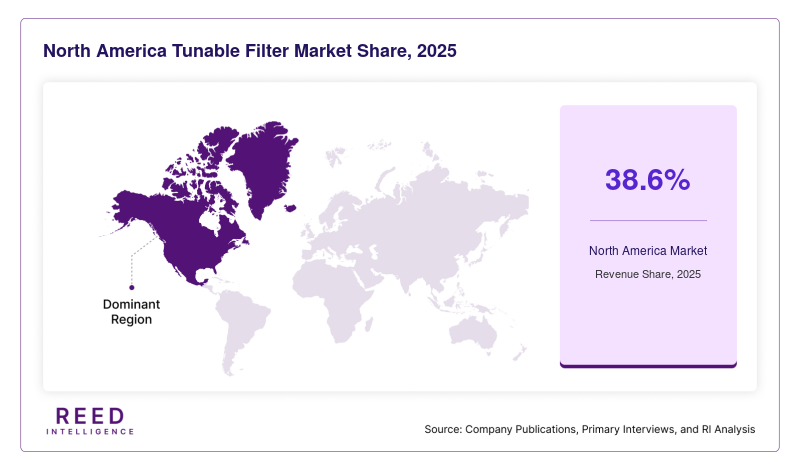
- North America dominated the market with a share of 38.6% in 2025, while Asia Pacific is expected to register the fastest CAGR of 12.8% through 2034.
- The optical tunable filters segment led by type with a 42.3% share, whereas acousto-optic tunable filters are projected to grow at a CAGR of 13.5%.
- By application, telecommunications accounted for the largest share at 36.9%, while healthcare applications are expected to grow at a CAGR of 14.1%.
- The U.S. remained the dominant country, with market values of USD 620 million in 2024 and USD 665 million in 2025.
Market Trends
Integration of Tunable Filters in Photonics and Optical Systems
The increasing use of photonic technologies across communication and sensing applications has significantly influenced the Tunable Filter Market. Tunable filters are being integrated into optical systems to enhance signal clarity and enable wavelength agility. This trend is particularly evident in fiber-optic communication and hyperspectral imaging, where precise wavelength selection is critical. Continuous advancements in miniaturization and integration are making tunable filters more efficient and adaptable for compact devices.
Adoption in Biomedical Imaging and Spectroscopy
Another notable trend shaping the market is the growing adoption of tunable filters in biomedical imaging and spectroscopy. These filters enable non-invasive diagnostic techniques by isolating specific wavelengths, improving imaging accuracy. Applications in fluorescence microscopy, Raman spectroscopy, and environmental monitoring are expanding. The increasing focus on early disease detection and advanced diagnostic tools is driving the incorporation of tunable filter technologies into medical and research equipment.
Market Drivers
Rising Demand for Advanced Communication Networks
The expansion of global communication infrastructure, particularly 5G and high-speed internet networks, is a key driver for the Tunable Filter Market. Tunable filters play a vital role in managing signal interference and optimizing bandwidth utilization. Their ability to dynamically adjust frequencies makes them essential in modern communication systems, where flexibility and performance are critical.
Growing Use in Defense and Aerospace Applications
The increasing adoption of tunable filters in defense and aerospace sectors is also driving market growth. These filters are used in radar systems, electronic warfare, and surveillance technologies, where precise frequency control is required. The rising investment in advanced defense technologies and the need for reliable signal processing solutions are contributing to increased demand for tunable filters.
Market Restraint
High Cost and Complex Manufacturing Processes
One of the primary challenges in the Tunable Filter Market is the high cost associated with manufacturing and integration. Tunable filters require sophisticated materials and precision engineering, which increases production costs. Additionally, the complexity of integrating these filters into existing systems can limit adoption, especially among small and medium-sized enterprises. The need for specialized expertise and high initial investment further restricts widespread deployment. These factors collectively act as a barrier to market growth, particularly in cost-sensitive regions and applications.
Market Opportunities
Expansion in Environmental Monitoring Applications
The increasing focus on environmental sustainability presents a significant opportunity for the Tunable Filter Market. Tunable filters are being used in remote sensing and atmospheric monitoring systems to detect pollutants and analyze environmental conditions. The growing demand for accurate and real-time environmental data is expected to drive adoption in this segment.
Development of Compact and Integrated Devices
Advancements in microfabrication and nanotechnology are enabling the development of compact tunable filters. These smaller and more efficient devices are suitable for portable applications, including handheld diagnostic tools and mobile communication devices. The trend toward miniaturization is expected to open new avenues for market growth, particularly in consumer electronics and wearable technologies.
Segmental Analysis
By Type
The optical tunable filters segment dominated the Tunable Filter Market with a share of 42.3% in 2024. These filters have been widely used in optical communication systems due to their ability to provide precise wavelength selection. Their compatibility with fiber-optic networks and high efficiency has contributed to their leading position.
The acousto-optic tunable filters segment is expected to grow at the fastest CAGR of 13.5% during the forecast period. This growth will be driven by their ability to offer rapid tuning speeds and high resolution. Their increasing use in spectroscopy and imaging applications will support segment expansion.
By Application
The telecommunications segment accounted for the largest share of 36.9% in 2024. The widespread use of tunable filters in managing signal frequencies and improving network performance has driven demand in this segment.
The healthcare segment is projected to grow at a CAGR of 14.1% through 2034. This growth will be supported by the increasing adoption of tunable filters in medical imaging and diagnostic equipment. The need for accurate and non-invasive diagnostic techniques will drive segment expansion.
By End-Use Industry
The aerospace and defense segment held a significant share of the Tunable Filter Market in 2024. The use of tunable filters in radar systems and surveillance technologies has contributed to their dominance.
The consumer electronics segment is expected to grow at a notable CAGR during the forecast period. The increasing demand for compact and efficient devices will drive the adoption of tunable filters in this segment. Advancements in technology will further support growth.
By Technology
The MEMS-based tunable filters segment dominated the market in 2024 due to their compact size and high performance. These filters have been widely used in various applications, including communication and sensing.
The liquid crystal tunable filters segment is expected to grow at a steady CAGR. Their ability to provide precise wavelength control and flexibility will support their adoption in imaging and spectroscopy applications.
Regional Analysis
North America
North America accounted for 38.6% of the Tunable Filter Market share in 2025 and is expected to grow at a CAGR of 9.8% during the forecast period. The region has a well-established technological infrastructure and strong presence of key market players, which has contributed to its dominance.
The United States led the regional market due to its advanced research and development capabilities. The country’s focus on innovation in communication technologies and defense systems has supported the adoption of tunable filters. Increasing investments in photonics research and the presence of leading technology firms have further strengthened market growth.
Europe
Europe held a market share of 26.4% in 2025 and is projected to grow at a CAGR of 9.5% through 2034. The region has been characterized by steady adoption of advanced optical technologies across various industries.
Germany emerged as the dominant country in the region, driven by its strong industrial base and focus on precision engineering. The country’s emphasis on automation and advanced manufacturing technologies has supported the integration of tunable filters in industrial applications. Additionally, ongoing research in photonics has contributed to market expansion.
Asia Pacific
Asia Pacific accounted for 22.7% of the market in 2025 and is anticipated to register the fastest CAGR of 12.8% during the forecast period. The region’s rapid industrialization and growing adoption of advanced technologies have driven market growth.
China dominated the regional market due to its expanding electronics and telecommunications industries. The country’s large-scale production capabilities and increasing investments in infrastructure development have supported the demand for tunable filters. The growing focus on technological innovation has further accelerated market growth.
Middle East & Africa
The Middle East & Africa region held a market share of 6.8% in 2025 and is expected to grow at a CAGR of 8.7% during the forecast period. The market in this region has been driven by increasing investments in communication infrastructure.
Saudi Arabia emerged as a key country, supported by its initiatives to modernize communication networks and diversify the economy. The adoption of advanced technologies in sectors such as defense and energy has contributed to the demand for tunable filters.
Latin America
Latin America accounted for 5.5% of the Tunable Filter Market share in 2025 and is projected to grow at a CAGR of 8.3% through 2034. The region has been witnessing gradual adoption of advanced technologies.
Brazil led the regional market due to its growing telecommunications sector. The country’s efforts to expand network coverage and improve connectivity have supported the adoption of tunable filters. Increasing investments in technology infrastructure are expected to drive future growth.
Competitive Landscape
The Tunable Filter Market is characterized by the presence of several established players focusing on innovation and product development. Companies are investing in research and development to enhance performance and expand application areas.
The market leader, Lumentum Holdings Inc., has maintained a strong position through continuous innovation and strategic partnerships. The company recently introduced advanced tunable filter solutions designed for high-speed communication networks, strengthening its market presence.
Other key players are focusing on expanding their product portfolios and entering emerging markets to gain a competitive edge. The competitive environment is expected to remain dynamic, with ongoing technological advancements shaping market strategies.
Key Players List
- Lumentum Holdings Inc.
- II-VI Incorporated
- Thorlabs Inc.
- Gooch & Housego PLC
- EXFO Inc.
- Santec Corporation
- DiCon Fiberoptics Inc.
- Brimrose Corporation
- Kent Optronics Inc.
- Netcom Inc.
- Smiths Interconnect
- Alnair Labs Corporation
- Omega Optical LLC
- Iridian Spectral Technologies
- Agiltron Inc.
Recent Developments
- In 2025, Lumentum Holdings Inc. launched a new range of tunable filters designed for high-capacity optical networks.
- II-VI Incorporated expanded its product portfolio with advanced acousto-optic tunable filters for spectroscopy applications.
- Thorlabs Inc. introduced compact tunable filters aimed at portable diagnostic devices.
- Gooch & Housego PLC invested in research to enhance filter efficiency and reduce manufacturing costs.
- Santec Corporation focused on expanding its presence in the Asia Pacific market through strategic partnerships.
Tunable Filter Market Segments
Type
- Optical Tunable Filters
- Acousto-Optic Tunable Filters
- Liquid Crystal Tunable Filters
Application
- Telecommunications
- Healthcare
- Environmental Monitoring
- Industrial Applications
End-Use Industry
- Aerospace & Defense
- Consumer Electronics
- Industrial
- Research & Academia
Technology
- MEMS-Based
- Liquid Crystal-Based
- Others
By Region
- North America
- Europe
- APAC
- Middle East and Africa
- LATAM