Tunnel Detection System Market Size, Share & Demand Report By Equipment Type (Seismic Sensors, Acoustic Sensors, Magnetic Sensors, Ground Penetrating Radar, Fiber Optic Systems), By Application (Military Surveillance, Transportation Tunnel Monitoring, Industrial Site Security), By End User (Infrastructure and Utility Operators, Transportation Authorities, Industrial Enterprises, Security Service Providers), By Region & Segment Forecasts, 2026–2034
USD 3950
Market Overview
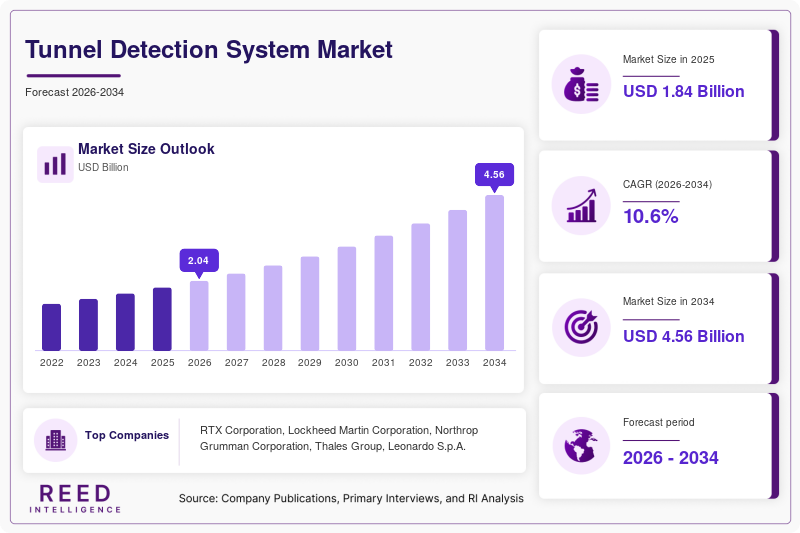
The global Tunnel Detection System Market size was valued at USD 1.84 billion in 2026 and is projected to reach USD 4.12 billion by 2034, registering a CAGR of 10.6% during 2026–2034. The market is experiencing sustained expansion due to the growing emphasis on border security, critical infrastructure protection, underground surveillance, and advanced threat detection across both developed and emerging economies. Governments and security agencies are increasingly investing in sophisticated tunnel detection technologies to identify illegal underground activities, prevent unauthorized cross-border movement, and safeguard strategic assets.
The rising complexity of underground threats has accelerated the adoption of advanced sensing systems, seismic monitoring equipment, ground-penetrating radar solutions, and integrated software platforms capable of real-time tunnel identification and risk assessment. Growing infrastructure investments, expansion of transportation tunnels, and increasing military modernization programs have further contributed to market growth. In addition, advancements in artificial intelligence, machine learning, and data analytics have enhanced detection accuracy while reducing false alarms, making tunnel detection systems more reliable and operationally efficient.
Key Highlights
- North America dominated the market with a 35.1% share in 2025.
- while Asia Pacific is expected to grow at the fastest CAGR of 12.3% during 2026–2034.
- By equipment type, seismic sensors accounted for the largest share of 39.4%.
- while integrated software platforms are projected to grow at a CAGR of 13.2%.
- By application, border security monitoring led with a 44.6% share.
- whereas critical infrastructure protection is expected to expand at a CAGR of 12.1%.
- The United States remained the dominant country, with market values of USD 540 million in 2024 and USD 596 million in 2025.
Market Trends
Integration of Artificial Intelligence into Underground Surveillance Systems
Artificial intelligence has become a significant trend shaping the Tunnel Detection System Market. Modern tunnel detection platforms are increasingly incorporating AI-powered algorithms capable of analyzing large volumes of sensor data in real time. These systems can distinguish between normal underground activities and suspicious tunnel excavation patterns with greater accuracy than conventional monitoring solutions. The ability to reduce false positives has improved operational efficiency for military agencies, border patrol authorities, and infrastructure operators. AI integration also enables predictive analytics, helping organizations identify potential threats before they escalate. As computing power becomes more accessible and software capabilities continue to evolve, AI-enabled tunnel detection systems are expected to gain widespread adoption across security and surveillance applications throughout the forecast period.
Growing Deployment of Multi-Sensor Detection Architectures
The increasing adoption of multi-sensor architectures is transforming the market landscape. Organizations are moving beyond single-technology solutions and implementing systems that combine seismic sensors, acoustic detectors, magnetic sensors, fiber-optic monitoring networks, and ground-penetrating radar technologies. Such integrated platforms provide broader underground visibility and improve detection reliability across diverse geological environments. Multi-sensor systems are particularly effective in border regions, military installations, and urban infrastructure projects where varying soil conditions can affect detection performance. The ability to collect and correlate data from multiple sources enhances decision-making and supports more accurate threat identification. This trend is expected to continue as end users seek comprehensive and scalable underground surveillance solutions capable of addressing evolving security requirements.
Market Drivers
Rising Investments in Border Security and National Defense Programs
Increasing investments in border security infrastructure represent a major growth driver for the Tunnel Detection System Market. Governments worldwide are strengthening surveillance capabilities to address concerns related to unauthorized border crossings, smuggling operations, and underground infiltration activities. Tunnel detection technologies have become essential components of modern border management strategies, particularly in regions experiencing persistent security challenges. Defense agencies are allocating larger budgets toward advanced detection systems that provide continuous underground monitoring and rapid threat identification. The integration of tunnel detection platforms into broader security networks enhances situational awareness and supports proactive response measures. As geopolitical uncertainties continue to influence national security priorities, demand for sophisticated underground detection solutions is expected to remain strong throughout the forecast period.
Expansion of Critical Infrastructure Protection Initiatives
Growing efforts to protect critical infrastructure assets are significantly supporting market expansion. Transportation tunnels, energy facilities, communication networks, military bases, and industrial complexes increasingly require advanced underground monitoring systems to detect unauthorized excavation activities and structural threats. Tunnel detection technologies help operators identify risks before they impact infrastructure integrity or operational continuity. The increasing complexity of urban environments has heightened the importance of underground surveillance, particularly in densely populated regions where infrastructure networks are expanding rapidly. Public and private sector stakeholders are investing in technologies that provide continuous monitoring, early warning capabilities, and enhanced asset protection. These investments are expected to generate substantial demand for tunnel detection systems over the coming years.
Market Restraint
High Deployment Costs and Technical Complexity
The Tunnel Detection System Market faces challenges associated with high deployment costs and technical implementation complexities. Advanced detection solutions often require extensive sensor networks, specialized software platforms, sophisticated communication infrastructure, and continuous maintenance support. The installation process can be particularly demanding in remote border regions, mountainous terrain, and geologically complex environments where sensor calibration and system optimization are critical for effective performance. Smaller government agencies and infrastructure operators may encounter budget limitations that delay procurement decisions or reduce deployment scale. In addition, achieving accurate detection results frequently requires skilled personnel capable of interpreting complex data patterns and managing integrated surveillance systems. These factors can increase operational expenditures and create barriers to adoption, particularly in developing regions where financial resources and technical expertise may be limited. Although technological advancements are gradually reducing system costs, affordability remains an important consideration influencing purchasing decisions across multiple end-user segments.
Market Opportunities
Emergence of Smart Border Management Programs
The growing adoption of smart border management initiatives presents substantial opportunities for market participants. Governments are increasingly deploying digital surveillance ecosystems that integrate tunnel detection technologies with drones, command-and-control platforms, video analytics systems, and intelligent monitoring networks. Tunnel detection solutions capable of seamlessly integrating with these broader security architectures are likely to experience strong demand. Vendors are focusing on developing interoperable platforms that provide centralized monitoring and real-time intelligence sharing across multiple agencies. The transition toward connected security environments creates opportunities for software providers, sensor manufacturers, and system integrators. As border modernization projects continue to expand globally, the demand for advanced underground detection capabilities is expected to accelerate significantly.
Increasing Demand from Civil Infrastructure Monitoring Applications
Civil infrastructure monitoring represents another promising opportunity for the Tunnel Detection System Market. Transportation authorities, construction companies, and utility operators are increasingly recognizing the value of underground detection technologies for identifying subsurface anomalies, unauthorized excavation activities, and structural vulnerabilities. Tunnel detection systems can support preventive maintenance strategies and improve safety outcomes across rail networks, highways, subway systems, and utility corridors. Rapid urbanization and large-scale infrastructure development projects are creating favorable conditions for broader adoption beyond traditional defense and security applications. Vendors that develop cost-effective solutions tailored to civil engineering requirements are likely to benefit from expanding market opportunities during the forecast period.
Segmental Analysis
By Equipment Type
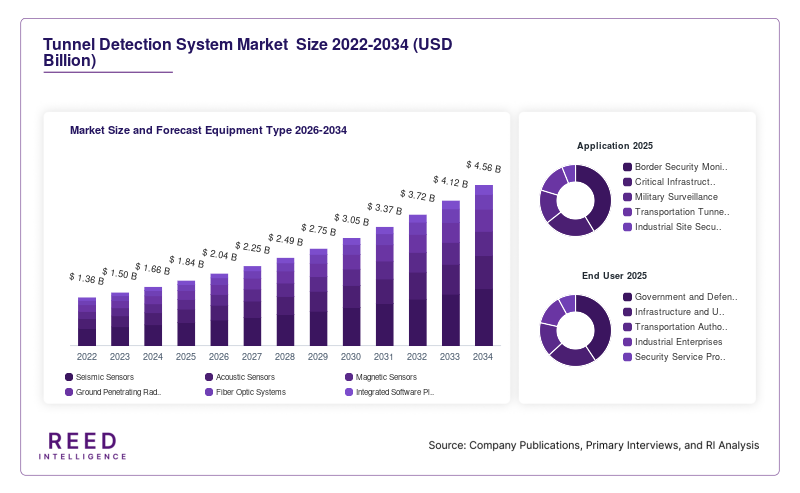
Seismic sensors represented the dominant subsegment within the equipment type category, accounting for approximately 39.4% of market share in 2024. These sensors are widely utilized due to their ability to detect underground vibrations associated with excavation activities and tunnel construction efforts. Defense agencies, border security organizations, and infrastructure operators rely on seismic sensing technologies because they offer continuous monitoring capabilities across large geographic areas. Advances in sensor sensitivity and signal processing algorithms have improved detection accuracy while reducing operational limitations. The widespread availability of seismic technologies and their compatibility with existing surveillance networks have further strengthened adoption. Additionally, continuous investment in sensor research and development has enabled manufacturers to enhance performance in complex geological conditions, supporting sustained market leadership.
Integrated software platforms are expected to emerge as the fastest-growing subsegment, expanding at a CAGR of 13.2% during 2026–2034. The increasing volume of data generated by underground monitoring systems has created demand for sophisticated software capable of consolidating, analyzing, and visualizing information from multiple sensor sources. Organizations are seeking platforms that provide automated threat assessment, predictive analytics, and real-time decision support. Advances in artificial intelligence and machine learning are further enhancing software functionality and operational value. The ability to integrate with command centers, surveillance systems, and broader security networks makes these platforms attractive for both defense and civil applications. Growing digital transformation initiatives across security sectors are expected to accelerate software adoption significantly.
By Application
Border security monitoring accounted for the largest share of the application segment, representing approximately 44.6% of market revenue in 2024. Governments around the world continue to prioritize border protection due to increasing concerns related to illegal migration, smuggling, and underground infiltration activities. Tunnel detection systems play a crucial role in identifying hidden underground routes and supporting proactive enforcement measures. Continuous investments in surveillance modernization programs have contributed to widespread deployment of advanced detection technologies across border regions. The integration of seismic sensors, acoustic monitoring systems, and radar-based solutions has improved detection effectiveness while enhancing operational efficiency. As national security remains a strategic priority for many countries, border security applications are expected to maintain a leading market position throughout the forecast period.
Critical infrastructure protection is projected to be the fastest-growing application segment, recording a CAGR of 12.1% during 2026–2034. Infrastructure operators increasingly recognize the importance of underground monitoring technologies in protecting transportation networks, energy facilities, communication systems, and industrial assets. The growing complexity of infrastructure networks and rising concerns regarding sabotage, unauthorized excavation, and structural vulnerabilities are supporting demand. Advanced tunnel detection systems provide early warning capabilities that help prevent operational disruptions and costly repairs. Furthermore, governments are implementing stricter infrastructure resilience requirements, encouraging broader adoption of underground surveillance solutions. These factors collectively position critical infrastructure protection as a major growth area within the market.
By End User
Government and defense agencies dominated the end-user segment, accounting for approximately 58.7% of total market share in 2024. These organizations represent the primary adopters of tunnel detection technologies due to their responsibility for national security, border protection, and military operations. Defense departments allocate significant resources toward advanced surveillance systems capable of identifying underground threats in real time. The increasing sophistication of security challenges has encouraged continuous investment in multi-layered monitoring infrastructure. Government procurement programs often involve large-scale deployments and long-term maintenance contracts, contributing substantially to market revenue. Additionally, ongoing modernization initiatives aimed at improving situational awareness and operational readiness continue to strengthen demand from this end-user category.
Infrastructure and utility operators are expected to be the fastest-growing end-user subsegment, expanding at a CAGR of 11.8% during 2026–2034. Rapid urbanization and infrastructure expansion have increased the need for advanced monitoring solutions capable of protecting underground assets and ensuring operational continuity. Utility providers, transportation authorities, and industrial facility operators are adopting tunnel detection technologies to identify subsurface risks and support preventive maintenance strategies. The growing emphasis on infrastructure resilience and public safety is encouraging investment in continuous monitoring systems. As technology costs gradually decline and awareness of underground risks increases, adoption among infrastructure-focused organizations is expected to accelerate significantly over the forecast period.
Regional Analysis
North America
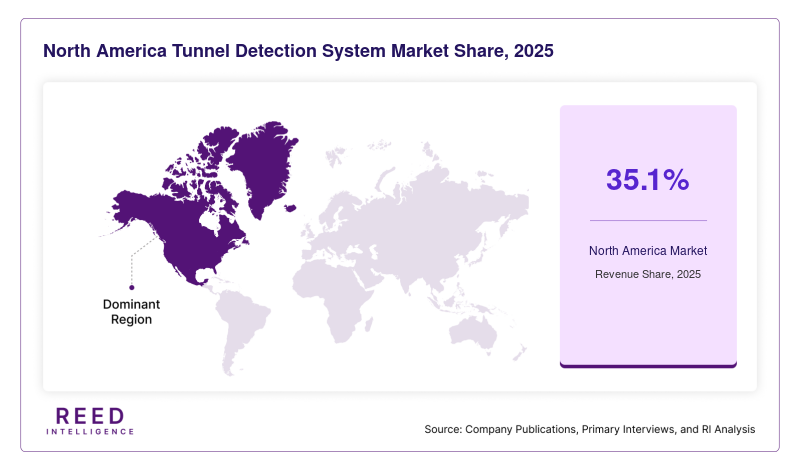
North America accounted for approximately 35.1% of the global Tunnel Detection System Market in 2025, making it the leading regional market. The region is projected to register a CAGR of 9.8% through 2034, supported by substantial investments in border surveillance technologies and advanced defense infrastructure. Security agencies continue to prioritize underground threat detection capabilities due to increasing concerns related to illegal cross-border activities and strategic asset protection. Continuous technological innovation and strong government funding further contribute to regional market leadership.
The United States remains the dominant country within North America. A major growth factor is the country's extensive investment in integrated border security programs that combine tunnel detection technologies with broader surveillance networks. Federal agencies continue to modernize monitoring infrastructure by deploying advanced sensor systems, AI-powered analytics platforms, and real-time intelligence solutions. These initiatives support long-term demand and encourage technology providers to expand product development activities.
Europe
Europe represented approximately 26.4% of global market revenue in 2025 and is expected to achieve a CAGR of 9.6% during the forecast period. Regional demand is supported by growing concerns regarding critical infrastructure security, transportation safety, and underground surveillance requirements. Governments across the region are investing in technologies capable of protecting strategic facilities and transportation corridors from potential underground threats. Regulatory focus on infrastructure resilience further strengthens market prospects.
Germany emerged as the leading country within Europe due to its advanced industrial infrastructure and ongoing investments in security modernization. A unique growth factor is the increasing deployment of underground monitoring systems within transportation and utility networks. Infrastructure operators are adopting advanced detection technologies to improve asset protection, support preventive maintenance initiatives, and enhance operational safety across complex underground environments.
Asia Pacific
Asia Pacific held approximately 22.8% of the global Tunnel Detection System Market in 2025 and is anticipated to record the fastest CAGR of 12.3% through 2034. Rising defense expenditures, expanding infrastructure development projects, and growing border security requirements are supporting strong market growth. Several countries in the region are investing heavily in surveillance technologies to address evolving security challenges while improving national defense capabilities.
China remains the dominant country in the Asia Pacific market. A distinctive growth factor is the large-scale expansion of infrastructure and transportation networks, which creates substantial demand for underground monitoring solutions. The country continues to invest in advanced sensing technologies and integrated security platforms that support both defense applications and infrastructure protection objectives, strengthening market growth prospects.
Middle East & Africa
The Middle East & Africa region accounted for approximately 8.4% of global market revenue in 2025 and is projected to expand at a CAGR of 10.5% during the forecast period. Regional growth is supported by increasing investments in border protection systems, defense modernization programs, and critical infrastructure security initiatives. Governments are adopting advanced surveillance technologies to address complex security concerns and improve monitoring capabilities across strategic locations.
Saudi Arabia represents the largest national market within the region. A key growth factor is the country's significant investment in national security enhancement programs associated with economic diversification initiatives. Authorities are deploying advanced underground detection technologies to protect energy infrastructure, border regions, and strategic facilities. These investments are creating favorable opportunities for international and domestic technology providers.
Latin America
Latin America captured approximately 7.3% of the global Tunnel Detection System Market in 2025 and is expected to grow at a CAGR of 9.4% through 2034. Increasing efforts to combat smuggling activities and strengthen border security frameworks are contributing to market development. Governments are gradually investing in advanced surveillance technologies to improve monitoring capabilities and support law enforcement operations across challenging geographic environments.
Brazil remains the dominant country within Latin America. A unique growth factor is the growing emphasis on protecting critical transportation and logistics infrastructure. Public agencies and private operators are investing in underground monitoring solutions to enhance operational safety and identify potential threats before they affect infrastructure performance. Continued modernization efforts are expected to support sustained market expansion.
Competitive Landscape
The Tunnel Detection System Market is characterized by the presence of established defense technology providers, sensor manufacturers, software developers, and specialized surveillance solution companies. Market participants focus on product innovation, sensor accuracy improvements, AI integration, and strategic partnerships to strengthen their competitive positions. Companies are increasingly investing in research and development activities aimed at improving underground detection performance across diverse environmental conditions.
RTX Corporation remains one of the leading market participants due to its extensive defense technology portfolio and strong presence in security modernization programs. The company recently expanded its underground surveillance capabilities through the integration of advanced data analytics and multi-sensor monitoring technologies. Other notable competitors continue to enhance product offerings through acquisitions, collaborative projects, and technology upgrades designed to address evolving customer requirements.
Competition is expected to intensify as emerging vendors introduce software-driven solutions and cost-effective monitoring platforms tailored for civil infrastructure applications. The growing importance of integrated surveillance ecosystems is encouraging companies to develop interoperable technologies that support seamless data sharing and centralized threat assessment.
Key Players
- RTX Corporation
- Lockheed Martin Corporation
- Northrop Grumman Corporation
- Thales Group
- Leonardo S.p.A.
- Elbit Systems Ltd.
- Saab AB
- BAE Systems plc
- Rheinmetall AG
- QinetiQ Group plc
- Israel Aerospace Industries Ltd.
- Geosense Ltd.
- KBR Inc.
- L3Harris Technologies, Inc.
- Teledyne Technologies Incorporated
Recent Developments
- RTX Corporation introduced an enhanced multi-sensor tunnel detection platform featuring AI-assisted threat identification capabilities.
- Thales Group expanded its underground surveillance portfolio through the deployment of integrated seismic and acoustic monitoring solutions for critical infrastructure applications.
- Saab AB launched a next-generation underground detection system designed to improve performance in complex geological environments.
- Leonardo S.p.A. upgraded its border security platform with advanced analytics modules for real-time underground threat assessment.
- Northrop Grumman Corporation developed an enhanced sensor fusion architecture to improve tunnel detection accuracy and operational response times.
Tunnel Detection System Market Segments
Equipment Type
- Seismic Sensors
- Acoustic Sensors
- Magnetic Sensors
- Ground Penetrating Radar
- Fiber Optic Systems
- Integrated Software Platforms
Application
- Border Security Monitoring
- Critical Infrastructure Protection
- Military Surveillance
- Transportation Tunnel Monitoring
- Industrial Site Security
End User
- Government and Defense Agencies
- Infrastructure and Utility Operators
- Transportation Authorities
- Industrial Enterprises
- Security Service Providers
By Region
- North America
- Europe
- APAC
- Middle East and Africa
- LATAM