Turbo Chiller Market Size, Share, Demand Report By Type (Water-Cooled Turbo Chillers, Air-Cooled Turbo Chillers, Evaporative-Cooled Turbo Chillers), By Application (Chemical, Food & Beverages, Pharmaceuticals), By Region & Segment Forecasts, 2026–2034
USD 3950
Turbo Chiller Size
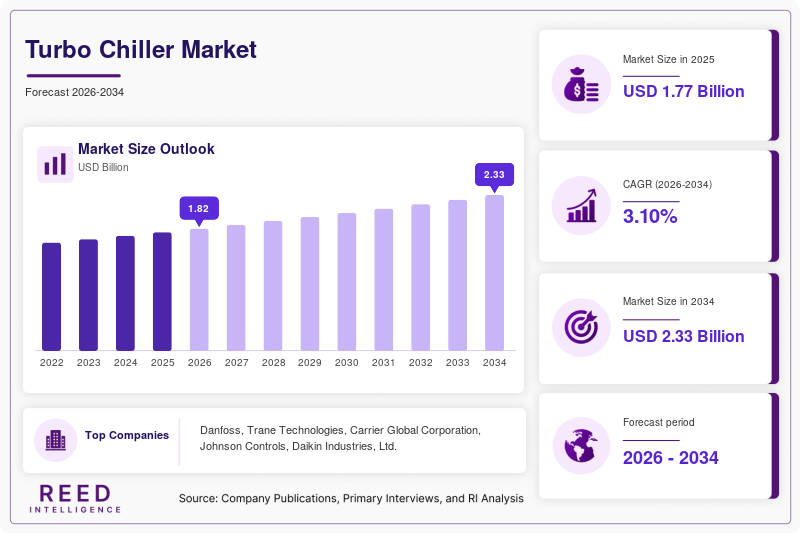
The global Turbo Chiller market size is projected at USD 1.82 billion in 2026 and is expected to hit USD 2.33 billion by 2034 with a CAGR of 3.10%. The market is increasingly influenced by demand for high-efficiency cooling, low-GWP refrigerants, oil-free compressor technology, and reliable thermal management in industrial and mission-critical facilities. Detailed segmentation by cooling technology, capacity, end-use application, and geography is important for assessing demand patterns, production capacity, competitive positioning, pricing, and emerging investment opportunities.
Key takeaways
- Asia Pacific dominated the global market in 2025 with approximately 45.5% share and is expected to remain the leading regional market through 2034, supported by industrialization, manufacturing expansion, and data-center construction.
- Water-cooled turbo chillers represented the dominant type segment in 2025 because of their suitability for high-load industrial and commercial cooling applications, while air-cooled systems are expected to record comparatively faster adoption in water-constrained locations.
- Among applications, chemical and pharmaceutical facilities remain major consumers because of their continuous and precision-oriented cooling requirements, while food & beverages is expected to expand steadily with processing and cold-chain investments.
- India is emerging as a high-potential country market, supported by data-center development, pharmaceuticals, food processing, commercial infrastructure, and manufacturing investments. The country is expected to grow at a rate above the global market average during 2026–2034.
- Large-capacity systems are expected to gain share as hyperscale data centers, industrial complexes, district cooling facilities, and high-density process applications require greater cooling output with improved part-load efficiency.
Turbo chillers are high-efficiency centrifugal refrigeration systems used to remove heat from chilled-water circuits and provide continuous thermal management for large buildings, industrial facilities, and process environments. Modern turbo chillers increasingly use oil-free magnetic-bearing compressors, variable-speed drives, permanent-magnet motors, intelligent controls, and lower-global-warming-potential refrigerants. These systems are particularly suited to installations where long operating hours, high cooling loads, reduced maintenance, and energy efficiency are important. Water-cooled configurations generally provide strong efficiency at large capacities, while air-cooled designs offer installation flexibility and eliminate dependence on cooling towers and condenser-water systems. Adoption is also moving toward modular and digitally monitored systems that can respond dynamically to changing loads. In terms of supply, manufacturers primarily measure output by refrigeration capacity in tons of refrigeration (TR) or megawatts rather than standardized unit counts; the market therefore tracks production through installed cooling capacity, compressor shipments, and chiller deliveries. Large industrial systems typically account for a substantial share of overall cooling capacity, while smaller modular systems contribute more units. Water-cooled equipment remains the principal capacity contributor, with air-cooled systems expanding in data centers and locations where water availability is constrained.
Turbo Chiller Trends
Shift toward oil-free magnetic-bearing and low-GWP systems
The technology landscape is moving from conventional lubricated centrifugal compressors toward oil-free magnetic-bearing architectures. Magnetic bearings reduce mechanical contact, eliminate traditional oil-management requirements, and support efficient operation over a broad load range. Variable-speed compression, advanced impeller designs, permanent-magnet motors, adaptive controls, and improved heat-exchanger performance are also becoming important differentiators. At the same time, manufacturers are transitioning portfolios toward lower-GWP refrigerants to address tightening environmental requirements and customer sustainability targets.
Sector-specific demand is increasingly coming from data centers, pharmaceuticals, specialty chemicals, food processing, semiconductor-related facilities, hospitals, and high-performance commercial buildings. Data-center operators favor turbo chillers because high-density computing creates concentrated heat loads and requires dependable cooling with strong part-load efficiency. Industrial users are seeking systems that can operate continuously, withstand demanding ambient conditions, and integrate with plant automation platforms. Modular architectures are gaining attention where phased capacity additions, redundancy, and constrained installation spaces are important.
Turbo Chiller Drivers
Rising demand for energy-efficient high-capacity cooling
Growing electricity costs and increasing cooling loads are encouraging facility owners to replace inefficient equipment with high-efficiency centrifugal systems. Turbo chillers can deliver strong full-load and part-load efficiency, while oil-free technology reduces maintenance associated with compressor lubrication. Expansion of manufacturing, commercial buildings, data centers, and process industries is strengthening demand for continuous and efficient cooling infrastructure.
Turbo Chiller Restraints
High initial investment and technical complexity
Turbo chiller installations generally require higher upfront investment than simpler packaged cooling systems, particularly when integrated with sophisticated controls, variable-speed drives, pumps, heat exchangers, and water-management infrastructure. Project design also requires specialized engineering because chiller performance is influenced by entering and leaving water temperatures, condenser conditions, load profiles, and site conditions. These factors can lengthen project evaluation and installation cycles.
Turbo Chiller Opportunities
Expansion of data centers and water-efficient cooling
The rapid growth of cloud computing, artificial intelligence, high-performance computing, and digital infrastructure is creating substantial demand for high-density cooling. Air-cooled magnetic-bearing systems can provide high capacity without cooling-tower water consumption, while water-cooled turbo chillers remain attractive for facilities with suitable water infrastructure. Additional opportunities exist in heat recovery, district cooling, industrial process optimization, and retrofit projects seeking lower lifecycle energy consumption.
Challenges in Turbo Chiller
Refrigerant transition and changing operating requirements
Manufacturers must balance efficiency, safety, refrigerant availability, environmental performance, and equipment cost. Refrigerant transitions can require redesign of compressors, controls, heat exchangers, and service procedures. In addition, next-generation facilities increasingly demand higher chilled-water temperatures, faster restart, remote diagnostics, cybersecurity-ready controls, and operation under wider ambient conditions, increasing engineering requirements.
Turbo Chiller Market Segmentation Analysis
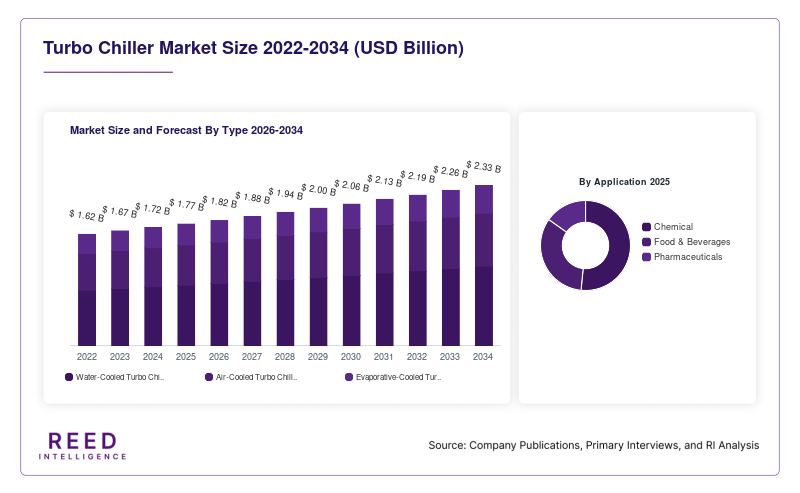
Segmentation demonstrates a market led by high-capacity water-cooled systems, which account for an estimated 60%+ of global market value, while air-cooled systems represent the fastest-growing technology area in several water-constrained and mission-critical applications. Among applications, chemical and pharmaceutical facilities together represent a significant portion of process-cooling demand, while food & beverages provides a broad base of recurring industrial and commercial installations. Production is increasingly concentrated in higher-capacity systems, where individual chillers commonly range from several hundred tons to multiple megawatts of cooling output.
By Type
Water-cooled systems held the largest market share in 2025, estimated at around 60%–65%, because they deliver efficient heat rejection for large continuous loads. Typical commercial and industrial configurations range from approximately 200 TR to above 2,000 TR, with larger engineered systems exceeding several megawatts. These chillers commonly use shell-and-tube evaporators and condensers, centrifugal compressors, variable-speed drives, and sophisticated chilled-water controls. The segment accounts for the largest proportion of industry cooling-capacity production and is widely used in chemical plants, pharmaceutical facilities, large commercial complexes, and district cooling installations.
Air-cooled equipment represents an estimated 25%–30% of market value and is expected to record faster growth as customers prioritize simplified installation and reduced water consumption. Current systems can span roughly 300–850 TR per chiller in advanced configurations, with multi-unit arrangements capable of reaching several megawatts. Air-cooled turbo chillers use finned heat exchangers, variable-speed fans, oil-free centrifugal compressors, and intelligent controls. Their strongest growth is anticipated in data centers, urban developments, industrial facilities, and regions facing restrictions on condenser-water availability.
Evaporative-cooled configurations account for a smaller share but provide an efficiency-oriented alternative where limited water use remains acceptable. These systems improve heat rejection through evaporative effects while reducing condenser temperatures compared with purely air-cooled designs. Typical installations range from medium to large capacity, and production is commonly configured around multi-compressor or multi-module architectures. Demand is concentrated in facilities seeking a balance between air-cooled installation simplicity and improved thermal efficiency during hot operating conditions.
By Application
Chemical processing is one of the largest turbo chiller applications, representing an estimated 25%–30% share. Cooling is required for reactors, condensation systems, process streams, equipment rooms, and temperature-sensitive production stages. Plants commonly deploy medium- to large-capacity systems, with installations frequently exceeding 500 TR in integrated facilities. Reliability, corrosion-resistant heat exchangers, stable chilled-water temperatures, and continuous operation are key specifications. Production demand is expected to remain strong as specialty chemicals, petrochemicals, and advanced materials manufacturing expands across Asia and the Middle East.
Food and beverage applications account for roughly 15%–20% of market demand and include dairy, brewing, beverage processing, meat processing, cold storage, and packaged-food production. Turbo chillers support process cooling, rapid temperature reduction, fermentation control, cold-chain infrastructure, and HVAC loads. Typical equipment ranges from smaller modular systems to installations exceeding several hundred tons. Demand is rising alongside food-processing automation, cold-chain development, packaged-food consumption, and investments in hygienic production environments.
Pharmaceutical facilities contribute approximately 15%–18% of demand, supported by stringent temperature and humidity requirements. Turbo chillers are used for cleanrooms, process cooling, laboratories, HVAC systems, and pharmaceutical manufacturing equipment. Installations prioritize high reliability, precise temperature control, redundancy, low vibration, and low-maintenance operation. Demand is strengthening as pharmaceutical manufacturing capacity expands in India, China, the United States, and Europe, particularly for biologics, injectable medicines, vaccines, and advanced therapies.
Turbo Chiller Regional Analysis
North America
North America represented a major share of global demand in 2025, driven by commercial HVAC modernization, data centers, healthcare, pharmaceuticals, and industrial facilities. The United States contributes the majority of regional demand, followed by Canada. Data centers are becoming a particularly important sector as AI-related workloads increase cooling density. Water-cooled high-capacity equipment remains important, while air-cooled magnetic-bearing systems are gaining adoption where fast deployment and water conservation are priorities.
Europe
Europe is characterized by strong demand for energy-efficient and environmentally responsible cooling technologies. Germany, the U.K., France, Italy, and the Nordic countries are important contributors, with demand distributed across pharmaceuticals, food processing, chemicals, commercial buildings, and industrial manufacturing. Low-GWP refrigerants, heat recovery, lifecycle efficiency, and retrofit modernization are central to regional purchasing decisions. Water-cooled systems remain significant, while compact oil-free systems are gaining traction.
Asia Pacific
Asia Pacific held approximately 45.5% of the global market in 2025 and is expected to remain the fastest-expanding major regional market. China, Japan, South Korea, and India are the largest contributors, with additional demand from Southeast Asia. Manufacturing, chemicals, pharmaceuticals, food processing, commercial construction, and data centers represent the principal end-use sectors. China contributes a large share through industrial and infrastructure investments, Japan emphasizes advanced energy-efficient technology, South Korea benefits from semiconductor and technology manufacturing, and India is rapidly expanding data-center and pharmaceutical capacity.
Middle East & Africa
The region presents attractive long-term potential because of extreme ambient temperatures, large commercial developments, industrial diversification, and data-center investment. The UAE and Saudi Arabia are major contributors, supported by tourism, real estate, healthcare, logistics, and digital infrastructure. Air-cooled and high-ambient systems are particularly relevant, while large water-cooled installations continue to serve district cooling and major industrial projects.
Top players in Turbo Chiller
- Danfoss
- Trane Technologies
- Carrier Global Corporation
- Johnson Controls
- Daikin Industries, Ltd.
- Mitsubishi Heavy Industries Thermal Systems, Ltd.
- Smardt Chiller Group
- LG Electronics
- Blue Star Limited
- Kirloskar Chillers
- McQuay International
- Climaveneta
- Multistack
- Thermax Limited
- SKM Air Conditioning LLC
Recent Developments in Turbo Chiller
- November 2025: Mitsubishi Heavy Industries Thermal Systems introduced the ETI-N magnetic-bearing centrifugal chiller series in Japan, combining oil-free compressor technology with a low-GWP refrigerant platform.
- February 2026: Johnson Controls launched the YORK YDAM air-cooled magnetic-bearing centrifugal chiller, targeting high-density multistory data centers and AI infrastructure with cooling capacity of up to approximately 3.5 MW.
- February 2026: Trane launched the HSAG air-cooled magnetic-bearing centrifugal chiller for Asia Pacific data-center applications, emphasizing oil-free operation, advanced controls, high efficiency, and low-GWP refrigerants.
- June 2026: Daikin highlighted development of its next-generation magnetic-bearing turbo compressor technology, including greater in-house development of the compressor motor, magnetic bearings, and impeller technologies for advanced cooling requirements.
- July 2026: Trane introduced the HSWE magnetic-bearing centrifugal chiller platform for Asia Pacific, developed to address high-efficiency and high-reliability cooling requirements, particularly for modern data centers.
Turbo Chiller Market Segments
By Type
- Water-Cooled Turbo Chillers
- Air-Cooled Turbo Chillers
- Evaporative-Cooled Turbo Chillers
By Application
- Chemical
- Food & Beverages
- Pharmaceuticals
By Region
- North America
- Europe
- APAC
- Middle East and Africa
- LATAM