Twin-Twin Transfusion Syndrome Treatment Market Size, Share & Demand Report By Treatment Type (Fetoscopic Laser Photocoagulation, Amnioreduction, Septostomy), By Stage (Stage I, Stage II, Stage III, Stage IV), By Diagnosis Method (Ultrasound Imaging, Doppler Imaging, MRI), By End-Use (Hospitals, Specialized Fetal Care Centers, Clinics), By Region & Segment Forecasts, 2025–2034
USD 3950
Market Overview
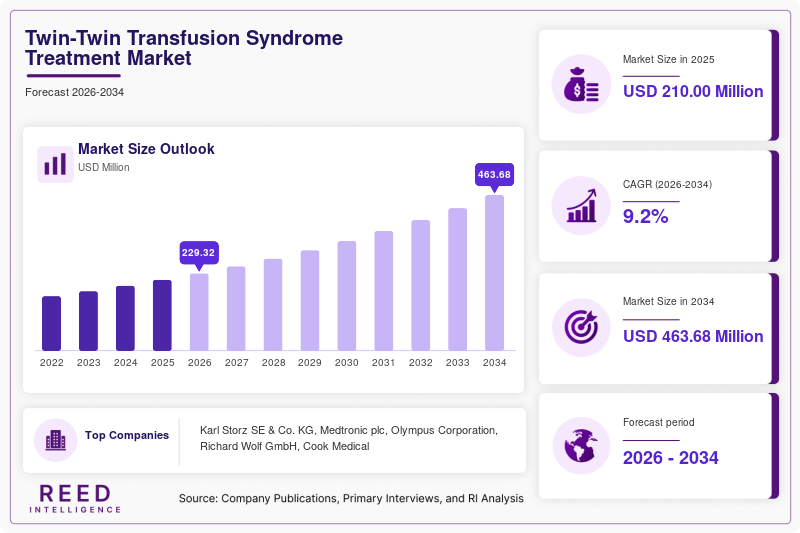
The Twin-Twin Transfusion Syndrome Treatment Market size was valued at approximately USD 210 million in 2025 and is projected to reach USD 465 million by 2034, expanding at a compound annual growth rate (CAGR) of 9.2% from 2025 to 2034. The market is witnessing steady growth due to increasing awareness of fetal complications associated with monochorionic twin pregnancies and the growing availability of advanced prenatal diagnostic technologies.
A key global factor supporting the growth of the Twin-Twin Transfusion Syndrome Treatment Market is the rising adoption of early prenatal screening and fetal monitoring programs. Improvements in ultrasound imaging and fetal medicine have enabled early detection of twin-twin transfusion syndrome (TTTS), allowing timely intervention and better clinical outcomes. Additionally, the expansion of specialized fetal care centers across developed and developing regions has contributed to improved treatment accessibility.
Key Highlights:
- North America dominated the market with a 40% share in 2025, while Asia Pacific is expected to register the fastest CAGR of 10.8% during the forecast period.
- Fetoscopic laser photocoagulation led the treatment segment with a 55% share, while amnioreduction is projected to grow at a CAGR of 9.9%.
- By end-use, hospitals held the largest share of 60%, while specialized fetal care centers are expected to grow fastest at a CAGR of 10.5%.
- The United States remained the dominant country, with market values of USD 85 million in 2025 and USD 92 million in 2026.
Market Trends
Advancements in Fetoscopic Laser Technologies
A significant trend in the Twin-Twin Transfusion Syndrome Treatment Market is the advancement of fetoscopic laser photocoagulation techniques. These procedures have become the standard of care for TTTS, enabling precise ablation of abnormal placental blood vessels. Technological innovations, including high-definition imaging systems and improved laser fibers, have enhanced procedural accuracy and reduced complications. As a result, clinicians are increasingly adopting minimally invasive surgical approaches for better fetal outcomes.
Increasing Focus on Multidisciplinary Fetal Care Centers
Another key trend is the growing establishment of multidisciplinary fetal care centers that integrate obstetrics, neonatology, and pediatric surgery. These centers provide comprehensive care for high-risk pregnancies, including TTTS cases. The collaborative approach improves diagnosis, treatment planning, and post-procedure monitoring. This trend is expected to strengthen the overall treatment ecosystem and drive demand for advanced TTTS therapies.
Market Drivers
Rising Incidence of Monochorionic Twin Pregnancies
The increasing number of twin pregnancies, particularly monochorionic twins, is a major driver of the Twin-Twin Transfusion Syndrome Treatment Market. Factors such as delayed maternal age and the growing use of assisted reproductive technologies have contributed to higher twin birth rates. This has directly increased the incidence of TTTS, thereby driving the demand for effective treatment solutions.
Improvements in Prenatal Diagnostic Capabilities
Advancements in prenatal diagnostic tools have significantly improved the detection of TTTS at early stages. High-resolution ultrasound and Doppler imaging enable accurate monitoring of fetal development and placental blood flow. Early diagnosis allows timely intervention, improving survival rates and reducing complications. This has led to increased adoption of TTTS treatment procedures globally.
Market Restraint
Limited Access to Specialized Treatment Centers
A major restraint in the Twin-Twin Transfusion Syndrome Treatment Market is the limited availability of specialized fetal therapy centers, particularly in low- and middle-income countries. TTTS treatment requires highly skilled professionals and advanced medical infrastructure, which are not widely accessible in many regions.
The complexity of procedures such as fetoscopic laser surgery also necessitates specialized training and equipment, increasing the barriers to entry for healthcare providers. As a result, patients in underserved regions often face delays in diagnosis and treatment, leading to adverse outcomes. This disparity in healthcare access continues to hinder the overall growth potential of the market.
Market Opportunities
Expansion of Telemedicine in Prenatal Care
The integration of telemedicine in prenatal care presents a significant opportunity for the Twin-Twin Transfusion Syndrome Treatment Market. Remote consultations and digital monitoring tools enable early identification of high-risk pregnancies, particularly in remote areas. Telemedicine platforms can connect patients with specialized fetal medicine experts, facilitating timely referrals and treatment planning.
Development of Next-Generation Minimally Invasive Devices
Ongoing research and development in minimally invasive surgical devices offer promising growth opportunities. Innovations in fetoscopic instruments, imaging systems, and laser technologies are expected to improve procedural safety and efficiency. These advancements will likely expand the adoption of TTTS treatments and enhance patient outcomes, contributing to market expansion.
Segmental Analysis
By Treatment Type
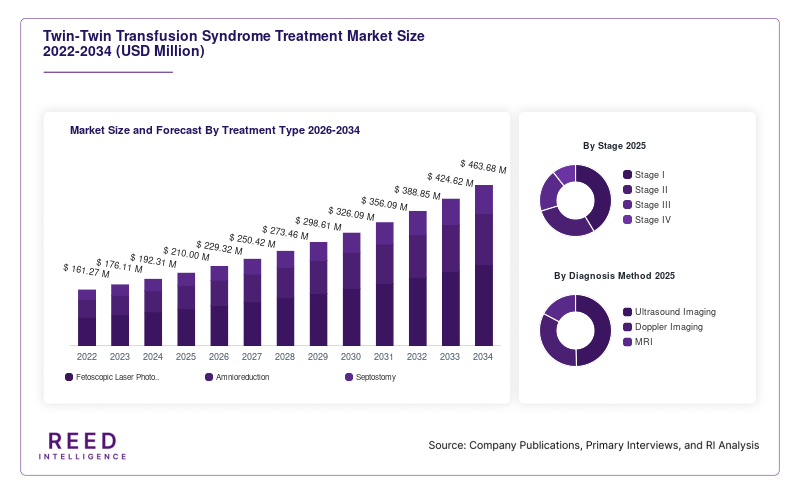
Fetoscopic laser photocoagulation dominated the Twin-Twin Transfusion Syndrome Treatment Market with a 55% share in 2025. This procedure is widely considered the standard treatment for TTTS, offering higher survival rates and better outcomes compared to alternative methods.
Amnioreduction is expected to grow at the fastest CAGR of 9.9%. This method will gain traction due to its relatively lower complexity and use in early-stage TTTS cases or when laser therapy is not feasible.
By Stage of TTTS
Stage II and III TTTS cases accounted for the largest share of 48% in 2025, as these stages typically require active medical intervention. Early diagnosis often leads to treatment at these stages.
Stage I TTTS is projected to grow at a CAGR of 10.2%, driven by increasing early detection and proactive management strategies aimed at preventing disease progression.
By End-Use
Hospitals held the largest share of 60% in 2025, as they serve as primary centers for TTTS diagnosis and treatment. The availability of advanced surgical facilities supports their dominance.
Specialized fetal care centers are expected to grow at a CAGR of 10.5%, driven by increasing demand for comprehensive and specialized care for high-risk pregnancies.
By Diagnosis Method
Ultrasound imaging dominated the market with a 70% share in 2025, as it is the primary diagnostic tool for detecting TTTS. Its non-invasive nature and widespread availability make it essential in prenatal care.
Doppler imaging is expected to grow at a CAGR of 10.3%, owing to its ability to provide detailed insights into blood flow patterns, improving diagnostic accuracy.
Regional Analysis
North America
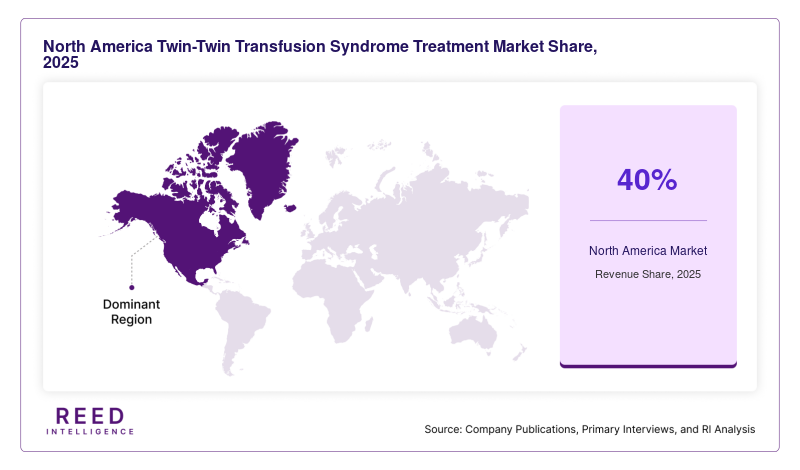
North America accounted for 40% of the Twin-Twin Transfusion Syndrome Treatment Market share in 2025 and will grow at a CAGR of 8.9% through 2034. The region benefits from advanced healthcare systems and widespread adoption of fetal medicine technologies.
The United States dominated the regional market due to its strong network of specialized fetal care centers. The presence of skilled practitioners and access to advanced treatment technologies have significantly improved TTTS management outcomes.
Europe
Europe held approximately 28% of the market share in 2025 and is expected to expand at a CAGR of 9.0% during the forecast period. The region has a well-established healthcare infrastructure and strong focus on maternal-fetal health.
Germany led the market due to its advanced medical research capabilities and availability of specialized treatment facilities. Government support for prenatal care programs has further driven market growth.
Asia Pacific
Asia Pacific represented 18% of the market share in 2025 and will register the fastest CAGR of 10.8% through 2034. Increasing healthcare investments and rising awareness of prenatal complications are driving growth.
China emerged as the dominant country due to its large population and improving healthcare infrastructure. Expanding access to prenatal diagnostics has increased the detection and treatment of TTTS cases.
Middle East & Africa
The Middle East & Africa accounted for 7% of the market share in 2025 and is projected to grow at a CAGR of 9.4%. The region is gradually adopting advanced medical technologies.
Saudi Arabia dominated the market, supported by investments in healthcare infrastructure and initiatives to improve maternal health services. The establishment of specialized care centers is contributing to market growth.
Latin America
Latin America held around 7% of the market share in 2025 and is expected to grow at a CAGR of 9.2% during the forecast period. The region is experiencing improvements in healthcare access and prenatal care awareness.
Brazil led the market due to increasing healthcare expenditure and growing focus on maternal health programs. Enhanced access to diagnostic services is supporting market expansion.
Competitive Landscape
The Twin-Twin Transfusion Syndrome Treatment Market is characterized by the presence of specialized medical device manufacturers and healthcare providers focusing on fetal medicine solutions. Companies are investing in technological advancements and expanding their product portfolios to strengthen their market position.
Karl Storz SE & Co. KG is a leading player in the market, known for its expertise in endoscopic equipment. The company recently introduced enhanced fetoscopic systems designed for improved visualization and precision during TTTS procedures.
Other key players are focusing on strategic collaborations with hospitals and research institutions to advance treatment technologies. Continuous innovation in minimally invasive surgical tools remains a critical strategy for maintaining competitiveness in this market.
Key Players List
- Karl Storz SE & Co. KG
- Medtronic plc
- Olympus Corporation
- Richard Wolf GmbH
- Cook Medical
- Stryker Corporation
- Boston Scientific Corporation
- B. Braun Melsungen AG
- Fujifilm Holdings Corporation
- Hologic, Inc.
- Siemens Healthineers
- GE Healthcare
- Philips Healthcare
- Intuitive Surgical, Inc.
- Teleflex Incorporated
Recent Developments
- In 2025, several healthcare institutions introduced advanced fetoscopic laser systems with improved imaging capabilities, enhancing procedural accuracy.
- Medical device companies increased investments in research focused on minimally invasive fetal surgery technologies.
- Strategic collaborations between hospitals and research centers expanded access to TTTS treatment solutions.
- New training programs for fetal surgeons were launched to improve procedural expertise globally.
- Advancements in prenatal imaging technologies improved early detection and diagnosis of TTTS cases.
Twin-Twin Transfusion Syndrome Treatment Market Segments
By Treatment Type
- Fetoscopic Laser Photocoagulation
- Amnioreduction
- Septostomy
By Stage
- Stage I
- Stage II
- Stage III
- Stage IV
By Diagnosis Method
- Ultrasound Imaging
- Doppler Imaging
- MRI
By End-Use
- Hospitals
- Specialized Fetal Care Centers
- Clinics
By Region
- North America
- Europe
- APAC
- Middle East and Africa
- LATAM