Tympanometer Market Size, Share Demand Report By Product Type (Handheld Tympanometers, Tabletop Tympanometers, Portable Digital Tympanometers), By Application (Diagnostic, Screening), By End-Use (Hospitals, Audiology Clinics, ENT Centers, Others), By Modality (Standalone, Hybrid) By Region & Segment Forecasts, 2025–2034
USD 3950
Market Overview
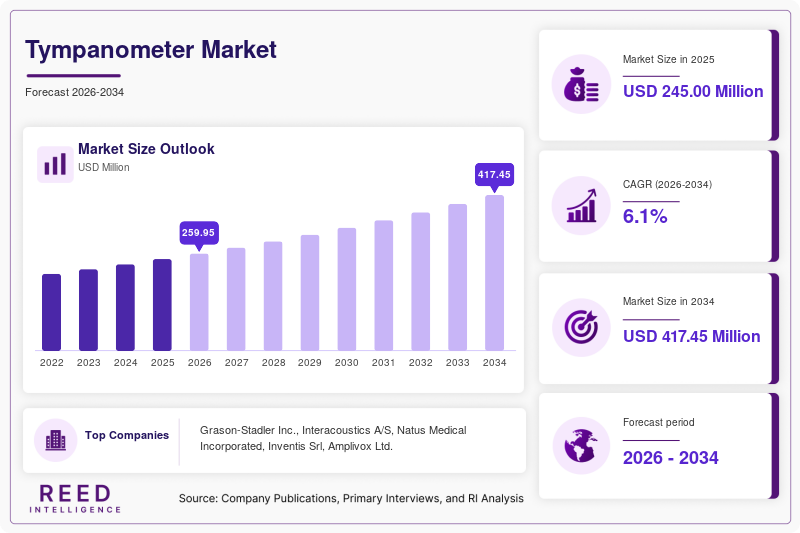
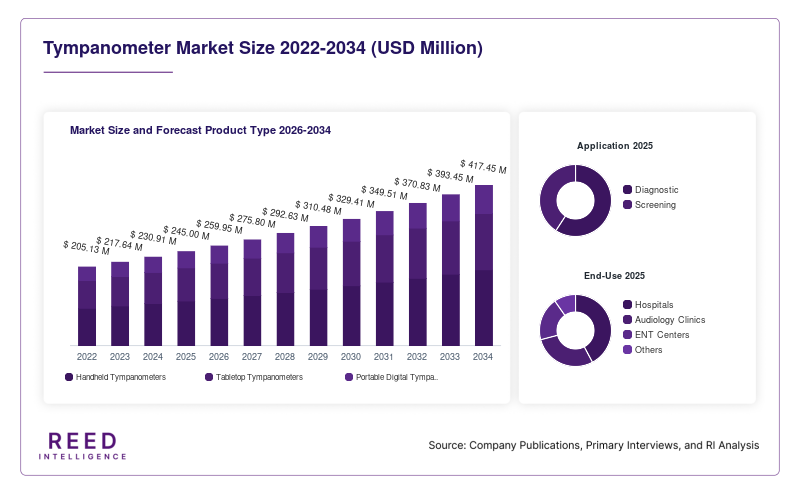
The global Tympanometer Market size was valued at approximately USD 245 million in 2025 and is projected to reach USD 415 million by 2034, expanding at a CAGR of 6.1% during the forecast period (2025–2034). The market is witnessing steady expansion due to increasing awareness of early diagnosis of hearing disorders and the growing integration of diagnostic devices in primary healthcare settings. Tympanometers, essential tools for evaluating middle ear function, are gaining importance in both clinical and screening environments.
One of the primary global factors supporting the Tympanometer Market growth is the rising prevalence of hearing impairments across all age groups. The increase in cases of otitis media, eardrum dysfunction, and conductive hearing loss has led to a higher demand for reliable and non-invasive diagnostic tools. Additionally, government-led screening programs and advancements in portable and automated tympanometry systems are enhancing accessibility in remote and underserved areas.
Key Highlights
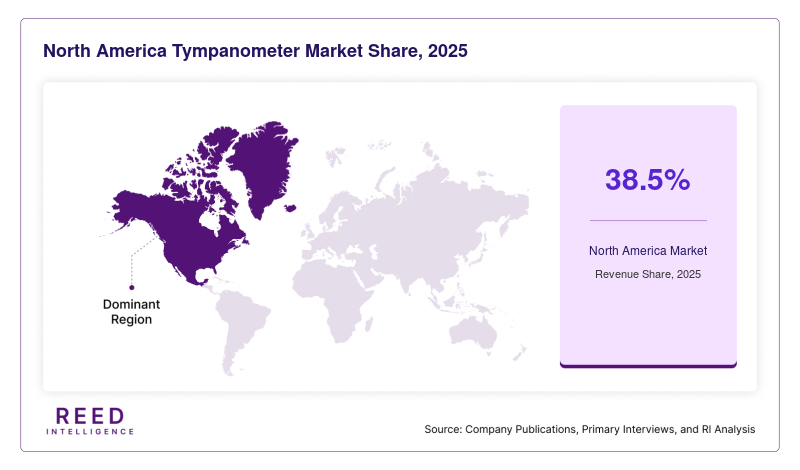
- North America dominated the Tympanometer Market with a 38.5% share in 2025, while Asia Pacific is expected to grow at the fastest CAGR of 7.4% during the forecast period.
- By product type, handheld tympanometers led the market in 2025 with a 56% share, while portable digital tympanometers are projected to grow at a CAGR of 7.2%.
- By end-use, hospitals dominated with a 47% share, while audiology clinics are anticipated to expand at a CAGR of 6.8%.
- The United States led the market, with values of USD 85 million in 2025 and an estimated USD 90 million in 2026.
Market Trends
Integration of Digital and Automated Tympanometry Systems
The Tympanometer Market is experiencing a shift toward digitalization, with automated tympanometry systems gaining adoption. These systems reduce operator dependency and improve diagnostic accuracy by providing standardized results. Integration with electronic medical records (EMR) systems is further enhancing workflow efficiency in healthcare facilities. Compact, touchscreen-enabled devices are also enabling ease of use in both clinical and field settings.
Growing Demand for Portable and Point-of-Care Devices
The demand for portable tympanometers is increasing as healthcare providers focus on expanding diagnostic capabilities beyond traditional hospital settings. Point-of-care testing has become a critical component in early detection, especially in pediatric and geriatric populations. Portable devices are particularly useful in school screening programs, home healthcare, and rural outreach initiatives. This trend is supporting broader market penetration and contributing to overall Tympanometer Market growth.
Market Drivers
Increasing Incidence of Ear Disorders
The rising number of patients diagnosed with middle ear infections and hearing loss conditions is a significant driver for the Tympanometer Market. Conditions such as otitis media and eustachian tube dysfunction require accurate diagnosis, which tympanometers provide efficiently. The growing pediatric population is particularly susceptible to such conditions, driving demand in both developed and developing regions.
Expansion of Preventive Healthcare and Screening Programs
Government and private sector initiatives promoting early diagnosis of hearing disorders are boosting the Tympanometer Market. School-based hearing screening programs and routine health check-ups are increasingly incorporating tympanometry tests. These initiatives are not only improving early detection rates but also expanding the usage of tympanometers across various healthcare settings.
Market Restraint
Restraint: High Cost of Advanced Tympanometry Equipment
Despite steady growth, the Tympanometer Market faces challenges due to the relatively high cost of advanced diagnostic devices. Digital and automated tympanometers, while offering improved accuracy and efficiency, require significant initial investment. This cost factor limits adoption among small clinics and healthcare facilities in low-income regions.
Additionally, maintenance costs and the need for trained professionals to operate sophisticated devices further hinder market growth. Budget constraints in public healthcare systems also restrict procurement, especially in developing countries. As a result, the market experiences uneven adoption across regions, with advanced systems concentrated in developed economies.
Market Opportunities
Emerging Markets with Untapped Healthcare Infrastructure
Developing regions present significant growth opportunities for the Tympanometer Market. Increasing healthcare investments and improving infrastructure are enabling the adoption of diagnostic devices. Governments are prioritizing hearing health, creating opportunities for manufacturers to expand their presence in these markets.
Technological Advancements in Wireless and AI-Based Diagnostics
The integration of artificial intelligence and wireless connectivity in tympanometers is opening new avenues for growth. AI-enabled devices can assist in interpreting results, reducing diagnostic errors. Wireless connectivity allows seamless data sharing, enabling telemedicine applications. These advancements are expected to enhance product value and drive adoption in the coming years.
Segmental Analysis
By Product Type
Handheld tympanometers dominated the Tympanometer Market in 2025, accounting for 56% of the total share. Their compact design, ease of use, and affordability made them widely adopted across various healthcare settings, including clinics and outreach programs.
Portable digital tympanometers are expected to grow at the fastest CAGR of 7.2%. Their ability to deliver accurate and automated results, along with enhanced connectivity features, will drive their adoption. These devices are particularly suitable for mobile healthcare services and telemedicine applications.
By Modality
Standalone tympanometers held the largest share of 62% in 2025 due to their widespread use in hospitals and specialized clinics. These devices offer comprehensive diagnostic capabilities and are preferred for detailed assessments.
Hybrid tympanometers are anticipated to grow at a CAGR of 6.9%. Their integration with other diagnostic tools and multifunctionality will make them increasingly popular among healthcare providers seeking efficiency and cost-effectiveness.
By End-Use
Hospitals dominated the Tympanometer Market with a 47% share in 2025, driven by high patient volumes and access to advanced diagnostic equipment. Hospitals remain the primary centers for diagnosing complex ear conditions.
Audiology clinics are projected to grow at a CAGR of 6.8%. The increasing number of specialized clinics focusing on hearing care is expected to drive demand. These clinics offer targeted services and are expanding in both urban and semi-urban areas.
By Application
Diagnostic applications accounted for 68% of the market share in 2025, as tympanometers are primarily used for detecting middle ear conditions. Their role in clinical diagnostics remains critical.
Screening applications are expected to grow at a CAGR of 7.1%. The expansion of school and community-based screening programs is driving demand for tympanometry devices in preventive healthcare.
Regional Analysis
North America
North America accounted for 38.5% of the Tympanometer Market share in 2025 and is expected to grow at a CAGR of 5.8% during the forecast period. The region’s growth will be driven by advanced healthcare infrastructure, high awareness levels, and widespread adoption of diagnostic technologies. The presence of well-established healthcare systems will continue to support steady demand.
The United States dominated the regional market due to strong reimbursement frameworks and a high prevalence of hearing disorders. The increasing integration of tympanometry in routine diagnostic procedures is supporting market expansion.
Europe
Europe held a 27% share of the Tympanometer Market in 2025 and is projected to grow at a CAGR of 5.6%. The region benefits from government-supported healthcare systems and increasing awareness of hearing health. Countries are investing in early detection programs, which is expected to sustain demand.
Germany led the European market due to its strong medical device industry and focus on technological innovation. The country’s emphasis on preventive healthcare is contributing to the adoption of tympanometers.
Asia Pacific
Asia Pacific captured 21% of the Tympanometer Market share in 2025 and is anticipated to grow at the fastest CAGR of 7.4%. Rapid urbanization, increasing healthcare spending, and growing awareness are key growth factors in the region.
China dominated the regional market due to its large population and expanding healthcare infrastructure. Government initiatives to improve rural healthcare access are boosting the adoption of portable tympanometers.
Middle East & Africa
The Middle East & Africa region held a 7% share of the Tympanometer Market in 2025 and is expected to grow at a CAGR of 6.2%. The market is supported by improving healthcare facilities and rising investments in medical technology.
Saudi Arabia led the region due to increased healthcare spending and modernization initiatives. The country’s focus on expanding diagnostic capabilities is driving demand.
Latin America
Latin America accounted for 6.5% of the Tympanometer Market share in 2025 and is projected to grow at a CAGR of 5.9%. The region is experiencing gradual improvements in healthcare infrastructure and awareness.
Brazil dominated the market due to its large healthcare system and growing emphasis on early diagnosis. Increased public health initiatives are supporting market growth.
Competitive Landscape
The Tympanometer Market is moderately competitive, with several global and regional players focusing on product innovation and geographic expansion. Companies are investing in research and development to introduce advanced, user-friendly devices.
A leading player in the market has strengthened its position through the launch of AI-integrated tympanometry systems, enhancing diagnostic accuracy and efficiency. Strategic partnerships and distribution agreements are also common, enabling companies to expand their market reach.
Other key players are focusing on cost-effective solutions to penetrate emerging markets. The competitive environment is characterized by continuous innovation and efforts to improve product accessibility.
Key Players List
- Grason-Stadler Inc.
- Interacoustics A/S
- Natus Medical Incorporated
- Inventis Srl
- Amplivox Ltd.
- Maico Diagnostics GmbH
- Otometrics (GN Group)
- Hill-Rom Holdings Inc.
- Welch Allyn (Baxter International)
- Frye Electronics Inc.
- MedRx Inc.
- Benson Medical Instruments
- PATH Medical GmbH
- Homoth Medizinelektronik GmbH & Co. KG
- Beijing Beier Hearing Technology Co., Ltd.
Recent Developments
- Recent developments in the Tympanometer Market include the introduction of compact wireless devices designed for telehealth applications.
- Several manufacturers have launched tympanometers with cloud connectivity, enabling real-time data sharing and remote diagnosis.
- Companies are also focusing on integrating artificial intelligence to assist clinicians in interpreting results more accurately.
- In addition, partnerships between device manufacturers and healthcare providers are increasing, aiming to expand access to hearing diagnostics in underserved regions. Product upgrades focusing on portability, battery efficiency, and user interface improvements are further shaping the competitive landscape.
Tympanometer Market Segments
Product Type
- Handheld Tympanometers
- Tabletop Tympanometers
- Portable Digital Tympanometers
Application
- Diagnostic
- Screening
End-Use
- Hospitals
- Audiology Clinics
- ENT Centers
- Others
Modality
- Standalone
- Hybrid
By Region
- North America
- Europe
- APAC
- Middle East and Africa
- LATAM