Typhoid Antibody Testing Market Size, Share & Demand Report By Product Type (Rapid Test Kits, ELISA Kits), By Test Type (IgM Tests, IgG Tests, Combined IgG/IgM Tests), By Technology (Immunochromatographic Assays, ELISA), By End-Use (Hospitals, Diagnostic Laboratories, Clinics) By Region & Segment Forecasts, 2026–2034
USD 3950
Market Overview
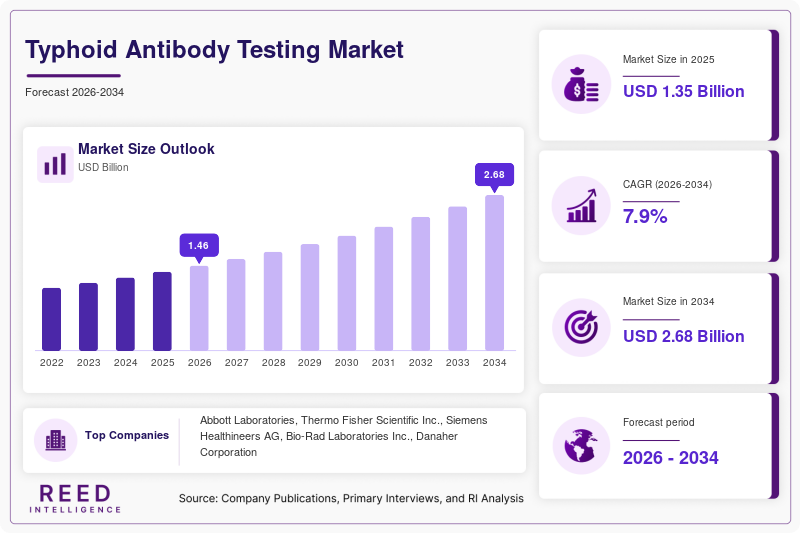
The global Typhoid Antibody Testing Market size was valued at approximately USD 1.35 billion in 2026 and is projected to reach USD 2.48 billion by 2034, expanding at a CAGR of 7.9% during the forecast period (2026–2034). The market growth reflects the increasing need for rapid and reliable diagnostic solutions to detect Salmonella Typhi infections, particularly in regions with high disease burden and limited access to advanced laboratory infrastructure.
One of the primary global factors supporting the expansion of the Typhoid Antibody Testing Market is the rising focus on early disease detection and preventive healthcare systems. Governments and healthcare organizations are increasingly investing in diagnostic infrastructure, especially in developing economies, to curb infectious disease outbreaks. This has driven the adoption of antibody-based diagnostic tests due to their cost-effectiveness, ease of use, and quick turnaround time compared to culture-based methods.
Key Highlights:
- North America dominated with 34.6% market share, while Asia Pacific is expected to register the fastest CAGR of 9.2%.
- Rapid test kits led the product segment with 52.1% share, while ELISA-based tests are projected to grow at a CAGR of 8.7%.
- Hospitals accounted for 47.3% share, whereas diagnostic laboratories are expected to grow at a CAGR of 8.4%.
- The U.S. market was valued at USD 410 million in 2024 and USD 435 million in 2025.
Market Trends
Increasing Adoption of Rapid Diagnostic Tests (RDTs)
A notable trend in the Typhoid Antibody Testing Market is the growing preference for rapid diagnostic tests (RDTs). These tests offer faster results, often within minutes, making them highly suitable for point-of-care settings. Healthcare providers increasingly favor RDTs in rural and resource-constrained environments where laboratory infrastructure is limited. The ease of use and minimal training requirements have further accelerated their adoption. Manufacturers are also focusing on enhancing accuracy levels, addressing earlier concerns regarding false positives, which is reinforcing their clinical reliability.
Integration of Digital Health Technologies in Diagnostics
Another emerging trend shaping the Typhoid Antibody Testing Market is the integration of digital health tools with diagnostic systems. Smart diagnostic platforms and connected devices are being introduced to streamline data collection, result interpretation, and remote patient monitoring. This trend is particularly evident in developed regions where healthcare digitization is advancing rapidly. Digital integration not only improves efficiency but also supports epidemiological tracking and disease surveillance. As a result, healthcare systems are better equipped to manage outbreaks and implement timely interventions, contributing to sustained market growth.
Market Drivers
Rising Prevalence of Typhoid Fever in Developing Regions
The increasing incidence of typhoid fever in low- and middle-income countries is a significant driver of the Typhoid Antibody Testing Market. Factors such as inadequate sanitation, unsafe drinking water, and limited access to healthcare contribute to the persistence of the disease. As governments and international health agencies intensify efforts to combat typhoid, the demand for diagnostic testing solutions continues to rise. Antibody testing plays a critical role in enabling early diagnosis, thereby reducing complications and improving patient outcomes.
Growing Demand for Cost-Effective Diagnostic Solutions
Another key driver is the growing demand for affordable diagnostic tools. Compared to molecular testing methods, antibody-based tests are relatively inexpensive and require minimal infrastructure. This makes them highly suitable for large-scale screening programs and use in primary healthcare settings. The affordability factor has encouraged widespread adoption, particularly in regions with constrained healthcare budgets. Manufacturers are focusing on developing low-cost kits without compromising quality, which is further driving market expansion.
Market Restraint
Limited Diagnostic Accuracy in Certain Test Formats
A major restraint in the Typhoid Antibody Testing Market is the variability in diagnostic accuracy associated with some antibody-based tests. Certain rapid diagnostic kits may exhibit lower specificity and sensitivity, leading to false-positive or false-negative results. This can affect clinical decision-making and reduce confidence among healthcare providers. Additionally, cross-reactivity with other infections can further complicate diagnosis. While advancements are being made to improve test performance, concerns regarding reliability continue to pose challenges for market growth, particularly in critical care settings where precise diagnosis is essential.
Market Opportunities
Expansion of Point-of-Care Testing in Rural Areas
The expansion of point-of-care testing presents a significant opportunity for the Typhoid Antibody Testing Market. Rural and remote regions often lack access to centralized laboratories, creating a demand for portable and easy-to-use diagnostic solutions. Companies can capitalize on this by developing compact, battery-operated devices and rapid test kits tailored for such environments. Increasing government initiatives to strengthen rural healthcare infrastructure further support this opportunity.
Development of High-Sensitivity Next-Generation Immunoassays
Advancements in immunoassay technology offer another promising opportunity. Next-generation antibody tests with improved sensitivity and specificity are being developed to overcome existing limitations. These innovations are expected to enhance diagnostic accuracy and expand clinical applications. As research and development investments increase, the introduction of advanced testing platforms is likely to open new growth avenues in both developed and emerging markets.
Segmental Analysis
By Product Type
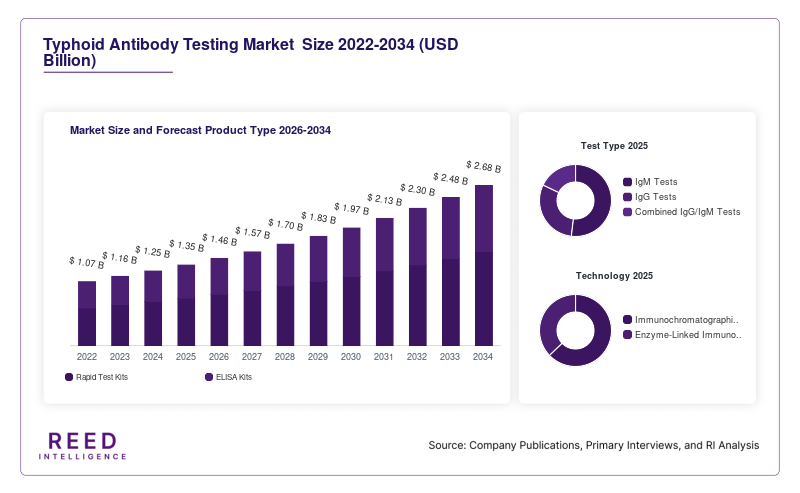
Rapid test kits dominated the Typhoid Antibody Testing Market with a 52.1% share in 2025, driven by their convenience and quick results. These kits are widely used in primary healthcare settings and emergency scenarios.
ELISA-based tests are expected to grow at a CAGR of 8.7%, owing to their higher accuracy and suitability for laboratory settings. Increasing demand for reliable diagnostic results is expected to support this segment.
By Test Type
IgM antibody tests held the largest share of 48.5% in 2025, as they are effective in detecting early-stage infections. Their ability to provide timely diagnosis has made them widely adopted.
Combined IgG/IgM tests are projected to grow at a CAGR of 8.9%, driven by their comprehensive diagnostic capabilities. These tests enable detection of both current and past infections, enhancing clinical decision-making.
By End-Use
Hospitals accounted for 47.3% share in 2025, reflecting their role as primary diagnostic centers for infectious diseases. Availability of skilled professionals and advanced equipment supports their dominance.
Diagnostic laboratories are anticipated to grow at a CAGR of 8.4%, supported by increasing outsourcing of diagnostic services. Laboratories offer specialized testing and higher throughput capabilities.
By Technology
Immunochromatographic assays dominated with 55.6% share in 2025, due to their simplicity and rapid results. These assays are widely used in point-of-care applications.
Enzyme-linked immunosorbent assays (ELISA) are expected to grow at a CAGR of 8.6%, driven by their enhanced sensitivity and specificity. Their use in confirmatory testing supports growth.
Regional Analysis
North America
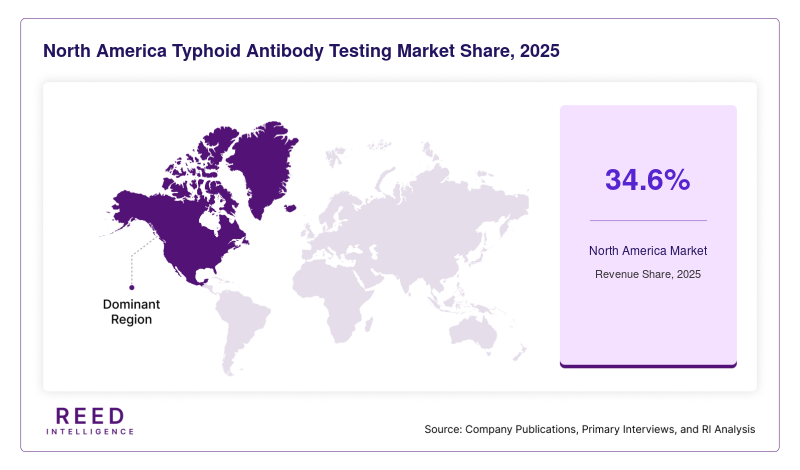
North America accounted for 34.6% of the Typhoid Antibody Testing Market share in 2025 and is expected to grow at a CAGR of 6.8% during 2026–2034. The region’s growth is supported by advanced healthcare infrastructure and high diagnostic awareness.
The United States remained the dominant country due to strong healthcare spending and early adoption of advanced diagnostic technologies. The presence of well-established diagnostic companies and continuous innovation in testing methods contributed to sustained market demand.
Europe
Europe held 27.2% share of the Typhoid Antibody Testing Market in 2025 and is projected to expand at a CAGR of 6.5%. The region benefits from structured healthcare systems and increasing focus on infectious disease control.
Germany led the regional market, driven by its robust laboratory network and emphasis on preventive healthcare. Government-backed initiatives to enhance disease surveillance further supported market growth.
Asia Pacific
Asia Pacific captured 22.8% share in 2025 and is expected to register the fastest CAGR of 9.2%. The region’s large population and high disease prevalence contribute to strong demand for diagnostic testing.
India emerged as the dominant country due to its high incidence of typhoid fever and expanding healthcare access. Government programs aimed at improving sanitation and diagnostic capabilities have played a crucial role in market expansion.
Middle East & Africa
The Middle East & Africa region accounted for 8.1% share in 2025 and is forecast to grow at a CAGR of 7.6%. Limited healthcare infrastructure in certain areas is offset by increasing investments in medical facilities.
South Africa led the market due to its relatively developed healthcare system and growing focus on infectious disease management. Public health initiatives have contributed to increased testing rates.
Latin America
Latin America held 7.3% share in 2025 and is projected to grow at a CAGR of 7.1%. The region is witnessing gradual improvements in healthcare accessibility and diagnostic services.
Brazil dominated the regional market, supported by government efforts to strengthen healthcare systems and increase awareness about infectious diseases. Expanding diagnostic networks have facilitated market growth.
Competitive Landscape
The Typhoid Antibody Testing Market is moderately competitive, with several global and regional players focusing on product innovation and expansion strategies. Key companies are investing in research and development to improve diagnostic accuracy and develop advanced testing solutions.
Abbott Laboratories is a leading player in the market, recognized for its extensive portfolio of diagnostic products. The company recently introduced an enhanced rapid antibody test with improved sensitivity, strengthening its market position. Other prominent players are also focusing on partnerships, mergers, and product launches to expand their global presence.
Key Players List
- Abbott Laboratories
- Thermo Fisher Scientific Inc.
- Siemens Healthineers AG
- Bio-Rad Laboratories Inc.
- Danaher Corporation
- F. Hoffmann-La Roche Ltd.
- Ortho Clinical Diagnostics
- Meridian Bioscience Inc.
- Trinity Biotech Plc
- CTK Biotech Inc.
- SD Biosensor Inc.
- Arkray Inc.
- Atlas Medical
- DiaSys Diagnostic Systems GmbH
- Omega Diagnostics Group PLC
Recent Developments
- 2025: Abbott Laboratories launched an upgraded rapid typhoid antibody test kit with enhanced detection capability.
- 2024: SD Biosensor introduced a new point-of-care testing solution targeting emerging markets.
- 2024: Thermo Fisher Scientific expanded its diagnostic product portfolio with improved ELISA kits.
- 2023: Bio-Rad Laboratories focused on automation in immunoassay platforms.
- 2023: Siemens Healthineers invested in digital diagnostic integration technologies.
Typhoid Antibody Testing Market Segments
Product Type
- Rapid Test Kits
- ELISA Kits
Test Type
- IgM Tests
- IgG Tests
- Combined IgG/IgM Tests
Technology
- Immunochromatographic Assays
- Enzyme-Linked Immunosorbent Assay (ELISA)
End-Use
- Hospitals
- Diagnostic Laboratories
- Clinics
Distribution Channel
- Direct Sales
- Third-Party Distributors
- Online Sales Platforms
By Region
- North America
- Europe
- APAC
- Middle East and Africa
- LATAM