UGG Boots Market Size, Share & Trends Analysis Report By Boot Type (Classic Boots, Mini & Ultra Mini Boots, Tall Boots, Platform Boots, Weather & Utility Boots), By Material (Sheepskin & Suede, Leather, Synthetic & Textile), By End User (Women, Men, Kids & Toddlers), By Distribution Channel (Offline, Online) and By Region (North America, Europe, APAC, Middle East and Africa, LATAM) Forecasts, 2026–2034
USD 3950
UGG Boots Market Size
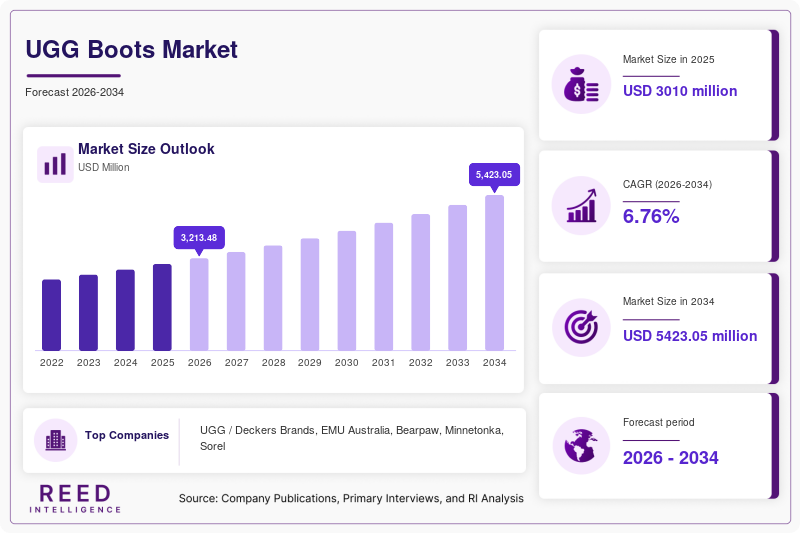
The global UGG boots market size was valued at USD 3,010 million in 2025 and is projected to grow from USD 3,210 million in 2026 to USD 5,423.05 million by 2034, registering a CAGR of 6.76% during the forecast period from 2026 to 2034.
The market is supported by the continued strength of the UGG brand's Classic franchise, expansion into shorter and platform silhouettes, wider men's and children's offerings, and the brand's effort to reduce dependence on winter-only demand. Deckers reported that UGG brand net sales increased 8.2% to USD 2.74 billion in fiscal 2026, while management highlighted growth in international markets, key franchises and year-round products.
UGG boots occupy a distinctive position between premium casual footwear and fashion footwear. The core proposition combines sheepskin or suede construction, warmth, softness and recognizable styling, while newer designs increasingly target fashion, everyday wear and multiple seasons. UGG's current Classic portfolio includes Ultra Mini, Mini, Short, Tall, Platform, Nubuck and weather-oriented variants, demonstrating how the brand is extending the original boot franchise into different silhouettes and use cases.
The commercial structure is also changing. Deckers reported that UGG revenue increased 8.2% in fiscal 2026, with wholesale sales up 12.7% and DTC sales up 3.6%. The company specifically attributed UGG growth to stronger global demand for key franchises and increased adoption of year-round products.
International expansion is an important demand mechanism. Deckers' overall international sales increased 26.8% in fiscal 2026, while the company said UGG growth was led by international markets. UGG already operates through retailers and its own stores across major markets including the U.S., Europe and Asia-Pacific.
UGG Boots Market Drivers
Strength of the Classic Boot Franchise
The Classic franchise remains the central commercial asset of the UGG boots category. Deckers describes UGG as a premium lifestyle brand built around iconic products, consumer loyalty and comfort, while its current Classic collection contains dozens of styles and variations.
The commercial mechanism is important because the company can introduce new heights, soles, materials, colors and embellishments without requiring consumers to learn an entirely new product identity. The Classic Ultra Mini, for example, is available in standard, platform, Western, nubuck and other variations. UGG also sells the Classic across women's, men's and children's categories, extending the same recognizable design language across customer groups.
Deckers' fiscal 2026 results reinforce the strength of this franchise-led model: UGG revenue increased 8.2%, and management specifically cited demand for key franchises as one reason for the increase.
Expansion Beyond Traditional Winter Footwear
UGG is reducing the category's dependence on a narrow winter-use proposition by expanding footwear into spring, summer and transitional seasons. Deckers states that UGG has diversified its footwear through spring and summer lines, men's slip-ons and sneakers, and new interpretations of its iconic Classics.
This strategy affects boots directly because shorter shafts and lighter constructions increase wearability outside the coldest months. The Classic Ultra Mini's lower shaft, for example, is designed for easier on-off use and greater versatility. Current UGG ranges also include weather-hybrid and lightweight designs.
The result is a broader purchase occasion: consumers can use short UGG boots in early autumn, spring and everyday casual settings instead of treating the product solely as deep-winter footwear.
Internationalization and Fashion-Led Brand Building
UGG is increasingly marketed as a global lifestyle brand rather than only a North American winter-boot brand. Deckers reported UGG sales growth in fiscal 2026 and stated that international growth led the brand's performance.
Marketing is also designed around fashion and cultural relevance. UGG's Autumn/Winter 2025 campaign included Sarah Jessica Parker, Jeremy Scott, Elsa Hosk, Leah Dou, Central Cee and other global creative figures, and featured Classic Ultra Mini, Classic Ultra Mini Platform, Classic Short, Classic Micro and other franchises.
This creates a demand mechanism in which footwear is purchased as a fashion statement as well as for warmth and comfort. It also allows the brand to enter markets where traditional sheepskin boots have a smaller functional role.
UGG Boots Market Restraints
Seasonality and Weather Exposure
Boot demand remains influenced by temperature, winter severity and fashion-season timing. Deckers explicitly states that a significant part of UGG's business has historically been seasonal, with the highest percentage of sales occurring in the company's third fiscal quarter. The company has attempted to reduce this exposure through year-round products.
Weather volatility can therefore affect both sell-through and inventory planning. A warm autumn can delay purchases of insulated boots, while an unusually cold period can create short-term spikes in demand. The shift toward mini boots, sandals, sneakers and lighter footwear helps offset this risk, but winter boots remain an important seasonal category.
Premium Pricing and Competitive Alternatives
UGG boots compete against established premium footwear brands as well as lower-priced alternatives and private-label products. The Classic Ultra Mini, for example, carries a materially higher price than many imitation or value alternatives available through mass-market retailers.
This creates a price-sensitivity issue, particularly when consumers can access visually similar silhouettes using synthetic materials. The competitive response depends on maintaining differentiation through brand recognition, materials, comfort, craftsmanship, collaborations and product innovation rather than competing primarily on price.
UGG Boots Market Opportunities
Short, Platform and Fashion-Forward Boot Silhouettes
The movement toward shorter shafts and platform soles creates opportunities to increase boot usage beyond traditional winter occasions. UGG currently markets the Classic Ultra Mini Platform as a bestseller and offers multiple platform and low-shaft variations.
The 2026 collection extends this direction through Western versions, calf-hair styles, Heritage designs and other fashion-oriented interpretations.
The commercial mechanism is product frequency. Instead of one consumer owning one traditional winter boot, multiple silhouettes can address different outfits, occasions and seasons.
Sustainable and Preferred Materials
Material innovation offers another differentiation route. UGG's current products use UGGplush, upcycled wool, recycled polyester and sugarcane EVA in various styles. The company has also reported that 100% of wool used in UGG footwear was repurposed or sourced from Responsible Wool Standard-certified sources in FY2024.
The ReImagined and Regenerate collections further demonstrate the use of surplus materials, regenerative sourcing and renewable components.
This can support premium positioning while addressing consumer and retailer interest in material traceability and reduced material waste.
Segmental Analysis
By Boot Type
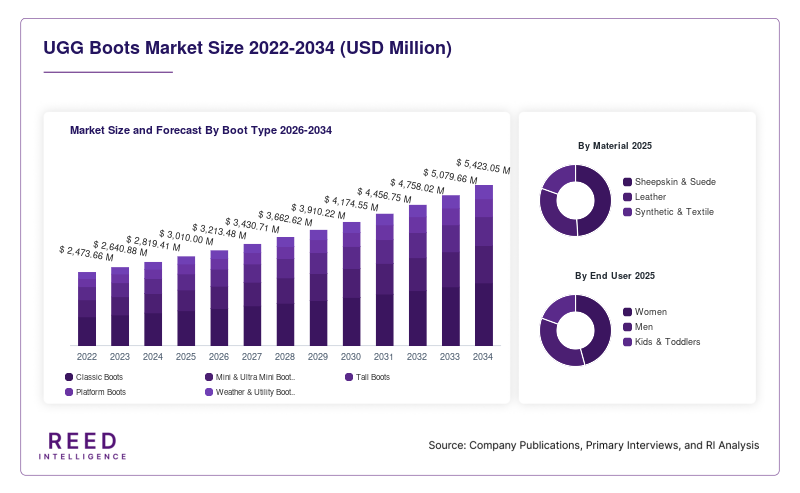
Classic Boots represent approximately 48% of the global market in 2025, making them the dominant product segment. The Classic franchise includes the original silhouette as well as multiple lengths, colors, platforms and material variations. UGG itself describes its Classic boots as its signature suede and sheepskin styles.
The Mini & Ultra Mini Boots segment is the fastest-growing category, with approximately 8.4% CAGR. The lower shaft provides easier on-off wear and greater styling flexibility. The current Ultra Mini is offered across women, men and kids, while the 2026 range adds Western, Nubuck and other versions.
By Material
Sheepskin & Suede account for approximately 68% share in 2025, reflecting the traditional UGG product construction and the continued prominence of the Classic franchise.
Synthetic & Textile materials are the fastest-growing material category at approximately 8.1% CAGR. The category includes recycled textiles, synthetic components and alternative constructions that allow UGG and competing brands to develop lighter, more versatile and lower-resource product variants.
UGG's current products increasingly combine traditional suede or sheepskin with UGGplush, recycled polyester and sugarcane EVA components.
By End User
Women account for approximately 63% of the market in 2025, reflecting the large established women's Classic and fashion-boot portfolio.
Men represent the fastest-growing end-user segment at approximately 8.2% CAGR. Deckers has specifically identified expansion of men's footwear, including slip-ons, sneakers and new boot styles, as part of the UGG growth strategy.
Current UGG men's collections include Classic Mini, Classic Ultra Mini, Weather Hybrid and new Birch boot formats, indicating greater investment in the men's product architecture.
By Distribution Channel
Offline distribution holds approximately 56% share in 2025. Department stores, specialty fashion retailers and UGG-owned stores remain important because consumers can evaluate fit, material softness, color and construction in person.
Online distribution is the fastest-growing channel at approximately 8.7% CAGR. UGG operates direct e-commerce while also selling through online retail partners. Deckers' DTC channel includes e-commerce and retail stores, and UGG's product range is distributed through both DTC and wholesale channels.
Online growth also benefits highly recognizable products such as the Classic Ultra Mini because consumers are already familiar with sizing, silhouette and material characteristics.
Regional Analysis
North America UGG Boots Market
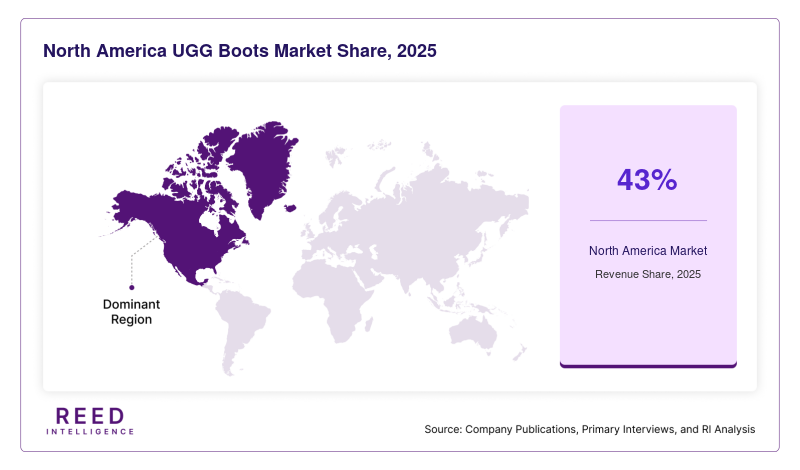
North America accounts for approximately 43% of the global UGG boots market in 2025, making it the dominant regional market. The region combines UGG's historical brand base, high consumer awareness, extensive department-store distribution, strong direct-to-consumer infrastructure and established winter footwear demand.
Deckers' fiscal 2026 results show that UGG remains a major contributor to the company's business, with UGG revenue reaching USD 2.74 billion and increasing 8.2% year over year. The company also maintains a substantial U.S. wholesale and DTC presence.
The U.S. market is also important for product innovation and cultural positioning. UGG has used campaigns with musicians, athletes, designers and other cultural figures to maintain relevance beyond functional winter footwear. Its 2025 campaign featured a broad international cast while highlighting the Classic Ultra Mini, Classic Short and Platform styles.
North America is projected to grow at approximately 6.1% CAGR. The principal mechanism is continued replacement of established Classic products combined with demand for shorter, platform and men's styles. The main constraint is the market's maturity and high exposure to seasonal purchasing.
Europe UGG Boots Market
Europe represents approximately 29% of the global market in 2025 and is projected to grow at approximately 6.7% CAGR. UGG has an established retail and e-commerce presence across major European fashion markets, including the United Kingdom, France, Germany and Spain.
The European product mix is becoming more fashion-oriented. UGG's current European collections include Classic Ultra Mini, Mini II, Platform, Nubuck, Western, Heritage and fashion-focused boot styles.
Europe is also important for brand collaborations and fashion storytelling. The 2025 Iconic From the First Step campaign moved between Venice Beach and Paris and incorporated designers, models, musicians and other cultural figures.
Consumer purchasing is influenced by fashion cycles, winter weather and the popularity of casual footwear. The region's broad climate range supports demand for both traditional warm boots and lighter transitional styles.
The key limitation is competition from European footwear brands and lower-priced fashion alternatives. Maintaining premium pricing requires continued differentiation through materials, brand equity, design and product freshness.
APAC UGG Boots Market
APAC represents approximately 18% of the global market in 2025 and is the fastest-growing region, with approximately 9.3% CAGR. The region has become increasingly important to UGG's global strategy, particularly through Japan, China, South Korea and Australia.
Deckers reported strong international momentum for UGG in fiscal 2026, and the company's UGG footprint includes major Asian markets such as Tokyo, Shanghai and Beijing.
Fashion positioning is particularly relevant in APAC because UGG can be marketed through streetwear, celebrity culture and seasonal fashion rather than only through cold-weather functionality. The 2024 Feels Like UGG campaign was shot in Seoul and featured international creatives, illustrating the company's use of Asian fashion markets in global brand building.
APAC's faster growth reflects lower historical penetration than North America together with expanding premium lifestyle consumption and fashion-led adoption. Short boots, platforms and lighter styles are particularly relevant because they allow consumers to wear recognizable UGG designs without requiring severe winter conditions.
Middle East and Africa UGG Boots Market
Middle East and Africa account for approximately 4% of the global market in 2025 and are projected to grow at approximately 7.2% CAGR. The region is a smaller market because warm climates reduce the functional requirement for heavily insulated winter boots.
Demand is therefore more closely connected with fashion, travel, premium retail and indoor climate-controlled environments. Shorter UGG boots, platform silhouettes and fashion variants can address consumers who value the brand identity without needing traditional winter functionality.
Premium shopping centers in Gulf markets provide an established distribution environment for international lifestyle brands, while tourism increases exposure to global fashion trends.
The primary limitation is climate. Heavy sheepskin boots have a narrower practical use case in hot-weather markets, making mini, lightweight and fashion-focused styles more commercially relevant than traditional tall winter boots.
LATAM UGG Boots Market
LATAM represents approximately 6% of the global market in 2025 and is projected to grow at approximately 7.8% CAGR. The market is supported by premium footwear consumption in large urban centers and growing exposure to international lifestyle brands.
UGG's global distribution model includes Latin America, while Deckers identifies international markets as an important source of UGG growth.
Demand is likely to remain concentrated in cooler climates, higher-income urban consumers and fashion-oriented customer groups. Short boots, platforms and seasonal designs offer a broader addressable market than heavily insulated traditional styles.
The main constraints are purchasing power, currency fluctuations and uneven premium-retail infrastructure across countries. These factors can make UGG boots more discretionary than essential footwear.
Competitive Landscape
The UGG boots market is characterized by strong brand differentiation, high recognition of the Classic silhouette and competition from premium lifestyle footwear companies and lower-priced lookalikes.
UGG/Deckers maintains a vertically coordinated brand model across product design, marketing, DTC retail and wholesale distribution, while independent third-party manufacturers produce its products. Deckers reported UGG revenue of USD 2.74 billion in fiscal 2026, with UGG wholesale revenue increasing 12.7% and DTC revenue increasing 3.6%.
The competitive strategy increasingly depends on extending the Classic franchise. Platform, Ultra Mini, Western, Heritage, Nubuck and weather-oriented versions allow the brand to refresh a familiar product architecture.
Marketing collaborations are another competitive tool. UGG's Post Malone partnership expanded the brand's men's Weather Hybrid positioning, while its 2025 campaign used a large international cast to connect the Classic franchise with fashion and popular culture.
Key Market Players
- UGG / Deckers Brands
- EMU Australia
- Bearpaw
- Minnetonka
- Sorel
- Koolaburra by UGG
- Mou
- Shepherd of Sweden
- Australia Luxe Collective
- Skechers
- Timberland
- Crocs
- Clarks
- Dr. Martens
- Steve Madden
Recent Market Developments
- September 2026 – The brand's 2026 new collection expanded into Western-inspired Classic Ultra Mini and Classic Tall styles, Heritage boots, calf-hair boots and other fashion-oriented designs. This broadens the Classic franchise beyond its traditional winter silhouette.
- August 2026 – The brand launched a back-to-school campaign featuring MUNA and introduced the Ultra Mini Bailey Bow, alongside new and established footwear and apparel. The product was initially exclusive to UGG and Journeys for 30 days.
UGG Boots Market Segments
By Boot Type
- Classic Boots
- Mini & Ultra Mini Boots
- Tall Boots
- Platform Boots
- Weather & Utility Boots
By Material
- Sheepskin & Suede
- Leather
- Synthetic & Textile
By End User
- Women
- Men
- Kids & Toddlers
By Distribution Channel
- Offline
- Online
By Region
- North America
- Europe
- APAC
- Middle East and Africa
- LATAM