Ultra High Definition Surgical Display Market Size, Share & Demand Report By Resolution (4K, 8K), By Display Type (LED, OLED, LCD), By Application (Laparoscopic Surgery, Endoscopy, Robot-Assisted Surgery, Others), By End-Use (Hospitals, Ambulatory Surgical Centers, Specialty Clinics), By Region & Segment Forecasts, 2025–2034
USD 3950
Market Overview
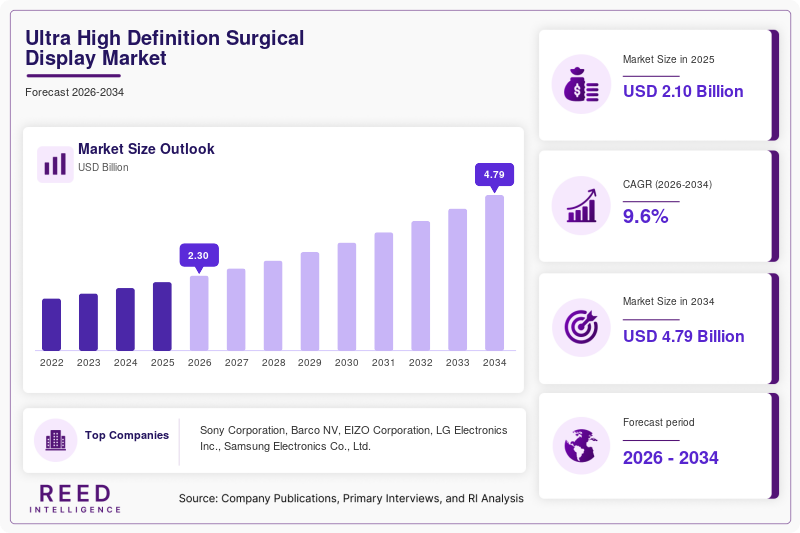
The Ultra High Definition Surgical Display Market size was valued at approximately USD 2.1 billion in 2025 and is projected to reach USD 4.8 billion by 2034, expanding at a CAGR of 9.6% during the forecast period (2025–2034). The market has been steadily evolving due to the increasing integration of advanced visualization technologies in operating rooms, particularly in minimally invasive and image-guided surgeries.
A key global factor supporting market growth is the rising adoption of precision-based surgical procedures, which require enhanced visualization clarity and accuracy. Ultra high definition (UHD) surgical displays provide superior resolution, color accuracy, and real-time imaging capabilities, enabling surgeons to make more informed decisions during complex procedures. The transition from conventional HD to 4K and 8K displays has further improved surgical outcomes and reduced procedural risks.
Key Highlights
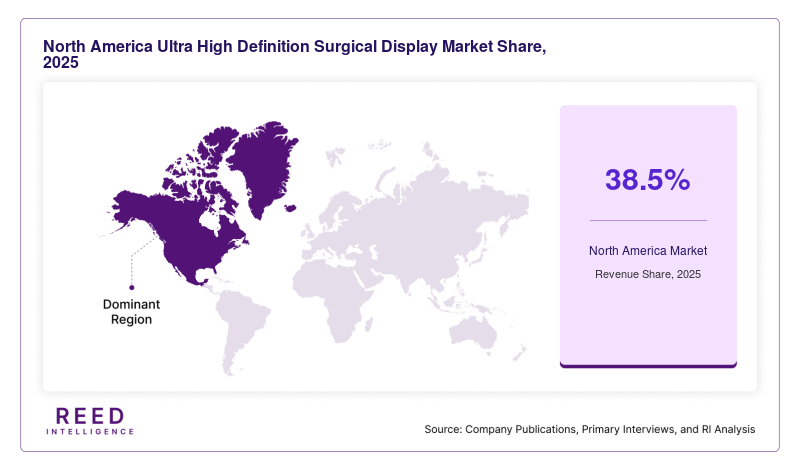
- North America dominated the market with a 38.5% share in 2025, while Asia Pacific is projected to grow at the fastest CAGR of 11.8%.
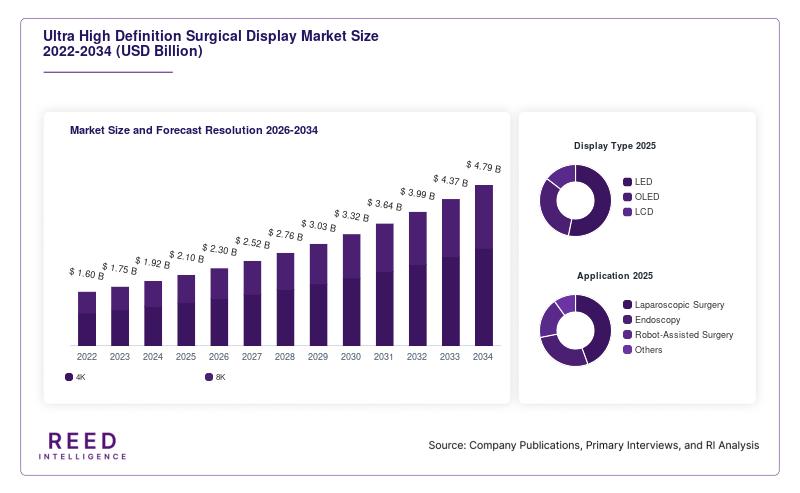
- By resolution, 4K displays held the largest share (54.2%), while 8K displays are expected to grow at a CAGR of 12.6%.
- By application, laparoscopic surgery dominated (31.7%), whereas robot-assisted surgery is projected to grow at 13.2% CAGR.
- The United States remained the dominant country, with market values of USD 720 million in 2025 and USD 785 million in 2026.
Market Trends
Integration of 8K and Advanced Imaging Technologies
A prominent trend in the Ultra High Definition Surgical Display Market is the growing adoption of 8K resolution displays and advanced imaging integration. These displays provide unparalleled image clarity, enabling surgeons to visualize minute anatomical structures with exceptional precision. The demand for 8K technology is particularly rising in neurosurgery, oncology, and complex cardiovascular procedures. In addition, the integration of augmented reality (AR) and artificial intelligence (AI)-based imaging systems into UHD displays is enhancing intraoperative decision-making. These technologies allow real-time overlay of diagnostic data onto surgical visuals, improving accuracy and reducing errors.
Shift Toward Hybrid Operating Rooms
Another notable trend shaping the Ultra High Definition Surgical Display Market is the increasing development of hybrid operating rooms (ORs). These advanced surgical environments combine traditional surgical capabilities with imaging systems such as CT, MRI, and fluoroscopy. UHD displays serve as a central component in these setups, facilitating seamless visualization of multi-source imaging data. Hospitals are prioritizing hybrid OR installations to improve surgical efficiency and patient outcomes. The trend is particularly strong in developed regions, where healthcare providers are investing heavily in integrated surgical ecosystems. Additionally, the demand for multi-display configurations and large-format screens is rising, supporting collaborative surgical workflows.
Market Drivers
Increasing Demand for Minimally Invasive Surgeries
The growing preference for minimally invasive surgical (MIS) procedures is a significant driver of the Ultra High Definition Surgical Display Market. MIS techniques rely heavily on high-quality imaging systems for accurate navigation and visualization. UHD displays offer enhanced depth perception and clarity, which are essential for procedures performed through small incisions. As patients increasingly opt for minimally invasive options due to shorter recovery times and reduced complications, healthcare providers are upgrading their imaging infrastructure. This shift is driving the demand for advanced surgical displays across hospitals and specialty clinics.
Technological Advancements in Display Systems
Rapid advancements in display technologies have significantly contributed to market growth. Innovations such as OLED panels, high dynamic range (HDR), and wide color gamut technologies have improved image quality and energy efficiency. These advancements are enabling UHD surgical displays to deliver more realistic and detailed visuals. Furthermore, improvements in display durability and sterilization compatibility have made these systems more suitable for surgical environments. Manufacturers are also focusing on developing lightweight and ergonomic displays, enhancing usability in operating rooms. The continuous evolution of display technology is expected to drive sustained growth in the Ultra High Definition Surgical Display Market.
Market Restraint
High Cost of Advanced Surgical Display Systems
One of the primary challenges facing the Ultra High Definition Surgical Display Market is the high cost associated with UHD display systems. The initial investment required for purchasing and installing advanced surgical displays, especially 8K systems, is significantly higher than conventional HD displays. Additionally, the cost of integrating these displays with existing hospital infrastructure and imaging systems can be substantial.
Maintenance and operational costs further add to the financial burden, particularly for small and mid-sized healthcare facilities. Budget constraints in developing regions often limit the adoption of advanced surgical technologies, slowing market penetration. While large hospitals in developed economies can afford these investments, smaller facilities may delay upgrades, impacting overall market growth.
Market Opportunities
Expansion in Emerging Healthcare Markets
Emerging economies present significant growth opportunities for the Ultra High Definition Surgical Display Market. Countries in Asia Pacific, Latin America, and the Middle East are witnessing rapid improvements in healthcare infrastructure. Governments and private investors are increasing spending on hospital modernization, creating demand for advanced surgical equipment. The rising prevalence of chronic diseases and growing awareness of advanced surgical techniques are further driving adoption. As healthcare systems in these regions continue to evolve, the demand for UHD surgical displays is expected to rise significantly.
Integration with Robotic Surgery Platforms
The increasing adoption of robotic-assisted surgical systems offers another promising opportunity for market growth. UHD displays play a crucial role in robotic surgeries by providing high-resolution visuals that enhance precision and control. As robotic surgery becomes more widespread, the need for compatible and advanced display systems will increase. Manufacturers are focusing on developing displays that seamlessly integrate with robotic platforms, offering improved visualization and workflow efficiency. This synergy between robotic systems and UHD displays is expected to create new growth avenues in the Ultra High Definition Surgical Display Market.
Segmental Analysis
By Resolution
The 4K resolution segment dominated the Ultra High Definition Surgical Display Market in 2025, accounting for 54.2% of the total share. This dominance is attributed to its balance between cost and performance, making it widely adopted across hospitals and surgical centers.
The 8K resolution segment is projected to grow at a CAGR of 12.6% during the forecast period. Its growth will be driven by increasing demand for ultra-precise imaging in complex surgical procedures, where enhanced visualization is critical.
By Display Type
LED-based displays held the largest share of 48.9% in 2025, owing to their energy efficiency, durability, and cost-effectiveness. These displays are widely used in operating rooms due to their reliability.
OLED displays are expected to witness the fastest growth, with a CAGR of 11.4%. Their superior contrast ratio and color accuracy will drive adoption in specialized surgical applications.
By Application
Laparoscopic surgery dominated the market with a 31.7% share in 2025, driven by the widespread use of minimally invasive techniques.
Robot-assisted surgery is anticipated to grow at a CAGR of 13.2%, fueled by advancements in robotic systems and increasing adoption in complex procedures.
By End-Use
Hospitals accounted for the largest share of 62.5% in 2025, as they are the primary users of advanced surgical equipment.
Ambulatory surgical centers (ASCs) are projected to grow at a CAGR of 10.8%, supported by the rising preference for outpatient procedures and cost-effective treatments.
Regional Analysis
North America
North America accounted for 38.5% of the Ultra High Definition Surgical Display Market share in 2025 and will continue to maintain a strong position, growing at a projected CAGR of 8.9% through 2034. The region’s growth is driven by advanced healthcare infrastructure and early adoption of innovative technologies.
The United States dominated the regional market due to high investments in surgical technologies and the presence of leading healthcare providers. The increasing number of complex surgical procedures and demand for precision-based treatments have contributed to market expansion.
Europe
Europe held approximately 27.2% market share in 2025 and is expected to grow at a CAGR of 8.5% during the forecast period. The region has a well-established healthcare system and a strong focus on technological innovation.
Germany emerged as the dominant country, supported by its advanced medical device industry and high adoption of minimally invasive procedures. The country’s emphasis on research and development has accelerated the adoption of UHD surgical displays.
Asia Pacific
Asia Pacific accounted for 20.4% of the market share in 2025 and is anticipated to grow at the fastest CAGR of 11.8%. Rapid healthcare infrastructure development and increasing healthcare expenditure are key factors driving growth.
China led the regional market due to its large patient population and expanding hospital network. The government’s focus on modernizing healthcare facilities has boosted the adoption of advanced surgical technologies.
Middle East & Africa
The Middle East & Africa region held 7.1% market share in 2025 and is projected to grow at a CAGR of 9.2%. Increasing investments in healthcare infrastructure and rising demand for advanced medical technologies are supporting growth.
Saudi Arabia dominated the region, driven by government initiatives to improve healthcare services and infrastructure. The adoption of advanced surgical equipment is steadily increasing in major hospitals.
Latin America
Latin America captured 6.8% of the market share in 2025 and is expected to grow at a CAGR of 9.0%. The region is experiencing gradual improvements in healthcare systems and increasing adoption of modern technologies.
Brazil emerged as the leading country, supported by a growing healthcare sector and rising demand for minimally invasive procedures. Investments in hospital upgrades are contributing to market growth.
Competitive Landscape
The Ultra High Definition Surgical Display Market is moderately consolidated, with several global players competing based on technological innovation and product quality. Leading companies are focusing on product development, partnerships, and geographic expansion to strengthen their market position.
A key market leader is Sony Corporation, which has introduced advanced 4K and 8K surgical display systems with enhanced imaging capabilities. The company’s focus on innovation and integration with surgical imaging systems has reinforced its leadership.
Other major players are actively investing in research and development to introduce next-generation display technologies. Strategic collaborations with healthcare providers are also helping companies expand their presence in emerging markets.
Key Players
- Sony Corporation
- Barco NV
- EIZO Corporation
- LG Electronics Inc.
- Samsung Electronics Co., Ltd.
- Stryker Corporation
- Olympus Corporation
- Karl Storz SE & Co. KG
- Smith & Nephew plc
- Steris plc
- Shenzhen Beacon Display Technology Co., Ltd.
- FSN Medical Technologies
- Advantech Co., Ltd.
- Richardson Electronics Ltd.
- Double Black Imaging
Recent Developments
- Sony Corporation launched a next-generation 8K surgical display with improved HDR capabilities.
- Barco NV introduced a multi-display integration platform for hybrid operating rooms.
- LG Electronics expanded its medical display portfolio with advanced OLED surgical monitors.
- Stryker Corporation partnered with hospitals to deploy integrated surgical visualization systems.
- EIZO Corporation developed high-brightness displays optimized for surgical environments.
Ultra High Definition Surgical Display Market Segments
Resolution
- 4K
- 8K
Display Type
- LED
- OLED
- LCD
Application
- Laparoscopic Surgery
- Endoscopy
- Robot-Assisted Surgery
- Others
End-Use
- Hospitals
- Ambulatory Surgical Centers
- Specialty Clinics
By Region
- North America
- Europe
- APAC
- Middle East and Africa
- LATAM