Ultralarge Volume Wearable Injectors Market Size, Share & Demand Report By Type (On-Body Injectors, Off-Body Injectors), By Application (Oncology, Immunology, Diabetes, Cardiovascular Diseases, Others), By End-Use (Hospitals, Home Care Settings, Specialty Clinics), By Distribution Channel (Hospital Pharmacies, Retail Pharmacies, Online Pharmacies), By Region & Segment Forecasts, 2025–2034
USD 3950
Market Overview
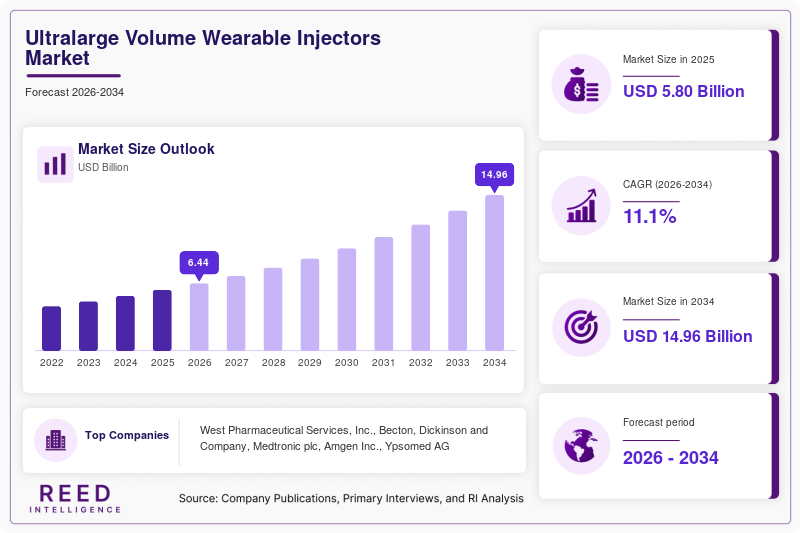
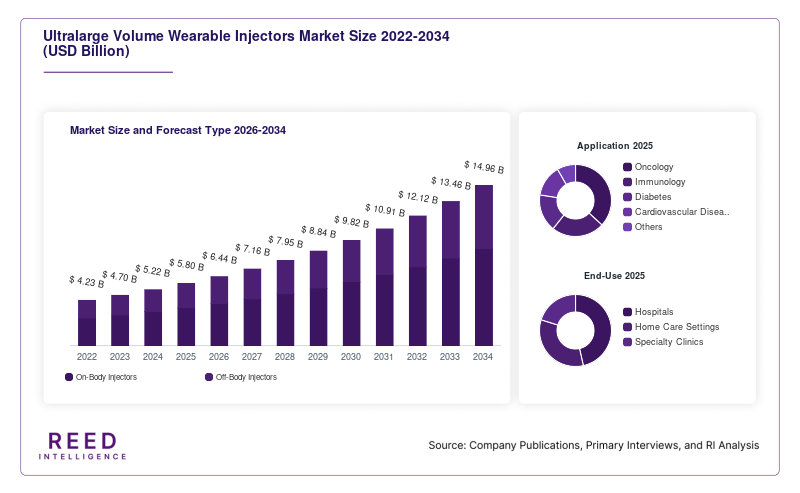
The global Ultralarge Volume Wearable Injectors Market size was valued at approximately USD 5.8 billion in 2025 and is projected to reach USD 14.9 billion by 2034, expanding at a CAGR of 11.1% during the forecast period (2025–2034). The market growth is primarily supported by the increasing demand for patient-centric drug delivery systems that enable self-administration of biologics and high-volume therapeutics outside clinical settings. The growing prevalence of chronic diseases such as autoimmune disorders and oncology conditions has accelerated the adoption of wearable injectors capable of delivering large drug volumes over extended durations.
A major global factor driving this market is the shift toward home-based healthcare and decentralized treatment models. Healthcare systems across developed and emerging economies are focusing on reducing hospital visits and optimizing costs, which has strengthened the demand for wearable drug delivery devices.
Key Highlights
- North America dominated the market with a 38.6% share in 2025, while Asia Pacific is expected to register the fastest CAGR of 13.4% during the forecast period.
- On-body injectors emerged as the leading type segment with a 61.2% share, while off-body injectors are projected to grow at a CAGR of 12.8%.
- In application, oncology held the largest share at 34.5%, whereas immunology is expected to grow fastest at a CAGR of 12.6%.
- The United States accounted for USD 2.1 billion in 2025 and is estimated to reach USD 2.4 billion in 2026.
Market Trends
Integration of Smart and Connected Technologies
The Ultralarge Volume Wearable Injectors Market is experiencing a shift toward smart devices integrated with connectivity features such as Bluetooth and mobile app synchronization. These advanced injectors allow real-time monitoring of drug delivery, adherence tracking, and remote physician oversight. The incorporation of digital health ecosystems is improving treatment compliance and enabling personalized therapies, especially for chronic disease management.
Expansion of Biologics and Biosimilars Pipeline
The rapid expansion of biologics and biosimilars has significantly influenced the demand for ultralarge volume wearable injectors. Many next-generation therapeutics require high-volume subcutaneous delivery, which traditional syringes or autoinjectors cannot support effectively. Pharmaceutical companies are increasingly collaborating with device manufacturers to develop combination products, thereby enhancing drug-device compatibility and improving patient convenience.
Market Drivers
Rising Adoption of Self-Administration Devices
The growing preference for self-administration among patients has driven demand for wearable injectors. These devices reduce dependency on healthcare professionals and minimize hospital visits. The convenience of administering large doses at home, combined with reduced treatment burden, has contributed to higher patient acceptance and adherence.
Increasing Prevalence of Chronic Diseases
The global burden of chronic diseases such as cancer, diabetes, and autoimmune disorders continues to rise. Many of these conditions require long-term biologic therapies that involve frequent and high-volume dosing. Ultralarge volume wearable injectors offer an efficient solution by enabling continuous or controlled drug delivery, thereby supporting improved therapeutic outcomes.
Market Restraint
High Device Cost and Reimbursement Challenges
The high cost associated with ultralarge volume wearable injectors remains a significant restraint for market growth. These devices involve advanced engineering, precision components, and integrated electronics, which increase manufacturing costs. As a result, affordability becomes a concern, particularly in price-sensitive markets.
In addition, reimbursement policies for wearable drug delivery devices vary across regions, limiting their widespread adoption. In several healthcare systems, reimbursement frameworks are still evolving and may not fully cover the cost of these advanced devices. This creates financial barriers for both patients and healthcare providers, slowing market penetration.
Market Opportunities
Emerging Markets Expansion
Developing regions present significant growth opportunities for the Ultralarge Volume Wearable Injectors Market. Improvements in healthcare infrastructure, rising awareness of advanced treatment options, and increasing healthcare expenditure are creating favorable conditions for market expansion. Companies are focusing on introducing cost-effective solutions tailored to these regions.
Development of Customized Drug-Device Combinations
The growing trend of personalized medicine has opened new avenues for customized drug-device combinations. Pharmaceutical companies are increasingly partnering with device manufacturers to co-develop wearable injectors specifically designed for targeted therapies. This approach enhances treatment efficacy and patient convenience, thereby driving demand in specialized therapeutic areas.
Segmental Analysis
By Type
On-body injectors dominated the Ultralarge Volume Wearable Injectors Market in 2025, accounting for 61.2% of the total share. These devices are directly attached to the patient’s body, allowing continuous drug delivery over extended periods. Their ease of use and improved patient comfort have contributed to their widespread adoption.
Off-body injectors are expected to register the fastest growth, with a projected CAGR of 12.8% during the forecast period. These devices offer flexibility in positioning and are suitable for specific clinical applications. Their ability to handle higher drug volumes with enhanced control will drive their adoption.
By Application
Oncology emerged as the leading application segment, holding a 34.5% share in 2025. The increasing use of biologics for cancer treatment and the need for high-dose drug administration have driven demand for wearable injectors in this segment.
Immunology is anticipated to grow at the fastest CAGR of 12.6% during the forecast period. The rising prevalence of autoimmune diseases and the development of targeted therapies will support the growth of this segment.
By End-Use
Hospitals accounted for the largest share of 46.3% in 2025, as they remain the primary point of care for complex treatments requiring supervision. The use of wearable injectors in hospital settings ensures accurate dosing and monitoring.
Home care settings are projected to grow at a CAGR of 13.1% during the forecast period. The increasing shift toward home-based treatment and patient preference for convenient healthcare solutions will drive growth in this segment.
By Distribution Channel
Hospital pharmacies dominated the market with a 49.7% share in 2025. These channels ensure reliable access to advanced medical devices and support integrated care delivery.
Online pharmacies are expected to witness the fastest growth, with a CAGR of 13.5%. The rising adoption of digital platforms and the convenience of online purchasing will contribute to the expansion of this segment.
Regional Analysis
North America
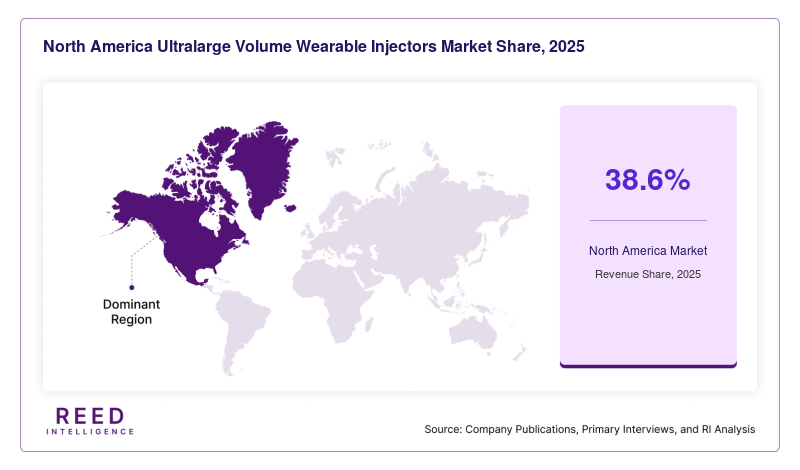
North America accounted for 38.6% of the Ultralarge Volume Wearable Injectors Market share in 2025 and is expected to grow at a CAGR of 10.2% during the forecast period. The region’s mature healthcare infrastructure, strong presence of key market players, and high adoption of advanced drug delivery technologies contributed to its leading position.
The United States dominated the regional market due to the widespread use of biologics and increasing demand for home-based care solutions. The country’s strong regulatory framework and continuous investment in healthcare innovation have supported the adoption of wearable injectors.
Europe
Europe held a 27.4% share of the market in 2025 and is projected to grow at a CAGR of 10.8% through 2034. The region’s growth was driven by rising healthcare awareness, increasing chronic disease burden, and supportive government initiatives promoting advanced medical technologies.
Germany emerged as the dominant country in Europe, supported by its well-established pharmaceutical industry and focus on research and development. The adoption of innovative drug delivery systems in clinical practice has further contributed to market expansion.
Asia Pacific
Asia Pacific accounted for 19.8% of the market share in 2025 and is anticipated to grow at the fastest CAGR of 13.4% during the forecast period. Rapid urbanization, increasing healthcare investments, and a growing patient population have driven market growth in the region.
China led the regional market due to its expanding healthcare infrastructure and rising demand for advanced treatment options. Government initiatives aimed at improving healthcare accessibility have also played a key role in boosting market growth.
Middle East & Africa
The Middle East & Africa region held a 7.2% share of the market in 2025 and is expected to grow at a CAGR of 9.6% during the forecast period. The market growth is supported by gradual improvements in healthcare systems and increasing awareness of modern treatment technologies.
Saudi Arabia emerged as the dominant country in the region, driven by significant investments in healthcare infrastructure and initiatives to modernize medical services.
Latin America
Latin America accounted for 7.0% of the market share in 2025 and is projected to grow at a CAGR of 9.9% through 2034. The region’s growth is attributed to rising healthcare expenditure and increasing adoption of advanced drug delivery devices.
Brazil dominated the regional market due to its large patient population and improving access to healthcare services. The expansion of private healthcare facilities has further supported market growth.
Competitive Landscape
The Ultralarge Volume Wearable Injectors Market is characterized by the presence of established medical device manufacturers and emerging players focusing on innovation. Companies are investing in research and development to enhance device efficiency and integrate smart technologies.
West Pharmaceutical Services, Inc. is a leading player in the market, known for its advanced drug delivery solutions. The company recently introduced a next-generation wearable injector platform designed to improve patient comfort and dosing accuracy.
Other key players are focusing on strategic collaborations, product launches, and geographic expansion to strengthen their market position. The competitive environment remains dynamic, with continuous advancements in wearable technology shaping the industry landscape.
Key Players List
- West Pharmaceutical Services, Inc.
- Becton, Dickinson and Company
- Medtronic plc
- Amgen Inc.
- Ypsomed AG
- Insulet Corporation
- Enable Injections, Inc.
- Stevanato Group
- Unilife Corporation
- Sensile Medical AG
- Roche Holding AG
- Novo Nordisk A/S
- Eli Lilly and Company
- Pfizer Inc.
- Gerresheimer AG
Recent Developments
- In 2025, West Pharmaceutical Services launched an advanced wearable injector platform with improved dosing precision.
- In 2024, Ypsomed AG expanded its manufacturing capabilities to meet rising demand for wearable injectors.
- In 2025, Enable Injections announced a collaboration with a pharmaceutical company to develop a drug-device combination product.
- In 2024, Becton, Dickinson and Company introduced a new wearable injector designed for high-volume biologics.
- In 2025, Insulet Corporation invested in R&D to enhance connectivity features in wearable drug delivery systems.
Ultralarge Volume Wearable Injectors Market Segments
Type
- On-Body Injectors
- Off-Body Injectors
Application
- Oncology
- Immunology
- Diabetes
- Cardiovascular Diseases
- Others
End-Use
- Hospitals
- Home Care Settings
- Specialty Clinics
Distribution Channel
- Hospital Pharmacies
- Retail Pharmacies
- Online Pharmacies
By Region
- North America
- Europe
- APAC
- Middle East and Africa
- LATAM