Ultramicrotome Market Size, Share & Demand Report By Product Type (Manual Ultramicrotomes, Semi-Automated Ultramicrotomes, Fully Automated Ultramicrotomes, Hybrid Ultramicrotomes), By Application (Biological Research, Materials Science, Nanotechnology, Semiconductor Analysis), By End-Use (Academic & Research Institutes, Pharmaceutical & Biotechnology Companies, Industrial Laboratories, Healthcare & Diagnostics Centers), By Technology (Conventional Ultramicrotomy, Cryo-Ultramicrotomy), By Region
USD 3950
Market Overview
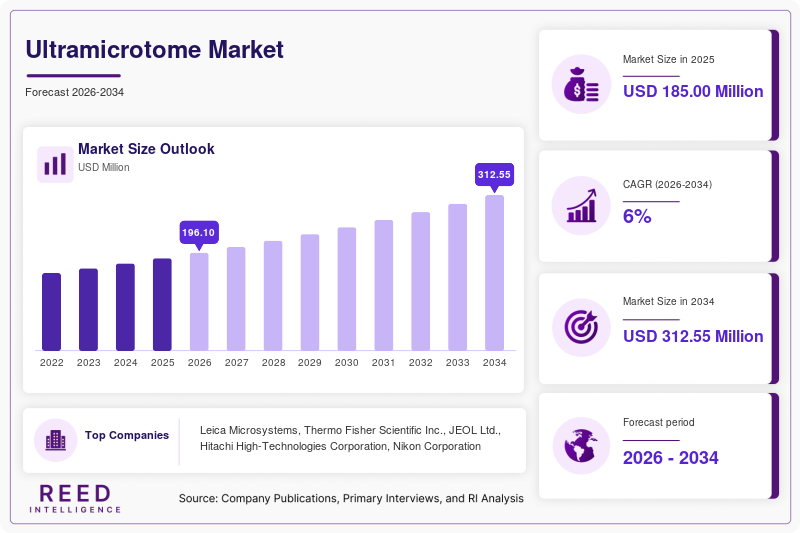
The global Ultramicrotome Market size was valued at approximately USD 185 million in 2025 and is projected to reach USD 312 million by 2034, expanding at a CAGR of 6.0% from 2025 to 2034. The market growth is primarily supported by the increasing demand for high-resolution imaging in life sciences and materials research, particularly in electron microscopy applications. Ultramicrotomes play a critical role in preparing ultra-thin sections for transmission electron microscopy (TEM), enabling precise structural analysis at the nanoscale.
A key global factor driving the Ultramicrotome Market is the steady expansion of nanotechnology and advanced material science research. Academic institutions, research laboratories, and industrial R&D centers are investing in precision sample preparation tools to enhance analytical accuracy and reproducibility. This has led to consistent adoption of ultramicrotomes across diverse sectors, including semiconductors, polymers, and biological sciences.
Key Highlights
- North America dominated the market with 38% share in 2025, while Asia Pacific is projected to grow at the fastest CAGR of 7.4%.
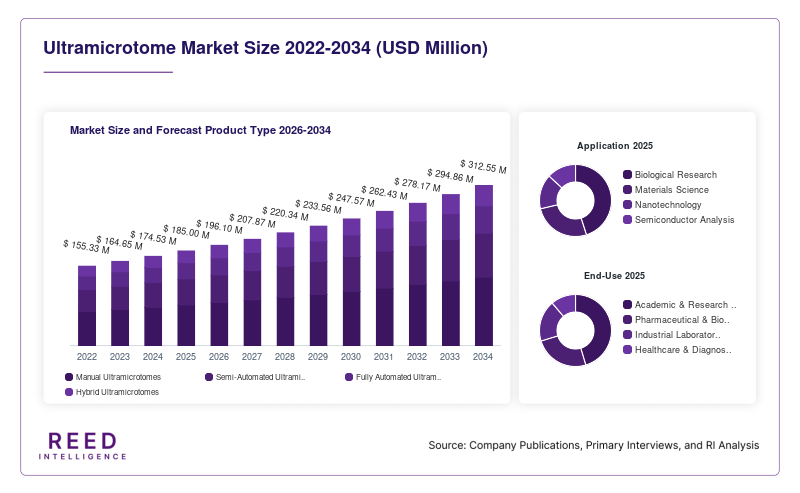
- The fully automated ultramicrotomes segment led with a 45% share in 2024, whereas hybrid ultramicrotomes are expected to grow at a CAGR of 7.8%.
- In applications, biological research accounted for the largest share of 52% in 2024, while materials science is anticipated to grow at 7.1% CAGR.
- The United States led globally, with a market size of USD 68 million in 2024 and USD 72 million in 2025.
Market Trends
Integration of Automation and Digital Interfaces
The Ultramicrotome Market is witnessing increased integration of automation and digital control systems. Manufacturers are incorporating touchscreen interfaces, programmable cutting parameters, and automated trimming features to enhance precision and reduce operator dependency. These advancements improve reproducibility and efficiency, especially in high-throughput laboratories. Automated ultramicrotomes also minimize sample loss and enable consistent section thickness, which is essential for electron microscopy imaging.
Rising Demand for Cryo-Ultramicrotomy
Cryo-ultramicrotomy is gaining traction due to its ability to preserve the native structure of biological and polymer samples. This technique allows sectioning at extremely low temperatures, reducing deformation and artifacts. The increasing focus on biomolecular research and polymer characterization has driven demand for cryo-capable ultramicrotomes. As research applications become more sophisticated, laboratories are prioritizing equipment that supports advanced sample preparation methods, contributing to the expansion of this niche segment within the Ultramicrotome Market.
Market Drivers
Expansion of Electron Microscopy Applications
The growing use of transmission electron microscopy in research and diagnostics is a major driver for the Ultramicrotome Market. High-resolution imaging requires ultra-thin specimen sections, which can only be achieved through precise ultramicrotomy. Increasing adoption of electron microscopy in cell biology, nanotechnology, and semiconductor inspection is fueling demand for advanced ultramicrotomes.
Growth in Life Sciences and Biomedical Research
The rising investment in life sciences research is accelerating demand for ultramicrotomes. Universities, research institutes, and pharmaceutical companies are expanding their capabilities in cellular and molecular studies. Ultramicrotomes are essential tools for preparing biological samples, making them indispensable in modern research environments. This expanding research ecosystem is significantly contributing to the overall growth of the Ultramicrotome Market.
Market Restraint
High Cost of Advanced Ultramicrotomes
The high cost associated with advanced ultramicrotomes is a key restraint in the market. Fully automated and cryo-ultramicrotomes require significant investment, which limits adoption among small laboratories and academic institutions with budget constraints. Additionally, maintenance costs and the need for skilled operators further increase the total cost of ownership. This financial barrier restricts market penetration in developing regions and smaller research facilities, thereby slowing the overall growth rate of the Ultramicrotome Market.
Market Opportunities
Emerging Applications in Semiconductor Analysis
The semiconductor industry presents a growing opportunity for the Ultramicrotome Market. As chip designs become more complex, the need for nanoscale analysis of materials and structures is increasing. Ultramicrotomes are used for preparing ultra-thin sections of semiconductor materials, enabling detailed failure analysis and quality control. The expansion of the electronics and semiconductor sectors is expected to create sustained demand for precision sectioning equipment.
Growth in Academic and Research Infrastructure in Emerging Economies
Emerging economies are investing heavily in research infrastructure, creating new opportunities for the Ultramicrotome Market. Governments and private institutions are establishing advanced laboratories and research centers, particularly in Asia Pacific and Latin America. This expansion is driving demand for scientific instruments, including ultramicrotomes. As access to funding and technology improves, these regions are expected to become significant contributors to market growth.
Segmental Analysis
By Type
Fully automated ultramicrotomes dominated the Ultramicrotome Market with a 45% share in 2024. Their ability to deliver consistent results with minimal manual intervention made them highly preferred in advanced laboratories.
Hybrid ultramicrotomes will grow at the fastest CAGR of 7.8%, driven by their flexibility in combining manual and automated functionalities. This adaptability allows users to handle diverse sample types efficiently.
By Application
Biological research held the largest share of 52% in 2024 due to the extensive use of ultramicrotomes in cellular and molecular studies.
Materials science is projected to grow at a CAGR of 7.1%, supported by increasing demand for nanoscale material analysis in industrial applications.
By End-Use
Academic and research institutes dominated with a 48% share in 2024, reflecting their high usage of ultramicrotomes for experimental studies.
Pharmaceutical and biotechnology companies will grow at a CAGR of 6.9%, driven by increasing research activities in drug development.
By Technology
Conventional ultramicrotomy technology held a 60% share in 2024, owing to its widespread use and cost-effectiveness.
Cryo-ultramicrotomy will grow at a CAGR of 7.5%, supported by increasing demand for advanced sample preservation techniques.
Regional Analysis
North America
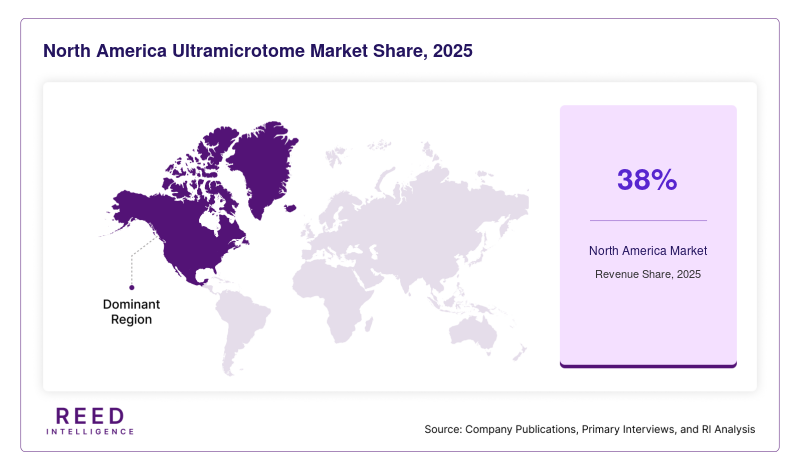
North America accounted for 38% of the Ultramicrotome Market share in 2025 and will grow at a CAGR of 5.5% during the forecast period. The region's strong research infrastructure and established presence of advanced laboratories have supported market dominance.
The United States remained the dominant country due to its extensive network of research institutions and advanced microscopy facilities. The presence of leading universities and federal funding for scientific research has driven consistent demand for ultramicrotomes.
Europe
Europe held approximately 27% market share in 2025 and will expand at a CAGR of 5.7% from 2025 to 2034. The region has a well-established base of life sciences and materials research organizations.
Germany dominated the European market due to its strong focus on industrial research and precision engineering. The country’s investment in materials science and nanotechnology has contributed to steady demand for ultramicrotomes.
Asia Pacific
Asia Pacific captured 22% of the market share in 2025 and is projected to grow at the fastest CAGR of 7.4%. Rapid industrialization and increasing research investments are driving growth in this region.
China emerged as the dominant country, supported by expanding research institutions and government initiatives to advance scientific capabilities. The country’s focus on technological innovation has accelerated the adoption of advanced laboratory equipment.
Middle East & Africa
The Middle East & Africa region accounted for 7% of the Ultramicrotome Market share in 2025 and will grow at a CAGR of 5.2%. Growth is supported by gradual improvements in research infrastructure.
The United Arab Emirates led the region due to increasing investments in healthcare and research facilities. The development of specialized laboratories has contributed to rising demand for ultramicrotomes.
Latin America
Latin America held around 6% market share in 2025 and is expected to grow at a CAGR of 5.4%. The region is experiencing steady development in academic and research sectors.
Brazil dominated the regional market due to its expanding network of universities and research institutes. Government support for scientific research has encouraged the adoption of advanced laboratory equipment.
Competitive Landscape
The Ultramicrotome Market is moderately consolidated, with key players focusing on product innovation and technological advancements. Leading companies are investing in automation, precision engineering, and user-friendly interfaces to enhance product performance.
Leica Microsystems emerged as a market leader, driven by its strong product portfolio and global presence. The company recently introduced advanced ultramicrotomes with enhanced automation features, improving efficiency and accuracy in sample preparation.
Other prominent players are emphasizing strategic collaborations and product launches to strengthen their market position. Continuous innovation and expansion into emerging markets are key strategies adopted by leading companies in the Ultramicrotome Market.
Key Players List
- Leica Microsystems
- RMC Boeckeler Instruments
- Diatome Ltd.
- Boeckeler Instruments Inc.
- Reichert Technologies
- SLEE Medical GmbH
- JEOL Ltd.
- Hitachi High-Technologies Corporation
- Nikon Corporation
- Thermo Fisher Scientific Inc.
- Sakura Finetek Japan Co., Ltd.
- Labtech Instruments Inc.
- EMS (Electron Microscopy Sciences)
- Micro Star Technologies
- Bright Instruments Ltd.
Recent Developments
- Leica Microsystems launched a next-generation automated ultramicrotome with improved digital controls.
- JEOL Ltd. expanded its microscopy solutions portfolio with integrated sample preparation systems.
- Thermo Fisher Scientific introduced enhanced cryo-ultramicrotomy solutions for advanced research applications.
- Hitachi High-Technologies strengthened its presence in Asia Pacific through strategic partnerships.
- RMC Boeckeler Instruments upgraded its product line with precision-focused ultramicrotomes.
Ultramicrotome Market Segments
Product Type
- Manual Ultramicrotomes
- Semi-Automated Ultramicrotomes
- Fully Automated Ultramicrotomes
- Hybrid Ultramicrotomes
Application
- Biological Research
- Materials Science
- Nanotechnology
- Semiconductor Analysis
End-Use
- Academic & Research Institutes
- Pharmaceutical & Biotechnology Companies
- Industrial Laboratories
- Healthcare & Diagnostics Centers
Technology
- Conventional Ultramicrotomy
- Cryo-Ultramicrotomy
By Region
- North America
- Europe
- APAC
- Middle East and Africa
- LATAM