Ultraviolet Disinfection Market Size, Share & Demand Report By Component (UV Lamps, UV Reactors, Quartz Sleeves, Controllers and Monitoring Systems, UV LED Systems), By Application (Water Treatment, Wastewater Treatment, Air Disinfection, Surface Disinfection), By End Use (Municipal Utilities, Healthcare Facilities, Industrial Manufacturing, Commercial Buildings, Residential Sector, Food and Beverage Industry), By Region & Segment Forecasts, 2026–2034
USD 3950
Market Overview
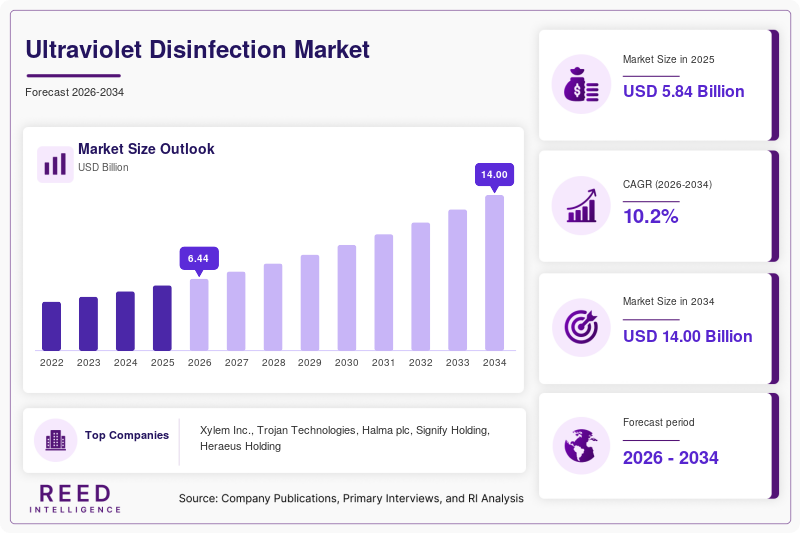
The global Ultraviolet Disinfection Market size was valued at approximately USD 5.84 billion in 2026 and is projected to reach nearly USD 12.76 billion by 2034, expanding at a CAGR of 10.2% during the forecast period of 2026–2034. The market continues to gain momentum due to increasing concerns regarding waterborne diseases, hospital-acquired infections, and the growing need for sustainable disinfection technologies across municipal, industrial, and commercial applications. Ultraviolet disinfection systems use UV-C radiation to deactivate microorganisms without relying on chemical agents, making them suitable for water treatment, wastewater management, air purification, and surface sterilization applications.
One major global factor supporting market growth is the increasing focus on public health infrastructure modernization. Governments and private utilities are investing in advanced disinfection systems to improve sanitation standards and reduce microbial contamination in water and air systems. The expansion of healthcare facilities, pharmaceutical manufacturing plants, food processing industries, and smart commercial buildings has further accelerated the adoption of UV disinfection technologies. In addition, growing awareness regarding antimicrobial resistance has encouraged industries to replace chemical-based disinfectants with environmentally efficient ultraviolet systems.
Key Highlights
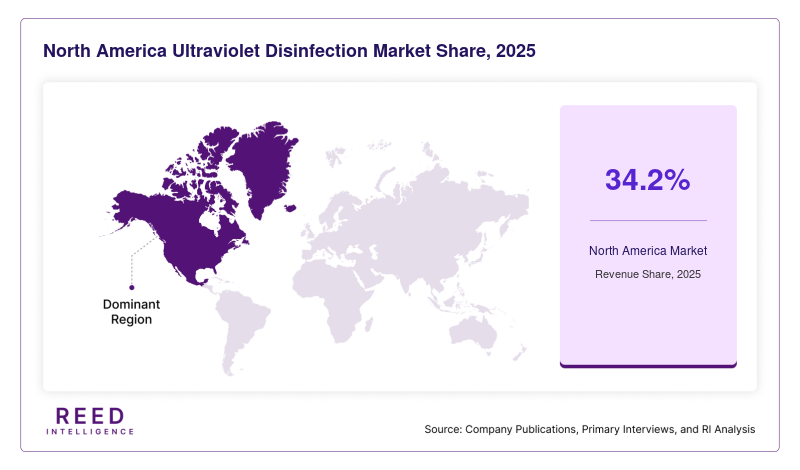
- North America dominated the market with a 34.2% share in 2025.
- Asia Pacific is expected to grow at the fastest CAGR of 11.8% during 2026–2034.
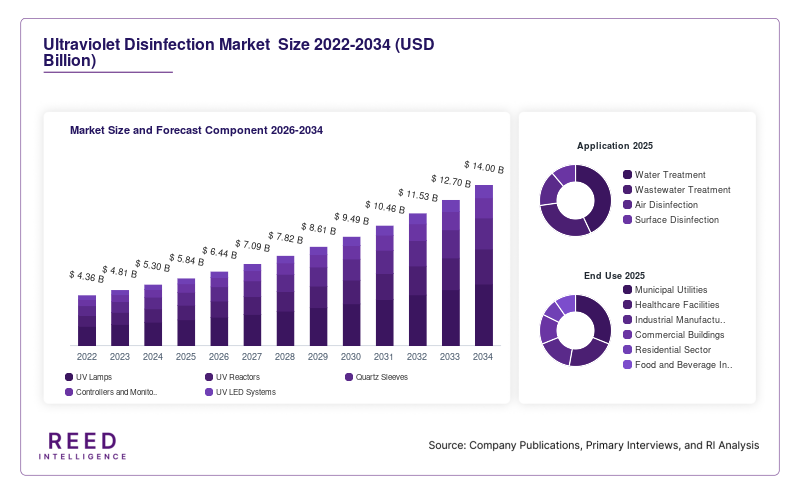
- By component, UV lamps accounted for the largest share of 39.4%, while UV LED systems are projected to grow at a CAGR of 13.1%.
- By application, water treatment led with a 44.6% share, whereas air disinfection is expected to expand at a CAGR of 12.2%.
- The United States remained the dominant country, with market values of USD 1.42 billion in 2024 and USD 1.56 billion in 2025.
Market Trends
Rising Adoption of UV LED Technology in Commercial Applications
The Ultraviolet Disinfection Market is witnessing a significant transition from conventional mercury-based UV lamps toward UV LED technology. Commercial facilities, hospitals, educational institutions, and transportation hubs are increasingly integrating UV LED systems because of their compact design, lower energy consumption, and longer operational lifespan. Unlike traditional systems, UV LEDs enable instant activation and flexible installation, making them suitable for portable and decentralized disinfection units. Manufacturers are focusing on improving LED intensity and wavelength efficiency to support large-scale sterilization operations. The growing preference for mercury-free technologies, combined with stricter environmental regulations regarding hazardous materials, has further strengthened the adoption of UV LED systems across developed economies.
Expansion of Smart Water Treatment Infrastructure
Smart infrastructure development is becoming an important trend influencing the Ultraviolet Disinfection Market. Municipal utilities and industrial operators are integrating digital monitoring systems with UV disinfection equipment to improve operational efficiency and maintenance planning. Automated UV reactors equipped with IoT-enabled sensors can monitor microbial levels, lamp intensity, and energy consumption in real time. This trend is especially visible in urban water treatment projects where authorities seek sustainable and data-driven sanitation systems. The integration of artificial intelligence and predictive maintenance tools has also improved system reliability while reducing downtime. Rapid investments in smart city initiatives across Asia Pacific and the Middle East are expected to accelerate the deployment of advanced ultraviolet disinfection technologies.
Market Drivers
Growing Demand for Chemical-Free Water Treatment Solutions
The increasing demand for environmentally sustainable water treatment methods is a major driver supporting the growth of the Ultraviolet Disinfection Market. Conventional chlorination processes often generate harmful by-products that may affect water quality and human health. UV disinfection systems provide an efficient alternative by neutralizing bacteria, viruses, and protozoa without introducing chemical residues into treated water. Municipal water authorities, food processing facilities, and pharmaceutical manufacturers are increasingly adopting ultraviolet systems to meet strict quality standards and environmental regulations. Rising concerns regarding water scarcity and contamination have further encouraged governments to invest in advanced treatment infrastructure. This shift toward chemical-free purification technologies continues to create stable demand across both developed and emerging markets.
Increasing Focus on Indoor Air Quality and Infection Prevention
The growing emphasis on indoor air quality management has accelerated demand for ultraviolet air disinfection systems. Hospitals, airports, offices, educational institutions, and hospitality facilities are investing in UV-based air purification technologies to minimize airborne pathogen transmission. The expansion of centralized HVAC systems integrated with ultraviolet sterilization modules has improved infection control in high-density indoor environments. In healthcare settings, ultraviolet systems are increasingly used to reduce hospital-acquired infections and improve patient safety standards. Corporate workplaces are also adopting advanced air purification technologies to create healthier environments for employees and visitors. The continued expansion of commercial real estate and public infrastructure projects is expected to sustain long-term market growth for ultraviolet disinfection solutions.
Market Restraint
High Initial Installation Costs and Maintenance Challenges
Despite strong growth prospects, the Ultraviolet Disinfection Market faces limitations associated with high installation and maintenance costs. Large-scale municipal and industrial UV systems require significant capital investment for reactors, control systems, electrical infrastructure, and monitoring equipment. Small and medium-sized enterprises often face budget constraints that limit the adoption of advanced ultraviolet technologies. In addition, conventional UV lamps require periodic replacement to maintain operational efficiency, increasing long-term maintenance expenses. Performance efficiency can also decline in water treatment systems with high turbidity levels, requiring additional filtration processes before ultraviolet exposure. In developing regions, limited technical expertise and inconsistent electricity supply further affect operational reliability. These factors can delay adoption among cost-sensitive end users and reduce penetration in rural infrastructure projects where affordability remains a primary concern.
Market Opportunities
Expansion of UV Disinfection in Healthcare Infrastructure
The modernization of healthcare infrastructure presents a substantial growth opportunity for the Ultraviolet Disinfection Market. Hospitals and diagnostic laboratories are increasingly adopting ultraviolet sterilization systems for operating rooms, patient wards, medical devices, and laboratory surfaces. Healthcare providers are focusing on infection prevention protocols to improve patient outcomes and reduce treatment costs associated with healthcare-associated infections. Portable ultraviolet robots and automated room sterilization systems are gaining popularity in advanced healthcare facilities due to their efficiency and minimal chemical exposure. Emerging economies are also expanding healthcare infrastructure through public investment programs, creating additional demand for ultraviolet disinfection equipment. The integration of automated sterilization technologies into hospital operations is expected to generate consistent market opportunities during the forecast period.
Increasing Adoption Across Food and Beverage Processing Facilities
The food and beverage industry is becoming an important growth area for ultraviolet disinfection technologies. Manufacturers are using UV systems for water purification, packaging sterilization, conveyor belt sanitation, and air treatment within production environments. Stringent food safety regulations and rising consumer awareness regarding hygiene standards are encouraging food processors to adopt advanced microbial control solutions. Ultraviolet systems help reduce contamination risks without affecting product quality or introducing chemical residues into processing environments. Beverage manufacturers, dairy facilities, and packaged food companies are particularly investing in ultraviolet purification systems to improve compliance with international safety standards. The rapid expansion of packaged food consumption and cold chain logistics is expected to strengthen demand for ultraviolet disinfection equipment globally.
Segmental Analysis
By Component
UV lamps accounted for the largest share of the Ultraviolet Disinfection Market in 2024, representing approximately 39.4% of total revenue. Conventional low-pressure and medium-pressure UV lamps continue to dominate due to their broad application across municipal water treatment plants, industrial facilities, healthcare institutions, and commercial buildings. These systems provide reliable microbial inactivation and remain cost-effective for large-scale disinfection operations. Municipal utilities particularly favor traditional UV lamps because of their established operational efficiency and compatibility with existing infrastructure. Industrial operators in food processing and pharmaceutical manufacturing also rely heavily on UV lamp systems for process water purification and equipment sterilization. Continuous improvements in lamp durability and reactor design have further strengthened the segment’s position across developed and emerging markets.
UV LED systems are projected to witness the fastest growth, registering a CAGR of 13.1% during the forecast period. The increasing demand for energy-efficient and environmentally sustainable technologies is accelerating adoption across healthcare, residential, and portable disinfection applications. UV LEDs provide several operational advantages including compact size, instant activation, lower heat generation, and mercury-free operation. Manufacturers are increasingly investing in advanced semiconductor technologies to improve UV output intensity and operational lifespan. The rapid adoption of smart consumer devices, portable sterilization units, and decentralized water treatment systems is further driving demand for UV LED products. As production costs continue to decline and efficiency levels improve, ultraviolet LED systems are expected to gain wider acceptance across commercial and industrial sectors.
By Application
Water treatment represented the dominant application segment in 2024, accounting for nearly 44.6% of the global Ultraviolet Disinfection Market. Municipal water treatment plants, industrial wastewater facilities, and desalination systems continue to deploy ultraviolet technology for microbial control and regulatory compliance. UV disinfection offers advantages over chemical treatment methods by eliminating pathogens without producing harmful disinfection by-products. Increasing investments in water reuse and recycling infrastructure have significantly strengthened segment demand worldwide. Industrial sectors including pharmaceuticals, food processing, electronics manufacturing, and chemicals also utilize ultraviolet systems to maintain high-purity water standards. Population growth, urbanization, and rising concerns regarding waterborne diseases continue to drive long-term investment in ultraviolet-based water treatment infrastructure across both developed and emerging economies.
Air disinfection is expected to emerge as the fastest-growing application segment, expanding at a CAGR of 12.2% during 2026–2034. Growing awareness regarding airborne infection transmission and indoor air quality management is encouraging the installation of UV sterilization systems within HVAC networks and standalone purification units. Hospitals, airports, educational institutions, offices, and hospitality facilities are increasingly integrating ultraviolet air treatment systems to improve occupant safety. Technological advancements in compact UV-C modules and smart air purification devices have further expanded commercial applications. Rising investments in smart buildings and sustainable ventilation systems are also contributing to segment growth. The increasing adoption of ultraviolet air disinfection in public transportation systems and commercial real estate projects is expected to sustain strong demand throughout the forecast period.
By End Use
Municipal utilities accounted for the largest share of the Ultraviolet Disinfection Market in 2024, contributing approximately 36.8% of global revenue. Governments worldwide are prioritizing investments in drinking water purification and wastewater treatment infrastructure to address rising sanitation concerns and environmental challenges. Ultraviolet disinfection systems are widely used in municipal facilities because they provide efficient pathogen control without altering water chemistry. Aging water infrastructure in developed countries and rapid urban development in emerging economies have increased demand for advanced ultraviolet treatment systems. Municipal authorities are also implementing stricter water quality regulations that require reliable and sustainable disinfection technologies. Continuous expansion of public infrastructure projects and increasing focus on water reuse strategies continue to support segment dominance globally.
Healthcare facilities are anticipated to record the fastest CAGR of 12.6% during the forecast period. Hospitals, diagnostic laboratories, pharmaceutical production facilities, and outpatient care centers are rapidly increasing adoption of ultraviolet disinfection technologies for infection control and sterilization applications. The growing emphasis on reducing hospital-acquired infections has accelerated deployment of ultraviolet room sterilizers, air purification systems, and medical equipment disinfection units. Healthcare operators are also integrating automated robotic UV systems to improve operational efficiency and reduce manual sanitation requirements. Expanding healthcare infrastructure in emerging economies and rising investment in advanced medical technologies continue to create substantial growth opportunities. Increasing patient awareness regarding hygiene and safety standards is expected to further strengthen demand within the healthcare segment.
Regional Analysis
North America
North America accounted for approximately 34.2% of the global Ultraviolet Disinfection Market in 2025 and continues to maintain a leading position due to strong infrastructure investments and advanced healthcare systems. The regional market is projected to expand at a CAGR of 9.4% during the forecast period. Municipal water treatment modernization programs across the United States and Canada continue to support widespread adoption of ultraviolet disinfection systems. The region also benefits from stringent environmental regulations related to wastewater treatment and public sanitation standards. Increasing deployment of UV air purification systems in commercial buildings and healthcare facilities further contributes to regional market expansion.
The United States remains the dominant country within North America due to large-scale investments in water infrastructure and healthcare modernization projects. Growing awareness regarding indoor air quality and infection prevention has increased demand for ultraviolet sterilization systems in schools, airports, and hospitality facilities. The presence of leading manufacturers and advanced research institutions supports continuous product innovation across the country. In addition, increasing adoption of UV LED technology in industrial and commercial applications is strengthening the long-term growth outlook for the American ultraviolet disinfection industry.
Europe
Europe represented nearly 27.6% of the global Ultraviolet Disinfection Market in 2025 and is expected to register a CAGR of 8.8% through 2034. The region has witnessed strong demand for ultraviolet systems due to strict regulations regarding drinking water quality and industrial wastewater discharge. European municipalities are increasingly investing in sustainable disinfection technologies to reduce dependence on chemical treatment methods. Growth in pharmaceutical manufacturing and food processing industries has also accelerated ultraviolet system adoption across Western Europe. Continuous emphasis on environmental sustainability and energy-efficient technologies further supports market development throughout the region.
Germany dominates the European market because of its advanced industrial infrastructure and strong environmental compliance standards. The country has expanded investments in smart water management systems integrated with ultraviolet sterilization technologies. Industrial sectors including pharmaceuticals, automotive manufacturing, and food processing continue to adopt UV systems for sanitation and process water treatment applications. Germany also benefits from technological innovation in UV LED development and automated disinfection solutions, which has enhanced the competitiveness of domestic manufacturers within the broader European ultraviolet disinfection industry.
Asia Pacific
Asia Pacific held approximately 22.9% of the global Ultraviolet Disinfection Market in 2025 and is projected to grow at the fastest CAGR of 11.8% during the forecast period. Rapid urbanization, population growth, and increasing industrialization are major factors driving regional demand for ultraviolet disinfection systems. Governments across China, India, Japan, and Southeast Asia are investing heavily in water treatment infrastructure to address sanitation challenges and rising pollution levels. The expansion of healthcare facilities and commercial buildings has further increased adoption of ultraviolet air and surface disinfection technologies throughout the region.
China represents the largest country-level market in Asia Pacific due to extensive investments in municipal wastewater treatment and industrial water recycling projects. Rising concerns regarding environmental pollution and water scarcity have encouraged authorities to strengthen regulations for wastewater discharge and drinking water quality. The country is also witnessing strong growth in electronics manufacturing and pharmaceutical production, both of which require advanced sterilization systems. Increasing domestic production of UV LED components and government support for energy-efficient technologies continue to accelerate market growth in China.
Middle East & Africa
The Middle East & Africa accounted for nearly 8.1% of the global Ultraviolet Disinfection Market in 2025 and is expected to expand at a CAGR of 9.7% through 2034. Demand for ultraviolet disinfection systems is increasing due to water scarcity concerns and rising investments in desalination and wastewater recycling infrastructure. Countries across the Gulf Cooperation Council are adopting advanced water purification technologies to support urban development and industrial expansion. The hospitality and healthcare sectors are also implementing ultraviolet air sterilization systems to improve hygiene standards in high-traffic environments.
Saudi Arabia remains the dominant market within the region due to substantial investment in desalination facilities and smart city projects. The country has prioritized sustainable water management strategies to address growing freshwater demand and industrial expansion. Large infrastructure development programs linked to tourism and urban modernization are increasing the deployment of ultraviolet disinfection systems across commercial facilities and public utilities. Rising awareness regarding infection prevention in healthcare institutions is also supporting the adoption of ultraviolet sterilization technologies throughout the Saudi Arabian market.
Latin America
Latin America captured approximately 7.2% of the global Ultraviolet Disinfection Market in 2025 and is anticipated to grow at a CAGR of 8.9% during the forecast period. Regional demand is primarily driven by increasing investments in municipal water treatment facilities and industrial sanitation systems. Countries across the region are focusing on improving access to safe drinking water and modernizing aging wastewater infrastructure. Growth in food processing, beverage production, and healthcare services has further increased the adoption of ultraviolet disinfection equipment across commercial and industrial sectors.
Brazil dominates the Latin American market due to its expanding urban population and increasing investment in public sanitation infrastructure. The government has introduced several water quality improvement initiatives aimed at reducing contamination risks in urban and rural areas. Industrial sectors including agriculture, food processing, and pharmaceuticals are increasingly implementing ultraviolet systems to comply with hygiene and environmental standards. The continued growth of private healthcare networks and commercial real estate projects is also contributing to market expansion throughout Brazil.
Competitive Landscape
The Ultraviolet Disinfection Market remains moderately consolidated, with major companies focusing on product innovation, strategic partnerships, and regional expansion to strengthen their competitive positions. Leading manufacturers are investing in UV LED technology, smart monitoring systems, and automated disinfection platforms to address evolving customer requirements across healthcare, industrial, and municipal sectors. Competition is driven by technological efficiency, energy consumption, operational reliability, and long-term maintenance costs.
Xylem Inc. continues to hold a leading position within the global market due to its broad portfolio of ultraviolet water treatment solutions and strong municipal infrastructure presence. The company recently expanded its advanced UV wastewater treatment systems for smart utility applications. Trojan Technologies has strengthened its market presence through continuous innovation in UV reactor performance and digital monitoring capabilities. Signify Holding has accelerated investment in UV-C air purification systems designed for commercial and healthcare facilities. Halma plc has focused on expanding its environmental and water treatment product offerings through strategic acquisitions. Heraeus Holding has introduced high-output UV lamp systems aimed at industrial and pharmaceutical applications, supporting operational efficiency improvements across large-scale facilities.
Key Players
- Xylem Inc.
- Trojan Technologies
- Halma plc
- Signify Holding
- Heraeus Holding
- Atlantic Ultraviolet Corporation
- Kuraray Co., Ltd.
- Evoqua Water Technologies
- Severn Trent Services
- American Ultraviolet
- Calgon Carbon Corporation
- Aquionics Inc.
- Lumalier Corporation
- Koninklijke Philips N.V.
- UV-Technik Speziallampen GmbH
Recent Developments
- In March 2025, Signify Holding launched a new UV-C upper-air disinfection platform designed for large commercial office environments and educational institutions.
- In July 2025, Xylem Inc. expanded its ultraviolet wastewater treatment portfolio with AI-enabled monitoring features for municipal utility operators.
- In November 2024, Trojan Technologies introduced a high-efficiency UV LED reactor system developed for industrial water recycling applications in semiconductor manufacturing facilities.
Ultraviolet Disinfection Market Segments
Component
- UV Lamps
- UV Reactors
- Quartz Sleeves
- Controllers and Monitoring Systems
- UV LED Systems
Application
- Water Treatment
- Wastewater Treatment
- Air Disinfection
- Surface Disinfection
End Use
- Municipal Utilities
- Healthcare Facilities
- Industrial Manufacturing
- Commercial Buildings
- Residential Sector
- Food and Beverage Industry
By Region
- North America
- Europe
- APAC
- Middle East and Africa
- LATAM