Ultraviolet Transilluminator Imaging System Market Size, Share Demand Report By Product Type (UV LED Transilluminators, UV Tube Transilluminators, Multi-Wavelength Imaging Systems, Compact Gel Documentation Systems), By Application (Molecular Biology Research, Clinical Diagnostics, Forensic Analysis, Biotechnology Research), By Distribution Channel (Direct Sales to Research Laboratories, Scientific Equipment Distributors, Online Laboratory Equipment Platforms, Academic Procurement Channels) By R
USD 3950
Market Overview
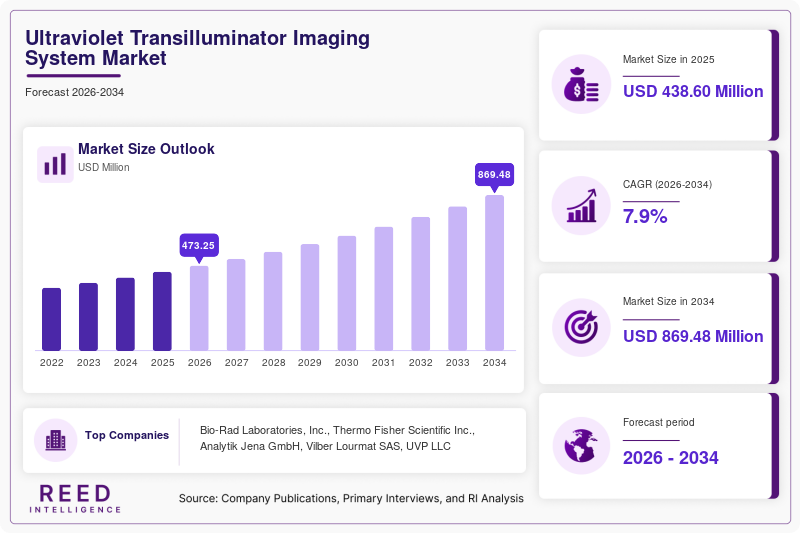
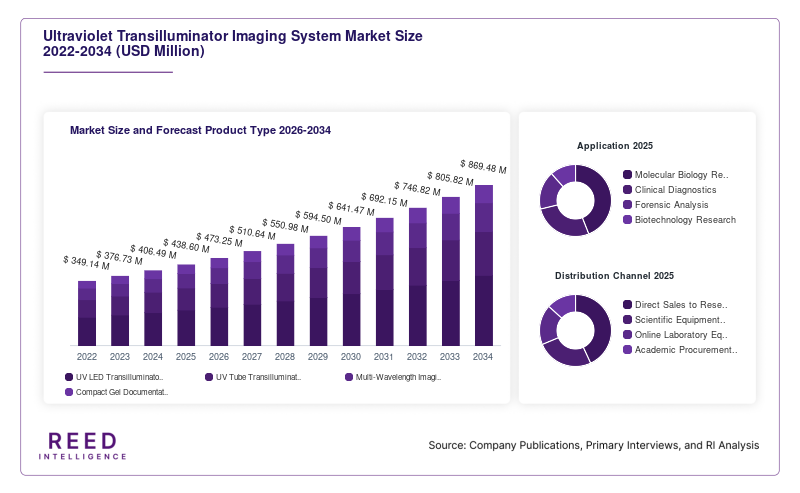
The Ultraviolet Transilluminator Imaging System Market size was valued at USD 438.6 million in 2025 and is projected to reach USD 812.9 million by 2033, expanding at a CAGR of 7.9% during 2025–2034. Ultraviolet transilluminator imaging systems are laboratory instruments used to visualize nucleic acids and proteins in electrophoresis gels. These systems emit ultraviolet light that causes fluorescent dyes bound to DNA, RNA, or proteins to glow, allowing researchers to capture clear images for documentation and analysis. The technology is widely used in molecular biology, genetic research, forensic science, and biotechnology laboratories.
Growing global investment in life sciences research has supported the expansion of the Ultraviolet Transilluminator Imaging System Market. Research institutions, biotechnology companies, and pharmaceutical laboratories rely on imaging systems to analyze genetic material during experiments involving polymerase chain reaction (PCR), gel electrophoresis, and molecular cloning. As genomics and molecular diagnostics continue to evolve, laboratories require imaging systems capable of delivering accurate visualization and documentation of experimental results.
Key Highlights
- North America accounted for 38.1% of the Ultraviolet Transilluminator Imaging System Market share in 2025, while Asia Pacific will register the fastest CAGR of 8.7% through 2034.
- UV LED transilluminators held the dominant share at 49.6% in 2025, while multi-wavelength imaging systems will grow at a CAGR of 9.1%.
- Molecular biology research represented the leading application segment with 42.3% share, whereas clinical diagnostics will expand at a CAGR of 8.8%.
- The United States remained the dominant country, with the market valued at USD 132.4 million in 2025 and projected to reach USD 142.8 million in 2026.
Ultraviolet Transilluminator Imaging System Market Trends
Integration of Digital Imaging and Data Management
Laboratories increasingly require imaging systems capable of capturing, analyzing, and storing experimental data efficiently. Modern ultraviolet transilluminator imaging systems now integrate high-resolution cameras, touchscreen interfaces, and digital documentation software. These features enable researchers to capture gel images, analyze band intensity, and store results within laboratory databases.
The integration of digital imaging technology also improves workflow efficiency by allowing researchers to share results with collaborators and maintain accurate experimental records. As laboratories adopt digital documentation practices, imaging system manufacturers are incorporating software tools that support automated image analysis and data management.
Transition Toward LED-Based Ultraviolet Illumination
Traditional ultraviolet transilluminators often rely on UV tubes, which can generate heat and require periodic replacement. Manufacturers are increasingly developing systems that use UV LED illumination instead of conventional lamps.
LED-based systems offer improved energy efficiency, longer operational lifespans, and more stable light intensity. These characteristics allow laboratories to obtain clearer images while reducing maintenance requirements. As research facilities prioritize energy-efficient laboratory equipment, LED-based transilluminator imaging systems are gaining wider adoption.
Ultraviolet Transilluminator Imaging System Market Drivers
Increasing Demand for Molecular Biology Research Tools
The expansion of molecular biology research has contributed significantly to the growth of the Ultraviolet Transilluminator Imaging System Market. Techniques such as DNA sequencing, gel electrophoresis, and nucleic acid analysis require imaging systems that can accurately visualize fluorescent signals within laboratory samples.
Research laboratories conducting genetic studies rely on ultraviolet imaging systems to verify DNA fragments and evaluate experimental results. As scientific research expands in genomics, proteomics, and biotechnology, demand for reliable imaging equipment continues to increase.
Growth of Biotechnology and Pharmaceutical R&D
Biotechnology and pharmaceutical companies frequently conduct experiments involving DNA analysis and protein characterization. Ultraviolet transilluminator imaging systems are essential tools in laboratories performing these analyses.
The growth of pharmaceutical research programs and biotechnology innovation has increased the number of laboratories requiring advanced imaging equipment. These systems help researchers document experimental results and analyze molecular interactions during drug discovery and development processes.
Ultraviolet Transilluminator Imaging System Market Restraint
Safety Concerns Associated with UV Radiation
Safety considerations associated with ultraviolet radiation present a challenge for the Ultraviolet Transilluminator Imaging System Market. Exposure to UV light can pose health risks, including skin irritation and eye damage. Laboratories must therefore implement safety precautions when operating UV-based imaging systems.
Many facilities require protective shields, UV-blocking goggles, and enclosed imaging chambers to minimize exposure risks. These safety requirements may increase equipment costs and operational complexity for research laboratories.
In addition, some laboratories are exploring alternative imaging methods that use visible light or blue-light illumination instead of UV radiation. These alternatives reduce potential exposure risks while still allowing visualization of certain fluorescent dyes.
Although UV transilluminator systems remain widely used in molecular biology laboratories, safety considerations may influence purchasing decisions for research facilities evaluating different imaging technologies.
Ultraviolet Transilluminator Imaging System Market Opportunities
Expansion of Genomics and Precision Medicine Research
Genomics research is expanding as scientists explore the genetic basis of diseases and personalized medicine strategies. Laboratories performing genetic analysis require imaging systems capable of visualizing DNA fragments and documenting gel electrophoresis results.
As research institutions and healthcare organizations invest in genomics studies, the need for laboratory imaging equipment may increase. Ultraviolet transilluminator imaging systems can support these research activities by enabling accurate visualization of nucleic acid samples.
Growth of Academic and Research Institutions
Universities and research institutes are expanding their life sciences programs to support biotechnology and biomedical innovation. These institutions require laboratory equipment for teaching, experimentation, and scientific research.
Ultraviolet transilluminator imaging systems are commonly used in academic laboratories for molecular biology experiments and student training programs. As educational institutions continue to expand laboratory facilities, demand for imaging equipment may increase.
Segmental Analysis
By Product Type
UV LED transilluminators accounted for 49.6% of the Ultraviolet Transilluminator Imaging System Market share in 2025. These systems provide stable UV illumination and improved energy efficiency compared to traditional UV tube-based devices. Laboratories prefer LED systems due to their longer operational lifespan and lower maintenance requirements.
Multi-wavelength imaging systems will grow at a CAGR of 9.1% during the forecast period. These systems allow researchers to visualize multiple fluorescent dyes using different wavelengths of light. Laboratories performing complex molecular biology experiments will increasingly adopt multi-wavelength imaging systems to enhance experimental accuracy.
By Application
Molecular biology research represented the largest application segment with 42.3% share in 2025. Ultraviolet transilluminator imaging systems are widely used to analyze DNA fragments in gel electrophoresis experiments.
Clinical diagnostics will grow at a CAGR of 8.8% during the forecast period. Diagnostic laboratories performing genetic testing and molecular diagnostics will expand their use of imaging systems for nucleic acid analysis.
By End-Use
Academic and research institutes accounted for the largest share of 46.5% in 2025 in the Ultraviolet Transilluminator Imaging System Market. Universities and scientific research organizations operate laboratories that perform molecular biology experiments requiring imaging systems.
Biotechnology and pharmaceutical companies will grow at a CAGR of 8.6% during the forecast period. These organizations conduct research involving genetic analysis, protein studies, and drug development experiments.
Regional Analysis
North America
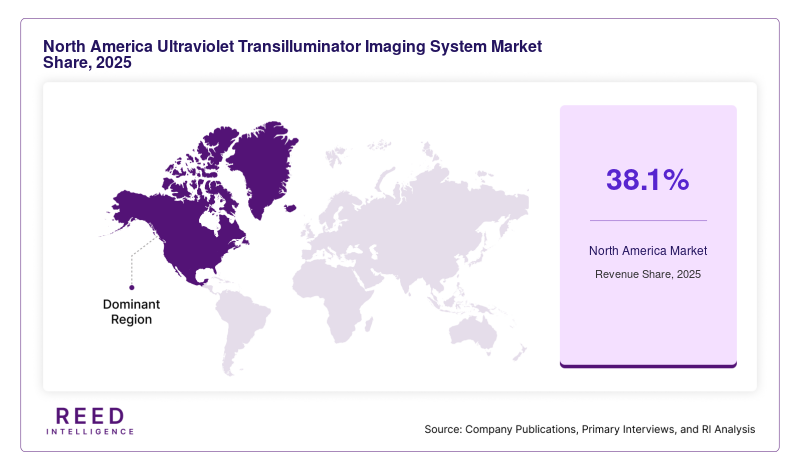
North America accounted for 38.1% of the Ultraviolet Transilluminator Imaging System Market share in 2025. The region will grow at a CAGR of 7.2% between 2025 and 2034. Strong research infrastructure and a large number of biotechnology companies have supported demand for laboratory imaging systems.
The United States remained the dominant country within the regional market. Research universities, biotechnology firms, and pharmaceutical companies operate numerous laboratories that conduct molecular biology experiments. These facilities frequently use ultraviolet transilluminator imaging systems for DNA visualization and gel documentation during research activities.
Europe
Europe represented 27.6% of the global Ultraviolet Transilluminator Imaging System Market in 2025 and will expand at a CAGR of 7.4% during the forecast period. The region has a well-established biotechnology research ecosystem supported by universities and pharmaceutical companies.
Germany emerged as the dominant country within the European market. The country hosts numerous research institutes and biotechnology laboratories that conduct genetic and molecular biology studies. Laboratories in these institutions rely on imaging systems to analyze experimental results obtained through gel electrophoresis.
Asia Pacific
Asia Pacific held 23.4% of the global Ultraviolet Transilluminator Imaging System Market share in 2025 and will grow at a CAGR of 8.7% through 2034. Expanding biotechnology research and increasing investment in life sciences have influenced regional market growth.
China represented the dominant country within the regional market. The country has invested significantly in biotechnology research infrastructure and academic institutions focused on life sciences.
Middle East & Africa
The Middle East & Africa accounted for 6.1% of the Ultraviolet Transilluminator Imaging System Market in 2025 and will expand at a CAGR of 7.5% during the forecast period. Growth has been supported by increasing investment in biomedical research facilities and academic laboratories.
Saudi Arabia emerged as the dominant country in the region due to the expansion of university research programs and biotechnology initiatives.
Latin America
Latin America represented 4.8% of the Ultraviolet Transilluminator Imaging System Market share in 2025 and will grow at a CAGR of 8.0% through 2034. Growth in research activities and laboratory infrastructure development has influenced market expansion.
Brazil dominated the regional market due to the presence of research universities and biotechnology laboratories conducting molecular biology studies.
Competitive Landscape
The Ultraviolet Transilluminator Imaging System Market includes manufacturers of laboratory imaging equipment and biotechnology research instruments. Companies focus on improving imaging resolution, enhancing UV illumination systems, and integrating digital documentation features into laboratory equipment.
A notable participant is Bio-Rad Laboratories, which supplies gel documentation and imaging systems used in molecular biology laboratories. The company continues to expand its laboratory imaging product portfolio to support biotechnology research.
Other market participants include Thermo Fisher Scientific, Analytik Jena, UVP LLC, and Vilber Lourmat. These companies supply imaging equipment designed for life sciences research laboratories.
Manufacturers are investing in research and product innovation to support the evolving needs of molecular biology laboratories.
Key Players
- Bio-Rad Laboratories
- Thermo Fisher Scientific
- Analytik Jena
- UVP LLC
- Vilber Lourmat
- Azure Biosystems
- Syngene
- Cleaver Scientific
- Labnet International
- Herolab GmbH
- Major Science
- Biobase Group
- DNR Bio-Imaging Systems
- ProteinSimple
- Cole-Parmer Instrument Company
Recent Developments
- In 2024, Bio-Rad Laboratories introduced an upgraded gel imaging system with enhanced digital documentation features.
- In 2023, Thermo Fisher Scientific expanded its laboratory imaging equipment portfolio for molecular biology research.
- In 2024, Analytik Jena developed a new multi-wavelength imaging system designed for advanced fluorescence analysis.
- In 2023, Vilber Lourmat introduced an LED-based UV transilluminator designed to improve energy efficiency.
- In 2024, Azure Biosystems expanded its imaging platform capabilities for biotechnology laboratories.
Ultraviolet Transilluminator Imaging System Market Segments
Product Type
- UV LED Transilluminators
- UV Tube Transilluminators
- Multi-Wavelength Imaging Systems
- Compact Gel Documentation Systems
Application
- Molecular Biology Research
- Clinical Diagnostics
- Forensic Analysis
- Biotechnology Research
Distribution Channel
- Direct Sales to Research Laboratories
- Scientific Equipment Distributors
- Online Laboratory Equipment Platforms
- Academic Procurement Channels
By Region
- North America
- Europe
- APAC
- Middle East and Africa
- LATAM