Underground Hydrogen Storage Market Size, Share & Demand Report By Storage Type (Salt Caverns, Depleted Gas Reservoirs, Aquifers), By Application (Industrial, Power Generation, Energy Storage), By End-Use Industry (Energy, Transportation, Chemicals), By Storage Depth (Shallow, Deep) & Segment Forecasts, 2026–2034
USD 3950
Market Overview
The global Underground Hydrogen Storage Market size was valued at approximately USD 1.85 billion in 2026 and is projected to reach USD 6.95 billion by 2034, expanding at a CAGR of 17.9% during the forecast period (2026–2034). The market is gaining traction as hydrogen becomes a central component in the global energy transition, particularly in balancing intermittent renewable energy sources such as wind and solar.
A key global factor supporting market growth is the increasing deployment of green hydrogen infrastructure. Governments and private entities are investing in hydrogen production, storage, and distribution networks to reduce reliance on fossil fuels. Underground storage solutions, including salt caverns, depleted reservoirs, and aquifers, offer large-scale capacity, cost efficiency, and long-term storage capabilities, making them a preferred option for utility-scale hydrogen management.
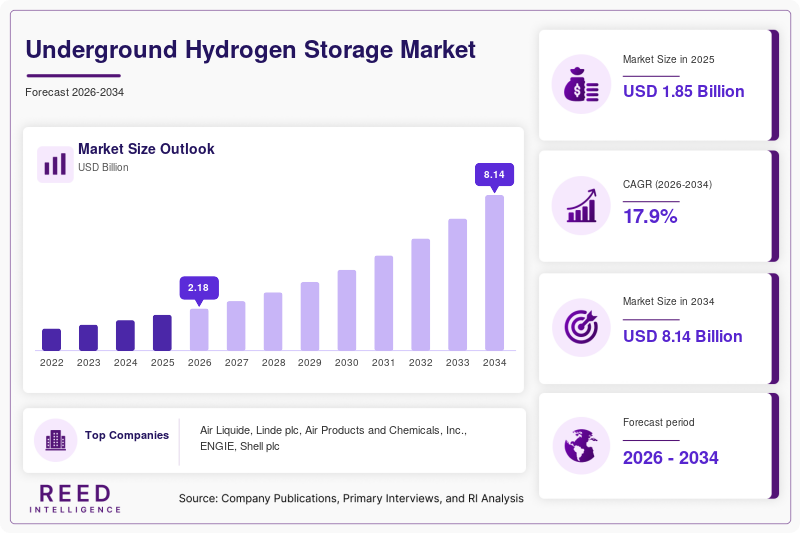
Key Highlights:
- Europe dominated the market with a 38.6% share in 2025, while Asia Pacific is expected to register the fastest CAGR of 19.8%.
- Salt caverns emerged as the leading storage type with a 54.2% share, while depleted gas reservoirs are projected to grow at a CAGR of 18.7%.
- Industrial application led the segment with a 46.5% share, whereas power generation is expected to grow at a CAGR of 19.2%.
- Germany, the dominant country, recorded market values of USD 410 million in 2024 and USD 455 million in 2025.
Market Trends
Expansion of Green Hydrogen Ecosystems
The development of integrated green hydrogen ecosystems is shaping the Underground Hydrogen Storage Market. Countries are establishing hydrogen valleys that combine production, storage, and distribution in a single network. Underground storage plays a critical role in these ecosystems by ensuring energy availability during peak demand and enabling seasonal storage. The trend is supported by policy frameworks encouraging decarbonization and energy security. As hydrogen production scales up, underground storage capacity is being expanded to accommodate surplus generation, especially from renewable sources.
Advancements in Subsurface Storage Technologies
Technological innovations in subsurface engineering are improving the efficiency and safety of underground hydrogen storage. Enhanced modeling tools, real-time monitoring systems, and advanced sealing techniques are reducing leakage risks and optimizing storage performance. These advancements are enabling the use of diverse geological formations, including depleted oil and gas reservoirs and aquifers. Additionally, digital twin technologies are being adopted to simulate storage behavior, improving operational decision-making. This trend is increasing investor confidence and facilitating large-scale project deployments across multiple regions.
Market Drivers
Rising Demand for Large-Scale Energy Storage
The increasing need for large-scale energy storage solutions is a major driver of the Underground Hydrogen Storage Market. As renewable energy generation grows, energy systems require mechanisms to store excess power and release it when needed. Hydrogen serves as an energy carrier, and underground storage provides the necessary capacity for long-term storage. This capability is essential for grid stability and energy reliability, particularly in regions with high renewable penetration.
Government Policies Supporting Hydrogen Infrastructure
Supportive government policies and funding initiatives are accelerating market growth. National hydrogen strategies, subsidies, and public-private partnerships are encouraging the development of hydrogen infrastructure, including storage facilities. Regulatory frameworks are also being established to standardize safety and operational guidelines for underground storage. These initiatives are reducing investment risks and attracting private sector participation, thereby expanding the market landscape.
Market Restraint
Geological and Technical Constraints
One of the primary challenges in the Underground Hydrogen Storage Market is the limitation posed by geological and technical factors. Suitable geological formations, such as salt caverns and depleted reservoirs, are not uniformly available across all regions. Identifying and developing these sites requires extensive geological surveys and significant capital investment.
Additionally, hydrogen’s small molecular size increases the risk of leakage and material degradation, posing technical challenges in maintaining storage integrity. The need for specialized materials and monitoring systems further adds to project costs. These constraints can delay project timelines and limit the scalability of underground storage solutions in certain regions.
Market Opportunities
Integration with Renewable Energy Projects
The integration of underground hydrogen storage with renewable energy projects presents a significant growth opportunity. As solar and wind installations expand, the need for efficient storage solutions becomes more critical. Underground storage can absorb excess energy during peak production and supply it during low generation periods. This integration enhances energy system flexibility and supports the transition to a low-carbon economy.
Development of Hydrogen Trading Hubs
The emergence of hydrogen trading hubs is creating new opportunities in the market. These hubs require large-scale storage facilities to manage supply and demand fluctuations. Underground storage provides the necessary infrastructure to support hydrogen trading and distribution networks. As global hydrogen markets evolve, the demand for centralized storage solutions is expected to increase, driving market growth.
Segmental Analysis
By Storage Type
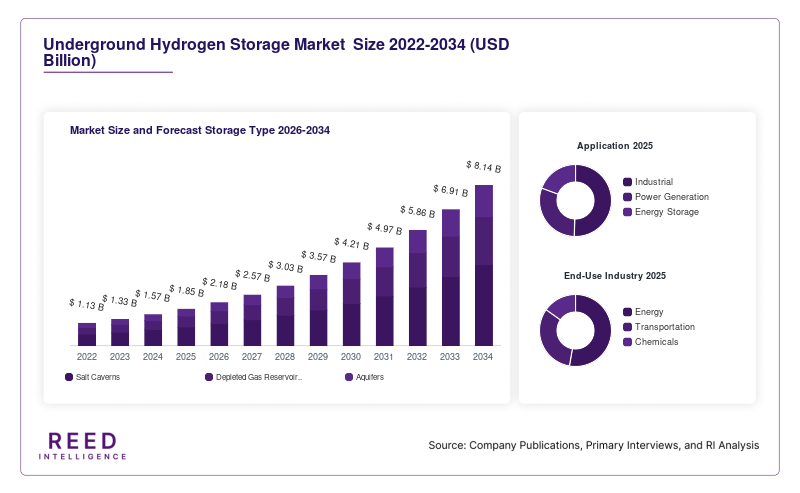
Salt caverns dominated the Underground Hydrogen Storage Market in 2025, accounting for 54.2% of the total share. Their high permeability, structural integrity, and cost-effectiveness make them suitable for large-scale hydrogen storage.
Depleted gas reservoirs are expected to be the fastest-growing subsegment, with a projected CAGR of 18.7%. Their widespread availability and existing infrastructure will enable cost-efficient conversion for hydrogen storage.
By Application
Industrial applications held the largest market share of 46.5% in 2025. Hydrogen is widely used in refining, chemical production, and steel manufacturing, necessitating reliable storage solutions.
Power generation is anticipated to grow at the fastest CAGR of 19.2%. The increasing use of hydrogen in energy systems will drive demand for storage solutions to support grid stability.
By End-Use Industry
The energy sector dominated the market with a 49.8% share in 2025, driven by the integration of hydrogen into energy systems.
The transportation sector is expected to witness the fastest growth, with a CAGR of 18.9%, as hydrogen fuel adoption increases in mobility applications.
By Storage Depth
Shallow storage systems accounted for the largest share of 57.3% in 2025 due to easier accessibility and lower development costs.
Deep storage systems are projected to grow at a CAGR of 18.4%, driven by their higher capacity and long-term storage capabilities.
Regional Analysis
North America
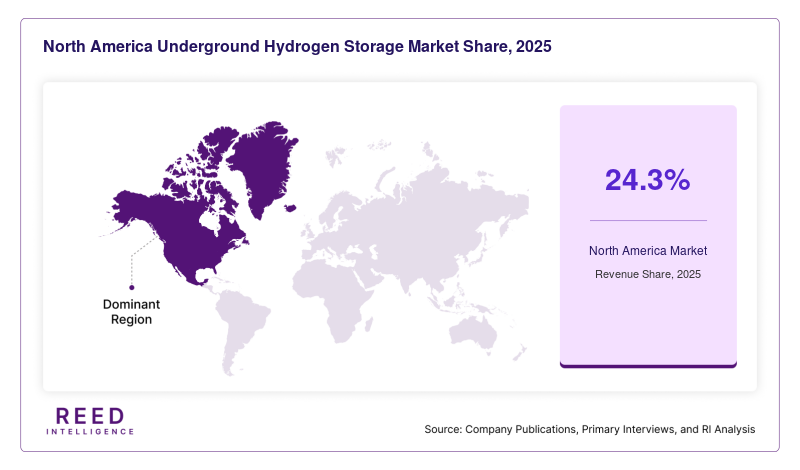
North America accounted for 24.3% of the Underground Hydrogen Storage Market share in 2025 and is projected to grow at a CAGR of 16.8% during the forecast period. The region benefits from established energy infrastructure and ongoing investments in clean energy technologies.
The United States dominated the regional market due to its extensive network of salt caverns and depleted gas reservoirs. The country’s focus on energy diversification and grid resilience has driven the adoption of underground hydrogen storage solutions.
Europe
Europe held the largest market share of 38.6% in 2025 and is expected to grow at a CAGR of 17.5% from 2026 to 2034. The region’s strong commitment to decarbonization and hydrogen adoption has significantly contributed to market expansion.
Germany emerged as the leading country, driven by its comprehensive hydrogen strategy and investments in renewable energy. The country’s emphasis on industrial decarbonization has increased demand for large-scale hydrogen storage.
Asia Pacific
Asia Pacific captured 21.7% of the market share in 2025 and is anticipated to grow at the fastest CAGR of 19.8% during the forecast period. Rapid industrialization and increasing energy demand are key factors supporting growth.
China led the regional market due to its large-scale hydrogen production initiatives and investments in energy infrastructure. The country’s focus on reducing carbon emissions has accelerated the development of underground storage facilities.
Middle East & Africa
The Middle East & Africa region accounted for 9.2% of the market share in 2025 and is expected to grow at a CAGR of 18.1%. The region’s abundant natural resources and strategic focus on energy exports are driving market growth.
Saudi Arabia dominated the region, leveraging its expertise in subsurface engineering and large-scale energy projects. The country’s investments in hydrogen production and storage are supporting its transition to a diversified energy economy.
Latin America
Latin America held a 6.2% market share in 2025 and is projected to grow at a CAGR of 17.2% during the forecast period. The region is gradually adopting hydrogen technologies to support sustainable energy development.
Brazil emerged as the leading country, driven by its renewable energy capacity and initiatives to develop hydrogen infrastructure. The country’s focus on clean energy integration is fostering demand for underground storage solutions.
Competitive Landscape
The Underground Hydrogen Storage Market is moderately consolidated, with key players focusing on technological advancements and strategic collaborations. Leading companies are investing in research and development to enhance storage efficiency and safety.
The market leader, Air Liquide, has recently expanded its hydrogen storage projects in Europe, focusing on integrating underground storage with renewable energy systems. Other major players are also forming partnerships with energy companies and governments to develop large-scale storage infrastructure.
Companies are emphasizing digital monitoring solutions and advanced materials to address technical challenges and improve operational performance. The competitive landscape is expected to evolve as new entrants and regional players expand their presence in the market.
Key Players List
- Air Liquide
- Linde plc
- Air Products and Chemicals, Inc.
- ENGIE
- Shell plc
- Equinor ASA
- Uniper SE
- Siemens Energy
- Chart Industries
- Nel ASA
- ITM Power
- McDermott International
- Worley Ltd.
- Baker Hughes
- Gazprom
Recent Developments
- In 2025, Air Liquide announced a new underground hydrogen storage facility integrated with renewable energy sources in Europe.
- Linde plc initiated a project to convert depleted gas reservoirs into hydrogen storage sites.
- ENGIE partnered with regional governments to develop hydrogen storage infrastructure in France.
- Siemens Energy launched advanced monitoring systems for underground hydrogen storage facilities.
- Shell plc invested in large-scale hydrogen storage projects to support its energy transition strategy.
Underground Hydrogen Storage Market Segments
Storage Type
- Salt Caverns
- Depleted Gas Reservoirs
- Aquifers
Application
- Industrial
- Power Generation
- Energy Storage
End-Use Industry
- Energy
- Transportation
- Chemicals
Storage Depth
- Shallow
- Deep
By Region
- North America
- Europe
- APAC
- Middle East and Africa
- LATAM