Underwater Camera Market Size, Share & Demand Report By Type (Autonomous Underwater Imaging Systems, Professional Industrial Cameras), By Application (Marine Research & Exploration, Offshore Oil & Gas Inspection, Defense & Security Surveillance,Environmental Monitoring), By End-Use (Scientific Research Institutes,Defense Organizations, Consumer Electronics Users, Environmental Agencies) By Region & Segment Forecasts, 2026–2034
USD 3950
Market Overview
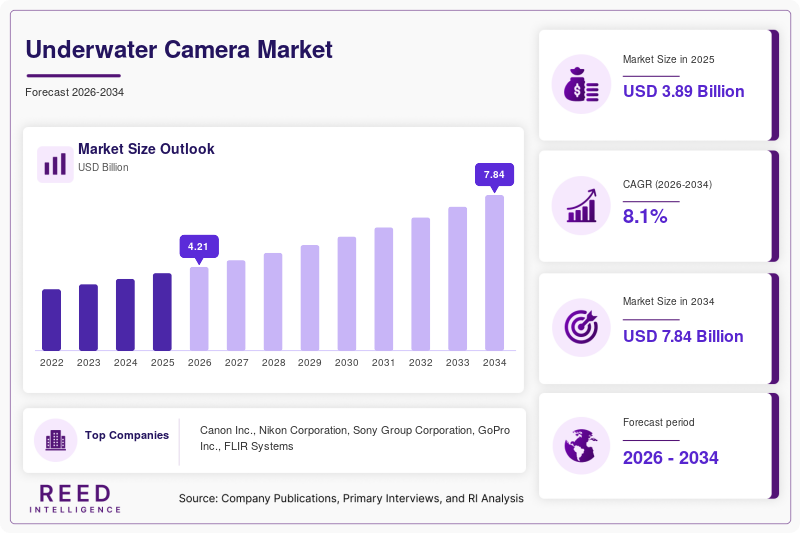
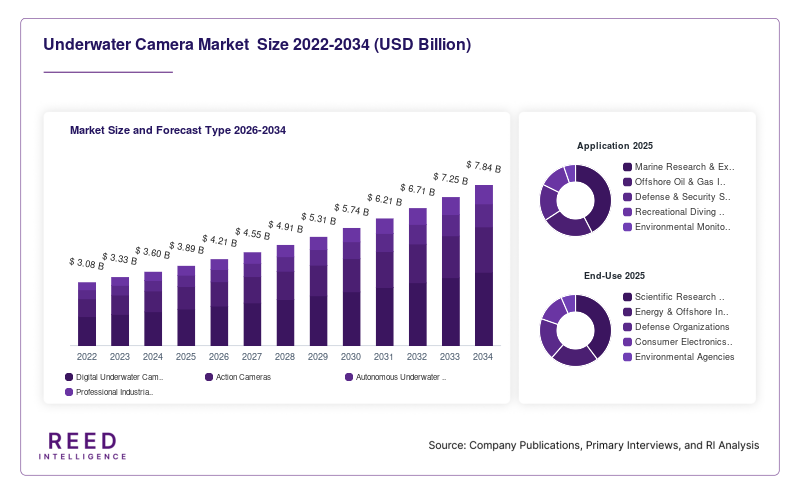
The global Underwater Camera Market size is estimated at approximately USD 4.2 billion in 2026 and is projected to reach nearly USD 7.8 billion by 2034, expanding at a CAGR of 8.1% during 2026–2034. Growth in this market is primarily driven by rising demand for underwater imaging solutions across marine research, recreational diving, offshore energy inspection, and defense applications. Increasing emphasis on ocean exploration and environmental monitoring has also strengthened adoption, as governments and private organizations invest in advanced imaging systems capable of operating in extreme underwater conditions. Technological advancements in high-resolution sensors, compact waterproof designs, and AI-enabled image processing further support market expansion.
A major global factor supporting growth is the rapid expansion of offshore renewable energy projects, particularly offshore wind farms, which require continuous underwater inspection and maintenance. These installations depend heavily on underwater cameras for structural monitoring, safety inspection, and maintenance planning. Additionally, rising marine tourism and underwater sports activities are increasing consumer demand for action cameras with enhanced waterproof capabilities.
Key Highlights
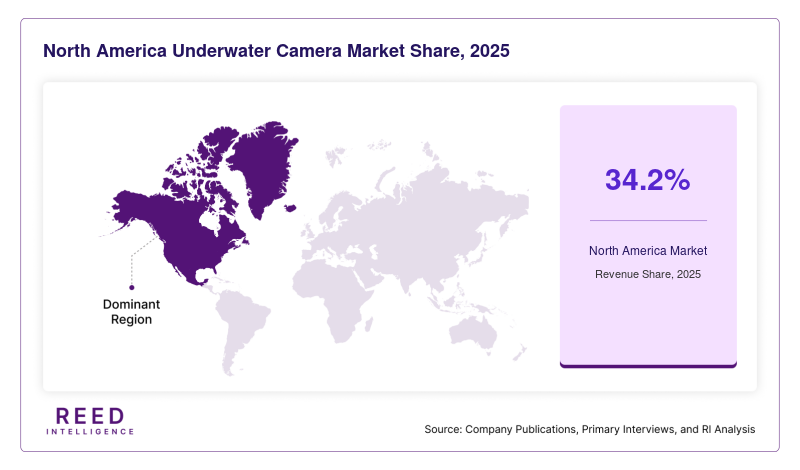
- North America dominated the market with a 34.2% share in 2025.
- Asia Pacific is expected to grow at the fastest CAGR of 11.2% during 2026–2034.
- By type, digital underwater cameras accounted for the largest share of 39.6%, while autonomous underwater imaging systems are projected to grow at a CAGR of 12.8%.
- By application, marine research and exploration led with a 42.1% share, whereas offshore oil & gas inspection is expected to expand at a CAGR of 10.9%.
- The United States remained the dominant country, with market values of USD 610 million in 2024 and USD 665 million in 2025.
Market Trends
Integration of AI-Based Image Processing in Underwater Imaging Systems
The Underwater Camera Market is witnessing a strong shift toward AI-based image processing technologies. Modern underwater cameras are increasingly equipped with artificial intelligence algorithms that enhance image clarity, remove distortions caused by water turbidity, and enable object recognition in real time. These systems are widely used in marine biology research, where automated species identification reduces manual workload and improves accuracy. In offshore energy sectors, AI-enabled cameras assist in detecting structural defects in pipelines and subsea equipment. The adoption of machine learning also enables predictive analytics for underwater environments, improving operational efficiency. As computing power becomes more compact and energy-efficient, AI integration is expected to become a standard feature in advanced underwater imaging systems.
Rising Demand for Compact and Action-Oriented Waterproof Cameras
Another key trend in the Underwater Camera Market is the growing preference for compact, lightweight, and rugged action cameras designed for recreational and professional use. Adventure tourism, scuba diving, and underwater sports are driving consumer demand for portable cameras capable of capturing high-resolution 4K and 8K video underwater. Manufacturers are focusing on enhancing waterproof depth ratings, shock resistance, and battery performance to meet consumer expectations. Social media content creation has further accelerated demand, as influencers and travel enthusiasts seek durable cameras for underwater storytelling. This trend is also supported by declining hardware costs, making advanced underwater imaging technology more accessible to a broader consumer base.
Market Drivers
Expansion of Marine Research and Environmental Monitoring Activities
The increasing focus on marine ecosystem preservation is a major driver of the Underwater Camera Market. Governments, environmental organizations, and research institutions are investing in advanced underwater imaging systems to study coral reefs, marine biodiversity, and climate change impacts. These cameras provide critical visual data for tracking ecosystem health and monitoring pollution levels in oceans. Rising concerns over marine degradation and plastic pollution have led to large-scale oceanographic surveys, where underwater cameras play a central role. Additionally, international initiatives aimed at sustainable ocean management are increasing funding for underwater exploration technologies, further accelerating market demand across scientific and environmental applications.
Growth in Offshore Oil, Gas, and Renewable Energy Projects
The expansion of offshore energy infrastructure significantly contributes to the growth of the Underwater Camera Market. Offshore oil rigs, subsea pipelines, and wind turbines require continuous monitoring to ensure structural integrity and operational safety. Underwater cameras are widely used for inspection, maintenance planning, and accident prevention in these environments. The transition toward renewable energy, particularly offshore wind farms, has created additional demand for durable imaging systems capable of operating in deep-sea conditions. As energy companies invest in automation and remote inspection technologies, underwater cameras integrated with robotics and ROV systems are becoming essential tools for efficient offshore operations.
Market Restraint
High Equipment Costs and Maintenance Complexity
One of the major restraints in the Underwater Camera Market is the high cost associated with advanced imaging systems and their maintenance. High-resolution underwater cameras, especially those used in industrial and scientific applications, require specialized waterproof housings, pressure-resistant components, and corrosion-resistant materials. These factors significantly increase production costs, limiting adoption among small-scale research institutions and recreational users. Additionally, maintenance in harsh underwater environments is complex and costly, as equipment often requires regular servicing to prevent damage from saltwater exposure and pressure fluctuations. This cost barrier restricts widespread deployment, particularly in developing regions with limited funding for marine technology.
Market Opportunities
Increasing Adoption of Autonomous Underwater Vehicles (AUVs)
The integration of underwater cameras with autonomous underwater vehicles presents a strong growth opportunity for the Underwater Camera Market. AUVs are increasingly used for deep-sea exploration, military surveillance, and offshore infrastructure inspection. These vehicles rely heavily on high-performance imaging systems to navigate and capture real-time data in environments where human access is limited. The combination of AI, robotics, and underwater imaging is enabling more efficient and cost-effective exploration of deep oceans. As AUV technology continues to advance, demand for compact, high-resolution underwater cameras is expected to rise significantly across commercial and defense sectors.
Expansion of Underwater Tourism and Recreational Diving
Growing interest in underwater tourism is creating new opportunities in the Underwater Camera Market. Popular diving destinations are witnessing increased demand for rental and personal underwater imaging equipment. Tourism operators are incorporating underwater photography services to enhance customer experiences, particularly in coral reef exploration and marine wildlife observation. Social media influence is also encouraging travelers to capture high-quality underwater visuals, boosting consumer-grade camera sales. Emerging markets in Asia Pacific and Latin America are experiencing rapid growth in diving tourism, further supporting the expansion of affordable and easy-to-use underwater camera systems.
Segmental Analysis
By Type
Digital underwater cameras held the dominant share of 39.6% in 2024, driven by widespread use in recreational diving and marine research. These cameras offer high-resolution imaging, compact design, and ease of use, making them the preferred choice across consumer and professional segments.
Autonomous underwater imaging systems are expected to grow at a CAGR of 12.8%, supported by increasing deployment in deep-sea exploration and defense applications. Their ability to operate independently in hazardous environments and integrate with AI-based analytics is driving strong adoption in offshore industries.
By Application
Marine research and exploration accounted for 42.1% share in 2024, making it the leading application segment. Growing focus on ocean biodiversity studies and environmental monitoring drives demand for advanced imaging systems in this segment.
Offshore oil and gas inspection is projected to grow at a CAGR of 10.9%, supported by rising need for subsea infrastructure monitoring. Increasing adoption of remote-operated vehicles integrated with cameras enhances operational safety and efficiency.
By End-Use
Scientific research institutes held a 36.4% share in 2024, driven by extensive marine biology and oceanographic studies. Government-funded programs further strengthen adoption in this segment.
Defense and security applications are expected to grow at a CAGR of 11.5%, supported by naval surveillance, border security, and underwater reconnaissance operations. Increasing geopolitical tensions are accelerating investment in advanced underwater imaging systems.
Regional Analysis
North America
North America accounted for 34.2% market share in 2025, with a projected CAGR of 7.9% during 2026–2034. Strong presence of marine research institutions and advanced offshore oil & gas infrastructure supports regional demand.
The United States dominates the regional market due to extensive defense applications and oceanographic research programs. A key growth factor is the increasing investment in underwater robotics integrated with imaging systems for naval surveillance and subsea exploration.
Europe
Europe held a 27.5% share in 2025, with expected growth at a CAGR of 7.4%. The region benefits from strong environmental monitoring policies and offshore renewable energy expansion.
Germany leads the regional market, supported by advanced marine engineering capabilities. Growth is driven by increasing deployment of underwater inspection systems in North Sea offshore wind projects.The region benefits from stringent environmental monitoring regulations and increasing deployment of underwater cameras in offshore wind energy projects. Germany leads the European market, supported by advanced engineering capabilities and growing investments in subsea inspection technologies across the North Sea and Baltic Sea regions.
Asia Pacific
Asia Pacific accounted for 23.8% share in 2025 and is projected to grow at a CAGR of 11.2%, the fastest globally. Rising marine tourism and expanding coastal infrastructure support demand.
China leads the region, driven by large-scale marine research initiatives and defense modernization. Increased investment in underwater surveillance for territorial waters is a key growth factor. Rapid expansion of marine tourism, coastal infrastructure development, and defense modernization are key growth drivers. China dominates the region due to large-scale marine exploration initiatives and increased investment in underwater surveillance systems for maritime security.
Middle East & Africa
The region held a 8.2% share in 2025, with CAGR projected at 8.5%. Offshore oil exploration remains the primary demand driver.
Saudi Arabia dominates the market, supported by extensive offshore energy projects and underwater pipeline inspection activities in the Red Sea and Arabian Gulf.Growth is primarily driven by offshore oil exploration activities and increasing demand for underwater inspection technologies. Saudi Arabia leads the regional market due to its extensive offshore energy projects and growing focus on subsea infrastructure monitoring.
Latin America
Latin America accounted for 6.3% share in 2025, growing at a CAGR of 7.8%. Expanding offshore oil exploration and marine biodiversity studies support market growth.
Brazil leads the region due to deep-water oil production activities and increasing investments in marine ecological research along its coastline.The region’s growth is supported by expanding offshore oil production and marine biodiversity research initiatives. Brazil dominates the market, driven by deep-water oil exploration activities and increasing adoption of underwater imaging systems for environmental monitoring.
Competitive Landscape
The Underwater Camera Market is moderately consolidated, with key players focusing on product innovation, sensor miniaturization, and AI integration. Leading companies include Canon Inc., Nikon Corporation, Sony Group Corporation, GoPro Inc., and FLIR Systems. Canon Inc. remains a prominent leader due to its strong optical imaging technology and wide product portfolio in professional underwater cameras. Recent development includes the launch of enhanced waterproof DSLR systems with improved depth resistance and low-light performance, strengthening its position in marine imaging solutions.
Key Players List
- Canon Inc
- Nikon Corporation
- Sony Group Corporation
- GoPro Inc.
- FLIR Systems
- Olympus Corporation
- Panasonic Holdings
- Ricoh Imaging
- Garmin Ltd.
- SeaLife Cameras
- Paralenz
- DJI
- Subsea Imaging Ltd.,
- Amphibico
- Teledyne Technologies
Recent Developments
- Launch of AI-enhanced underwater imaging cameras for deep-sea exploration applications.
- Expansion of underwater camera integration with autonomous robotic systems in offshore wind inspection projects.
- Introduction of compact 8K underwater action cameras targeting professional diving and content creation markets.
Underwater Camera Market Segments
Type
- Digital Underwater Cameras
- Action Cameras
- Autonomous Underwater Imaging Systems
- Professional Industrial Underwater Cameras
Application
- Marine Research & Exploration
- Offshore Oil & Gas Inspection
- Defense & Security Surveillance
- Recreational Diving & Tourism
- Environmental Monitoring
End-Use
- Scientific Research Institutes
- Energy & Offshore Industry
- Defense Organizations
- Consumer Electronics Users
- Environmental Agencies
By Region
- North America
- Europe
- APAC
- Middle East and Africa
- LATAM