Underwater Marine IoT Market Size, Share, Growth & Industry Analysis Report By Component (Underwater Sensors, Software & Analytics Platforms, Connectivity Devices, Autonomous Underwater Systems), By Application (Structural Health Monitoring, Environmental Monitoring, Surveillance Systems, Offshore Energy Exploration), By End-Use Industry (Oil & Gas, Defense & Maritime Security, Marine Research, Offshore Renewable Energy, Port Infrastructure), Regional Outlook and Forecast, 2026–2034
USD 3950
Market Overview
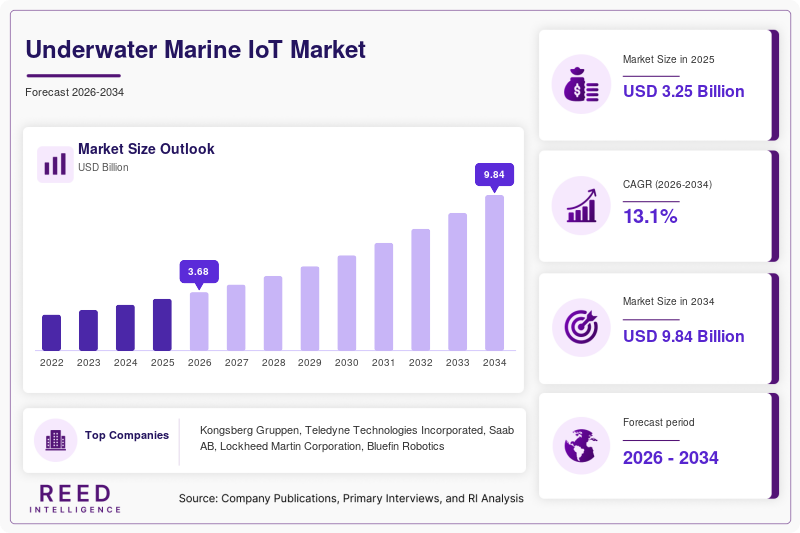
The Underwater Marine IoT Market size valued at USD 3.25 billion in 2026 and projected to reach USD 8.65 billion by 2034, growing at a CAGR of 13.1% (2026–2034). The increasing integration of connected sensor networks, autonomous underwater vehicles, and real-time data analytics platforms is significantly transforming marine operations across defense, oil & gas, and environmental monitoring sectors.
A key global factor driving market growth is the rising demand for real-time ocean intelligence systems to support offshore exploration and marine sustainability initiatives. Governments and private enterprises are increasingly investing in smart underwater infrastructure to enhance navigation safety, monitor seabed conditions, and improve resource extraction efficiency. Additionally, advancements in acoustic communication technologies and edge-based underwater computing have improved data transmission reliability in deep-sea environments.
Key Highlights
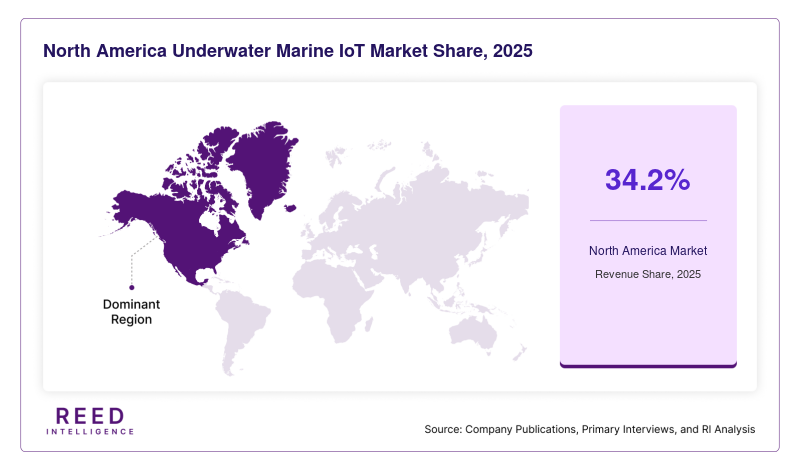
North America dominated the market with a 34.2% share in 2025.
Asia Pacific is expected to grow at the fastest CAGR of 11.2% during 2026–2034.
By equipment type, sensors accounted for the largest share of 38.5%.
while software solutions are projected to grow at a CAGR of 12.4%.
By application, structural health monitoring led with a 41.7% share, whereas corrosion detection is expected to expand at a CAGR of 11.8%.
The United States remained the dominant country, with market values of USD 510 million in 2024 and USD 560 million in 2025.
Market Trends
Integration of AI-Enabled Underwater Sensor Networks
One of the prominent trends in the Underwater Marine IoT Market is the increasing integration of artificial intelligence with underwater sensor networks. These AI-enabled systems are designed to process large volumes of oceanic data in real time, enabling predictive maintenance, anomaly detection, and autonomous decision-making. Machine learning algorithms are being deployed to enhance acoustic signal interpretation, which is critical for deep-sea exploration and defense applications. The convergence of AI with IoT has improved operational efficiency in offshore drilling platforms and subsea monitoring systems. Furthermore, AI-driven predictive analytics helps reduce downtime and improves the lifespan of underwater equipment by identifying potential failures before they occur. This trend is also gaining traction in marine biodiversity studies, where AI models assist in tracking marine species movement patterns and ecosystem changes.
Expansion of Hybrid Acoustic-Optical Communication Systems
Another significant trend is the development of hybrid acoustic-optical communication technologies that enhance underwater data transmission speed and reliability. Traditional acoustic systems often face limitations such as latency and signal distortion, while optical systems provide high-speed transmission but limited range. The integration of both technologies allows seamless data exchange between underwater IoT devices, improving connectivity in complex marine environments. This hybrid approach is increasingly adopted in offshore energy installations, submarine exploration missions, and environmental monitoring networks. Additionally, research institutions are actively developing energy-efficient communication protocols to support long-duration underwater deployments, further strengthening the market landscape.
Market Drivers
Rising Offshore Oil & Gas Exploration Activities
A major driver of the Underwater Marine IoT Market is the increasing exploration of offshore oil and gas reserves. As onshore reserves decline, energy companies are expanding into deepwater and ultra-deepwater regions, requiring advanced monitoring systems for safe and efficient operations. Underwater IoT solutions play a crucial role in pipeline monitoring, leak detection, and equipment performance tracking. These systems help reduce operational risks and ensure compliance with environmental safety regulations. Additionally, offshore platforms are increasingly adopting digital twin technologies integrated with IoT sensors to simulate real-time underwater conditions. This enhances decision-making and reduces operational costs. The demand for reliable subsea communication and monitoring systems continues to grow as exploration activities expand into harsher marine environments.
Growing Demand for Maritime Security and Surveillance
Another key driver is the rising focus on maritime security across global waters. Nations are investing heavily in underwater surveillance systems to monitor territorial waters, detect unauthorized vessels, and safeguard critical infrastructure. Underwater IoT networks equipped with sonar sensors and autonomous underwater vehicles are being deployed for continuous surveillance operations. These systems are particularly important in strategic maritime zones and shipping routes where security threats are higher. Additionally, increasing geopolitical tensions have prompted defense organizations to adopt advanced underwater monitoring technologies. The integration of IoT with naval defense systems enhances situational awareness and strengthens national security frameworks.
Market Restraint
High Deployment and Maintenance Costs in Deep-Sea Environments
One of the major restraints in the Underwater Marine IoT Market is the high cost associated with deploying and maintaining IoT systems in deep-sea environments. Underwater equipment must withstand extreme pressure, corrosive saltwater conditions, and limited accessibility, which significantly increases manufacturing and installation expenses. Additionally, specialized materials such as titanium alloys and pressure-resistant enclosures are required, further raising costs. Maintenance operations often require advanced robotic systems or manned submersibles, making routine servicing both complex and expensive. These financial constraints limit adoption among small and medium enterprises, particularly in developing economies. Furthermore, the lack of standardized infrastructure for underwater communication increases integration challenges, leading to higher operational inefficiencies. Despite technological advancements, cost barriers remain a critical challenge restricting large-scale deployment of underwater IoT systems, especially in remote or deep-ocean regions where logistical support is limited.
Market Opportunities
Expansion of Offshore Renewable Energy Projects
The rapid growth of offshore renewable energy projects presents a significant opportunity for the Underwater Marine IoT Market. Wind farms, tidal energy systems, and wave energy converters require continuous underwater monitoring to ensure structural stability and operational efficiency. IoT-enabled sensors are increasingly used to track turbine foundations, underwater cables, and environmental conditions such as currents and seabed movement. As countries transition toward clean energy, investments in offshore installations are expected to rise significantly. This creates strong demand for advanced monitoring systems that can provide real-time insights and predictive maintenance capabilities. Additionally, integration with cloud-based analytics platforms enables remote monitoring of offshore assets, reducing operational costs and improving energy output efficiency.
Rising Adoption of Smart Ocean Research Initiatives
Another major opportunity lies in the expansion of smart ocean research initiatives supported by governments and academic institutions. These programs focus on understanding marine ecosystems, climate change impacts, and biodiversity conservation using IoT-enabled underwater devices. Autonomous sensors and underwater drones are being deployed to collect high-resolution environmental data across large oceanic regions. This data supports scientific research, disaster prediction, and sustainable marine resource management. Increasing funding for oceanographic studies is expected to accelerate the deployment of underwater IoT networks globally. Moreover, collaborations between research institutes and technology companies are fostering innovation in low-power, long-duration underwater sensing technologies.
Segmental Analysis
By Component
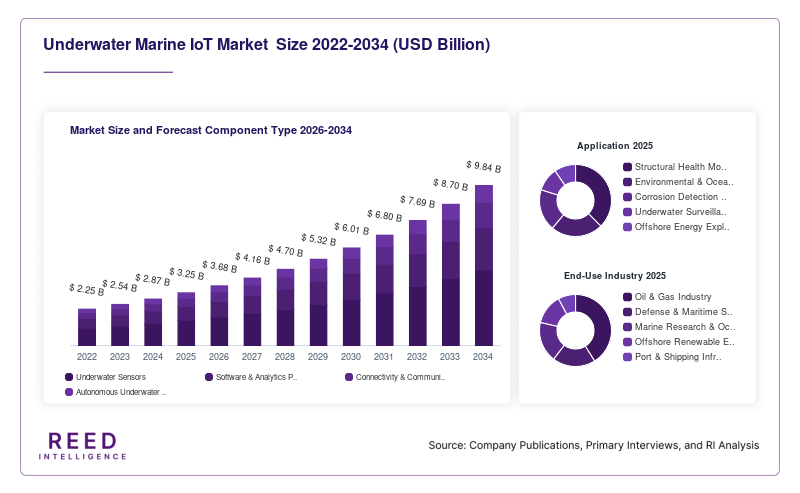
The sensor segment dominated the market with approximately 38.5% share in 2024, driven by widespread deployment in underwater monitoring, structural health assessment, and environmental data collection. These sensors are essential for measuring parameters such as pressure, temperature, salinity, and vibration in harsh marine environments.
The software segment is expected to grow at a CAGR of 12.4%, fueled by increasing demand for real-time analytics, predictive modeling, and data visualization platforms. Integration of AI-based software solutions enhances decision-making and enables autonomous underwater system management.
By Application
Structural health monitoring held the largest share of 41.7% in 2024, as offshore platforms and underwater pipelines require continuous inspection to prevent failures. IoT systems help detect stress, corrosion, and structural anomalies early.
Corrosion detection is expected to grow at a CAGR of 11.8%, driven by the need to extend infrastructure lifespan in harsh saline environments. Advanced sensor coatings and predictive analytics are improving detection accuracy.
By End-Use
The oil & gas sector accounted for 44.3% share in 2024, supported by extensive offshore drilling and pipeline monitoring activities. IoT systems enhance safety and operational efficiency in deepwater exploration.
The defense sector is projected to grow at a CAGR of 12.1%, driven by rising maritime security concerns and increasing investment in underwater surveillance systems for national security applications.
Regional Analysis
North America
North America accounted for approximately 34.2% market share in 2025, with a projected CAGR of 12.6% during 2026–2034. The region’s dominance is driven by advanced offshore infrastructure, strong defense investments, and early adoption of underwater IoT technologies.
The United States and Canada lead regional growth, supported by extensive offshore oil exploration activities and naval modernization programs. Increasing deployment of smart underwater surveillance systems for coastal security is also contributing to market expansion across the region.
Europe
Europe held nearly 27.8% share in 2025, growing at a CAGR of 11.4% during the forecast period. The region benefits from strong environmental monitoring regulations and advanced marine research initiatives.
Germany and Norway are the key contributors, with Norway focusing heavily on offshore oil platforms and subsea monitoring technologies. The presence of advanced maritime research institutions further supports innovation in underwater IoT systems.
Asia Pacific
Asia Pacific is expected to grow at the fastest CAGR of 11.2% during 2026–2034, holding around 22.5% market share in 2025. Rapid industrialization and expanding maritime trade routes are key growth drivers.
China and Japan dominate the region, with China investing heavily in underwater surveillance and marine infrastructure development. Increasing offshore wind energy projects in Japan also support IoT deployment.
Middle East & Africa
The region accounted for 9.1% share in 2025, with a projected CAGR of 10.8%. Growth is driven by offshore oil exploration and port modernization projects.
Saudi Arabia leads the market due to large-scale offshore energy investments and smart marine infrastructure initiatives supporting Vision 2030 development goals.
Latin America
Latin America held around 6.4% share in 2025, expanding at a CAGR of 10.5%. Offshore oil production in Brazil and Mexico is the primary growth driver.
Brazil dominates the region, supported by deepwater oil exploration projects in the pre-salt basins, requiring advanced underwater IoT monitoring systems.
Competitive Landscape
The Underwater Marine IoT Market is moderately consolidated, with key players focusing on sensor innovation, autonomous systems, and advanced communication technologies. Leading companies include Kongsberg Gruppen, Teledyne Technologies, Saab AB, Bluefin Robotics, and Lockheed Martin Corporation. These firms are investing heavily in R&D to enhance underwater communication reliability and energy efficiency.
Kongsberg Gruppen is a prominent leader, known for its advanced subsea sensor and autonomous underwater vehicle solutions. Recent developments include the expansion of integrated ocean monitoring platforms designed for deep-sea exploration and offshore energy applications. Companies are also forming strategic partnerships with research institutions to improve AI-enabled underwater analytics and expand global deployment capabilities.
Key Players List
- Kongsberg Gruppen
- Teledyne Technologies
- Saab AB
- Lockheed Martin Corporation
- Bluefin Robotics
- General Electric Company
- Nortek Group
- Fugro
- Sonardyne International
- iXblue
- Ocean Infinity
- Hydroid Inc.
- L3Harris Technologies
- EvoLogics GmbH
- Atlas Elektronik
Recent Developments
- Kongsberg Gruppen expanded its underwater IoT platform with enhanced AI-based predictive maintenance capabilities for offshore wind farms in 2026.
- Teledyne Technologies launched a new generation of deep-sea acoustic sensor networks designed for long-range communication in 2025.
- Saab AB partnered with European marine institutes to develop autonomous underwater surveillance systems for coastal defense applications in 2026.
Underwater Marine IoT Market Segments
Component Type
- Underwater Sensors
- Software & Analytics Platforms
- Connectivity & Communication Devices
- Autonomous Underwater Systems (AUVs & ROVs)
Application
- Structural Health Monitoring
- Environmental & Ocean Monitoring
- Corrosion Detection Systems
- Underwater Surveillance & Security
- Offshore Energy Exploration
End-Use Industry
- Oil & Gas Industry
- Defense & Maritime Security
- Marine Research & Oceanography
- Offshore Renewable Energy
- Port & Shipping Infrastructure
By Region
- North America
- Europe
- APAC
- Middle East and Africa
- LATAM