Underwater Turbine Market Size, Share & Demand Report By Type (Tidal Turbines, Ocean Current Turbines, River Hydrokinetic Turbines), By Application (Power Generation, Desalination, Water Pumping), By End-Use (Utilities, Industrial, Commercial), By Region & Segment Forecasts, 2025–2034
USD 3950
Market Overview
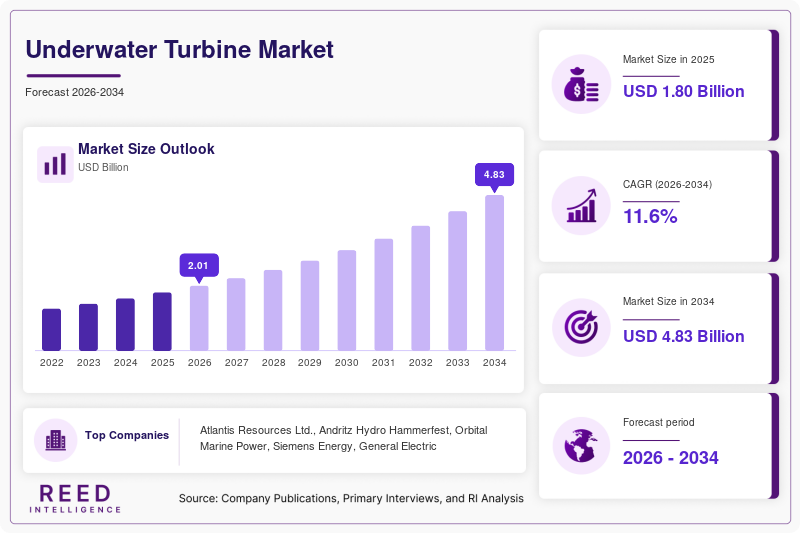
The Underwater Turbine Market size is gaining traction as countries and industries shift toward renewable energy sources that offer predictable and sustainable power generation. Underwater turbines, also known as marine or hydrokinetic turbines, harness the kinetic energy of flowing water from ocean currents, tidal streams, and river flows to generate electricity. In 2025, the global underwater turbine market size is estimated at USD 1.8 billion, and it is expected to grow to approximately USD 2.1 billion in 2026. With increasing investments in marine renewable infrastructure, the market is projected to reach USD 5.6 billion by 2034, expanding at a CAGR of 11.6% from 2025 to 2034.
The market’s expansion is driven by the growing need for reliable renewable energy solutions that complement intermittent sources such as solar and wind. Unlike solar and wind power, underwater turbines provide predictable energy generation due to the consistent nature of tidal and ocean currents. This reliability is encouraging governments and private players to invest in pilot and commercial-scale projects. Additionally, advancements in turbine efficiency, corrosion-resistant materials, and subsea installation technologies are reducing operational costs and improving system longevity.
Key Highlights
- Market size projected to reach USD 5.6 billion by 2034
- CAGR of 11.6% from 2025 to 2034
- Tidal energy remains a dominant application segment
- Increasing investments in marine renewable infrastructure
- Technological advancements improving efficiency and durability
Market Trends
Integration of Hybrid Renewable Energy Systems
One of the prominent trends in the underwater turbine market is the integration of underwater turbines with other renewable energy systems such as offshore wind and solar power. Hybrid energy platforms are being developed to optimize energy generation and ensure a stable power supply. These systems combine multiple energy sources to overcome the intermittency challenges associated with individual technologies. For instance, tidal turbines can generate power during periods when solar and wind output is low, ensuring continuous electricity generation. This integration is particularly beneficial for offshore installations and island grids where reliability is critical.
The development of multi-source energy farms is also attracting investments from energy companies seeking diversified renewable portfolios. Hybrid systems reduce infrastructure costs by sharing transmission and grid connection facilities. Moreover, the use of advanced monitoring and control systems allows operators to optimize energy output in real time. This trend is expected to drive innovation and expand the adoption of underwater turbines in large-scale renewable energy projects.
Advancements in Floating and Modular Turbine Designs
Another significant trend shaping the underwater turbine market is the emergence of floating and modular turbine technologies. Traditional fixed-bottom turbines often face limitations due to seabed conditions and installation challenges. Floating turbines, on the other hand, can be deployed in deeper waters with strong currents, significantly expanding the potential deployment areas. These systems are easier to install, maintain, and relocate, reducing overall project costs.
Modular turbine designs are also gaining popularity as they enable scalability and flexibility. Operators can deploy multiple smaller units instead of a single large turbine, reducing the risk of system failure and improving maintenance efficiency. Additionally, modular systems allow for incremental capacity expansion based on demand. These innovations are enhancing the commercial viability of underwater turbines and attracting interest from both public and private stakeholders.
Market Drivers
Rising Demand for Predictable Renewable Energy Sources
The increasing demand for reliable and predictable renewable energy is a major driver of the underwater turbine market. Unlike solar and wind energy, which are subject to weather variability, tidal and ocean currents follow predictable patterns. This consistency allows for accurate forecasting of energy generation, making underwater turbines an attractive option for grid operators. The ability to provide stable power output supports grid stability and reduces the need for backup power sources.
As energy systems transition toward higher shares of renewable energy, the importance of predictability becomes more pronounced. Utilities and governments are investing in technologies that can provide baseload renewable power, and underwater turbines are well-positioned to meet this demand. This driver is particularly relevant in regions with strong tidal currents and limited land availability for other renewable installations.
Government Support and Renewable Energy Policies
Government initiatives and policy frameworks supporting renewable energy adoption are significantly driving the growth of the underwater turbine market. Many countries have introduced subsidies, tax incentives, and funding programs to promote marine energy projects. These policies aim to accelerate the transition to low-carbon energy systems and reduce dependence on fossil fuels.
In addition, regulatory bodies are streamlining permitting processes for marine energy installations, reducing project development timelines. Public-private partnerships are also playing a key role in financing large-scale projects. As governments continue to prioritize clean energy, the underwater turbine market is expected to benefit from sustained policy support and increased funding for research and development.
Market Restraint
High Installation and Maintenance Costs
Despite its potential, the underwater turbine market faces a significant restraint in the form of high installation and maintenance costs. Deploying turbines in marine environments requires specialized equipment, skilled labor, and extensive site assessments. The harsh underwater conditions, including corrosion, biofouling, and strong currents, further increase maintenance requirements and operational expenses.
These high costs can limit the adoption of underwater turbines, particularly in developing regions with budget constraints. For example, small island nations may find it challenging to invest in large-scale marine energy projects despite having favorable tidal conditions. Additionally, the lack of established supply chains and standardized technologies contributes to cost inefficiencies. This restraint may slow market growth in the short term, although ongoing technological advancements are expected to reduce costs over time.
Market Opportunities
Expansion in Island and Remote Area Electrification
Underwater turbines present a significant opportunity for electrification in island and remote coastal regions. These areas often rely on diesel generators for power, which are costly and environmentally harmful. By harnessing local water currents, underwater turbines can provide a sustainable and cost-effective energy solution. This approach reduces fuel dependency and enhances energy security.
Governments and international organizations are increasingly focusing on renewable energy solutions for remote communities. Funding initiatives and pilot projects are being launched to demonstrate the feasibility of marine energy systems. As technology becomes more affordable, the adoption of underwater turbines in these regions is expected to increase, creating new growth opportunities for market players.
Technological Innovations in Energy Storage Integration
The integration of underwater turbines with advanced energy storage systems offers another promising opportunity for market growth. Energy storage technologies, such as batteries and hydrogen systems, can store excess energy generated during peak tidal flows and release it during low-demand periods. This capability enhances the reliability and efficiency of underwater turbine systems.
Innovations in energy storage are also enabling the development of off-grid and microgrid solutions powered by marine energy. These systems are particularly useful for industrial operations, offshore platforms, and remote communities. As storage technologies continue to evolve, their integration with underwater turbines is expected to unlock new applications and drive market expansion.
Segmental Analysis
By Type
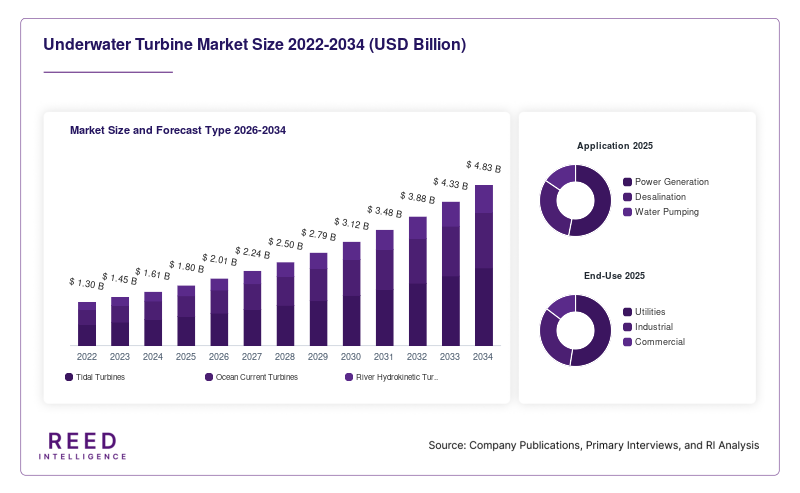
The tidal turbines segment dominated the underwater turbine market in 2024, accounting for approximately 58% of the total market share. Tidal turbines are widely adopted due to their predictable energy generation and high efficiency in strong tidal currents. These turbines are commonly installed in coastal areas with significant tidal ranges, making them a reliable source of renewable energy. Their ability to provide consistent power output has made them a preferred choice for utility-scale projects.
The ocean current turbines segment is expected to be the fastest-growing, with a CAGR of 12.8% during the forecast period. This growth is driven by advancements in floating turbine technologies that enable deployment in deep-sea environments. Ocean currents offer vast untapped energy potential, and innovations in turbine design are making it possible to harness this energy more effectively. Increasing investments in research and development are further supporting the growth of this segment.
By Application
The power generation segment held the largest share of the market in 2024, accounting for around 65% of total revenue. Underwater turbines are primarily used for electricity generation, supplying power to grids and off-grid systems. The growing demand for renewable energy and the need to reduce carbon emissions are driving the adoption of underwater turbines in this segment.
The desalination segment is expected to grow at the fastest CAGR of 11.9% during the forecast period. Underwater turbines can be integrated with desalination plants to provide a sustainable energy source for water treatment processes. This application is particularly relevant in water-scarce regions where energy costs for desalination are high. The combination of renewable energy and water treatment solutions is creating new growth opportunities.
By End-Use
The utilities segment dominated the market in 2024, capturing approximately 60% of the total market share. Utility companies are investing in underwater turbines to diversify their energy portfolios and meet renewable energy targets. Large-scale projects and grid integration are key factors driving the growth of this segment.
The industrial segment is expected to be the fastest-growing, with a CAGR of 12.2% during the forecast period. Industries located in coastal areas are adopting underwater turbines to reduce energy costs and improve sustainability. The ability to generate on-site renewable energy is a major advantage for industrial users. As companies focus on reducing their carbon footprint, the adoption of underwater turbines in industrial applications is expected to increase.
Regional Analysis
North America
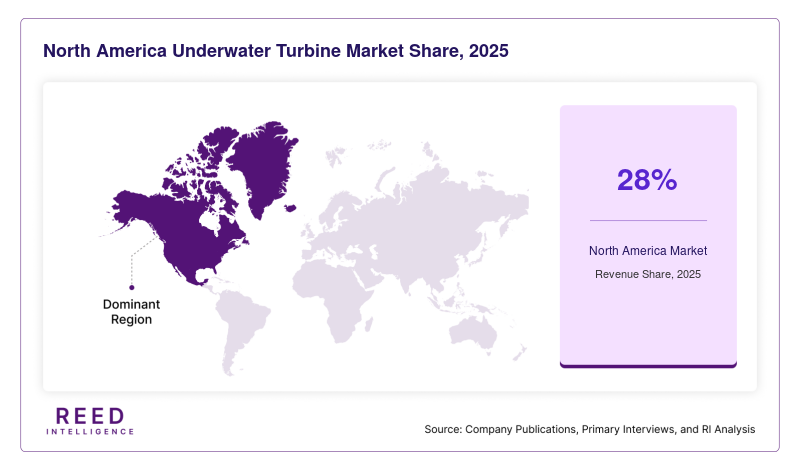
North America accounted for approximately 28% of the underwater turbine market share in 2025 and is projected to grow at a CAGR of 10.8% through 2034. The region’s growth is supported by strong investments in renewable energy infrastructure and favorable government policies. The presence of advanced research institutions and technology developers is also contributing to innovation in marine energy systems.
The United States dominates the North American market, driven by its extensive coastline and strong focus on clean energy initiatives. A key growth factor is the increasing number of pilot projects in tidal energy, particularly in Alaska and the Pacific Northwest. These projects are demonstrating the commercial viability of underwater turbines and encouraging further investments.
Europe
Europe held a market share of around 32% in 2025 and is expected to grow at a CAGR of 11.2% during the forecast period. The region is a global leader in marine renewable energy, with several large-scale tidal energy projects already in operation. Strong regulatory support and funding from regional bodies are driving market growth.
The United Kingdom leads the European market, supported by its favorable tidal conditions and well-established marine energy sector. A unique growth factor is the presence of dedicated test sites for marine energy technologies, which facilitate innovation and commercialization. These sites enable companies to test and refine turbine designs in real-world conditions.
Asia Pacific
Asia Pacific accounted for approximately 22% of the market share in 2025 and is projected to grow at the highest CAGR of 12.4% through 2034. Rapid industrialization and increasing energy demand are driving the adoption of renewable energy solutions in the region. Governments are actively investing in marine energy projects to diversify their energy mix.
China dominates the Asia Pacific market, driven by its large-scale investments in renewable energy infrastructure. A key growth factor is the country’s focus on developing coastal energy resources to reduce reliance on fossil fuels. Government-backed research programs and pilot projects are accelerating the deployment of underwater turbines.
Middle East & Africa
The Middle East & Africa region held a market share of about 10% in 2025 and is expected to grow at a CAGR of 10.5% during the forecast period. The region is gradually exploring marine energy as part of its renewable energy strategy. Coastal countries are investing in pilot projects to assess the feasibility of underwater turbines.
South Africa leads the market in this region, supported by its extensive coastline and growing focus on renewable energy. A unique growth factor is the increasing demand for decentralized energy solutions in remote coastal areas. Underwater turbines offer a viable option for providing reliable power in these regions.
Latin America
Latin America accounted for around 8% of the market share in 2025 and is projected to grow at a CAGR of 10.9% through 2034. The region’s growth is driven by increasing investments in renewable energy and the need to reduce dependence on fossil fuels. Coastal countries are exploring marine energy as a sustainable alternative.
Brazil dominates the Latin American market, supported by its vast coastline and strong renewable energy policies. A key growth factor is the government’s focus on diversifying the energy mix and promoting clean energy technologies. Pilot projects in tidal energy are expected to drive market growth in the coming years.
Competitive Landscape
The underwater turbine market is moderately fragmented, with several key players focusing on technological innovation and strategic partnerships to strengthen their market position. Companies are investing in research and development to improve turbine efficiency, durability, and cost-effectiveness. Collaborations with governments and research institutions are also common, enabling companies to participate in pilot projects and large-scale deployments.
One of the leading players in the market is Atlantis Resources, known for its expertise in tidal energy projects. The company has been involved in several large-scale installations and continues to expand its project portfolio. A recent development in the market includes the launch of advanced modular turbine systems designed to reduce installation costs and improve scalability.
Other major players are focusing on expanding their geographic presence and enhancing their product offerings. The competitive landscape is expected to evolve as new entrants bring innovative technologies and established companies scale up their operations.
Key Players
- Atlantis Resources Ltd.
- Andritz Hydro Hammerfest
- Orbital Marine Power
- Siemens Energy
- General Electric
- Nova Innovation
- Verdant Power
- OpenHydro (Naval Energies)
- Minesto AB
- Tocardo International BV
- Sustainable Marine Energy
- Sabella SAS
- Schottel Hydro
- Voith Hydro
- Ocean Renewable Power Company
Recent Developments
- A leading marine energy company introduced a floating tidal turbine platform designed for deep-water deployment, improving efficiency and reducing installation costs.
- A European consortium launched a large-scale tidal energy project aimed at supplying power to coastal communities, showcasing the commercial viability of underwater turbines.
- A technology provider partnered with a government agency to develop hybrid renewable energy systems integrating underwater turbines with offshore wind farms.
Underwater Turbine Market Segments
Type
- Tidal Turbines
- Ocean Current Turbines
- River Hydrokinetic Turbines
Application
- Power Generation
- Desalination
- Water Pumping
End-Use
- Utilities
- Industrial
- Commercial
By Region
- North America
- Europe
- APAC
- Middle East and Africa
- LATAM