Uniaxial Tester Market Size, Share & Demand Report By Type (Electromechanical Uniaxial Testers, Servo-Hydraulic Uniaxial Testers), By Application (Tensile Testing, Compression Testing, Bending Testing), By End-Use (Manufacturing, Construction, Automotive & Aerospace, Research & Development) By Region & Segment Forecasts, 2025–2034
USD 3950
Market Overview
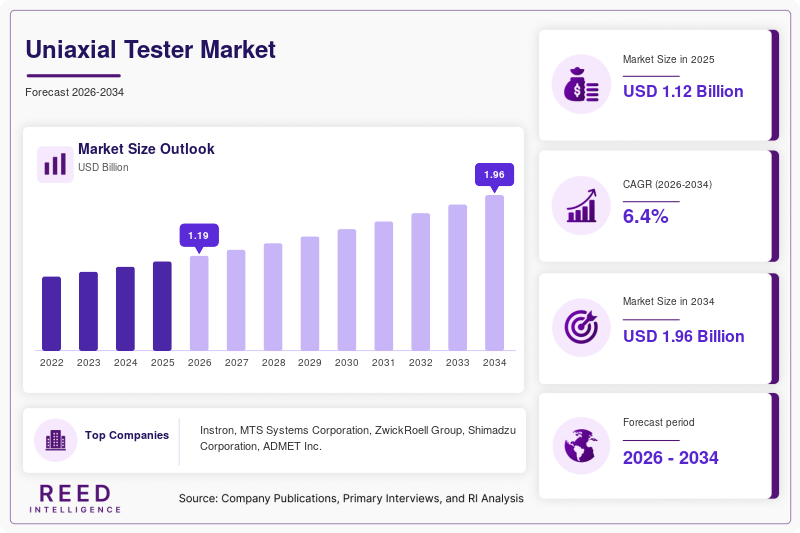
The Uniaxial Tester Market size is estimated to reach USD 1.12 billion, followed by USD 1.19 billion in 2026. The market is projected to grow at a compound annual growth rate (CAGR) of 6.4% from 2025 to 2034, reaching approximately USD 2.01 billion by 2034. This growth trajectory reflects rising industrial automation, increasing demand for high-performance materials, and stricter quality assurance requirements across sectors such as construction, automotive, aerospace, and manufacturing.
One of the primary growth factors is the rising demand for advanced material testing in infrastructure and construction projects. Governments and private players are investing heavily in modern infrastructure, which requires reliable testing equipment to evaluate tensile strength, compression behavior, and elasticity of materials. Another key factor is the expansion of the automotive and aerospace industries, where lightweight and durable materials must undergo rigorous testing to meet safety standards. Additionally, technological advancements such as digital interfaces, automation, and integration with data analytics platforms are enhancing the efficiency and precision of uniaxial testing equipment.
Key Highlights
- The market size is projected to reach USD 2.01 billion by 2034, reflecting steady expansion driven by industrial demand. This growth highlights increasing reliance on material testing solutions across multiple sectors.
- The market is expected to grow at a CAGR of 6.4% during the forecast period from 2025 to 2034. This consistent growth rate indicates stable adoption of uniaxial testing technologies worldwide.
- Demand from construction and automotive industries continues to rise due to the need for reliable material strength testing. These sectors depend heavily on accurate testing systems to ensure safety and performance standards.
- There is a growing shift toward automated and digital testing systems that improve efficiency and reduce human error. Advanced software integration and real-time data monitoring are further supporting this trend.
Market Trends
Integration of Digital and Automated Testing Systems
The Uniaxial Tester Market is experiencing a significant shift toward digitalization and automation. Modern testing systems are increasingly equipped with advanced software interfaces, automated load control, and real-time data acquisition capabilities. These features enhance testing accuracy while reducing human error and operational time. Industries are adopting such systems to streamline quality control processes and improve efficiency. Additionally, cloud-based data storage and analytics enable organizations to monitor testing performance remotely and maintain comprehensive records for compliance purposes. This trend is particularly prominent in developed markets, where manufacturers prioritize precision and efficiency in production workflows.
Rising Demand for Customizable and Application-Specific Solutions
Another notable trend in the Uniaxial Tester Market is the growing demand for customizable testing solutions tailored to specific industry requirements. Different materials, such as metals, polymers, composites, and ceramics, require unique testing parameters and configurations. Manufacturers are responding by offering modular designs and adaptable testing systems that can accommodate diverse applications. This trend is driven by the increasing complexity of materials used in sectors like aerospace and electronics. Customization also enables end-users to optimize testing procedures, improve reliability, and reduce operational costs, making it a key factor influencing purchasing decisions.
Market Drivers
Growth in Infrastructure and Construction Activities
The rapid expansion of infrastructure projects worldwide is a major driver of the Uniaxial Tester Market. Governments and private investors are allocating substantial funds to develop transportation networks, residential buildings, and industrial facilities. These projects require extensive material testing to ensure structural integrity and safety. Uniaxial testers play a critical role in evaluating the mechanical properties of construction materials such as concrete, steel, and composites. The increasing emphasis on sustainable and durable construction materials further amplifies the need for reliable testing equipment, driving market growth across both developed and emerging economies.
Increasing Adoption in Automotive and Aerospace Industries
The automotive and aerospace sectors are significant contributors to the growth of the Uniaxial Tester Market. These industries require high-performance materials that can withstand extreme conditions while maintaining safety standards. Uniaxial testing is essential for assessing tensile strength, fatigue resistance, and deformation characteristics of materials used in vehicle and aircraft components. With the growing focus on lightweight materials to improve fuel efficiency and reduce emissions, the demand for advanced testing solutions is rising. This trend is further supported by continuous innovation and research in material science, encouraging the adoption of sophisticated testing equipment.
Market Restraint
High Initial Investment and Maintenance Costs
One of the primary restraints in the Uniaxial Tester Market is the high initial investment required for advanced testing systems. Modern uniaxial testers equipped with digital controls, automation features, and precision sensors can be expensive, making them less accessible for small and medium-sized enterprises. In addition to the purchase cost, maintenance and calibration expenses add to the overall financial burden. Regular servicing is essential to ensure accurate results, which increases operational costs over time.
This restraint significantly impacts market penetration in developing regions, where budget constraints limit the adoption of high-end testing equipment. For example, small-scale manufacturers in emerging economies often rely on conventional testing methods due to cost considerations, thereby slowing the adoption of advanced systems. Despite the long-term benefits of improved efficiency and accuracy, the upfront cost remains a barrier for many potential users, affecting overall market growth.
Market Opportunities
Expansion of Research and Development Activities
The increasing focus on research and development in materials science presents significant opportunities for the Uniaxial Tester Market. Academic institutions, research laboratories, and industrial R&D centers are investing in advanced testing equipment to explore new materials and improve existing ones. This trend is driven by the need for innovative solutions in industries such as renewable energy, electronics, and healthcare. Uniaxial testers are essential tools for evaluating material behavior under controlled conditions, making them indispensable in research applications. The growing emphasis on innovation is expected to create sustained demand for high-precision testing systems.
Adoption in Emerging Economies
Emerging economies offer substantial growth opportunities for the Uniaxial Tester Market due to rapid industrialization and infrastructure development. Countries in Asia Pacific, Latin America, and Africa are witnessing increased investments in manufacturing and construction sectors. As these industries expand, the need for standardized testing procedures becomes more critical. Governments are also implementing regulations to ensure product quality and safety, further driving the demand for testing equipment. Additionally, the availability of cost-effective solutions tailored to local markets is encouraging adoption, making emerging economies a key growth avenue for market participants.
Segmental Analysis
By Type
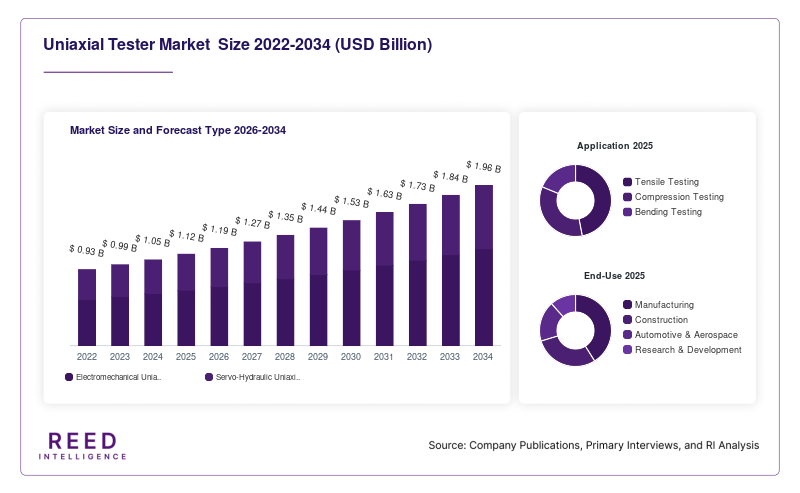
The electromechanical uniaxial testers segment dominated the market in 2024, accounting for approximately 58% of the total share. These testers are widely used due to their accuracy, ease of operation, and suitability for a wide range of materials. Industries such as construction, automotive, and manufacturing rely on electromechanical testers for routine quality control and material testing applications. Their ability to provide precise load control and consistent results makes them a preferred choice among end-users. Additionally, advancements in digital interfaces and automation features are enhancing their performance and usability, further supporting their dominance in the market.
The servo-hydraulic uniaxial testers segment is expected to grow at the fastest CAGR of 7.2% during the forecast period. These testers are designed for high-force applications and are commonly used in aerospace, defense, and heavy machinery industries. The growth of this segment is driven by the increasing demand for testing high-strength materials and complex components. Additionally, the ability to simulate real-world conditions and perform dynamic testing makes servo-hydraulic testers highly valuable. As industries continue to develop advanced materials, the demand for high-performance testing systems is expected to rise significantly.
By Application
The tensile testing segment held the largest market share of approximately 46% in 2024. Tensile testing is one of the most common applications of uniaxial testers, used to evaluate the strength and elasticity of materials. This application is widely used across industries such as construction, automotive, and manufacturing. The increasing demand for high-quality materials and the need for standardized testing procedures are driving the growth of this segment. Additionally, advancements in testing technologies are improving the accuracy and efficiency of tensile testing, further supporting its dominance in the market.
Compression testing is the fastest-growing application segment, with a projected CAGR of 6.9%. This growth is driven by the increasing use of materials that require evaluation under compressive forces, such as concrete and ceramics. The construction industry, in particular, relies heavily on compression testing to ensure the durability and safety of structures. Additionally, the growing focus on infrastructure development and the use of advanced materials are contributing to the rising demand for compression testing solutions.
By End-Use
The manufacturing sector accounted for the largest market share of approximately 52% in 2024. Manufacturers use uniaxial testers extensively for quality control and product development. The need to maintain consistent product quality and comply with industry standards drives the adoption of testing equipment in this sector. Additionally, the increasing automation of manufacturing processes is encouraging the use of advanced testing systems that can integrate seamlessly with production lines, improving efficiency and reducing downtime.
The research and development sector is expected to grow at the highest CAGR of 7.0% during the forecast period. This growth is driven by the increasing focus on innovation and the development of new materials. Research institutions and laboratories require high-precision testing equipment to conduct experiments and analyze material properties. The growing investment in R&D activities across various industries, including healthcare, electronics, and renewable energy, is expected to drive the demand for uniaxial testers in this segment.
Regional Analysis
North America
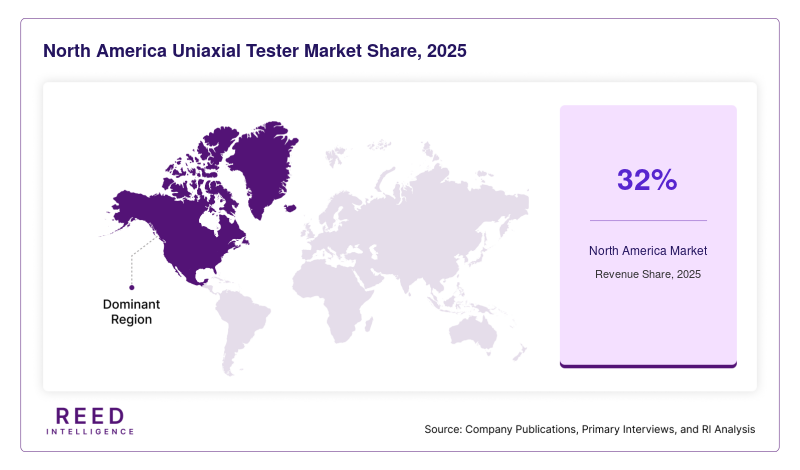
North America accounted for approximately 32% of the Uniaxial Tester Market share in 2025 and is expected to grow at a CAGR of 5.8% during the forecast period. The region benefits from a well-established industrial base and strong demand for advanced testing solutions across sectors such as aerospace, automotive, and construction. The presence of leading manufacturers and continuous technological advancements contribute to market growth. Additionally, stringent regulatory standards for product quality and safety drive the adoption of reliable testing equipment.
The United States dominates the North American market due to its robust manufacturing sector and high investment in research and development. A unique growth factor in this region is the increasing adoption of automated testing systems integrated with data analytics. Companies are focusing on improving operational efficiency and reducing testing time, which supports the demand for advanced uniaxial testers.
Europe
Europe held around 27% of the global market share in 2025 and is projected to expand at a CAGR of 5.6% through 2034. The region’s strong focus on quality assurance and compliance standards drives the adoption of uniaxial testing equipment. Industries such as automotive, aerospace, and construction are key contributors to market growth. Additionally, the presence of established manufacturers and technological innovation supports market expansion.
Germany leads the European market, supported by its advanced manufacturing sector and emphasis on engineering excellence. A unique growth factor is the increasing use of sustainable materials, which require precise testing to ensure performance and durability. This trend is encouraging the adoption of advanced uniaxial testers across various industries.
Asia Pacific
Asia Pacific is the fastest-growing region, accounting for 24% of the market share in 2025 and expected to grow at a CAGR of 7.5%. Rapid industrialization, urbanization, and infrastructure development are key drivers of market growth. Countries such as China, India, and Japan are investing heavily in manufacturing and construction, increasing the demand for material testing equipment.
China dominates the Asia Pacific market due to its large-scale industrial base and growing focus on quality control. A unique growth factor is the expansion of manufacturing facilities and the adoption of advanced technologies. This trend is driving the demand for efficient and cost-effective testing solutions, boosting market growth in the region.
Middle East & Africa
The Middle East & Africa region held approximately 9% of the market share in 2025 and is expected to grow at a CAGR of 6.1%. The region’s growth is driven by increasing investments in infrastructure and construction projects. Governments are focusing on developing modern infrastructure, which requires reliable testing equipment to ensure material quality and safety.
The United Arab Emirates is a key market in this region, supported by large-scale construction projects and technological adoption. A unique growth factor is the increasing emphasis on quality standards in construction materials, which is driving the demand for uniaxial testers in the region.
Latin America
Latin America accounted for around 8% of the global market share in 2025 and is projected to grow at a CAGR of 6.0%. The region’s growth is supported by expanding industrial activities and infrastructure development. Countries such as Brazil and Mexico are investing in manufacturing and construction, increasing the demand for testing equipment.
Brazil leads the Latin American market due to its growing industrial base and infrastructure projects. A unique growth factor is the rising adoption of standardized testing procedures to improve product quality and competitiveness. This trend is encouraging the use of advanced uniaxial testers in the region.
Competitive Landscape
The Uniaxial Tester Market is moderately fragmented, with several global and regional players competing based on product quality, innovation, and pricing strategies. Leading companies are focusing on developing advanced testing systems with enhanced accuracy, automation, and data integration capabilities. They are also expanding their product portfolios to cater to diverse industry requirements and strengthen their market presence.
Instron is considered a leading player in the market, known for its comprehensive range of material testing solutions and strong global presence. The company has recently introduced advanced digital testing systems with improved software capabilities, enabling real-time data analysis and remote monitoring. Other key players are investing in research and development to introduce innovative products and gain a competitive edge. Strategic collaborations, mergers, and acquisitions are also common strategies adopted by market participants to expand their market share and enhance their technological capabilities.
Key Players
- Instron
- MTS Systems Corporation
- ZwickRoell Group
- Shimadzu Corporation
- ADMET Inc.
- Tinius Olsen
- Hegewald & Peschke
- AMETEK Inc.
- Lloyd Instruments
- Torontech Group International
- Jinan Testing Equipment IE Corporation
- Qualitest International Inc.
- United Testing Systems Inc.
- ETS Intarlaken Technologies
- Presto Group
Recent Developments
- In 2024, Instron launched a new series of automated uniaxial testers with enhanced data analytics capabilities, improving testing efficiency and accuracy.
- In 2023, ZwickRoell introduced modular testing systems designed for customizable applications across multiple industries.
- In 2024, Shimadzu Corporation expanded its product portfolio by launching high-capacity servo-hydraulic testers for aerospace applications.
Uniaxial Tester Market Segments
Type
- Electromechanical Uniaxial Testers
- Servo-Hydraulic Uniaxial Testers
Application
- Tensile Testing
- Compression Testing
- Bending Testing
End-Use
- Manufacturing
- Construction
- Automotive & Aerospace
- Research & Development
By Region
- North America
- Europe
- APAC
- Middle East and Africa
- LATAM