Uniform Rental Market Size, Share Demand Report By Rental Type (Workwear, Healthcare Uniforms, Hospitality Uniforms), By Application (Industrial, Healthcare, Hospitality) By Region & Segment Forecasts, 2026–2034
USD 3950
Uniform Rental Market Size
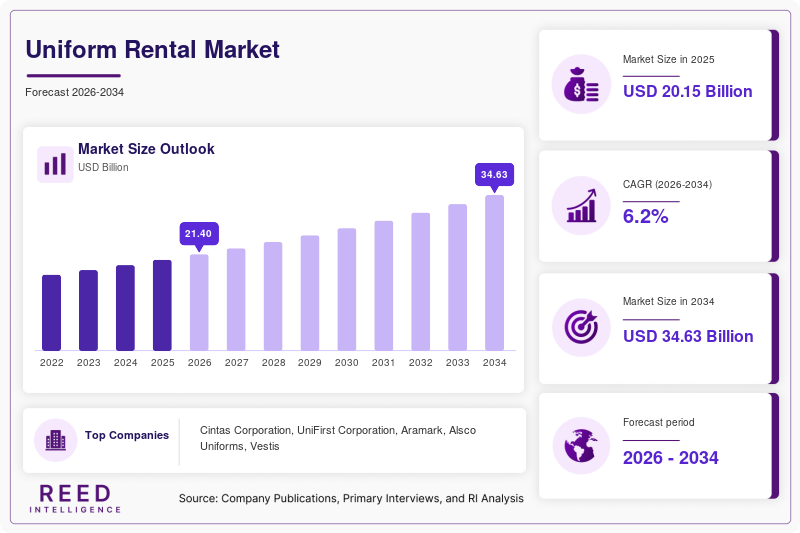
Global Uniform Rental market size is projected at USD 21.4 billion in 2026 and is expected to hit USD 34.6 billion by 2034 with a CAGR of 6.2%. The market is supported by recurring demand for professionally managed workwear, healthcare apparel, protective clothing, laundering, repair, replacement, and inventory services. Detailed data by rental type, application, geography, customer size, and service model is increasingly important for evaluating demand concentration and competitive positioning across fragmented regional markets.
Key takeaways
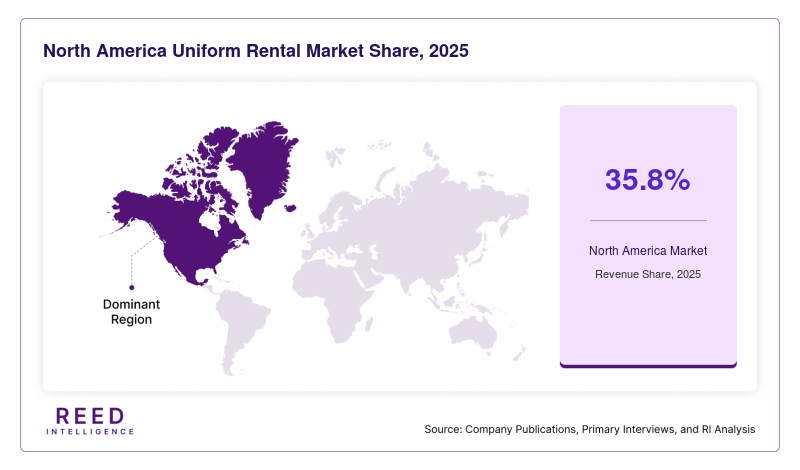
- North America dominated with approximately 35.8% share in 2026, while Asia Pacific is the fastest-growing region at a CAGR of 7.5% through 2034.
- Workwear accounted for nearly 52.6% of global revenue in 2026, while healthcare uniforms represent a rapidly expanding category with approximately 6.8% CAGR.
- Industrial applications held about 46.9% share, supported by manufacturing, construction, logistics, food processing, and energy-sector requirements.
- Healthcare applications represented approximately 28.7% share, driven by hospitals, clinics, laboratories, and infection-control requirements.
- India is an emerging country market, projected to reach approximately USD 1.15 billion by 2034, expanding at a CAGR of 9.1% from 2026 to 2034.
The global uniform rental market comprises the recurring rental, laundering, maintenance, repair, replacement, delivery, and inventory management of uniforms and specialized work apparel. Global providers manage an estimated 1.9 billion rented garment cycles annually, with workwear contributing approximately 52.6%, healthcare uniforms 28.7%, and hospitality uniforms 18.7% of revenue. Adoption is strongest among organizations with more than 100 employees because outsourced garment management reduces internal procurement and laundry requirements while maintaining standardized appearance and workplace hygiene. Digital garment tracking, RFID identification, automated inventory platforms, and route-optimization technologies are increasing service penetration across industrial and institutional customers.
Uniform Rental Market Trends
Connected Garment Management and Sustainable Rental Programs
Technology is shifting uniform rental from a conventional laundry-and-delivery service toward an integrated garment-management model. RFID tags, barcode systems, cloud-based inventory dashboards, automated replenishment, route optimization, and mobile service applications allow providers to track individual garments throughout their lifecycle. RFID-enabled programs can monitor thousands of garments per customer location and improve visibility of replacement cycles, missing items, utilization rates, and service frequency.
Sustainability is also influencing procurement decisions, particularly among manufacturing, healthcare, foodservice, and hospitality organizations. Rental models extend garment utilization through professional laundering, repair, alteration, and controlled replacement. Demand is increasing for recycled polyester, organic cotton blends, lower-water laundering processes, and energy-efficient industrial washers. Large customers are increasingly incorporating garment life-cycle reporting into supplier evaluations, creating demand for measurable environmental performance alongside conventional uniform services.
Uniform Rental Market Drivers
Outsourcing of Workplace Apparel Management
Organizations are increasingly outsourcing uniform procurement, laundering, repair, storage, and replacement to specialized providers to reduce administrative workloads and improve consistency. Industrial customers with large workforces can manage tens of thousands of garments through recurring rental contracts, while standardized laundering protocols support hygiene and appearance requirements. Recurring service contracts also provide predictable expenditure compared with irregular direct purchasing and internal laundry operations.
Uniform Rental Market Restraints
High Service Logistics and Garment Replacement Costs
Uniform rental providers require extensive logistics infrastructure covering garment collection, sorting, washing, drying, finishing, repair, storage, and delivery. Fuel, labor, utilities, textile inputs, and equipment maintenance can significantly affect operating margins. Garment loss and excessive replacement rates also increase costs, particularly when customers operate geographically dispersed facilities. Small businesses may therefore consider direct uniform purchasing more economical where employee counts and service volumes are limited.
Uniform Rental Market Opportunities
Expansion of Smart and Sustainable Uniform Services
Connected inventory management creates opportunities for providers to differentiate through real-time garment visibility and predictive replacement. Smart RFID programs can support asset tracking across multiple locations and reduce unnecessary garment purchases. Sustainable textiles and water-efficient laundering also provide opportunities as customers establish environmental procurement targets. Growth in food processing, pharmaceutical manufacturing, logistics, cleanrooms, and private healthcare facilities is expanding demand for specialized garments requiring controlled cleaning and documented service procedures.
Challenges in Uniform Rental Market
Managing Complex Multi-Site Service Networks
Uniform rental companies face operational challenges when servicing customers with hundreds of locations, different employee sizes, varying garment specifications, and distinct collection schedules. Maintaining consistent inventory availability requires sophisticated forecasting and route planning. Supply disruptions involving textiles, closures, zippers, and protective materials can further delay replacement cycles. Providers must also meet sector-specific laundering standards while controlling water, energy, labor, and transportation costs across large processing networks.
Uniform Rental Market Segmentation Analysis
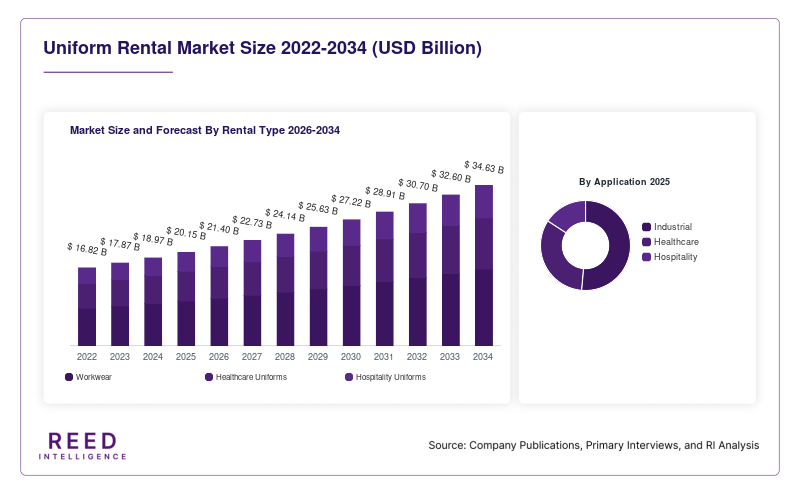
Workwear represented the dominant rental type with approximately 52.6% of 2026 revenue, followed by healthcare uniforms at 28.7% and hospitality uniforms at 18.7%. By application, industrial users accounted for 46.9%, healthcare 28.7%, and hospitality 24.4%. Demand is increasingly concentrated among organizations requiring recurring garment replenishment, professional laundering, employee-specific sizing, and documented hygiene processes.
By Type
Workwear generated approximately 52.6% of global revenue in 2026 and represents the largest rental category. An estimated 980 million workwear garment cycles are processed annually, covering shirts, trousers, jackets, coveralls, high-visibility apparel, and protective garments. Standard rental specifications commonly include polyester-cotton blends, reinforced seams, 180–300 gsm fabric weights, industrial laundering compatibility, and optional reflective strips. Manufacturing, construction, logistics, utilities, automotive, and food-processing companies represent the largest customer base.
Healthcare uniforms accounted for around 28.7% of revenue, with approximately 540 million annual garment cycles across hospitals, clinics, laboratories, dental facilities, and long-term care institutions. Typical products include scrubs, lab coats, patient-care uniforms, jackets, and specialized protective garments. Fabrics commonly range from 150–220 gsm, with durable colorfast construction and industrial wash compatibility. Demand is supported by infection-control procedures, employee identification, centralized laundry, and frequent replacement requirements.
Hospitality uniforms represented approximately 18.7% of revenue and generate more than 350 million annual garment cycles. The segment includes chef jackets, kitchen trousers, front-office apparel, housekeeping uniforms, restaurant garments, and event-service clothing. Materials typically use 120–240 gsm cotton or blended fabrics designed for repeated laundering and comfort during long shifts. Hotels, restaurants, catering operators, casinos, cruise operators, and institutional foodservice providers increasingly use rental programs to maintain consistent brand presentation.
By Application
Industrial applications contributed approximately 46.9% of 2026 revenue and represent the largest application segment. More than 890 million annual garment cycles are associated with manufacturing, automotive, construction, energy, chemicals, logistics, and food-processing operations. Customers frequently require flame-resistant, high-visibility, anti-static, chemical-resistant, or reinforced apparel. Rental programs enable scheduled replacement and professional laundering while supporting workplace safety policies across facilities with workforces ranging from fewer than 100 employees to more than 10,000.
Healthcare applications held approximately 28.7% share, corresponding to about 545 million annual garment cycles. Hospitals and clinics represent the principal users, followed by laboratories, pharmacies, dental centers, and elder-care facilities. Demand centers on scrubs, coats, protective garments, and reusable apparel requiring frequent industrial laundering. Rental providers can coordinate employee-specific sizing, scheduled collection, hygienic processing, and redistribution across multiple healthcare departments, supporting consistent garment availability.
Hospitality accounted for approximately 24.4% of market revenue and more than 460 million annual garment cycles. Hotels, restaurants, catering companies, resorts, casinos, and cruise operators use rental services for kitchen, housekeeping, concierge, foodservice, and front-office uniforms. Garments generally emphasize comfort, stain resistance, color retention, and brand consistency. High employee turnover and seasonal staffing increase the value of flexible inventory management and rapid size replacement services.
Uniform Rental Market Regional Analysis
North America Uniform Rental Market
North America accounted for approximately 35.8% of global revenue in 2026, supported by established rental infrastructure and strong adoption among industrial and institutional customers. The United States contributes the majority of regional revenue, followed by Canada. Industrial applications represent nearly 49% of regional demand, while healthcare and hospitality contribute approximately 29% and 22%, respectively. Large national contracts remain important to regional providers.
Europe Uniform Rental Market
Europe represented approximately 27.2% share in 2026, with Germany, the United Kingdom, France, Italy, and the Netherlands serving as major contributors. Industrial and healthcare customers together account for roughly 76% of regional demand. Stringent workplace safety, hygiene, textile durability, and sustainability requirements encourage recurring rental programs. Germany represents a particularly significant industrial customer base, while the United Kingdom maintains strong adoption across healthcare, hospitality, and facilities services.
Asia Pacific Uniform Rental Market
Asia Pacific held approximately 24.1% share and is projected to expand at the fastest regional CAGR of 7.5% through 2034. China, Japan, India, South Korea, and Australia are major contributors. Industrial applications account for nearly 51% of regional demand, followed by healthcare at 27% and hospitality at 22%. Manufacturing expansion, organized healthcare, food processing, logistics, and hotel development are broadening the customer base for outsourced garment services.
Latin America Uniform Rental Market
Latin America represented approximately 7.4% of global revenue in 2026. Brazil and Mexico are the leading contributors, together accounting for more than 60% of regional demand. Industrial customers contribute around 50%, while healthcare and hospitality account for approximately 27% and 23%. Demand is supported by manufacturing, mining, food processing, retail distribution, healthcare expansion, and professionalization of uniform management among medium-sized enterprises.
Middle East & Africa Uniform Rental Market
Middle East & Africa accounted for approximately 5.5% of global revenue. The United Arab Emirates, Saudi Arabia, South Africa, and Qatar are major contributors, with hospitality and industrial services forming important demand centers. Hospitality contributes approximately 31% of regional revenue, followed by industrial applications at 44% and healthcare at 25%. Tourism infrastructure, construction projects, healthcare investments, and foodservice expansion are supporting recurring uniform-service adoption.
Top players in Uniform Rental Market
- Cintas Corporation
- UniFirst Corporation
- Aramark
- Alsco Uniforms
- Vestis
- Superior Uniform Group
- Berendsen
- Elis SA
- Johnson Service Group PLC
- Rentokil Initial PLC
- AmeriPride Services
- Mission Linen Supply
Recent Developments in Uniform Rental Market
- 2026, January: Uniform rental providers expanded RFID-enabled garment tracking programs to improve inventory visibility, automated replenishment, and multi-site customer management.
- 2025, November: Major textile-service operators increased investments in energy-efficient washing and drying equipment to reduce resource consumption across high-volume processing facilities.
- 2025, August: Rental providers expanded sustainable workwear portfolios using recycled fibers, durable blended fabrics, and garment-repair programs designed to extend product life.
- 2025, May: Healthcare-focused uniform services increased specialized garment offerings for hospitals, laboratories, outpatient facilities, and long-term care organizations.
- 2024, October: Leading service companies strengthened digital customer platforms covering uniform ordering, employee sizing, delivery schedules, garment tracking, and service-performance reporting.
Uniform Rental Market Segments
By Rental Type
- Workwear
- Healthcare Uniforms
- Hospitality Uniforms
By Application
- Industrial
- Healthcare
- Hospitality
By Region
- North America
- Europe
- APAC
- Middle East and Africa
- LATAM