Uninterrupted Power System (UPS) Market Size, Share, Demand & Industry Analysis Report By UPS Type (Online UPS, Line-Interactive UPS, Offline UPS, Modular UPS), By Power Rating (Below 10 kVA, 10–100 kVA, 100–500 kVA, Above 500 kVA), By End-Use Industry (Data Centers, Healthcare Facilities, Telecommunications, Manufacturing, Commercial Buildings, Government & Defense, Energy & Utilities, Others), By Region & Segment Forecasts, 2026–2034
USD 3950
Market Overview
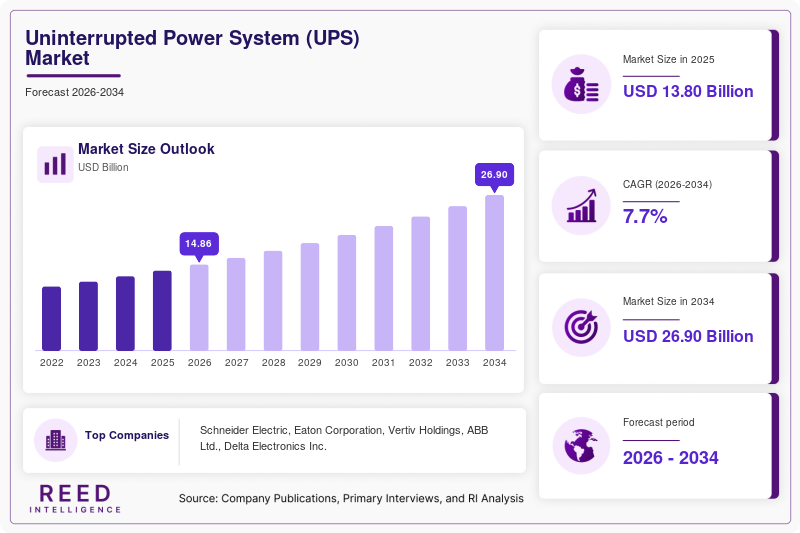
The global Uninterrupted Power System (UPS) Market size was valued at USD 13.8 billion in 2026 and is projected to reach USD 24.9 billion by 2034, expanding at a CAGR of 7.7% during the forecast period from 2026 to 2034. The market continues to gain momentum as organizations across industries prioritize business continuity, power quality management, and infrastructure resilience. UPS solutions have become a critical component of modern electrical ecosystems, protecting sensitive equipment from outages, voltage fluctuations, surges, and frequency disturbances.
The increasing dependence on digital infrastructure has been a major factor supporting market expansion globally. The rapid growth of cloud computing, data centers, telecommunications networks, healthcare facilities, manufacturing automation systems, and smart buildings has created sustained demand for reliable backup power solutions. Enterprises are investing heavily in uninterrupted power technologies to minimize downtime, prevent data loss, and ensure operational efficiency. Furthermore, the expansion of edge computing facilities and distributed energy networks is encouraging the adoption of advanced UPS systems with enhanced monitoring and energy management capabilities.
Key Highlights
- North America dominated the market with a 35.4% share in 2025, while Asia Pacific is expected to grow at the fastest CAGR of 9.8% during 2026–2034.
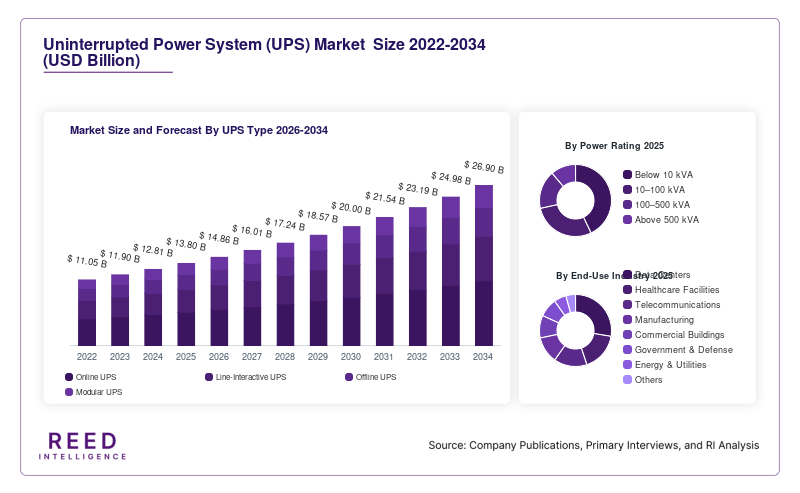
- By UPS type, Online UPS accounted for the largest share of 46.8%, while Modular UPS is projected to grow at a CAGR of 10.9%.
- By power rating, 10–100 kVA systems held the largest share of 39.6%, whereas Above 500 kVA systems are expected to expand at a CAGR of 10.4%.
- By end-use industry, Data Centers led with a 31.4% share, while Healthcare Facilities are projected to grow at a CAGR of 10.7%.
- The United States remained the dominant country, with market values of USD 3.65 billion in 2024 and USD 3.94 billion in 2025.
Market Trends
Rising Adoption of Lithium-Ion Battery-Based UPS Systems
One of the most significant developments shaping the Uninterrupted Power System (UPS) Market is the growing transition from traditional lead-acid batteries toward lithium-ion battery technologies. Organizations are increasingly selecting lithium-ion-powered UPS solutions due to their longer service life, lower maintenance requirements, smaller footprint, and higher energy density. These advantages help businesses reduce total ownership costs while improving system reliability. Large data centers, industrial facilities, and telecommunications operators are accelerating investments in advanced battery technologies to optimize power backup infrastructure. As battery prices continue to decline and performance improves, lithium-ion integration is expected to become a standard feature across both enterprise and industrial UPS deployments throughout the forecast period.
Growing Demand for Intelligent and Remote Monitoring Capabilities
Digital transformation initiatives across industries are increasing demand for UPS systems equipped with intelligent monitoring and predictive maintenance features. Modern UPS solutions are increasingly integrated with cloud-based management platforms, Internet of Things connectivity, and artificial intelligence-enabled diagnostics. These capabilities allow facility managers to monitor power conditions, battery health, and equipment performance in real time. Predictive analytics can identify potential failures before disruptions occur, reducing maintenance expenses and downtime risks. Organizations operating mission-critical infrastructure increasingly value visibility and automation in power management systems. Consequently, manufacturers are focusing on software-driven UPS platforms that support remote supervision, centralized control, and enhanced operational efficiency across multiple facilities.
Market Drivers
Expansion of Global Data Center Infrastructure
The continuous expansion of data center infrastructure worldwide is a major growth driver for the Uninterrupted Power System (UPS) Market. Cloud service providers, hyperscale operators, financial institutions, and digital enterprises rely heavily on uninterrupted power availability to maintain business operations and ensure data integrity. Even brief power interruptions can result in significant financial losses and service disruptions. As a result, operators are investing in sophisticated UPS architectures capable of delivering high reliability and scalability. The increasing adoption of artificial intelligence workloads, cloud computing services, and edge data centers is creating additional demand for advanced backup power solutions. This trend is expected to remain a key contributor to market growth throughout the forecast period.
Increasing Automation Across Industrial Facilities
Industrial automation is becoming increasingly widespread across manufacturing, logistics, energy, and processing industries. Automated production environments rely on sensitive electronic systems, robotics, control equipment, and communication networks that require stable power quality. UPS systems provide essential protection against voltage fluctuations, power outages, and transient disturbances that can interrupt production operations. Manufacturers are adopting advanced UPS technologies to safeguard productivity, minimize downtime, and protect valuable equipment investments. The ongoing implementation of Industry 4.0 initiatives and smart factory strategies is creating favorable conditions for UPS adoption. As industrial facilities become more digitized and interconnected, demand for reliable backup power infrastructure is expected to increase steadily.
Market Restraint
High Initial Investment and Maintenance Costs
Despite favorable growth prospects, the Uninterrupted Power System (UPS) Market faces challenges related to high capital expenditure requirements. Large-capacity UPS installations often involve substantial investments in power electronics, battery systems, cooling infrastructure, monitoring software, and installation services. Small and medium-sized enterprises may find these costs difficult to justify, particularly in price-sensitive markets. In addition to upfront expenses, ongoing maintenance, battery replacement, testing procedures, and system upgrades contribute to total ownership costs. Organizations operating aging UPS infrastructure may delay modernization projects due to budget constraints. For example, manufacturing facilities in developing economies often prioritize production equipment investments over power protection upgrades. These financial considerations can slow adoption rates, especially among organizations with limited operational budgets. Although technological advancements are gradually improving efficiency and lowering lifecycle costs, investment barriers remain a significant factor influencing purchasing decisions across several end-user segments.
Market Opportunities
Increasing Electrification of Healthcare Infrastructure
Healthcare facilities are becoming increasingly dependent on digital medical equipment, diagnostic technologies, electronic health records, and life-support systems. Reliable backup power has become a critical operational requirement across hospitals, laboratories, and specialized treatment centers. UPS solutions ensure uninterrupted functionality during power disturbances, protecting patient safety and maintaining service continuity. Growing healthcare investments in emerging economies are creating substantial opportunities for UPS manufacturers. Governments and private healthcare providers are expanding medical infrastructure, often incorporating advanced power protection systems during facility development. As healthcare digitization accelerates and regulatory requirements for power reliability become more stringent, demand for specialized UPS solutions is expected to grow significantly over the coming years.
Emergence of Smart Cities and Critical Urban Infrastructure
The development of smart cities presents substantial opportunities for participants in the Uninterrupted Power System (UPS) Market. Urban infrastructure increasingly relies on connected technologies, including intelligent transportation systems, surveillance networks, public safety platforms, telecommunications equipment, and smart utility management systems. These applications require continuous power availability to function effectively. Municipal authorities are investing in resilient energy infrastructure capable of supporting growing digital ecosystems. UPS systems play a critical role in ensuring operational continuity across these applications. Furthermore, investments in smart airports, metro networks, and public service facilities are creating additional opportunities for suppliers offering scalable and energy-efficient power protection solutions tailored to urban infrastructure requirements.
Segmental Analysis
By UPS Type
Online UPS systems represented the dominant subsegment, accounting for approximately 46.8% of market revenue in 2024. These systems provide continuous power conditioning and deliver the highest level of protection against voltage fluctuations, frequency variations, and power interruptions. Their ability to supply clean and stable electricity makes them particularly suitable for mission-critical applications such as data centers, healthcare facilities, telecommunications infrastructure, and financial institutions. Organizations operating sensitive electronic equipment increasingly prefer online UPS systems due to their reliability and operational performance. Furthermore, technological advancements in efficiency optimization and battery management have improved the attractiveness of online UPS solutions, enabling vendors to strengthen their market position across both developed and emerging economies.
Modular UPS systems are expected to register the fastest growth rate, advancing at a CAGR of 10.9% through 2034. These systems provide scalability, flexibility, and ease of maintenance, making them attractive for facilities with evolving power requirements. Businesses can expand capacity incrementally without replacing existing infrastructure, reducing capital expenditure risks. The rapid growth of cloud computing facilities, edge data centers, and distributed digital infrastructure is accelerating demand for modular architectures. Organizations value their ability to improve redundancy while minimizing downtime during maintenance activities. In addition, advancements in intelligent monitoring, predictive diagnostics, and energy management software are enhancing the performance of modular UPS platforms, supporting their growing adoption across multiple end-use industries.
By Power Rating
The 10–100 kVA category emerged as the largest power rating segment, accounting for approximately 39.6% of market share in 2024. This segment serves a broad range of commercial, industrial, and institutional applications, including office buildings, healthcare facilities, educational institutions, telecommunications sites, and medium-sized data centers. The balance between cost efficiency and performance makes these systems highly versatile across diverse operational environments. Organizations often select this capacity range because it offers adequate protection for critical infrastructure while maintaining manageable installation and maintenance costs. Continuous investments in commercial construction and digital infrastructure expansion have contributed significantly to the strong market position of this power rating category.
Systems rated above 500 kVA are projected to witness the fastest expansion, achieving a CAGR of 10.4% throughout the forecast period. Growth is primarily driven by increasing investments in hyperscale data centers, large industrial facilities, and utility-scale digital infrastructure projects. These high-capacity UPS systems support extensive computing operations and mission-critical applications that require uninterrupted power availability. The expansion of artificial intelligence processing facilities, cloud computing environments, and high-density server installations is creating substantial demand for advanced large-capacity solutions. Improvements in power efficiency, modular design, and battery technologies are also making high-capacity UPS systems more attractive to enterprises seeking scalable and resilient power protection infrastructure.
By End-Use Industry
Data centers held the leading position among end-use industries, accounting for approximately 31.4% of market revenue in 2024. The continuous expansion of cloud computing services, digital storage requirements, and enterprise data processing activities has significantly increased the need for reliable backup power systems. Data center operators prioritize uninterrupted operations because even brief outages can result in substantial financial losses and service disruptions. UPS systems provide essential protection for servers, networking equipment, and storage infrastructure. The increasing deployment of edge computing facilities and artificial intelligence workloads is further strengthening demand. As digital transformation initiatives continue worldwide, data centers are expected to remain a major source of UPS market revenue.
Healthcare facilities are forecast to be the fastest-growing end-use segment, expanding at a CAGR of 10.7% through 2034. Hospitals, diagnostic laboratories, emergency care centers, and specialized treatment facilities increasingly rely on sophisticated medical technologies that require continuous power availability. UPS systems ensure uninterrupted operation of life-support equipment, imaging systems, monitoring devices, and electronic health record platforms. Growing healthcare infrastructure investments across emerging economies are creating favorable market conditions. Additionally, stricter regulatory requirements regarding patient safety and operational continuity are encouraging healthcare providers to modernize their power protection infrastructure. These factors collectively support strong growth prospects for UPS solutions within the healthcare sector.
Regional Analysis
North America
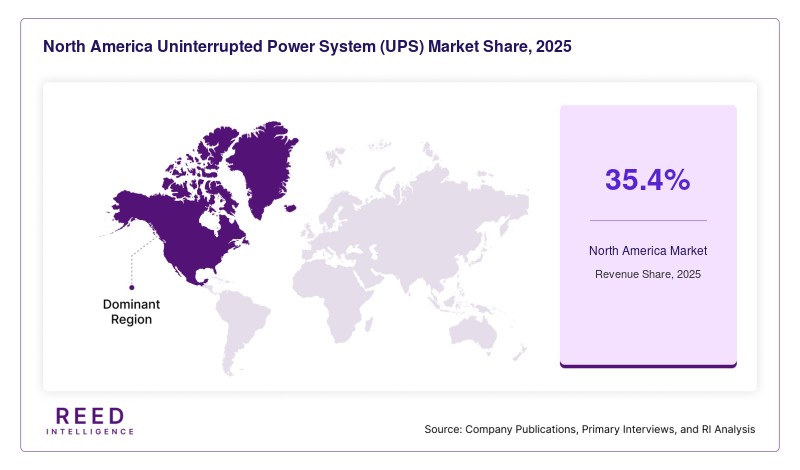
North America accounted for approximately 35.4% of the global market share in 2025, making it the largest regional market for UPS systems. The region benefits from extensive data center investments, widespread digital transformation initiatives, and high adoption of advanced power management technologies. Organizations across financial services, healthcare, and telecommunications sectors continue to prioritize power reliability and infrastructure resilience. These factors are expected to support a regional CAGR of 7.1% through 2034.
The United States remains the dominant market within North America. A unique growth factor is the rapid expansion of hyperscale cloud facilities and artificial intelligence processing centers. These facilities require continuous power availability and sophisticated backup solutions. Significant investments in digital infrastructure modernization continue to stimulate demand for high-capacity UPS systems across the country.
Europe
Europe represented approximately 27.1% of global revenue in 2025 and continues to demonstrate steady growth prospects. The region's focus on energy efficiency, environmental sustainability, and resilient industrial infrastructure supports consistent demand for UPS technologies. Enterprises are adopting advanced systems to improve operational continuity and comply with stringent energy performance standards. The market is projected to grow at a CAGR of 6.8% during the forecast period.
Germany remains the leading country in the European market. A unique growth factor is the country's advanced manufacturing ecosystem and widespread implementation of Industry 4.0 technologies. Automated production facilities require stable power quality and backup capabilities to prevent production interruptions. This industrial modernization trend continues to drive substantial UPS adoption across manufacturing sectors.
Asia Pacific
Asia Pacific held approximately 24.6% of the global market in 2025 and is projected to register the fastest CAGR of 9.8% through 2034. Rapid urbanization, digitalization, industrial expansion, and growing investments in information technology infrastructure are driving market growth. Countries across the region are increasing spending on telecommunications networks, cloud computing facilities, and smart city projects, creating strong demand for UPS solutions.
China dominates the regional market due to its large-scale industrial base and expanding digital economy. A unique growth factor is the rapid deployment of new data center infrastructure to support cloud services, e-commerce platforms, and artificial intelligence applications. This continuous infrastructure expansion is generating substantial opportunities for UPS manufacturers throughout the country.
Middle East & Africa
The Middle East & Africa region accounted for approximately 6.5% of global revenue in 2025 and is expected to grow at a CAGR of 8.1% during the forecast period. Demand is being supported by investments in critical infrastructure, telecommunications networks, healthcare facilities, and commercial developments. Governments are prioritizing infrastructure resilience and energy security, which is encouraging the adoption of advanced backup power systems.
Saudi Arabia is the dominant market within the region. A unique growth factor is the implementation of large-scale economic diversification programs and smart infrastructure initiatives. New industrial zones, digital service hubs, and urban development projects require reliable power protection solutions, creating sustained demand for UPS technologies across multiple sectors.
Latin America
Latin America captured approximately 6.4% of the global market share in 2025 and is forecast to expand at a CAGR of 7.5% through 2034. Growth is supported by increasing digitalization, modernization of telecommunications infrastructure, and rising awareness regarding power reliability. Businesses are investing in backup power solutions to mitigate operational disruptions caused by grid instability and power quality issues.
Brazil remains the leading country in the regional market. A unique growth factor is the increasing deployment of digital banking platforms and financial technology infrastructure. Financial institutions require uninterrupted operations and secure data processing environments, driving strong demand for reliable UPS systems capable of supporting mission-critical applications.
Competitive Landscape
The Uninterrupted Power System (UPS) Market remains moderately consolidated, with established global manufacturers competing through product innovation, technological advancement, and strategic partnerships. Leading companies are focusing on intelligent power management capabilities, lithium-ion battery integration, modular system development, and energy-efficient architectures to strengthen their market positions.
Schneider Electric continues to maintain a leading position due to its broad product portfolio, global distribution network, and strong presence across data center and industrial applications. The company recently expanded its intelligent UPS offerings with enhanced remote monitoring and predictive maintenance capabilities designed for digital infrastructure environments.
Other significant participants include Eaton, Vertiv, ABB, and Delta Electronics, all of which continue to invest in advanced battery technologies and scalable power management platforms. Competitive differentiation increasingly depends on software integration, energy efficiency, lifecycle support services, and customization capabilities. Strategic collaborations with cloud providers, telecommunications operators, and industrial enterprises are becoming common as vendors seek long-term growth opportunities. The market is also witnessing increasing investment in sustainable UPS technologies designed to reduce operational costs and improve environmental performance.
Key Players
- Schneider Electric
- Eaton Corporation
- Vertiv Holdings
- ABB Ltd.
- Delta Electronics Inc.
- Toshiba Corporation
- Mitsubishi Electric Corporation
- Huawei Technologies
- Riello Elettronica
- Socomec Group
- Legrand SA
- Fuji Electric Co., Ltd.
- Cyber Power Systems
- Kehua Data Co., Ltd.
- AEG Power Solutions
Recent Developments
- In 2025, Schneider Electric introduced an advanced modular UPS platform featuring AI-enabled predictive maintenance capabilities for large-scale data center applications.
- In 2025, Vertiv expanded its lithium-ion UPS portfolio with enhanced energy efficiency features designed for hyperscale computing facilities and edge deployments.
- In 2024, Eaton launched a new high-capacity UPS solution incorporating intelligent remote monitoring functions to support industrial and commercial infrastructure.
- In 2024, ABB enhanced its digital power management ecosystem by integrating cloud-based analytics capabilities into selected UPS product lines.
- In 2025, Delta Electronics expanded manufacturing capacity for energy-efficient UPS systems to address growing demand from telecommunications and healthcare sectors.
Uninterrupted Power System (UPS) Market Segments
By UPS Type
- Online UPS
- Line-Interactive UPS
- Offline UPS
- Modular UPS
By Power Rating
- Below 10 kVA
- 10–100 kVA
- 100–500 kVA
- Above 500 kVA
By End-Use Industry
- Data Centers
- Healthcare Facilities
- Telecommunications
- Manufacturing
- Commercial Buildings
- Government & Defense
- Energy & Utilities
- Others
By Region
- North America
- Europe
- APAC
- Middle East and Africa
- LATAM