Unmanned Aircraft Systems Market Size, Share & Demand Report By Platform Type (Fixed-Wing UAS, Rotary-Wing UAS), By Component (Hardware Systems, Software & Analytics Solutions), By Application (Defense & Military Operations, Agriculture, Infrastructure Inspection, Surveying & Mapping), By End User (Government & Defense Organizations, Commercial Enterprises, Research Institutions), By Range (Short-Range Systems, Medium-Range Systems) and By Region, Forecasts, 2026–2034
USD 3950
Market Overview
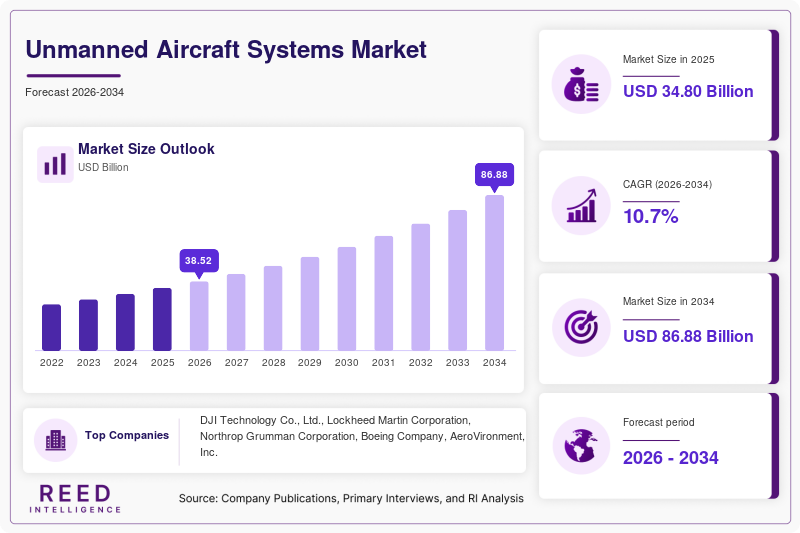
The Unmanned Aircraft Systems Market was valued at USD 34.8 billion in 2026 and is projected to reach USD 78.6 billion by 2034, expanding at a CAGR of 10.7% during the forecast period (2026–2034). The market continues to evolve as unmanned aerial technologies gain wider acceptance across defense, commercial, industrial, and public-sector applications. Advancements in autonomous flight systems, sensor integration, communication technologies, and artificial intelligence are transforming the capabilities of unmanned aircraft systems (UAS), enabling them to perform increasingly complex missions with greater efficiency and reliability.
A major global factor supporting market growth has been the increasing adoption of automation technologies across critical industries. Governments, enterprises, and infrastructure operators are integrating unmanned systems into surveillance, inspection, mapping, logistics, emergency response, and environmental monitoring activities. These systems reduce operational risks, improve data accuracy, and lower labor-intensive costs, making them valuable tools across multiple sectors.
Key Highlights
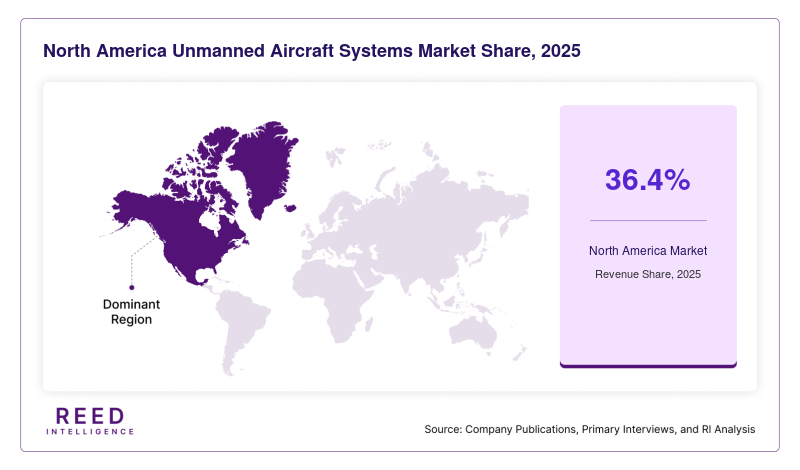
- North America dominated the market with 36.4% share in 2025, while Asia Pacific is expected to register the fastest CAGR of 12.8% during 2026–2034.
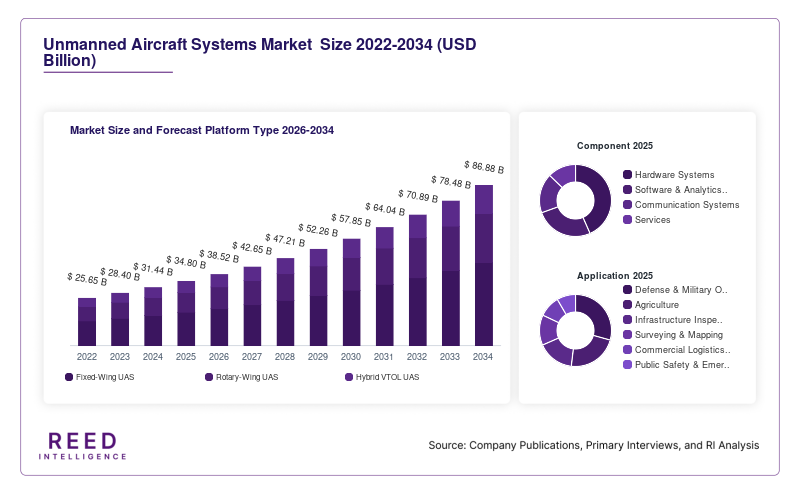
- By platform type, Fixed-Wing UAS accounted for the largest share of 41.8% in 2025, whereas Hybrid VTOL UAS is projected to grow at 13.6% CAGR.
- By component, Hardware Systems represented 62.3% share in 2025, while Software & Analytics Solutions are forecast to expand at 14.2% CAGR.
- By application, Defense & Military Operations held 45.1% market share in 2025, while Commercial Logistics & Delivery is expected to grow at 15.4% CAGR.
- By end-user, Government & Defense Organizations remained dominant with 48.6% share, whereas Commercial Enterprises are anticipated to grow at 13.9% CAGR.
- The United States remained the leading country market, valued at USD 10.8 billion in 2024 and USD 11.9 billion in 2025.
Market Trends
Integration of Artificial Intelligence and Autonomous Navigation
Artificial intelligence is becoming a central component of modern unmanned aircraft systems. Advanced algorithms enable autonomous route planning, obstacle avoidance, target recognition, and mission optimization. AI-powered systems can process large volumes of aerial data in real time, reducing operator workload and improving mission effectiveness. As computing capabilities continue to improve, manufacturers are increasingly incorporating machine learning and predictive analytics into next-generation platforms.
Growth of Hybrid VTOL Platforms
Hybrid vertical take-off and landing (VTOL) aircraft are emerging as an important trend within the Unmanned Aircraft Systems Market. These platforms combine the endurance advantages of fixed-wing aircraft with the operational flexibility of rotary-wing systems. Hybrid designs are becoming attractive for infrastructure inspections, agricultural monitoring, emergency response, and remote-area logistics due to their ability to operate without traditional runways while maintaining longer flight durations.
Market Drivers
Expansion of Defense Modernization Programs
Defense agencies worldwide continue to prioritize unmanned capabilities as part of modernization strategies. UAS platforms are increasingly utilized for reconnaissance, intelligence gathering, surveillance, target acquisition, border monitoring, and tactical support operations. Their ability to provide persistent situational awareness while minimizing personnel exposure has accelerated procurement activities across military organizations.
Increasing Demand for Aerial Data Collection
Organizations across industries require accurate geospatial and operational data for decision-making. Unmanned aircraft systems provide high-resolution imagery, thermal mapping, terrain modeling, and asset inspection capabilities. Utilities, mining companies, construction firms, and environmental agencies are increasingly deploying drones to collect actionable information efficiently, supporting sustained market growth.
Market Restraint
Regulatory Complexity and Airspace Integration Challenges
Despite growing adoption, regulatory compliance remains a significant challenge for the Unmanned Aircraft Systems Market. Airspace management requirements, certification processes, privacy concerns, and operational restrictions can delay deployment and increase implementation costs. Variations in regulations across countries also create challenges for international operators and manufacturers.
Market Opportunities
Drone-Based Logistics and Last-Mile Delivery Expansion
The growing need for faster and more efficient delivery networks presents significant opportunities for UAS manufacturers. Healthcare supplies, consumer products, industrial parts, and emergency goods can increasingly be transported using unmanned aircraft. Advancements in payload management and autonomous navigation are expected to support broader commercial deployment.
Infrastructure Digitalization and Smart Asset Monitoring
Governments and enterprises are investing heavily in smart infrastructure initiatives. UAS platforms equipped with advanced sensors can monitor bridges, pipelines, railways, power grids, and telecommunications assets. As predictive maintenance strategies become more prevalent, demand for drone-based inspection solutions is expected to increase substantially.
Segmental Analysis
By Platform Type
Fixed-Wing UAS
Fixed-wing unmanned aircraft systems accounted for 41.8% of market share in 2025. Their dominance was supported by superior flight endurance, greater operational range, and higher efficiency during large-area missions. These systems are widely utilized for surveillance, mapping, environmental monitoring, and long-distance reconnaissance applications.
Hybrid VTOL UAS
Hybrid VTOL systems are expected to expand at a CAGR of 13.6% through 2034. Their growth will be supported by increasing demand for platforms capable of operating in confined environments while maintaining extended flight performance. Enhanced mission flexibility will drive adoption across logistics, inspection, and emergency response applications.
By Component
Hardware Systems
Hardware systems represented 62.3% market share in 2025. This segment included airframes, propulsion technologies, sensors, payload equipment, navigation systems, and communication modules. Growing technological sophistication of unmanned aircraft platforms supported continued demand for advanced hardware solutions.
Software & Analytics Solutions
Software and analytics solutions are projected to grow at a CAGR of 14.2% during the forecast period. Growth will be driven by increasing requirements for autonomous mission planning, data processing, predictive analytics, and cloud-based operational management. The rising importance of actionable intelligence derived from aerial data will further strengthen segment expansion.
By Application
Defense & Military Operations
Defense and military operations generated 45.1% of market revenue in 2025. This segment maintained leadership because unmanned aircraft systems play a critical role in reconnaissance, surveillance, intelligence gathering, target acquisition, and tactical mission support.
Commercial Logistics & Delivery
Commercial logistics and delivery applications are anticipated to register a CAGR of 15.4% through 2034. Growth will be supported by expanding e-commerce networks, increasing demand for rapid transportation services, and improvements in autonomous delivery technologies. Wider regulatory acceptance is expected to accelerate adoption in this segment.
By End User
Government & Defense Organizations
Government and defense organizations accounted for 48.6% share in 2025. Significant procurement budgets and long-term strategic investments in national security capabilities supported sustained segment leadership.
Commercial Enterprises
Commercial enterprises are forecast to grow at a CAGR of 13.9% during the forecast period. Businesses are increasingly deploying unmanned aircraft systems to improve operational visibility, asset management, infrastructure inspections, and decision-making processes. Growing recognition of productivity benefits will support future expansion.
By Range
Medium-Range Systems
Medium-range systems held 44.5% market share in 2025. These platforms offered an effective balance between operational endurance, payload capacity, and deployment flexibility, making them suitable for a broad range of commercial and governmental applications.
Long-Range Systems
Long-range systems are expected to expand at a CAGR of 12.7% through 2034. Demand will increase as organizations require extended operational coverage for surveillance, monitoring, and strategic intelligence missions across remote regions.
Regional Analysis
North America
North America accounted for 36.4% of the Unmanned Aircraft Systems Market in 2025 and is expected to grow at a CAGR of 9.8% during 2026–2034.
The United States dominated the regional market due to its advanced aerospace ecosystem and extensive investment in unmanned aviation research. Strong collaboration among aerospace manufacturers, technology companies, and government agencies accelerated innovation across defense and commercial applications. Continuous development of autonomous flight technologies and advanced mission systems further supported market expansion throughout the region.
Europe
Europe represented 24.7% market share in 2025 and is projected to expand at a CAGR of 9.9% during the forecast period.
Germany emerged as the leading country market owing to its strong industrial engineering capabilities and growing use of drone technologies across manufacturing environments. The country's increasing deployment of unmanned aircraft for industrial inspections, environmental analysis, and engineering projects supported regional growth. Investments in advanced aviation technologies also strengthened market development across Europe.
Asia Pacific
Asia Pacific held 27.3% share of the global market in 2025 and is forecast to register the fastest CAGR of 12.8% during 2026–2034.
China remained the dominant country market due to its extensive drone manufacturing ecosystem and growing adoption of autonomous aviation technologies. The country's large-scale deployment of drones across industrial sectors and increasing focus on intelligent transportation systems created strong growth opportunities. Continued investment in commercial drone innovation further strengthened regional market prospects.
Middle East & Africa
The Middle East & Africa accounted for 6.1% market share in 2025 and is expected to expand at a CAGR of 10.6% through 2034.
The United Arab Emirates led regional demand due to growing investments in smart government initiatives and advanced aerial mobility programs. The adoption of unmanned systems for urban planning, infrastructure assessment, and public service modernization supported market growth. Increasing interest in autonomous technologies across multiple sectors contributed to regional expansion.
Latin America
Latin America captured 5.5% market share in 2025 and is projected to grow at a CAGR of 9.1% during the forecast period.
Brazil represented the dominant market within the region. The country benefited from increasing deployment of drones in environmental observation, land management, and agricultural operations. Growing utilization of unmanned systems for monitoring large geographical areas enhanced operational efficiency and supported broader market adoption.
Competitive Landscape
The Unmanned Aircraft Systems Market is characterized by continuous innovation, technological advancement, and strategic partnerships among aerospace manufacturers, defense contractors, software providers, and drone technology companies. Market participants are focusing on improving autonomous capabilities, extending flight endurance, integrating advanced sensors, and enhancing data analytics platforms.
DJI Technology Co., Ltd.
DJI remains a leading participant in commercial drone markets. The company continues expanding enterprise-focused solutions designed for industrial inspections, mapping, surveying, and infrastructure management. In 2025, DJI introduced enhanced AI-enabled analytics capabilities for enterprise drone platforms to improve operational efficiency across industrial applications.
Lockheed Martin Corporation
Lockheed Martin maintains a strong presence in military unmanned aviation through investments in advanced reconnaissance and autonomous mission technologies. The company focuses on integrating next-generation intelligence capabilities into defense-oriented unmanned systems.
Northrop Grumman Corporation
Northrop Grumman is recognized for its expertise in long-endurance surveillance platforms and advanced defense technologies. The company continues developing sophisticated unmanned systems designed for strategic intelligence operations.
Boeing Company
Boeing participates in both military and commercial unmanned aviation initiatives. The company emphasizes autonomous operations, advanced communication technologies, and next-generation aerial mobility solutions.
AeroVironment, Inc.
AeroVironment specializes in tactical unmanned aircraft systems and mission-focused aerial solutions. Its portfolio includes lightweight platforms designed for defense, security, and intelligence applications.
Key Players List
- DJI Technology Co., Ltd.
- Lockheed Martin Corporation
- Northrop Grumman Corporation
- Boeing Company
- AeroVironment, Inc.
- General Atomics Aeronautical Systems, Inc.
- BAE Systems plc
- Elbit Systems Ltd.
- Israel Aerospace Industries Ltd.
- Leonardo S.p.A.
- RTX Corporation
- Textron Inc.
- Saab AB
- Thales Group
- Parrot SA
Unmanned Aircraft Systems Market Segments
Platform Type
- Fixed-Wing UAS
- Rotary-Wing UAS
- Hybrid VTOL UAS
Component
- Hardware Systems
- Software & Analytics Solutions
- Communication Systems
- Services
Application
- Defense & Military Operations
- Agriculture
- Infrastructure Inspection
- Surveying & Mapping
- Commercial Logistics & Delivery
- Public Safety & Emergency Response
End User
- Government & Defense Organizations
- Commercial Enterprises
- Research Institutions
Range
- Short-Range Systems
- Medium-Range Systems
- Long-Range Systems
By Region
- North America
- Europe
- APAC
- Middle East and Africa
- LATAM