US Bicycle Apparels & Accessories Market Size, Share & Demand Report By Product Type (Helmets, Cycling Jerseys, Gloves, Protective Eyewear, Hydration Accessories, Smart Cycling Accessories, Footwear, Others), By Distribution Channel (Offline Retail Stores, Online Retail Platforms), By End User (Recreational Cyclists, Professional Cyclists, Women Cyclists, Urban Commuters) & Segment Forecasts, 2026–2034
USD 3950
Market Overview
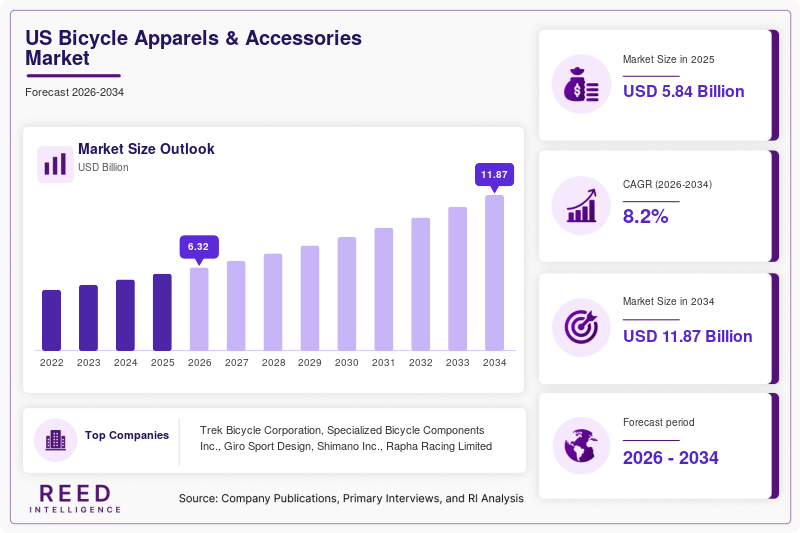
The US Bicycle Apparels & Accessories Market size was valued at USD 5.84 billion in 2026 and is projected to reach USD 10.97 billion by 2034, expanding at a CAGR of 8.2% during the forecast period from 2026 to 2034. The market continues to benefit from the rising adoption of cycling as both a recreational activity and a fitness-oriented transportation option across urban and suburban areas in the United States. Growing consumer awareness regarding personal health, sustainability, and outdoor sports participation has increased demand for performance-oriented cycling products, including jerseys, helmets, gloves, hydration packs, smart lighting systems, and protective accessories.
One of the major global factors supporting market growth is the expansion of sustainable mobility initiatives. Governments and municipalities worldwide are investing in cycling infrastructure, bike-sharing programs, and low-emission transportation systems. This global transition toward environmentally responsible mobility has strengthened consumer interest in cycling culture, which directly supports the demand for advanced bicycle apparels and accessories in the US market. In addition, the growing popularity of e-bikes and connected cycling technologies has encouraged manufacturers to introduce premium accessories with smart safety and tracking features.
Key Highlights
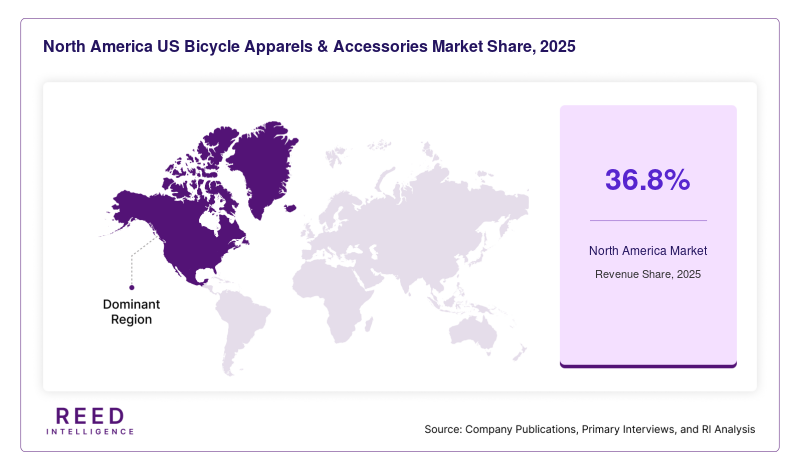
- North America dominated the market with a 36.8% share in 2025, while Asia Pacific is expected to grow at the fastest CAGR of 9.8% during 2026–2034.
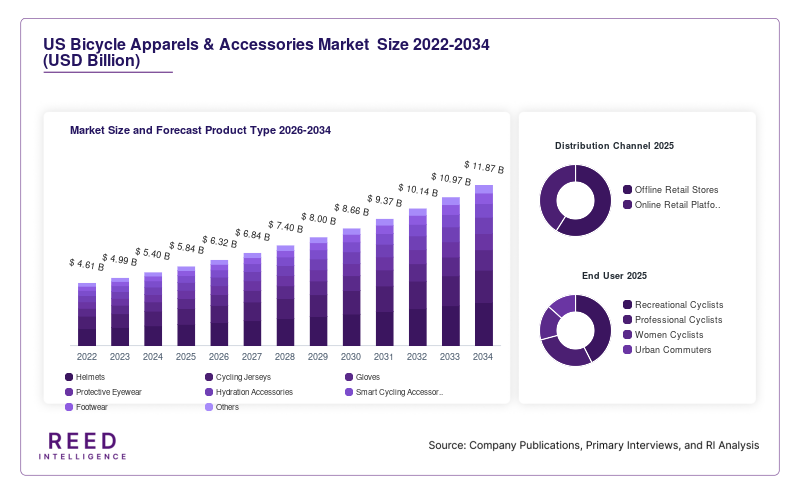
- By product type, helmets accounted for the largest share of 27.4%, while smart cycling accessories are projected to grow at a CAGR of 10.9%.
- By distribution channel, offline retail stores led with a 58.6% share, whereas online retail platforms are expected to expand at a CAGR of 11.4%.
- By end user, recreational cyclists held a 49.2% share, while women cyclists are expected to grow at a CAGR of 10.2% during the forecast period.
- The United States remained the dominant country, with market values of USD 5.12 billion in 2024 and USD 5.46 billion in 2025.
Market Trends
Rising Integration of Smart Cycling Accessories
The integration of smart technologies into bicycle accessories has become a noticeable trend across the US Bicycle Apparels & Accessories Market. Consumers are increasingly adopting GPS-enabled helmets, smart rear lights, performance tracking wearables, and connected cycling glasses that enhance rider safety and riding efficiency. Demand for accessories integrated with Bluetooth connectivity and mobile applications has increased among urban commuters and performance cyclists seeking real-time navigation and biometric monitoring. Manufacturers are responding by introducing products with crash detection systems, LED visibility enhancements, and wireless communication capabilities. This trend is particularly strong among younger consumers who prioritize convenience and technology integration in fitness-related purchases. Growing compatibility between cycling accessories and fitness applications is also encouraging repeat purchases and premium product adoption.
Expansion of Sustainable and Recycled Material Usage
Sustainability-focused product development is becoming an important trend shaping the competitive environment of the market. Manufacturers are increasingly using recycled polyester, biodegradable fabrics, and eco-friendly packaging materials in cycling apparel production. Consumers are paying closer attention to environmental impact, which has encouraged brands to improve supply chain transparency and reduce material waste. Several companies are launching cycling jerseys, gloves, and padded shorts made from recycled ocean plastics and moisture-resistant organic fibers. Retailers are also promoting durable multi-season products to reduce replacement frequency. This trend aligns with broader sustainability goals across the sportswear industry and supports the increasing preference for ethically sourced products among environmentally conscious consumers in the United States.
Market Drivers
Growing Participation in Recreational and Fitness Cycling
The increasing popularity of cycling as a fitness activity continues to support the expansion of the US Bicycle Apparels & Accessories Market. Consumers across different age groups are incorporating cycling into daily wellness routines due to growing awareness regarding cardiovascular health, weight management, and outdoor exercise benefits. Recreational cycling clubs, organized cycling events, and long-distance riding communities have expanded significantly across major metropolitan areas. This growth has increased demand for high-performance apparel, safety equipment, hydration accessories, and weather-resistant gear. In addition, the rise of hybrid work models has provided consumers with more flexibility to participate in outdoor recreational activities. As more individuals purchase bicycles for fitness and leisure purposes, the requirement for specialized cycling accessories and protective products continues to increase.
Rapid Growth of E-Commerce and Direct-to-Consumer Channels
The expansion of digital retail infrastructure has become a major growth driver for the market. Consumers increasingly prefer online platforms for purchasing cycling apparel and accessories because of broader product availability, competitive pricing, and personalized recommendations. Direct-to-consumer strategies adopted by major brands have enabled manufacturers to strengthen customer relationships and improve profit margins. Online channels also support detailed product comparisons, user reviews, and virtual fitting technologies that improve buyer confidence. Subscription-based product launches and social media marketing campaigns are further increasing online engagement. Smaller brands are benefiting from marketplace platforms and digital advertising tools that allow nationwide customer access without extensive physical retail investments. The continued growth of e-commerce logistics networks is expected to support long-term market expansion.
Market Restraint
High Product Costs and Seasonal Demand Fluctuations
The US Bicycle Apparels & Accessories Market faces challenges associated with premium product pricing and seasonal purchasing patterns. High-performance cycling helmets, weatherproof jackets, advanced wearable devices, and smart accessories often involve elevated production costs because of technical fabrics, integrated electronics, and specialized safety certifications. As a result, premium products remain less accessible to price-sensitive consumers, particularly occasional cyclists and entry-level riders. Seasonal demand fluctuations also create inventory management challenges for manufacturers and retailers. Sales of winter cycling apparel and outdoor riding accessories generally decline during extreme weather conditions in several US regions, affecting revenue stability throughout the year.
These challenges can reduce profit margins and increase discounting pressure among market participants. Smaller retailers often face difficulties maintaining large seasonal inventories, while manufacturers must balance production schedules with uncertain weather-driven demand. For example, prolonged inflationary pressure on raw materials such as synthetic fabrics and electronic components has increased retail prices across several product categories. In response, some consumers shift toward low-cost imported products, which intensifies competition and affects premium brand positioning. Despite these restraints, companies are increasingly investing in lightweight multi-season products and flexible inventory planning to reduce operational risks.
Market Opportunities
Increasing Demand for Women-Specific Cycling Products
The rising participation of women in recreational cycling, endurance sports, and urban commuting is creating significant growth opportunities within the market. Manufacturers are increasingly developing apparel and accessories specifically designed for female riders, including ergonomically fitted jerseys, lightweight helmets, padded shorts, and performance footwear. Women-focused cycling communities and fitness campaigns are improving product visibility and encouraging broader market participation. In addition, social media platforms and digital fitness applications are helping brands target female consumers through personalized advertising and influencer partnerships. Retailers are also expanding product assortments to include style-oriented designs without compromising technical functionality. This opportunity is expected to support higher product diversification and strengthen revenue growth for companies investing in inclusive product development strategies.
Expansion of Smart Urban Mobility Infrastructure
The continued development of cycling-friendly urban infrastructure across US cities is expected to create favorable conditions for market growth. Municipal investments in protected bike lanes, bicycle parking systems, and commuter safety initiatives are encouraging more individuals to adopt cycling as a daily transportation option. This trend is increasing demand for commuter-oriented accessories such as reflective clothing, waterproof bags, mobile charging systems, and anti-theft devices. Smart city initiatives are also promoting connected transportation ecosystems where cycling plays a more important role in reducing urban congestion and emissions.
Manufacturers are expected to benefit from growing partnerships with bike-sharing operators, mobility technology companies, and public transportation agencies. Accessories designed for urban commuters are becoming more compact, multifunctional, and technology-enabled to meet evolving consumer requirements. The increasing popularity of electric bicycles is further expanding opportunities for battery-powered lighting systems, smart helmets, and advanced navigation devices. As urban cycling adoption continues to increase, companies capable of delivering durable and connected commuter products are likely to gain a competitive advantage.
Segmental Analysis
By Product Type
Helmets accounted for the dominant share of the US Bicycle Apparels & Accessories Market in 2024, representing approximately 27.4% of total revenue. The segment continues to benefit from increasing consumer awareness regarding rider safety and the implementation of stricter safety regulations across multiple states. Consumers are increasingly purchasing lightweight, impact-resistant helmets equipped with ventilation systems and adjustable fit technologies. Demand is particularly strong among urban commuters, recreational cyclists, and professional riders participating in endurance events. Manufacturers are focusing on improving helmet aesthetics and comfort while incorporating advanced protective materials such as expanded polycarbonate shells and multi-directional impact protection systems. Retailers are also promoting bundled sales of helmets with gloves, reflective gear, and protective eyewear to encourage higher accessory purchases.
Smart cycling accessories are projected to register the fastest CAGR of 10.9% during the forecast period due to increasing consumer preference for connected and technology-enabled riding experiences. Products such as GPS-enabled cycling computers, smart rear lights, biometric fitness trackers, and crash-detection helmets are witnessing rising demand among urban commuters and professional cyclists. Growth in the segment is supported by expanding smartphone integration and the popularity of performance analytics applications. Consumers increasingly seek products capable of providing navigation support, route optimization, and health monitoring features during rides. Manufacturers are investing in wireless connectivity, battery efficiency, and compact product design to improve user convenience. The increasing adoption of electric bicycles and smart mobility ecosystems is also expected to accelerate demand for intelligent cycling accessories.
By Distribution Channel
Offline retail stores represented the leading distribution channel in 2024, accounting for 58.6% of total market share. Specialty bicycle stores, sports equipment retailers, and multi-brand sporting outlets continue to attract consumers seeking personalized product recommendations and physical product testing before purchase. Many cyclists prefer in-store purchases for premium helmets, footwear, and technical apparel because professional fitting services improve comfort and performance. Retail stores also support product demonstrations and expert consultations that strengthen customer trust. Several manufacturers continue expanding partnerships with independent bicycle retailers to improve regional market penetration. Seasonal promotional campaigns and organized cycling community events hosted by physical stores further contribute to customer engagement and repeat purchases.
Online retail platforms are expected to record the fastest CAGR of 11.4% during the forecast period due to changing consumer shopping behavior and expanding e-commerce infrastructure. Digital platforms provide consumers with access to broader product assortments, competitive pricing structures, and convenient home delivery services. Online channels also support direct-to-consumer business models that allow brands to improve customer engagement and collect purchasing insights. Social media advertising, influencer partnerships, and virtual product comparison tools are increasingly influencing purchasing decisions among younger consumers. Subscription-based product launches and limited-edition collections have also strengthened digital sales performance. Improvements in logistics networks and simplified return policies are expected to further accelerate online purchases of bicycle apparel and accessories across the United States.
By End User
Recreational cyclists held the largest share of the market in 2024, contributing approximately 49.2% of total revenue. The segment benefits from increasing participation in leisure cycling activities, fitness routines, and weekend outdoor recreation programs across suburban and urban areas. Recreational cyclists typically purchase a wide range of accessories, including helmets, gloves, hydration systems, padded shorts, and reflective safety equipment. Rising awareness regarding physical wellness and stress management has encouraged more consumers to adopt cycling as a regular recreational activity. Manufacturers are introducing affordable product lines with comfort-focused features to attract entry-level consumers. Community cycling groups, local riding events, and family-oriented outdoor programs are also contributing to higher spending on apparel and accessory products within this segment.
Women cyclists are projected to witness the fastest CAGR of 10.2% during the forecast period due to increasing female participation in recreational sports and urban commuting activities. Manufacturers are increasingly launching women-specific products featuring ergonomic designs, lightweight materials, and style-oriented aesthetics. Demand for performance-focused cycling jerseys, padded shorts, and breathable apparel has increased significantly among female consumers. Fitness influencers and women-focused cycling communities are also improving product visibility through digital engagement and organized riding campaigns. Retailers are expanding dedicated product sections for female cyclists to improve accessibility and customer experience. The growing availability of customizable apparel sizes and premium safety accessories is expected to further support segment growth across the forecast period.
Regional Analysis
North America
North America accounted for 36.8% of the global US Bicycle Apparels & Accessories Market share in 2025 and is expected to maintain steady expansion at a CAGR of 7.9% during the forecast period. Market growth in the region is supported by high consumer spending on sports equipment, advanced cycling infrastructure, and increasing participation in outdoor recreational activities. The region also benefits from strong brand presence and widespread availability of premium cycling products through specialty stores and digital retail channels. Demand for performance apparel and smart safety accessories remains particularly strong among fitness-oriented consumers.
The United States remains the dominant country within the region due to its extensive recreational cycling community and increasing urban commuting culture. One unique growth factor supporting the US market is the rapid expansion of organized cycling events and endurance competitions across states such as California, Colorado, and Texas. These events encourage consumers to invest in professional-grade apparel, protective gear, and connected accessories. In addition, the growing popularity of e-bikes among older consumers has expanded demand for lightweight helmets, ergonomic gloves, and reflective commuter accessories.
Europe
Europe represented a significant share of the global market in 2025 and is projected to grow at a CAGR of 8.1% between 2026 and 2034. Regional growth is supported by strong cycling culture, government-supported sustainability initiatives, and widespread urban bicycle adoption. Countries across Western Europe continue to invest heavily in bicycle lanes and green transportation infrastructure, encouraging greater demand for cycling accessories and weather-resistant apparel. Consumers in the region increasingly prioritize durable, high-quality products designed for long-distance commuting and professional cycling applications.
Germany emerged as the dominant country in the European market due to its advanced cycling infrastructure and large population of recreational and commuter cyclists. A unique growth factor driving the German market is the increasing adoption of high-performance cycling apparel for all-weather commuting. Consumers are investing in thermal jackets, waterproof gloves, and reflective visibility equipment to support year-round cycling usage. The expansion of premium e-bike sales across Germany has also accelerated demand for advanced safety accessories and integrated smart lighting products.
Asia Pacific
Asia Pacific is expected to record the fastest CAGR of 9.8% during the forecast period due to rapid urbanization, increasing disposable income, and expanding interest in outdoor sports activities. Countries across the region are witnessing rising bicycle adoption for commuting and fitness purposes, particularly in densely populated urban centers. The growth of domestic manufacturing capabilities and the increasing presence of international sportswear brands are supporting broader product accessibility. Online retail expansion and mobile commerce penetration are also improving consumer access to affordable cycling apparel and accessories.
China remains the dominant country in the region because of its large bicycle manufacturing ecosystem and expanding urban mobility initiatives. One unique factor contributing to market growth is the strong integration of smart mobility technologies within urban transportation systems. Consumers are increasingly purchasing GPS-enabled accessories, mobile-connected helmets, and battery-powered lighting systems for daily commuting. Rising participation in cycling tourism and mountain biking activities has additionally increased demand for performance apparel and hydration equipment among younger consumers.
Middle East & Africa
The Middle East & Africa region accounted for a smaller market share in 2025 but is projected to expand at a CAGR of 7.4% through 2034. Growth in the region is supported by increasing awareness regarding healthy lifestyles, growing participation in outdoor sports, and expanding investments in recreational infrastructure. Countries in the Gulf region are increasingly promoting cycling events and fitness campaigns to encourage active living among urban populations. Demand for lightweight and breathable cycling apparel is particularly strong due to hot climate conditions across several regional markets.
The United Arab Emirates represents the dominant country within the regional market due to government-supported sports initiatives and growing cycling tourism activities. A unique growth factor supporting the UAE market is the development of dedicated cycling tracks and endurance racing events in cities such as Dubai and Abu Dhabi. These developments have increased consumer spending on premium helmets, moisture-resistant apparel, and advanced hydration accessories. Luxury sports retailers are also expanding product availability for professional and recreational cyclists across the country.
Latin America
Latin America is anticipated to witness moderate growth during the forecast period, supported by increasing urban cycling adoption and rising consumer awareness regarding affordable transportation alternatives. The region is projected to expand at a CAGR of 7.6% from 2026 to 2034. Demand for protective accessories, reflective clothing, and commuter-focused cycling products is increasing steadily across metropolitan areas. Governments in several countries are promoting cycling infrastructure projects to reduce traffic congestion and support sustainable mobility initiatives.
Brazil remains the dominant country in the Latin American market due to its large urban population and expanding recreational sports culture. One unique growth factor supporting the Brazilian market is the rising popularity of community-based cycling events and long-distance road cycling groups. These activities are increasing demand for breathable apparel, padded cycling shorts, and lightweight helmets. Domestic retailers are also introducing cost-effective product lines designed specifically for entry-level cyclists, improving market accessibility among middle-income consumers.
Competitive Landscape
The US Bicycle Apparels & Accessories Market remains moderately fragmented, with established sportswear companies and specialized cycling brands competing across premium and mid-range product categories. Leading participants focus on product innovation, digital retail expansion, sustainability initiatives, and strategic partnerships to strengthen market positioning. Companies are investing in lightweight materials, smart connectivity features, and advanced protective technologies to differentiate their product portfolios. Brand visibility through professional cycling sponsorships and influencer marketing campaigns continues to influence consumer purchasing behavior.
Giro Sport Design remains one of the leading companies in the market due to its extensive portfolio of helmets, footwear, and protective accessories designed for professional and recreational cyclists. The company has strengthened its competitive position through continuous investment in advanced safety technologies and lightweight product materials. Trek Bicycle Corporation, Specialized Bicycle Components, Rapha Racing Limited, and Shimano Inc. also maintain strong market presence through diversified product offerings and extensive retail distribution networks.
Key Players
- Trek Bicycle Corporation
- Specialized Bicycle Components Inc.
- Giro Sport Design
- Shimano Inc.
- Rapha Racing Limited
- Pearl Izumi USA Inc.
- Fox Racing Inc.
- Castelli Cycling
- Garmin Ltd.
- POC Sports
- Bell Sports Inc.
- Bontrager
- Louis Garneau Sports Inc.
- Assos of Switzerland GmbH
- Endura Limited
Recent Developments
- In February 2026, Giro Sport Design introduced a next-generation smart helmet collection featuring integrated crash-detection technology, adaptive LED lighting, and Bluetooth-enabled navigation support for urban cyclists.
- In August 2025, Specialized Bicycle Components expanded its direct-to-consumer digital platform in the United States to enhance customization options for cycling apparel, helmets, and commuter accessories.
- In November 2025, Shimano Inc. announced a strategic collaboration with a connected fitness technology provider to develop advanced cycling computers with real-time performance analytics and route optimization features.
- In March 2026, Rapha Racing Limited launched a sustainable cycling apparel range manufactured using recycled polyester fabrics and moisture-management materials designed for long-distance commuter and endurance cyclists.
US Bicycle Apparels & Accessories Market Segments
Product Type
- Helmets
- Cycling Jerseys
- Gloves
- Protective Eyewear
- Hydration Accessories
- Smart Cycling Accessories
- Footwear
- Others
Distribution Channel
- Offline Retail Stores
- Online Retail Platforms
End User
- Recreational Cyclists
- Professional Cyclists
- Women Cyclists
- Urban Commuters
By Region
- North America
- Europe
- APAC
- Middle East and Africa
- LATAM