USB Retimer Market Size, Share, Demand Report By Type (USB4 Retimers, USB 3.2 Retimers, USB 3.2 Gen 2x2 Retimers, USB4 + Thunderbolt Combo Retimers), By Application (Laptops & PCs, Docking Stations, Servers & Data Centers, Monitors & Peripherals), By End-use (Consumer Electronics, Enterprise & Data Centers, Automotive Electronics, Industrial Automation), By Region & Segment Forecasts, 2026–2034
USD 3950
Market Overview
The global USB Retimer Market size is estimated at USD 1.42 billion and is projected to reach USD 3.18 billion by 2034, expanding at a CAGR of 10.6% during the forecast period. The expansion of USB4, USB 3.2 Gen 2x2, and PCIe Gen 4/5 ecosystems is significantly driving demand for advanced signal conditioning solutions, positioning the USB Retimer Market as a critical enabler of next-generation connectivity infrastructure.
A key global factor supporting USB Retimer Market growth is the rapid proliferation of high-bandwidth computing environments, including AI-enabled PCs, hyperscale data centers, and ultra-compact consumer electronics. These systems require robust signal integrity management due to increasing data speeds and longer transmission channels, making retimers essential components in modern electronic architectures.
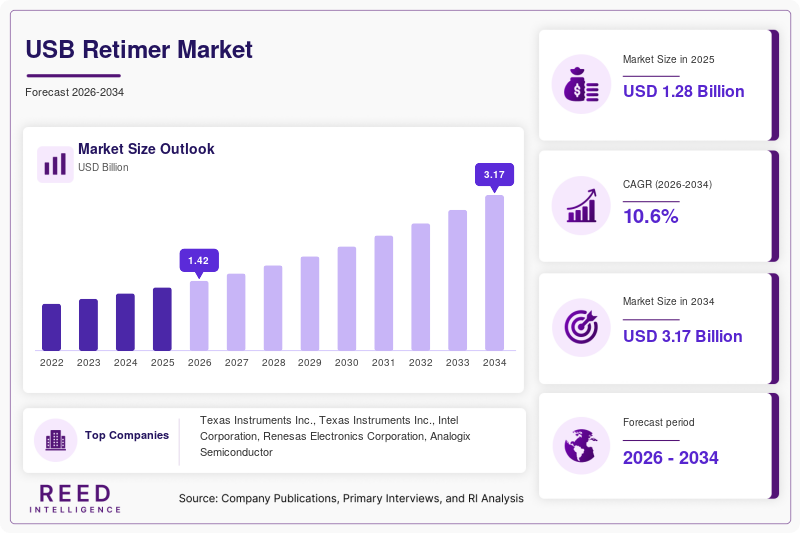
Key Highlights:
- Dominant region share (2025): Asia Pacific – 38.4%
- Fastest-growing region CAGR (2026–2034): Middle East & Africa – 12.1%
- Leading subsegment (Type): USB4/USB 3.2 Gen 2x2 retimers – 44.7% share in 2025
- Fastest-growing subsegment: USB4 + Thunderbolt combo retimers – 11.8% CAGR
- Dominant country (2024 market value): United States – USD 410 million
- Dominant country (2025 market value): United States – USD 455 million
Market Trends
Transition Toward USB4 and PCIe-Integrated Ecosystems
The USB Retimer Market is increasingly shaped by the transition toward USB4 and PCIe Gen 4/5 architectures. These high-speed protocols introduce significant signal integrity challenges due to increased data rates and longer PCB trace requirements. As a result, OEMs are integrating retimers directly into system-on-chip and motherboard designs to ensure stable transmission performance. This integration trend is strengthening the USB Retimer Market across premium computing devices and enterprise-grade systems.
Rising Adoption in AI Infrastructure and Data Centers
Another major trend in the USB Retimer Market is the accelerating adoption of retimers in AI computing environments and hyperscale data centers. As workloads become more data-intensive, particularly in machine learning and cloud computing, reliable high-speed interconnects are essential. USB-C based server architectures and GPU-to-storage communication pathways are increasingly dependent on retimers for signal conditioning, reinforcing market expansion across enterprise infrastructure.
Market Drivers
Increasing Demand for High-Bandwidth Connectivity
The USB Retimer Market is primarily driven by the global shift toward high-bandwidth connectivity standards such as USB4, which supports up to 40 Gbps data rates. As laptops, gaming systems, and professional workstations evolve, signal degradation over longer channels has become a critical challenge. Retimers restore signal quality by compensating for jitter and insertion loss, ensuring consistent performance across devices and strengthening the overall USB Retimer Market growth trajectory.
Expansion of Cloud and AI Computing Infrastructure
Rapid expansion of hyperscale data centers and AI computing clusters is another major driver of the USB Retimer Market. These environments require highly reliable interconnect solutions for storage systems, processors, and accelerators. Retimers play a vital role in maintaining signal integrity in dense PCB layouts and high-speed data pathways, making them essential components in modern cloud infrastructure and enterprise computing ecosystems.
Market Restraints
Increasing Design Complexity and Integration Challenges
The USB Retimer Market faces constraints due to rising design complexity in advanced electronic systems. As devices become smaller and more power-efficient, integrating retimers into compact architectures requires advanced engineering expertise, precise PCB layout optimization, and thermal management strategies. Additionally, compatibility challenges across multiple USB standards increase validation efforts and extend development cycles, limiting rapid adoption in cost-sensitive segments of the USB Retimer Market.
Market Opportunities
Expansion of USB-C Standardization Across Devices
The global shift toward USB-C standardization presents significant opportunities for the USB Retimer Market. USB-C is becoming the universal interface for smartphones, laptops, monitors, and industrial systems. This convergence increases the demand for multi-protocol retimers capable of supporting USB4, DisplayPort, and PCIe signals. As adoption expands across consumer and enterprise devices, the USB Retimer Market is expected to witness sustained growth.
Growing Adoption in Automotive and Industrial Systems
Another key opportunity in the USB Retimer Market lies in automotive and industrial digitalization. Modern vehicles increasingly rely on high-speed interfaces for infotainment systems, advanced driver assistance systems, and sensor fusion technologies. Similarly, industrial automation systems require reliable high-speed data transmission for real-time monitoring and control applications. These developments are expanding the application scope of the USB Retimer Market across non-traditional sectors.
Segmental Analysis
By Type
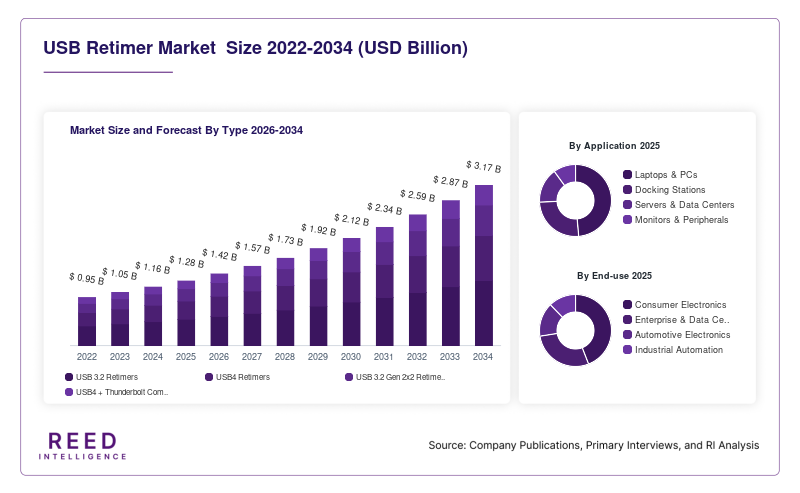
USB4 and USB 3.2 Gen 2x2 retimers dominated the USB Retimer Market with 44.7% share in 2025. This dominance is attributed to widespread adoption in high-performance laptops, docking stations, and enterprise computing systems requiring stable 40 Gbps data transmission. The USB Retimer Market continues to benefit from increasing integration of these retimers into advanced computing architectures.
USB4 + Thunderbolt combo retimers represent the fastest-growing category, expected to expand at a CAGR of 11.8% due to increasing demand for multi-protocol compatibility. These solutions enable seamless interoperability across diverse high-speed standards, making them increasingly important in premium computing and professional-grade devices within the USB Retimer Market.
By Application
Docking stations accounted for the largest share of 36.9% in the USB Retimer Market in 2025 due to rising hybrid work models and multi-device connectivity requirements. These systems rely heavily on retimers to maintain stable signal transmission across multiple ports and external displays.
Servers and data centers are emerging as the fastest-growing application segment, expected to grow at a CAGR of 12.4%. Increasing AI workloads, cloud computing expansion, and high-performance storage systems are driving strong demand in this segment of the USB Retimer Market.
By End-use
Consumer electronics held the dominant 41.3% share of the USB Retimer Market in 2025, supported by widespread adoption of laptops, gaming systems, and smartphones. The shift toward USB-C universal connectivity continues to reinforce this segment.
Enterprise and data center end-use is the fastest-growing category, projected to expand at a CAGR of 12.0% due to rapid digital transformation, AI adoption, and cloud infrastructure expansion, significantly contributing to the long-term growth of the USB Retimer Market.
Regional Analysis
North America
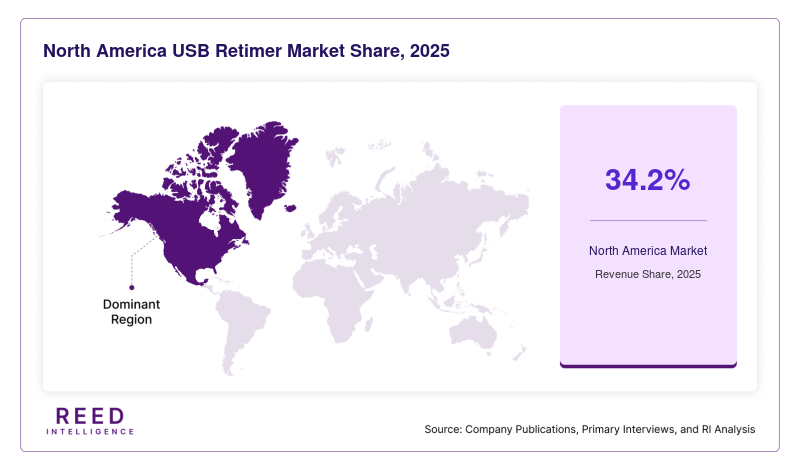
North America accounted for 34.2% share of the USB Retimer Market in 2025 and is projected to expand at a CAGR of 10.2% from 2026 to 2034. The region benefits from strong semiconductor innovation, early adoption of advanced computing technologies, and high penetration of cloud infrastructure. The USB Retimer Market in this region is strongly supported by hyperscale data center expansion and AI-driven hardware development. The United States dominates due to extensive R&D investment and widespread deployment of USB4-enabled computing systems, strengthening its leadership position in the global USB Retimer Market.
Europe
Europe held 26.5% share of the USB Retimer Market in 2025 and is expected to grow at a CAGR of 9.8% during the forecast period. The region’s growth is driven by strong industrial automation, automotive electronics integration, and digital transformation initiatives. Germany leads the European USB Retimer Market due to its advanced automotive manufacturing ecosystem and Industry 4.0 adoption. Increasing demand for high-speed in-vehicle infotainment systems and industrial connectivity solutions continues to support steady expansion of the USB Retimer Market across Europe.
Asia Pacific
Asia Pacific dominated the USB Retimer Market with 38.4% share in 2025 and is projected to grow at a CAGR of 11.4% through 2034. The region benefits from large-scale electronics manufacturing, cost-efficient production ecosystems, and strong consumer electronics demand. China leads the regional USB Retimer Market due to its dominance in laptop, smartphone, and peripheral manufacturing. Taiwan and South Korea also contribute significantly through advanced semiconductor design capabilities, reinforcing Asia Pacific’s leadership position in the global USB Retimer Market.
Middle East & Africa
The Middle East & Africa accounted for 5.1% share of the USB Retimer Market in 2025 and is expected to register the fastest CAGR of 12.1% during 2026–2034. Growth is supported by rapid digital infrastructure development, smart city initiatives, and increasing investments in cloud data centers. The UAE leads the regional USB Retimer Market due to large-scale digital transformation programs and expansion of high-performance computing infrastructure, enhancing regional adoption of advanced connectivity technologies.
Latin America
Latin America held 6.2% share of the USB Retimer Market in 2025 and is projected to grow at a CAGR of 9.6% through 2034. The region is witnessing steady growth driven by expanding IT infrastructure, increasing enterprise digitization, and rising consumer electronics adoption. Brazil dominates the Latin American USB Retimer Market due to growing demand for high-speed connectivity in enterprise systems and increasing adoption of USB-C-enabled devices across commercial and consumer applications.
Competitive Landscape
The USB Retimer Market is moderately consolidated with strong participation from global semiconductor and connectivity solution providers. Key players include Texas Instruments, Intel Corporation, Renesas Electronics, Analogix Semiconductor, and Parade Technologies. Texas Instruments maintains a leading position due to its extensive high-speed interface portfolio and strong OEM partnerships across computing and industrial sectors. Intel continues to strengthen its presence through integration of Thunderbolt and USB4 technologies into its processor ecosystems. Renesas Electronics and Analogix Semiconductor are focusing on multi-protocol retimer innovation, while Parade Technologies is expanding its USB-C ecosystem capabilities. Recent advancements in low-power retimer architectures and AI-optimized signal conditioning solutions are further shaping competition in the USB Retimer Market.
Key Players List
- Texas Instruments Inc.
- Intel Corporation
- Renesas Electronics Corporation
- Analogix Semiconductor
- Parade Technologies Ltd.
- Microchip Technology Inc.
- NXP Semiconductors
- STMicroelectronics
- Broadcom Inc.
- Synopsys Inc.
- Astera Labs Inc.
- Credo Technology Group
- ON Semiconductor
- Analog Devices Inc.
- Diodes Incorporated
Recent Developments
- 2025 – Texas Instruments launched enhanced USB4 and USB 3.2 retimer solutions focused on low-power operation, improved signal reach, and optimized performance for AI PCs, laptops, and docking stations in high-speed computing environments.
- 2025 – Intel Corporation integrated next-generation Thunderbolt and USB4 retimer functionality into its platform architecture to support AI-driven workloads, high-performance computing, and advanced connectivity ecosystems.
- 2025 – Renesas Electronics expanded its partnerships with OEMs for USB4-enabled docking systems, focusing on multi-protocol retimer solutions supporting USB, DisplayPort, and PCIe tunneling.
- 2025 – Astera Labs introduced advanced retimer architectures designed for PCIe Gen5 and USB4 applications, targeting hyperscale data centers and AI infrastructure requiring ultra-low latency and high signal integrity.
- 2025 – Parade Technologies announced development progress in USB-C and next-generation PCIe retimer solutions aimed at enterprise servers and future high-bandwidth computing systems.
USB Retimer Market Segments
By Type
- USB 3.2 Retimers
- USB4 Retimers
- USB 3.2 Gen 2x2 Retimers
- USB4 + Thunderbolt Combo Retimers
By Application
- Laptops & PCs
- Docking Stations
- Servers & Data Centers
- Monitors & Peripherals
By End-use
- Consumer Electronics
- Enterprise & Data Centers
- Automotive Electronics
- Industrial Automation
By Region
- North America
- Europe
- APAC
- Middle East and Africa
- LATAM