UV Stabilized Thermoplastic Elastomer For Automotive Market Size, Share & Demand Report By Type (Styrenic Block Copolymers (SBCs), Thermoplastic Polyolefins (TPOs), Thermoplastic Polyurethanes (TPUs), Others), By Application (Exterior Components, Interior Components, Under-the-Hood Components), By End-Use (Passenger Vehicles, Commercial Vehicles) By Region & Segment Forecasts, 2026–2034
USD 3950
Market Overview
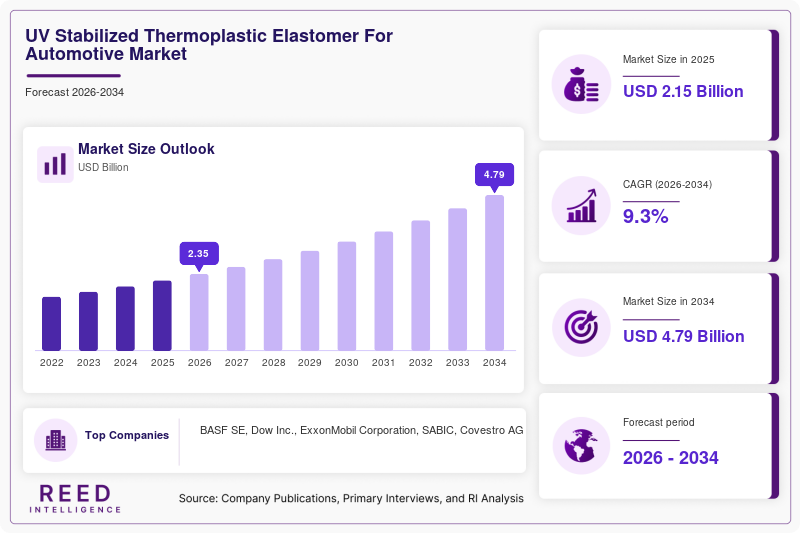
The UV Stabilized Thermoplastic Elastomer For Automotive Market size was valued at approximately USD 2.15 billion in 2026 and is projected to reach USD 4.38 billion by 2034, expanding at a CAGR of 9.3% during the forecast period from 2026 to 2034. The market is witnessing steady expansion due to increasing demand for lightweight, durable, and weather-resistant materials in modern automotive manufacturing. UV-stabilized thermoplastic elastomers (TPEs) offer enhanced resistance to ultraviolet radiation, making them suitable for exterior and interior automotive components exposed to prolonged sunlight.
A key global factor supporting market growth is the rising emphasis on vehicle longevity and aesthetics, especially in regions experiencing high solar radiation. Automotive manufacturers are increasingly replacing conventional rubber and PVC materials with UV-stabilized TPEs due to their recyclability, flexibility, and improved resistance to fading and cracking. This transition aligns with regulatory trends promoting sustainable materials and improved fuel efficiency through weight reduction.
Key Highlights
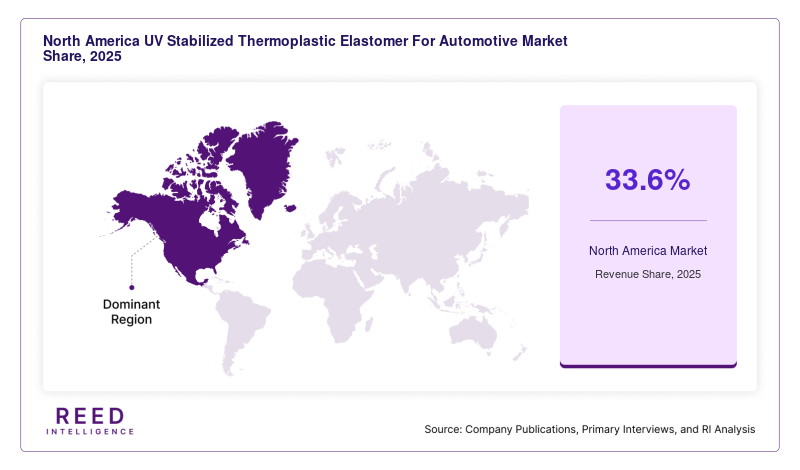
- North America dominated the market with a 33.6% share in 2025.
- Asia Pacific is expected to grow at the fastest CAGR of 10.8% during 2026–2034.
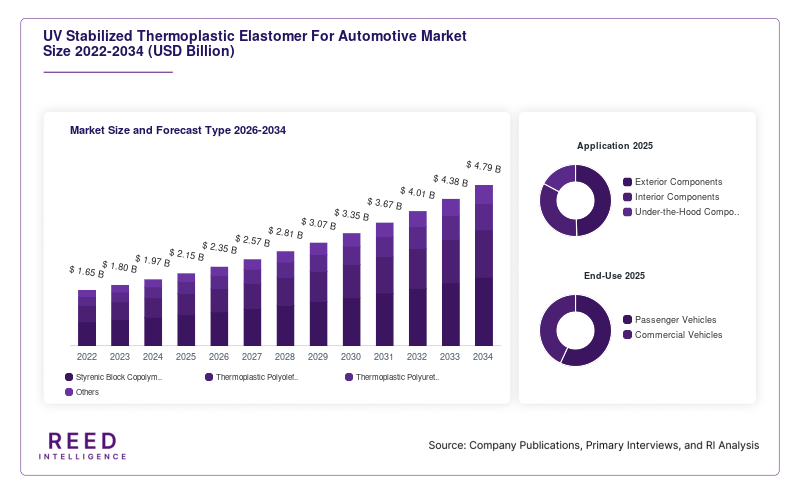
- By type, styrenic block copolymers (SBCs) accounted for the largest share of 42.1%.
- while thermoplastic polyolefins (TPOs) are projected to grow at a CAGR of 10.5%.
- By application, exterior components led with a 47.8% share, whereas interior components are expected to expand at a CAGR of 9.9%.
- The United States remained the dominant country, with market values of USD 510 million in 2024 and USD 558 million in 2025.
Market Trends
Rising Integration of Sustainable and Recyclable Materials in Automotive Manufacturing
The automotive industry is undergoing a structural shift toward sustainability, which is directly influencing the adoption of UV stabilized thermoplastic elastomers. These materials are increasingly preferred due to their recyclability and lower environmental impact compared to traditional thermoset rubber. Automotive manufacturers are prioritizing materials that align with circular economy principles, particularly in Europe and North America where environmental regulations are stringent. UV stabilized TPEs offer extended product life cycles, reducing replacement frequency and overall material waste. This trend is also supported by consumer awareness regarding eco-friendly vehicles. As automakers integrate sustainability into their brand identity, the demand for high-performance UV-resistant elastomers is expected to rise steadily across multiple vehicle segments.
Increasing Demand for Lightweight Materials to Improve Fuel Efficiency and EV Range
Lightweighting remains a critical trend in the automotive sector, particularly with the growing penetration of electric vehicles. UV stabilized thermoplastic elastomers are significantly lighter than traditional materials such as rubber and metal, making them ideal for reducing vehicle weight without compromising durability. This trend is especially relevant for electric vehicles, where reducing weight directly enhances battery efficiency and driving range. Additionally, these materials provide flexibility in design and ease of processing, allowing manufacturers to develop complex geometries with fewer components. The combination of UV resistance and lightweight properties positions these elastomers as a key material in next-generation automotive design strategies.
Market Drivers
Expansion of Electric Vehicle Production and Demand for Durable Exterior Components
The rapid expansion of electric vehicle production is a major driver for the UV stabilized thermoplastic elastomer market. Electric vehicles require materials that can withstand environmental stress while maintaining structural integrity and aesthetics. UV stabilized TPEs are widely used in seals, trims, and protective covers that are exposed to sunlight and harsh weather conditions. Their ability to resist degradation over time makes them suitable for long-term applications. As global EV production increases, especially in Asia Pacific and Europe, the demand for UV-resistant elastomers is expected to grow significantly. This trend is further reinforced by government incentives promoting electric mobility.
Growing Need for Enhanced Aesthetic Appeal and Material Longevity
Automotive manufacturers are increasingly focusing on enhancing the visual appeal and durability of vehicle components. UV stabilized thermoplastic elastomers help maintain color stability and surface finish even after prolonged exposure to sunlight. This is particularly important for exterior components such as bumpers, window seals, and trims, where fading or cracking can affect brand perception. The ability of these materials to retain their properties over time reduces maintenance costs and improves customer satisfaction. As consumers demand vehicles that retain their appearance and performance over extended periods, manufacturers are investing more in advanced material solutions like UV stabilized TPEs.
Market Restraint
High Cost of Advanced UV Stabilization Additives and Processing Challenges
One of the primary restraints affecting the UV stabilized thermoplastic elastomer market is the relatively high cost associated with advanced UV stabilization additives and specialized processing techniques. These materials require the incorporation of stabilizers such as hindered amine light stabilizers (HALS) and UV absorbers, which increase overall production costs. Small and mid-sized manufacturers often face challenges in adopting these materials due to budget constraints. Additionally, achieving uniform dispersion of additives during processing can be technically complex, requiring advanced machinery and expertise. This increases operational costs and limits scalability in cost-sensitive markets. For instance, in emerging economies, automotive manufacturers may prefer conventional materials to maintain cost competitiveness, thereby restraining market penetration of UV stabilized TPEs despite their performance benefits.
Market Opportunities
Increasing Adoption in Emerging Automotive Markets
Emerging economies present significant growth opportunities for the UV stabilized thermoplastic elastomer market. Countries in Asia Pacific, Latin America, and the Middle East are experiencing rapid urbanization and rising disposable incomes, leading to increased vehicle ownership. Automotive manufacturers in these regions are gradually adopting advanced materials to meet international quality standards. UV stabilized TPEs offer a cost-effective solution in the long term due to their durability and reduced maintenance requirements. As local production capabilities improve and supply chains become more efficient, the adoption of these materials is expected to accelerate. This creates a favorable environment for market expansion and investment.
Technological Advancements in Material Formulation and Processing
Ongoing advancements in polymer science are creating new opportunities for the development of high-performance UV stabilized thermoplastic elastomers. Innovations in additive technology and compounding processes are enabling manufacturers to produce materials with enhanced UV resistance, flexibility, and mechanical strength. These advancements are also helping reduce production costs and improve processing efficiency. For example, the development of bio-based TPEs with UV stabilization properties is gaining attention as a sustainable alternative. Such innovations are expected to open new application areas and drive market growth. As research and development efforts continue, the market is likely to benefit from improved product performance and expanded use cases.
Segmental Analysis
By Type
Styrenic block copolymers (SBCs) dominated the market in 2024, accounting for a share of 42.1%. These materials are widely used due to their excellent flexibility, ease of processing, and cost-effectiveness. SBCs offer good UV resistance when combined with stabilizers, making them suitable for various automotive applications. Their compatibility with different additives allows manufacturers to customize properties based on specific requirements. Additionally, SBCs are lightweight and recyclable, aligning with industry trends toward sustainability. The widespread use of SBCs in seals, gaskets, and trims contributes to their dominant position in the market.
Thermoplastic polyolefins (TPOs) are expected to be the fastest-growing subsegment, with a CAGR of 10.5%. The growth is driven by their superior impact resistance, durability, and enhanced UV stability. TPOs are increasingly used in exterior components such as bumpers and body panels due to their ability to withstand harsh environmental conditions. Their low density and high strength make them ideal for lightweight automotive designs. Additionally, advancements in compounding technology are improving the performance of TPOs, further supporting their adoption. As manufacturers seek materials that offer both durability and cost efficiency, TPOs are expected to gain significant traction.
By Application
Exterior components dominated the market in 2024, holding a share of 47.8%. These include bumpers, trims, and seals that are directly exposed to sunlight and require high UV resistance. UV stabilized thermoplastic elastomers provide excellent protection against fading, cracking, and degradation, making them ideal for these applications. The growing emphasis on vehicle aesthetics and durability further drives the demand for these materials in exterior components. Additionally, their lightweight properties contribute to improved fuel efficiency, enhancing their appeal among manufacturers.
Interior components are projected to be the fastest-growing subsegment, with a CAGR of 9.9%. The growth is driven by increasing demand for high-quality, durable materials that enhance the interior appearance and comfort of vehicles. UV stabilized TPEs are used in dashboards, door panels, and other interior parts to prevent discoloration and degradation caused by sunlight exposure. The rising consumer preference for premium interiors and advanced features is further supporting this trend. As automotive manufacturers focus on improving user experience, the adoption of UV stabilized elastomers in interior applications is expected to increase.
By End-Use
Passenger vehicles dominated the market in 2024, accounting for a share of 61.3%. The high production volume of passenger cars and increasing consumer demand for durable and aesthetically appealing vehicles drive this segment. UV stabilized thermoplastic elastomers are widely used in passenger vehicles to enhance performance and longevity. The growing adoption of electric and hybrid vehicles further supports demand, as these vehicles require lightweight and durable materials.
Commercial vehicles are expected to be the fastest-growing subsegment, with a CAGR of 9.7%. The growth is driven by increasing demand for durable materials that can withstand heavy usage and harsh environmental conditions. UV stabilized TPEs are used in various components to improve durability and reduce maintenance costs. The expansion of logistics and transportation industries further contributes to this growth. As fleet operators seek cost-effective solutions, the adoption of advanced materials in commercial vehicles is expected to rise
Regional Analysis
North America
North America held a significant share of 33.6% in 2025 and is expected to maintain steady growth with a CAGR of 8.7% during the forecast period. The region’s mature automotive industry and strong focus on material innovation contribute to its dominant position. The presence of leading automotive manufacturers and stringent quality standards drives the demand for high-performance UV stabilized thermoplastic elastomers. Additionally, increasing investments in electric vehicle production further support market expansion.
The United States remains the dominant country in this region, driven by its advanced manufacturing infrastructure and strong emphasis on sustainability. A unique growth factor is the increasing adoption of lightweight materials in electric vehicles to enhance energy efficiency. This trend is encouraging manufacturers to integrate UV stabilized TPEs into various vehicle components.
Europe
Europe accounted for approximately 28.4% of the market share in 2025 and is projected to grow at a CAGR of 9.1%. The region’s strong regulatory framework promoting environmentally friendly materials is a key driver for market growth. Automotive manufacturers are actively adopting UV stabilized thermoplastic elastomers to comply with emission and recycling regulations. The demand is particularly strong in premium vehicle segments.
Germany leads the European market due to its robust automotive manufacturing base. A unique growth factor is the region’s focus on circular economy practices, which encourages the use of recyclable materials. This has significantly increased the adoption of UV stabilized TPEs in automotive applications.
Asia Pacific
Asia Pacific is expected to witness the fastest growth with a CAGR of 10.8% during the forecast period, supported by a market share of 24.7% in 2025. Rapid industrialization and increasing vehicle production in countries such as China, India, and Japan are driving demand. The region’s growing middle-class population and rising disposable incomes further contribute to market expansion.
China dominates the regional market due to its large-scale automotive production and strong government support for electric vehicles. A unique growth factor is the increasing investment in local manufacturing of advanced materials, which enhances supply chain efficiency and reduces costs.
Middle East & Africa
The Middle East & Africa region held a smaller share of around 6.3% in 2025 but is projected to grow at a CAGR of 8.5%. The region’s harsh climatic conditions, including high UV exposure, create a strong demand for UV-resistant materials in automotive applications. This makes UV stabilized thermoplastic elastomers particularly relevant.
Saudi Arabia leads the market in this region, supported by its growing automotive sector. A unique growth factor is the increasing focus on vehicle durability in extreme weather conditions, which drives the adoption of advanced elastomers.
Latin America
Latin America accounted for approximately 7.0% of the market share in 2025 and is expected to grow at a CAGR of 8.9%. The region’s automotive industry is gradually recovering and adopting advanced materials to improve vehicle performance and longevity. Increasing foreign investments are also supporting market growth.
Brazil is the dominant country in this region, driven by its large automotive manufacturing base. A unique growth factor is the rising demand for cost-effective yet durable materials, which positions UV stabilized thermoplastic elastomers as an attractive option.
Competitive Landscape
The UV stabilized thermoplastic elastomer for automotive market is moderately consolidated, with key players focusing on product innovation and strategic partnerships. Leading companies are investing in research and development to enhance material performance and expand application areas. The market is characterized by intense competition, with players striving to offer cost-effective and high-performance solutions.
BASF SE is recognized as a leading player due to its extensive product portfolio and strong global presence. The company recently introduced advanced UV stabilized elastomer grades designed for high-performance automotive applications. Other major players are also focusing on expanding their production capacities and strengthening their distribution networks. Collaborations with automotive manufacturers are common strategies to gain a competitive edge.
Key Players List
- BASF SE
- Dow Inc.
- ExxonMobil Corporation
- SABIC
- Covestro AG
- Arkema S.A.
- LG Chem Ltd.
- Kuraray Co., Ltd.
- Mitsubishi Chemical Group Corporation
- Teknor Apex Company
- RTP Company
- Huntsman Corporation
- Celanese Corporation
- Asahi Kasei Corporation
- DuPont de Nemours, Inc.
Recent Developments
- BASF SE launched a new range of UV stabilized thermoplastic elastomers designed for enhanced weather resistance in automotive exteriors.
- SABIC expanded its production capacity for advanced elastomers in Asia Pacific to meet rising demand from automotive manufacturers.
- Dow Inc. introduced innovative additive technologies to improve UV stability and processing efficiency of thermoplastic elastomers
UV Stabilized Thermoplastic Elastomer For Automotive Market Segments
Type
- Styrenic Block Copolymers (SBCs)
- Thermoplastic Polyolefins (TPOs)
- Thermoplastic Polyurethanes (TPUs)
- Others
Application
- Exterior Components
- Interior Components
- Under-the-Hood Components
End-Use
- Passenger Vehicles
- Commercial Vehicles
By Region
- North America
- Europe
- APAC
- Middle East and Africa
- LATAM