UVC Lighting High Purity Quartz Sand Market Size, Share Demand Report By Purity Level (99.99% (4N), 99.999% (5N), Others), By Application (UVC Lamp Manufacturing, Water Purification Systems, Air Disinfection, Surface Sterilization), By End-Use Industry (Healthcare, Municipal, Industrial, Commercial), By Form (Granular, Powdered), By Region & Segment Forecasts, 2026–2034
USD 3950
Market Overview
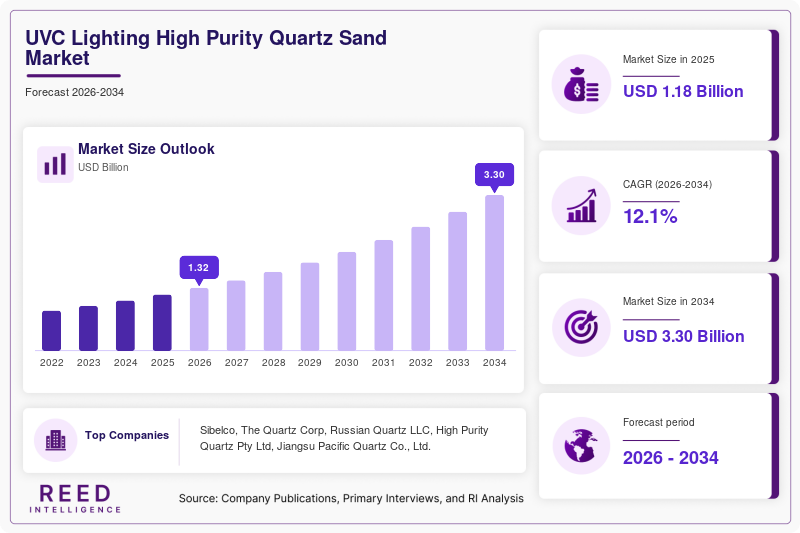
The UVC Lighting High Purity Quartz Sand Market size was valued at approximately USD 1.18 billion in 2026 and is projected to reach USD 2.94 billion by 2034, expanding at a CAGR of 12.1% during the forecast period (2026–2034). This growth trajectory reflects the increasing demand for high-transmittance quartz materials used in UVC lighting systems, particularly for disinfection and sterilization applications across healthcare, water treatment, and industrial sectors.
A major global factor supporting market expansion has been the rising emphasis on advanced sanitation technologies, driven by stricter environmental and health regulations. Governments and private industries have increasingly adopted UVC-based solutions for microbial control, thereby accelerating the demand for high purity quartz sand, which is a critical raw material for manufacturing UVC lamp envelopes and components.
Key Highlights:
- Asia Pacific dominated the market with a 41.6% share in 2025, while the Middle East & Africa is projected to register the fastest CAGR of 13.4% during the forecast period.
- By purity level, the 99.99% (4N) segment led with a 48.3% share, while the 99.999% (5N) segment is expected to grow at a CAGR of 13.2%.
- By application, UVC lamp manufacturing held the largest share of 56.7%, whereas water purification systems are anticipated to grow at a CAGR of 12.8%.
- China remained the dominant country, with market values of USD 412 million in 2024 and USD 458 million in 2025.
Market Trends
Integration of Advanced Purification Technologies
The market has been witnessing a shift toward advanced beneficiation and purification techniques such as acid leaching and plasma processing. These technologies enhance the purity level of quartz sand to meet stringent UVC transmission standards. Manufacturers are increasingly investing in refining processes to produce ultra-high purity grades that minimize impurities like iron and aluminum, which can affect optical performance.
Expansion of UVC Applications Beyond Healthcare
While healthcare remains a primary application, UVC lighting adoption has expanded into sectors such as HVAC systems, food processing, and municipal water treatment. This diversification has significantly increased the consumption of high purity quartz sand, as these applications require durable and high-performance quartz components for sustained UV exposure.
Market Drivers
Rising Demand for UVC-Based Disinfection Solutions
The growing reliance on UVC lighting for sterilization across public and private infrastructures has been a strong driver. High purity quartz sand is essential for producing quartz glass that ensures efficient UV transmission. As industries seek reliable and chemical-free disinfection methods, demand for high-quality quartz materials continues to rise.
Growth in Semiconductor and Optoelectronics Industries
The expansion of semiconductor and optoelectronics manufacturing has indirectly supported the market. These industries require high purity quartz for various applications, including photolithography and optical components. The overlap in material requirements has strengthened supply chain investments and improved production capabilities, benefiting the UVC lighting segment.
Market Restraint
High Processing Costs and Limited Resource Availability
Producing ultra-high purity quartz sand involves complex and energy-intensive processes, resulting in high production costs. Additionally, the availability of naturally occurring high-grade quartz deposits is limited, which creates supply constraints and price volatility in the market.
Market Opportunities
Emergence of Smart Water Treatment Infrastructure
The development of smart cities and intelligent water management systems presents new opportunities for UVC lighting integration. High purity quartz sand will play a critical role in enabling efficient UV-based purification systems, particularly in urban water recycling and desalination projects.
Technological Advancements in UV-C LED Systems
The shift toward UV-C LED technology is expected to create additional demand for specialized quartz materials. These systems require precision-engineered quartz components to maintain performance and durability, opening avenues for innovation and product differentiation among manufacturers.
Segmental Analysis
By Purity Level
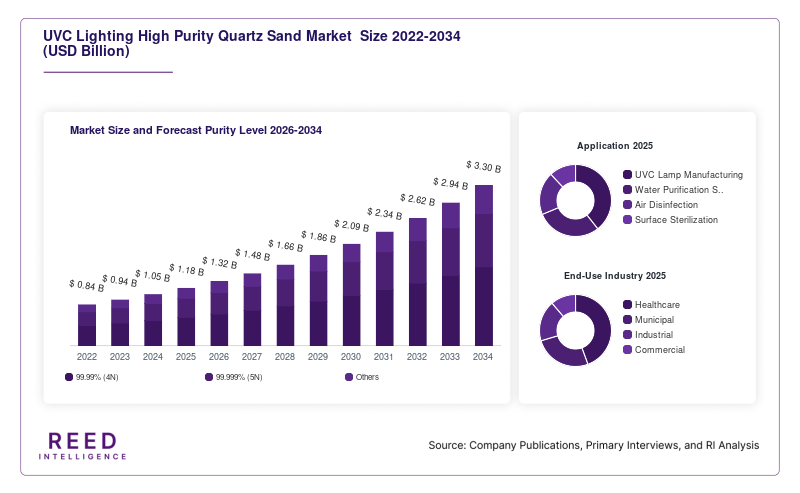
The 99.99% (4N) purity segment dominated the market in 2025, accounting for 48.3% of the total share. This segment benefited from its balance between cost and performance, making it widely used in standard UVC lamp manufacturing. Its suitability for large-scale production and consistent quality made it the preferred choice among manufacturers.
The 99.999% (5N) segment is expected to grow at a CAGR of 13.2% during the forecast period. This growth will be driven by increasing demand for high-performance UVC systems requiring superior optical clarity and minimal impurity levels. The segment will gain traction in advanced applications such as semiconductor-grade UV systems and precision sterilization equipment.
By Application
UVC lamp manufacturing emerged as the dominant application segment, holding a 56.7% share in 2025. The widespread use of quartz glass in lamp envelopes and sleeves contributed to its leading position. The segment’s growth was supported by increasing deployment of UVC lamps in healthcare and industrial environments.
Water purification systems are projected to be the fastest-growing segment, with a CAGR of 12.8%. The rising demand for clean water and the adoption of UV-based purification technologies will drive this segment. High purity quartz sand will be essential for producing durable and efficient quartz components used in these systems.
By End-Use Industry
The healthcare sector accounted for the largest share of 34.5% in 2025. Hospitals and laboratories extensively utilized UVC lighting for sterilization, driving demand for high-quality quartz materials. The sector’s strict hygiene standards ensured consistent consumption of high purity quartz sand.
The municipal sector is expected to grow at a CAGR of 12.9% during the forecast period. Increasing investments in public sanitation and water treatment infrastructure will fuel demand. Governments will prioritize UV-based solutions for large-scale disinfection, boosting the need for high purity quartz components.
By Form
Granular quartz sand held the dominant share of 61.2% in 2025 due to its widespread use as a raw material in quartz glass production. Its ease of processing and availability made it a preferred choice among manufacturers.
Powdered quartz is anticipated to grow at a CAGR of 11.8%, driven by its application in precision manufacturing processes. The segment will benefit from advancements in material processing technologies that require finer particle sizes for improved product quality.
Regional Analysis
North America
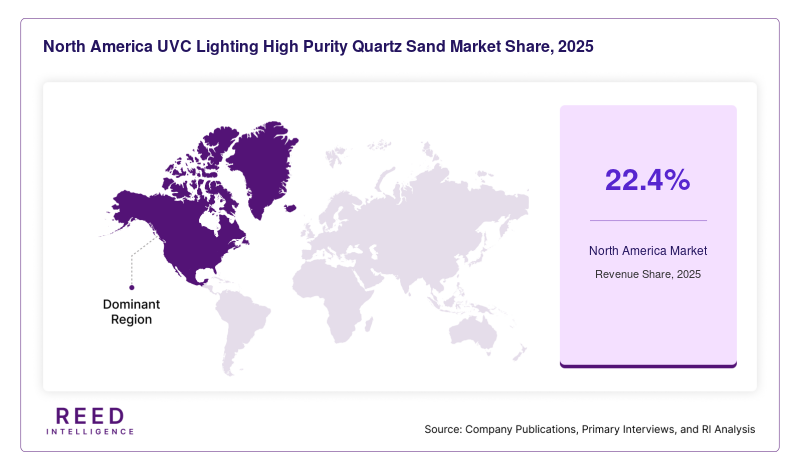
North America accounted for 22.4% of the market share in 2025 and is expected to grow at a CAGR of 11.6% during the forecast period. The United States dominated the region due to its advanced healthcare infrastructure and increasing adoption of UVC disinfection systems in commercial spaces. The presence of established quartz processing facilities further supported regional growth.
Europe
Europe held a 19.7% share in 2025 and will expand at a CAGR of 11.2% through 2034. Germany emerged as the leading country, driven by strong environmental regulations and investments in sustainable water treatment technologies. The region’s focus on reducing chemical usage in sanitation processes has boosted demand for UVC-compatible quartz materials.
Asia Pacific
Asia Pacific captured the largest share of 41.6% in 2025 and is projected to grow at a CAGR of 12.7%. China led the region due to its extensive manufacturing base and abundant quartz reserves. Rapid industrialization and increasing adoption of UVC systems in public infrastructure have significantly contributed to market expansion.
Middle East & Africa
The Middle East & Africa region accounted for 8.3% of the market share in 2025 and is expected to grow at the fastest CAGR of 13.4%. Saudi Arabia dominated the region, supported by investments in desalination and water purification projects. The need for efficient water treatment solutions in arid regions has accelerated UVC adoption.
Latin America
Latin America held a 8.0% share in 2025 and is anticipated to grow at a CAGR of 11.0%. Brazil led the market due to its expanding industrial base and increasing focus on improving water quality standards. Government initiatives aimed at enhancing sanitation infrastructure have supported regional growth.
Competitive Landscape
The UVC Lighting High Purity Quartz Sand Market is moderately consolidated, with key players focusing on product quality, technological advancements, and strategic partnerships. Leading companies include Sibelco, The Quartz Corp, Russian Quartz LLC, High Purity Quartz Pty Ltd, and Jiangsu Pacific Quartz Co., Ltd. Among these, The Quartz Corp stands out as a market leader due to its extensive global presence and advanced purification capabilities.
The company recently expanded its production capacity to meet rising demand for ultra-high purity quartz materials used in UVC applications. Other players are investing in research and development to enhance product performance and reduce impurity levels. Strategic collaborations with UVC lighting manufacturers have also become a common approach to strengthen market positioning. The competitive environment is characterized by continuous innovation and efforts to secure high-quality raw material sources.
Key Players List
- Sibelco
- The Quartz Corp
- Russian Quartz LLC
- High Purity Quartz Pty Ltd
- Jiangsu Pacific Quartz Co., Ltd.
- Covia Holdings Corporation
- Creswick Quartz
- Nordic Mining ASA
- Ron Coleman Mining
- Fineton Industrial Minerals Limited
- Momentive Technologies
- Heraeus Holding GmbH
- Shin-Etsu Chemical Co., Ltd.
- Murata Manufacturing Co., Ltd.
- Tosoh Corporation
Recent Developments
- In 2025, The Quartz Corp announced the expansion of its refining facility to increase production of ultra-high purity quartz.
- Jiangsu Pacific Quartz Co., Ltd. introduced a new product line tailored for UVC LED applications.
- Sibelco invested in advanced purification technologies to enhance product quality and reduce processing costs.
- High Purity Quartz Pty Ltd entered into a partnership with a UVC lighting manufacturer to develop customized quartz solutions.
- Momentive Technologies launched a new range of quartz materials designed for high-intensity UV applications.
UVC Lighting High Purity Quartz Sand Market Segments
Purity Level
- 99.99% (4N)
- 99.999% (5N)
- Others
Application
- UVC Lamp Manufacturing
- Water Purification Systems
- Air Disinfection
- Surface Sterilization
End-Use Industry
- Healthcare
- Municipal
- Industrial
- Commercial
Form
- Granular
- Powdered
By Region
- North America
- Europe
- APAC
- Middle East and Africa
- LATAM