Vacuum Dust Filters Market Size, Share & Demand Report By Filter Type (HEPA Filters, Cartridge Filters, Bag Filters, Foam Filters, Nanofiber Filters), By Application (Industrial Manufacturing, Pharmaceutical Processing, Construction, Food and Beverage Processing, Residential Cleaning, Commercial Cleaning), By End Use (Industrial, Commercial, Residential) By Region & Segment Forecasts, 2026–2034
USD 3950
Market Overview
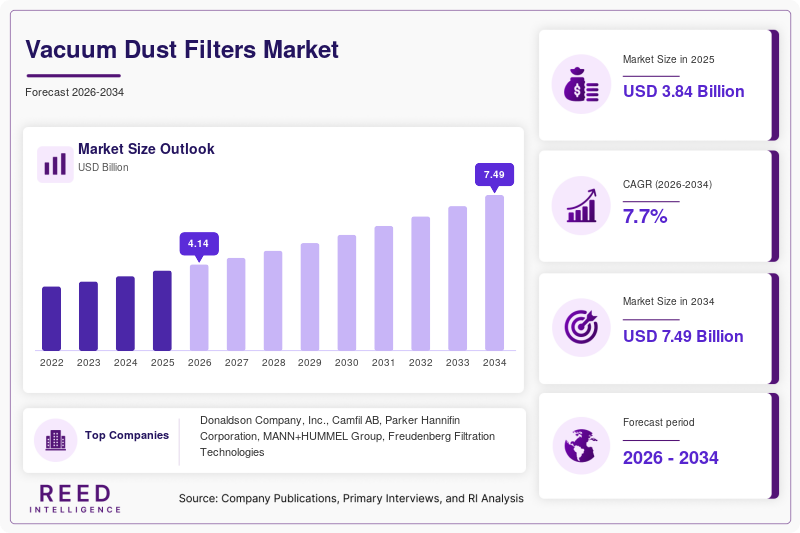
The global Vacuum Dust Filters Market size was valued at USD 3.84 billion in 2026 and is projected to reach USD 6.97 billion by 2034, expanding at a CAGR of 7.7% during the forecast period from 2026 to 2034. The market continues to gain momentum as industries increase investments in workplace air quality management, industrial safety systems, and emission control technologies. Vacuum dust filters are widely used across manufacturing plants, pharmaceuticals, food processing facilities, automotive workshops, mining operations, and residential cleaning equipment to capture fine dust particles and improve operational efficiency.
One of the major global factors supporting market growth is the rising implementation of industrial air pollution regulations across developed and emerging economies. Governments and environmental agencies are tightening workplace emission standards to reduce occupational hazards and airborne contamination. This has encouraged manufacturers to adopt advanced vacuum filtration systems with higher filtration efficiency, low maintenance requirements, and energy-saving capabilities. In addition, the rapid expansion of smart factories and automated industrial environments has increased the demand for high-performance dust collection systems integrated with sensor-based monitoring and predictive maintenance technologies.
Key Highlights
- North America dominated the Vacuum Dust Filters Market with a 35.1% share in 2025, while Asia Pacific is expected to grow at the fastest CAGR of 9.4% during 2026–2034.
- By filter type, HEPA filters accounted for the largest share of 39.6%, while nanofiber filters are projected to grow at a CAGR of 10.2%.
- By application, industrial manufacturing led with a 42.8% share, whereas pharmaceutical processing is expected to expand at a CAGR of 9.8%.
- The United States remained the dominant country, with market values of USD 780 million in 2024 and USD 845 million in 2025.
Market Trends
Integration of Smart Filtration Monitoring Systems
The Vacuum Dust Filters Market is witnessing strong adoption of smart filtration monitoring systems across industrial and commercial environments. Manufacturers are increasingly integrating sensors, cloud connectivity, and predictive maintenance software into vacuum dust filter systems to improve operational efficiency and reduce equipment downtime. Smart monitoring solutions help operators track airflow pressure, filter clogging, energy consumption, and replacement cycles in real time. This trend is becoming highly relevant in automotive manufacturing, chemical processing, and electronics industries where uninterrupted dust management is essential for production continuity and workplace safety.
Industrial facilities are also shifting toward automated maintenance scheduling to reduce labor costs and improve productivity. Smart vacuum dust filters can notify operators before filter performance declines significantly, allowing timely replacement and minimizing equipment failure risks. The integration of Internet of Things technologies into industrial air filtration systems is further supporting this trend. As companies focus on digital transformation and factory automation, demand for intelligent vacuum dust filters with data analytics capabilities is expected to expand steadily throughout the forecast period.
Rising Preference for Sustainable and Reusable Filter Materials
Sustainability has become an important purchasing factor in the Vacuum Dust Filters Market as industries seek environmentally responsible filtration solutions. End users are increasingly adopting reusable and washable filter materials to reduce operational waste and long-term maintenance expenses. Manufacturers are developing filter cartridges using recyclable synthetic fibers, advanced cellulose blends, and nanofiber technology to improve filtration performance while lowering environmental impact. This trend is especially visible in Europe and North America where sustainability regulations are influencing industrial equipment procurement strategies.
The demand for energy-efficient filtration systems is also rising because companies aim to reduce power consumption in industrial operations. Vacuum dust filters with low airflow resistance and extended lifecycle capabilities help minimize energy usage and replacement frequency. In addition, commercial cleaning equipment manufacturers are introducing eco-friendly vacuum filters for residential and hospitality applications. Growing awareness regarding indoor air quality and sustainable manufacturing practices is expected to encourage continuous innovation in recyclable and reusable vacuum filtration technologies over the coming years.
Market Drivers
Expansion of Industrial Manufacturing and Processing Facilities
Rapid industrialization across emerging economies is one of the key growth drivers for the Vacuum Dust Filters Market. Manufacturing sectors including automotive, electronics, cement, metal fabrication, chemicals, and food processing generate large amounts of airborne dust and particulate matter during production activities. Industrial operators are increasingly investing in advanced dust filtration systems to maintain worker safety, comply with emission standards, and improve machine performance. Vacuum dust filters play a critical role in preventing contamination and extending equipment lifespan in high-volume industrial facilities.
Countries across Asia Pacific, the Middle East, and Latin America are experiencing significant growth in manufacturing investments, creating strong demand for industrial dust collection solutions. Expansion of warehouse automation and large-scale production units is further supporting the installation of centralized vacuum filtration systems. In addition, rising awareness regarding occupational respiratory diseases has encouraged industries to adopt high-efficiency filtration technologies. The continuous growth of industrial production output is expected to maintain stable demand for vacuum dust filters throughout the forecast period.
Increasing Demand for Indoor Air Quality Solutions
The growing focus on indoor air quality management is significantly driving the Vacuum Dust Filters Market across residential, commercial, and healthcare environments. Consumers and businesses are becoming more aware of the health risks associated with fine dust particles, allergens, bacteria, and airborne pollutants. This has increased demand for vacuum cleaners and air filtration systems equipped with advanced dust filters capable of capturing microscopic contaminants effectively.
Healthcare facilities, laboratories, educational institutions, and office buildings are increasingly deploying vacuum dust filtration systems to maintain hygienic indoor conditions. Demand for HEPA-based vacuum filters has risen considerably because of their ability to trap fine particles and improve air cleanliness standards. The expansion of urban residential infrastructure and rising disposable incomes are also supporting sales of premium vacuum cleaning systems with multi-stage filtration capabilities. As awareness regarding respiratory health and environmental hygiene continues to increase globally, the market for vacuum dust filters is expected to witness sustained long-term growth.
Market Restraint
High Maintenance and Replacement Costs of Advanced Filters
One of the primary restraints affecting the Vacuum Dust Filters Market is the high maintenance and replacement cost associated with advanced filtration systems. High-efficiency filters such as HEPA, ULPA, and nanofiber-based products require periodic inspection, cleaning, and replacement to maintain optimal performance. In industrial settings where filtration systems operate continuously under heavy dust loads, maintenance expenses can increase substantially over time. Small and medium-sized enterprises often face budget limitations that restrict investment in premium vacuum dust filtration technologies.
In addition, specialized filters designed for pharmaceutical manufacturing, semiconductor processing, or hazardous dust management require strict compliance with regulatory standards, increasing operational costs further. Improper maintenance can reduce filtration efficiency and lead to equipment failure, resulting in production disruptions and additional repair expenses. Some industries in developing regions continue using conventional dust collection methods due to the higher initial investment associated with advanced vacuum filtration systems. The need for skilled technicians, regular system calibration, and costly replacement components may continue to limit market penetration among price-sensitive end users during the forecast period.
Market Opportunities
Growing Adoption of Vacuum Dust Filters in Pharmaceutical Facilities
The pharmaceutical sector is creating substantial growth opportunities for the Vacuum Dust Filters Market due to increasing investments in contamination control and cleanroom operations. Pharmaceutical manufacturing environments require strict dust management systems to prevent product contamination and maintain regulatory compliance. Vacuum dust filters are widely used in powder handling, tablet production, chemical mixing, and packaging operations where airborne particles can compromise product quality.
The expansion of global pharmaceutical production capacity and rising demand for generic medicines are encouraging companies to modernize manufacturing facilities with advanced air filtration systems. In addition, stricter guidelines related to Good Manufacturing Practices are driving adoption of high-efficiency vacuum filtration technologies in research laboratories and biotechnology facilities. Manufacturers are developing compact, low-noise, and antimicrobial filter systems specifically designed for pharmaceutical applications. As investments in healthcare infrastructure and pharmaceutical production continue to rise globally, the market is expected to experience strong opportunities from this rapidly expanding sector.
Rising Demand from Construction and Infrastructure Projects
The increasing number of construction and infrastructure development projects worldwide is opening new opportunities for the Vacuum Dust Filters Market. Construction activities generate significant volumes of concrete dust, silica particles, wood debris, and airborne contaminants that require efficient dust management systems. Contractors and construction companies are adopting industrial vacuum filtration equipment to comply with workplace safety standards and improve air quality on construction sites.
Rapid urbanization in emerging economies is driving investments in residential buildings, transportation infrastructure, commercial complexes, and industrial facilities. This growth is increasing the use of portable vacuum dust filters and heavy-duty industrial filtration systems in construction operations. In addition, growing awareness regarding silica dust exposure and worker respiratory safety is encouraging stricter regulatory enforcement in several countries. Equipment manufacturers are introducing mobile filtration units with high suction performance and durable filter media to meet the evolving requirements of the construction industry. These developments are expected to create considerable long-term growth potential for market participants.
Segmental Analysis
By Filter Type
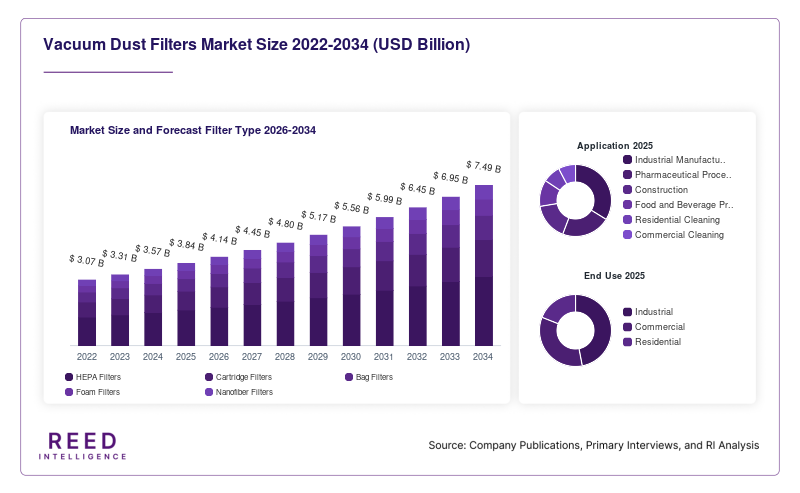
HEPA filters accounted for the largest share of the Vacuum Dust Filters Market in 2024, representing 39.6% of global revenue. The dominance of this subsegment is mainly attributed to its high filtration efficiency and widespread use across industrial, commercial, healthcare, and residential applications. HEPA filters are capable of capturing extremely fine particles, allergens, bacteria, and airborne contaminants, making them suitable for environments requiring strict air quality standards. Hospitals, pharmaceutical facilities, electronics manufacturing plants, and laboratory environments extensively utilize HEPA-based vacuum dust filters to maintain clean operating conditions. Rising consumer awareness regarding indoor air quality has also increased the demand for HEPA-equipped household vacuum cleaners and commercial cleaning equipment.
Nanofiber filters are projected to witness the fastest growth, expanding at a CAGR of 10.2% during the forecast period. These filters are gaining popularity because they offer superior dust holding capacity, lower airflow resistance, and longer operational lifespan compared to conventional filter materials. Nanofiber technology is increasingly being adopted in industrial manufacturing, mining, and automotive applications where high dust loads require efficient filtration systems. Manufacturers are investing in advanced nanofiber media development to improve filtration efficiency while reducing maintenance costs and energy consumption. The lightweight structure and enhanced particle capture performance of nanofiber filters are expected to support their rapid adoption across multiple end-use industries over the coming years.
By Application
Industrial manufacturing emerged as the leading application segment in the Vacuum Dust Filters Market, accounting for 42.8% of global revenue in 2024. Manufacturing facilities generate significant amounts of airborne dust and particulate matter during processes such as grinding, welding, polishing, cutting, and material handling. Vacuum dust filters are essential for maintaining equipment performance, reducing workplace contamination, and ensuring employee safety within industrial environments. Industries including automotive, metal fabrication, chemicals, electronics, and food processing rely heavily on centralized vacuum filtration systems to improve operational efficiency and comply with environmental regulations. Continuous expansion of industrial production activities worldwide continues to strengthen demand for high-capacity vacuum filtration equipment.
Pharmaceutical processing is expected to register the fastest CAGR of 9.8% during the forecast period due to increasing emphasis on contamination control and regulatory compliance. Pharmaceutical manufacturers require advanced vacuum dust filtration systems to maintain cleanroom conditions and prevent cross-contamination during powder handling and drug production processes. The expansion of biotechnology research facilities and rising global medicine demand are creating strong opportunities for specialized filtration equipment providers. In addition, growing investments in vaccine production, laboratory infrastructure, and sterile manufacturing environments are encouraging adoption of compact, antimicrobial, and high-efficiency vacuum filtration systems designed specifically for pharmaceutical applications.
By End Use
The industrial sector held the dominant share of the Vacuum Dust Filters Market in 2024, contributing 48.3% of overall revenue. Industrial end users rely on vacuum dust filters to manage airborne pollutants generated during heavy manufacturing operations, mining activities, and material processing tasks. Large-scale industrial plants require durable and high-capacity filtration systems capable of operating continuously in demanding conditions. Rising implementation of workplace safety standards and industrial air pollution regulations has encouraged manufacturers to invest in advanced dust collection technologies. The growing use of automated machinery and robotic production systems is further increasing the importance of reliable vacuum filtration equipment across industrial facilities worldwide.
The commercial sector is anticipated to experience the fastest growth during the forecast period, expanding at a CAGR of 8.9%. Commercial establishments including office buildings, shopping centers, hospitals, hotels, educational institutions, and airports are increasingly prioritizing indoor air quality management and hygiene standards. The rising adoption of commercial cleaning equipment with advanced filtration systems is supporting demand for vacuum dust filters across service industries. Growth in the hospitality and healthcare sectors, combined with increasing urban infrastructure development, is creating favorable conditions for commercial filtration equipment suppliers. In addition, heightened awareness regarding airborne pollutants and public health protection is encouraging broader deployment of efficient dust filtration technologies in commercial environments.
Regional Analysis
North America
North America accounted for 35.1% of the global Vacuum Dust Filters Market in 2025 and is expected to maintain a stable growth trajectory with a CAGR of 7.1% during the forecast period. The region benefits from strong industrial infrastructure, strict environmental regulations, and widespread adoption of advanced filtration technologies across manufacturing facilities. Demand for vacuum dust filters remains high in automotive production, food processing, electronics manufacturing, and commercial cleaning sectors. The presence of established filtration equipment manufacturers and rising investments in industrial automation continue to support market expansion across the region.
The United States remains the dominant country within North America due to its extensive industrial manufacturing base and high awareness regarding occupational air quality standards. The country is witnessing increased adoption of smart vacuum filtration systems integrated with predictive maintenance technologies. Growth in pharmaceutical manufacturing and logistics infrastructure is also supporting market demand. In addition, the rising popularity of premium household vacuum cleaners equipped with HEPA filtration systems is contributing to steady sales growth across residential applications.
Europe
Europe represented 27.4% of the global Vacuum Dust Filters Market in 2025 and is projected to expand at a CAGR of 6.9% through 2034. The regional market is driven by stringent workplace safety regulations and strong emphasis on sustainable industrial operations. Industries across Germany, France, Italy, and the United Kingdom are adopting advanced dust collection systems to reduce airborne emissions and improve production efficiency. Demand for reusable and recyclable filter materials is particularly strong in the region due to sustainability initiatives and environmental compliance requirements.
Germany continues to dominate the European market because of its large industrial manufacturing sector and advanced engineering capabilities. The country has experienced increasing investments in smart factories and automated production systems that require efficient dust filtration technologies. Automotive manufacturing remains a major contributor to market demand, supported by precision engineering and strict air quality management standards. In addition, Germany’s focus on energy-efficient industrial equipment is encouraging the development of low-resistance and high-performance vacuum filtration systems.
Asia Pacific
Asia Pacific held 24.3% of the global Vacuum Dust Filters Market in 2025 and is expected to register the fastest CAGR of 9.4% during the forecast period. Rapid industrialization, urban expansion, and rising construction activities are major factors driving market growth in the region. Countries such as China, India, Japan, and South Korea are experiencing increased demand for industrial vacuum filtration systems across manufacturing plants, mining facilities, and commercial infrastructure projects. Growing awareness regarding workplace safety and environmental pollution is further encouraging adoption of advanced filtration technologies.
China remains the leading country in the Asia Pacific market due to its extensive manufacturing ecosystem and large-scale industrial output. The country has witnessed substantial investments in electronics production, automotive manufacturing, and renewable energy equipment facilities, all of which require efficient dust management systems. Government policies aimed at reducing industrial pollution are also supporting market expansion. In addition, the increasing middle-class population and rising consumer spending on household cleaning appliances are strengthening demand for residential vacuum dust filters.
Middle East & Africa
The Middle East & Africa region accounted for 7.2% of the global Vacuum Dust Filters Market in 2025 and is forecast to grow at a CAGR of 6.4% during the study period. Market growth in the region is supported by rising investments in construction, mining, oil and gas processing, and industrial manufacturing. Industrial facilities are increasingly deploying vacuum dust filters to manage airborne contaminants and improve operational safety standards. Growing infrastructure modernization initiatives across Gulf countries are also creating opportunities for industrial filtration equipment suppliers.
Saudi Arabia emerged as the dominant country within the region due to ongoing industrial diversification projects and expansion of manufacturing capabilities. Large-scale infrastructure developments and mining activities are generating strong demand for heavy-duty dust filtration systems. The country is also investing in industrial automation and smart factory technologies that require advanced vacuum filtration solutions. In addition, rising focus on worker safety standards in industrial sectors is encouraging companies to adopt efficient air quality management systems across production facilities.
Latin America
Latin America captured 6.0% of the global Vacuum Dust Filters Market in 2025 and is expected to grow at a CAGR of 6.7% during the forecast period. The regional market is supported by increasing industrial activity in mining, agriculture processing, cement manufacturing, and food production sectors. Companies are gradually modernizing industrial facilities with improved dust control systems to comply with environmental regulations and enhance workplace safety. Demand for portable vacuum filtration systems is also increasing across commercial cleaning and construction applications.
Brazil remains the leading country in the Latin American market because of its large manufacturing sector and expanding infrastructure development activities. The country is witnessing growing demand for industrial vacuum dust filters in mining operations, metal processing plants, and food production facilities. Rising investments in commercial real estate projects and urban transportation infrastructure are also supporting market expansion. In addition, increasing awareness regarding employee health protection and industrial emission management is contributing to wider adoption of advanced filtration technologies across Brazilian industries.

Competitive Landscape
The Vacuum Dust Filters Market remains moderately fragmented with the presence of international manufacturers and regional filtration equipment suppliers competing across industrial, commercial, and residential applications. Companies are focusing on product innovation, strategic partnerships, and expansion of manufacturing capabilities to strengthen their market position. Advanced filtration technologies, energy-efficient systems, and smart monitoring capabilities have become important competitive factors within the industry.
Donaldson Company remains one of the leading participants in the market due to its extensive industrial filtration portfolio and strong global distribution network. The company continues to invest in advanced nanofiber filtration technologies and smart monitoring systems designed for industrial dust collection applications. Camfil, Parker Hannifin, MANN+HUMMEL, and Freudenberg Filtration Technologies are also actively expanding their product offerings to address rising demand for sustainable and high-performance filtration systems.
Key Players
- Donaldson Company, Inc.
- Camfil AB
- Parker Hannifin Corporation
- MANN+HUMMEL Group
- Freudenberg Filtration Technologies
- Nederman Holding AB
- AAF International
- Eaton Corporation plc
- Sly Inc.
- Imperial Systems Inc.
- Dustcontrol AB
- Nilfisk Group
- Tennant Company
- Bosch Limited
- Dyson Ltd.
Recent Developments
- In March 2025, Donaldson Company expanded its industrial filtration production facility in Southeast Asia to support rising demand from electronics and automotive manufacturers.
- In July 2025, Parker Hannifin launched a new smart vacuum dust filtration platform equipped with predictive maintenance sensors for industrial processing facilities.
- In November 2024, MANN+HUMMEL introduced recyclable nanofiber vacuum filters designed to reduce maintenance frequency and improve energy efficiency in manufacturing environments.
- In February 2025, Nilfisk Group unveiled a compact commercial vacuum filtration system targeted at hospitals and large office facilities requiring advanced indoor air quality management.
Vacuum Dust Filters Market Segments
Filter Type
- HEPA Filters
- Cartridge Filters
- Bag Filters
- Foam Filters
- Nanofiber Filters
Application
- Industrial Manufacturing
- Pharmaceutical Processing
- Construction
- Food and Beverage Processing
- Residential Cleaning
- Commercial Cleaning
End Use
- Industrial
- Commercial
- Residential
By Region
- North America
- Europe
- APAC
- Middle East and Africa
- LATAM