Vacuum Gas Oil Market Size, Share & Demand Report By Type (Light Vacuum Gas Oil, Heavy Vacuum Gas Oil), By Application (Fluid Catalytic Cracking, Hydrocracking, Others), By End-Use (Refineries, Petrochemical Plants), By Sulfur Content (Low Sulfur, High Sulfur) & Segment Forecasts, 2026–2034
USD 3950
Market Overview
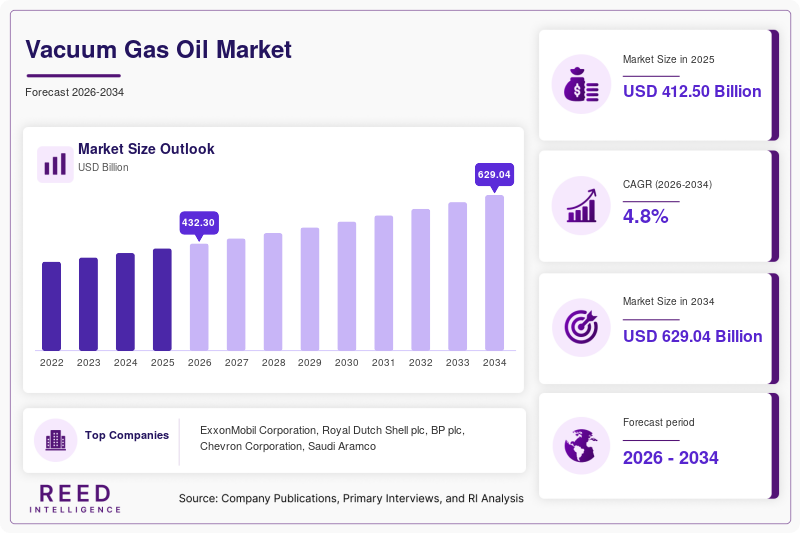
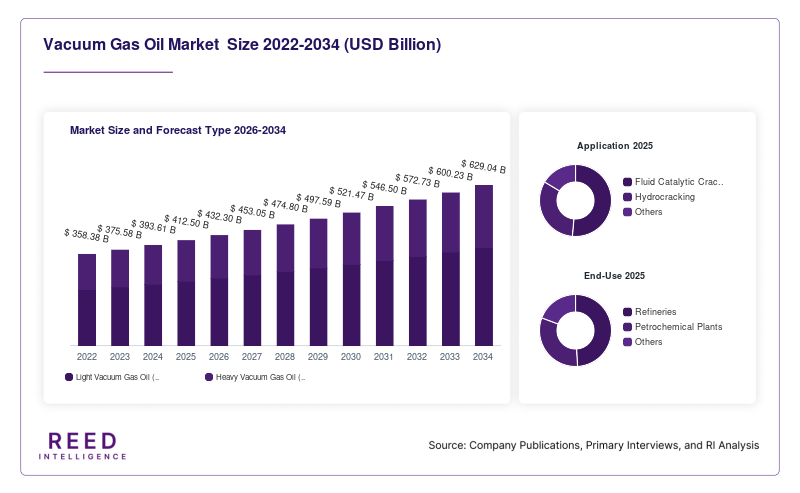
The Vacuum Gas Oil Market size was valued at approximately USD 412.5 billion in 2026 and is projected to reach USD 598.7 billion by 2034, expanding at a CAGR of 4.8% during the forecast period (2026–2034). Vacuum gas oil (VGO), a key intermediate product derived from crude oil refining, plays a critical role in the production of gasoline, diesel, and petrochemical feedstocks. Its importance in fluid catalytic cracking (FCC) units and hydrocracking processes continues to anchor its relevance across global refining operations.
One of the primary global factors supporting market growth is the steady demand for transportation fuels in emerging economies, where industrialization, urban expansion, and population growth continue to increase fuel consumption. This has sustained refining throughput levels, thereby driving consistent demand for vacuum gas oil as a feedstock.
Key Highlights
- Dominant region: Asia Pacific held approximately 38.6% market share in 2025, while the region is projected to grow at a CAGR of 5.6% during 2026–2034.
- Fastest-growing region: Middle East & Africa is expected to expand at a CAGR of 5.9% over the forecast period.
- By type: Heavy vacuum gas oil dominated with 61.2% share in 2025, while light vacuum gas oil is anticipated to grow at a CAGR of 5.4%.
- By application: Fluid catalytic cracking led with 47.8% share, whereas hydrocracking is projected to grow at a CAGR of 5.7%.
- Dominant country: The United States market was valued at USD 72.4 billion in 2024 and reached USD 75.1 billion in 2025, driven by refinery optimization and fuel demand stability.
Market Trends
Increasing Integration of Advanced Refining Technologies
Refineries are increasingly adopting advanced technologies such as hydrocracking optimization and residue upgrading systems. These technologies improve the conversion efficiency of vacuum gas oil into higher-value fuels and petrochemicals. As refining margins tighten, operators are focusing on maximizing output from existing feedstocks, which has elevated the strategic importance of vacuum gas oil within refinery configurations.
Rising Demand for Petrochemical Feedstocks
Another notable trend shaping the Vacuum Gas Oil Market is the growing use of VGO as a feedstock in petrochemical production. With global demand for plastics, synthetic fibers, and specialty chemicals rising, refiners are shifting toward integrated refining-petrochemical complexes. This transition is increasing the consumption of vacuum gas oil in downstream chemical processes, particularly in Asia Pacific and the Middle East.
Market Drivers
Expanding Global Refining Capacity
The expansion of refining capacity, especially in developing regions, is a key driver of the Vacuum Gas Oil Market. Countries in Asia and the Middle East are investing in large-scale refineries to meet domestic fuel demand and boost export capabilities. This expansion directly increases the production and utilization of vacuum gas oil as a critical intermediate product.
Growth in Transportation Fuel Consumption
The continued reliance on gasoline, diesel, and aviation fuels remains a significant driver. Despite the gradual transition toward alternative energy, conventional fuels still dominate the transportation sector. Vacuum gas oil plays a central role in producing these fuels through cracking processes, ensuring stable demand across global markets.
Market Restraint
Transition Toward Renewable Energy and Electrification
A major restraint for the Vacuum Gas Oil Market is the global shift toward renewable energy sources and electric mobility. Governments and industries are increasingly investing in low-carbon alternatives, which may reduce long-term demand for fossil fuel-based products. This transition could limit the growth potential of vacuum gas oil, particularly in developed economies.
Market Opportunities
Expansion of Refinery-Petrochemical Integration
The integration of refining and petrochemical operations presents a significant opportunity. By utilizing vacuum gas oil in petrochemical production, companies can diversify revenue streams and improve profit margins. This trend is particularly strong in Asia and the Middle East, where new complexes are being designed with integrated capabilities.
Technological Advancements in Upgrading Processes
Advancements in upgrading technologies, such as residue hydrocracking and catalytic conversion, are opening new avenues for vacuum gas oil utilization. These technologies enable refiners to process heavier and lower-quality crude oils more efficiently, thereby increasing the availability and economic value of vacuum gas oil.
Segmental Analysis
By Type
The Vacuum Gas Oil Market is segmented into Light Vacuum Gas Oil (LVGO) and Heavy Vacuum Gas Oil (HVGO).
Heavy vacuum gas oil dominated the market with a 61.2% share in 2025, owing to its extensive use in fluid catalytic cracking units for producing gasoline and diesel. Its higher molecular weight and composition make it suitable for large-scale refining operations.
Light vacuum gas oil is projected to grow at a CAGR of 5.4% during the forecast period. This growth will be driven by its increasing use in hydrocracking processes, where it yields higher-quality fuels with lower sulfur content, aligning with environmental regulations.
By Application
The market is segmented into Fluid Catalytic Cracking (FCC), Hydrocracking, and Others.
Fluid catalytic cracking held the dominant position with a 47.8% share in 2025, as it remains the primary process for converting vacuum gas oil into gasoline and lighter products. Its widespread adoption across refineries ensures consistent demand.
Hydrocracking is anticipated to be the fastest-growing segment, with a CAGR of 5.7%. This growth will be supported by the increasing demand for cleaner fuels and stricter emission standards, which encourage refiners to adopt hydrocracking technologies.
By End-Use
The Vacuum Gas Oil Market is segmented into Refineries, Petrochemical Plants, and Others.
Refineries dominated the segment with a 69.5% share in 2025, as vacuum gas oil is primarily produced and consumed within refining operations. The segment’s dominance is linked to its essential role in fuel production.
Petrochemical plants are expected to grow at a CAGR of 5.8%. The rising demand for chemical products and polymers will drive the use of vacuum gas oil as a feedstock, particularly in integrated complexes.
By Sulfur Content
The market is segmented into Low Sulfur VGO and High Sulfur VGO.
High sulfur vacuum gas oil dominated with a 55.3% share in 2025, due to its widespread availability and use in traditional refining processes.
Low sulfur vacuum gas oil is projected to grow at a CAGR of 5.6%, driven by environmental regulations and the need for cleaner fuel production. Refiners are increasingly adopting desulfurization technologies to meet emission standards.
Regional Analysis
North America
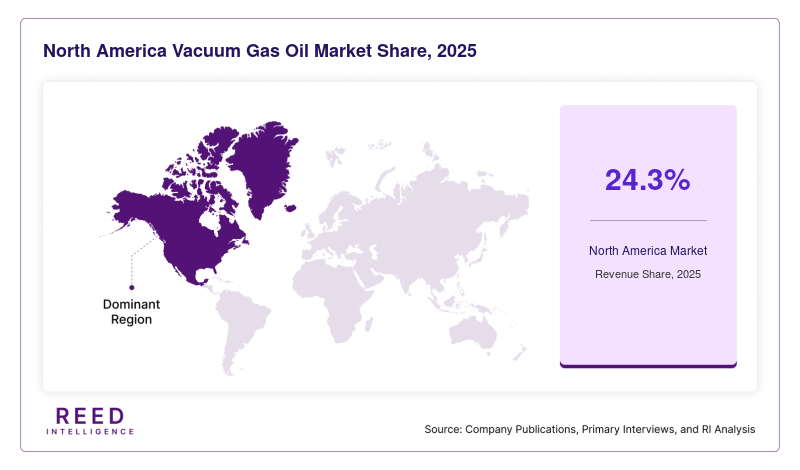
North America accounted for 24.3% of the Vacuum Gas Oil Market share in 2025 and is expected to grow at a CAGR of 3.9% during the forecast period. The United States dominated the region due to its advanced refining infrastructure and focus on high-efficiency operations. The country’s growth is driven by modernization of existing refineries and stable domestic fuel consumption patterns.
Europe
Europe held approximately 18.7% market share in 2025 and will grow at a CAGR of 3.5% from 2026 to 2034. Germany emerged as the dominant country, supported by its strong industrial base and refining sector. The region’s focus on cleaner fuel production has encouraged refiners to optimize vacuum gas oil usage in hydrocracking processes.
Asia Pacific
Asia Pacific led the Vacuum Gas Oil Market with a 38.6% share in 2025 and is projected to grow at a CAGR of 5.6%. China dominated the region due to its large-scale refining capacity and growing demand for petrochemicals. The country’s rapid industrialization and increasing energy consumption continue to drive market expansion.
Middle East & Africa
The Middle East & Africa region accounted for 10.2% of market share in 2025 and is expected to grow at a CAGR of 5.9%. Saudi Arabia led the region, benefiting from abundant crude oil reserves and ongoing investments in refinery expansion. The region’s focus on downstream diversification supports increased utilization of vacuum gas oil.
Latin America
Latin America held around 8.2% share in 2025 and is forecast to grow at a CAGR of 4.1%. Brazil dominated the region due to its expanding refining capacity and rising fuel demand. Investments in refinery upgrades have improved the efficiency of vacuum gas oil processing, contributing to market growth.
Competitive Landscape
The Vacuum Gas Oil Market is moderately consolidated, with key players focusing on refining efficiency, capacity expansion, and integration strategies. Leading companies include ExxonMobil Corporation, Royal Dutch Shell plc, BP plc, Chevron Corporation, and Saudi Aramco. Among these, ExxonMobil Corporation is recognized as a market leader due to its extensive refining network and technological capabilities.
The company has recently invested in advanced hydrocracking units to enhance vacuum gas oil conversion efficiency and increase production of low-sulfur fuels. Other players are also focusing on upgrading refinery infrastructure and expanding into petrochemical integration to strengthen their market position.
Strategic collaborations, mergers, and investments in sustainable refining technologies are shaping the competitive landscape. Companies are also exploring digital solutions to optimize refining operations and improve yield from vacuum gas oil feedstocks.
Key Players List
- ExxonMobil Corporation
- Royal Dutch Shell plc
- BP plc
- Chevron Corporation
- Saudi Aramco
- TotalEnergies SE
- Indian Oil Corporation Ltd.
- Reliance Industries Limited
- PetroChina Company Limited
- Sinopec Limited
- Valero Energy Corporation
- Marathon Petroleum Corporation
- Phillips 66
- Kuwait Petroleum Corporation
- Petrobras
Recent Developments
- In 2025, ExxonMobil Corporation upgraded its refining facilities to improve vacuum gas oil conversion rates and reduce emissions.
- In 2024, Saudi Aramco expanded its downstream operations with a focus on integrated refining and petrochemical projects.
- In 2025, Reliance Industries Limited enhanced its hydrocracking capacity to increase production of cleaner fuels from vacuum gas oil.
- In 2024, Sinopec invested in advanced catalytic cracking technologies to optimize VGO utilization.
- In 2025, BP plc initiated digital transformation programs aimed at improving refinery efficiency and maximizing output from vacuum gas oil feedstocks.
Vacuum Gas Oil Market Segments
Type
- Light Vacuum Gas Oil (LVGO)
- Heavy Vacuum Gas Oil (HVGO)
Application
- Fluid Catalytic Cracking (FCC)
- Hydrocracking
- Others
End-Use
- Refineries
- Petrochemical Plants
- Others
Sulfur Content
- Low Sulfur Vacuum Gas Oil
- High Sulfur Vacuum Gas Oil
By Region
- North America
- Europe
- APAC
- Middle East and Africa
- LATAM