Vacuum Induction Melting Furnace VIM Market Size, Share & Demand Report By Furnace Type (Small-Capacity Furnaces, Medium-Capacity Furnaces, Large-Capacity Furnaces), By Application (Aerospace Alloy Production, Medical-Grade Alloy Production, Automotive Component Manufacturing, Energy Equipment Manufacturing), By End-Use Industry (Aerospace and Defense, Automotive, Medical Devices, Energy and Power, Industrial Manufacturing), By Region & Segment Forecasts, 2026–2034
USD 3950
Market Overview
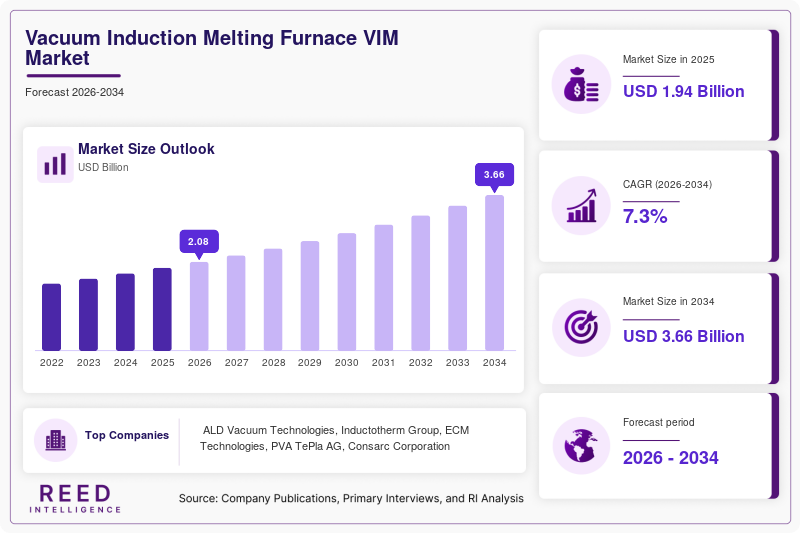
The global Vacuum Induction Melting Furnace VIM Market size was valued at USD 1.94 billion in 2026 and is projected to reach USD 3.42 billion by 2034, expanding at a CAGR of 7.3% during the forecast period from 2026 to 2034. The market is witnessing consistent expansion due to increasing demand for high-purity specialty alloys across aerospace, automotive, defense, and energy industries. Vacuum induction melting furnaces are widely used for producing superalloys, titanium alloys, stainless steel, and specialty metals where contamination control and metallurgical precision are essential. Manufacturers are increasingly adopting advanced VIM systems to improve production quality, reduce oxidation risks, and achieve superior material properties required in critical industrial applications.
A major global factor supporting market growth is the rising demand for lightweight and high-strength materials in aerospace and advanced manufacturing industries. Aircraft engine manufacturers and defense contractors are increasingly utilizing vacuum induction melting technologies to produce materials capable of withstanding extreme temperatures and mechanical stress. In addition, the expansion of electric vehicle manufacturing and renewable energy infrastructure is creating stronger demand for precision-engineered alloys produced through vacuum melting technologies. Automation integration, energy-efficient furnace designs, and digital process monitoring systems are also improving operational efficiency, encouraging broader adoption of VIM equipment across industrial production facilities.
Key Highlights
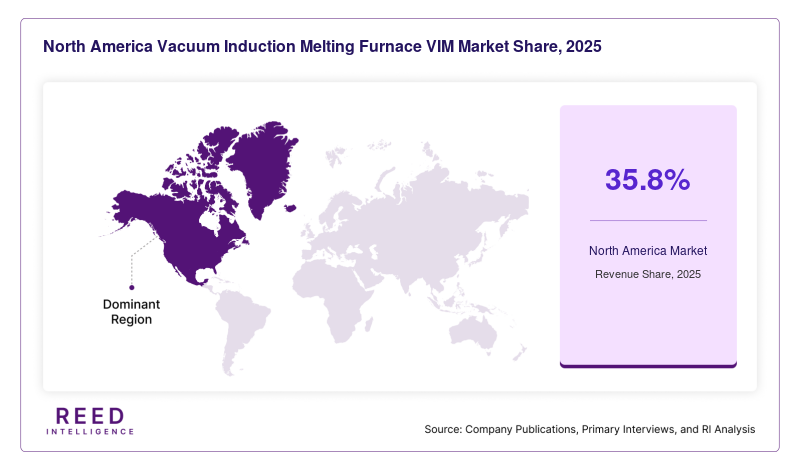
- North America dominated the market with a 35.8% share in 2025, while Asia Pacific is expected to grow at the fastest CAGR of 9.1% during 2026–2034.
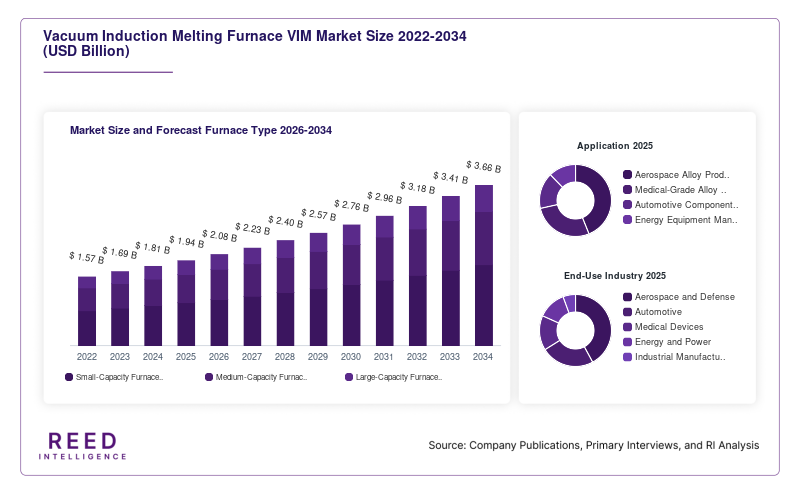
- By furnace type, medium-capacity furnaces accounted for the largest share of 41.6%, while large-capacity furnaces are projected to grow at a CAGR of 8.7%.
- By application, aerospace alloys led with a 38.9% share, whereas medical-grade alloy production is expected to expand at a CAGR of 9.4%.
- By end-use industry, aerospace and defense held the dominant share of 43.1%, while energy and power applications are anticipated to grow at a CAGR of 8.9%.
- The United States remained the dominant country, with market values of USD 540 million in 2024 and USD 598 million in 2025.
Market Trends
Increasing Adoption of Automated and Digital Furnace Systems
The Vacuum Induction Melting Furnace VIM Market is witnessing rising adoption of automated furnace systems integrated with digital process monitoring technologies. Manufacturers are increasingly utilizing intelligent control systems to improve melting precision, temperature consistency, and alloy composition management. Automated VIM systems help reduce operational errors and improve repeatability in high-value alloy production processes. Advanced sensors and real-time monitoring software are also allowing operators to optimize vacuum pressure, energy consumption, and melting cycles. This trend is becoming increasingly important in industries such as aerospace and medical manufacturing where metallurgical accuracy directly influences product reliability and safety standards. Companies are investing in smart manufacturing infrastructure to improve operational efficiency and reduce production downtime.
Growing Demand for High-Performance Superalloys
The increasing use of high-performance superalloys in aerospace, defense, and energy applications is supporting long-term demand for vacuum induction melting furnace technologies. Industries requiring materials with superior thermal resistance, corrosion protection, and structural integrity are expanding investments in advanced alloy manufacturing. VIM systems are preferred because they provide contamination-free melting environments essential for producing premium-grade materials. Demand for nickel-based and titanium-based superalloys is rising due to the expansion of aircraft engine manufacturing and gas turbine production. In addition, renewable energy projects and nuclear power applications are creating additional opportunities for specialized alloy production. This trend is encouraging furnace manufacturers to develop high-capacity and energy-efficient VIM solutions for industrial-scale operations.
Market Drivers
Expansion of Aerospace and Defense Manufacturing Activities
The steady growth of the aerospace and defense industry is a major factor driving the Vacuum Induction Melting Furnace VIM Market. Aircraft manufacturers are increasing production of commercial and military aircraft, leading to higher demand for high-strength and lightweight alloys produced through vacuum melting technologies. VIM systems are essential for manufacturing turbine blades, engine components, and structural materials that require superior metallurgical purity. Defense modernization programs across multiple countries are also increasing demand for specialty metals used in missile systems, armored vehicles, and advanced defense equipment. The requirement for reliable and contamination-free alloy production is encouraging manufacturers to invest in advanced vacuum induction melting infrastructure across aerospace supply chains.
Rising Demand for Precision Metallurgy in Medical and Energy Industries
The medical and energy sectors are increasingly adopting precision metallurgy technologies, supporting demand for vacuum induction melting furnaces. Medical implant manufacturers require biocompatible and corrosion-resistant alloys with highly controlled chemical compositions. VIM systems provide the vacuum environment necessary to minimize impurities and achieve consistent alloy quality. In the energy sector, gas turbines, nuclear components, and renewable energy systems require materials capable of operating under high temperatures and mechanical stress. These applications depend on specialty alloys produced through advanced melting technologies. As industrial standards become stricter regarding material performance and reliability, demand for high-precision VIM equipment continues to rise across global manufacturing industries.
Market Restraint
High Initial Investment and Operational Costs
High capital investment requirements remain a significant restraint for the Vacuum Induction Melting Furnace VIM Market. Establishing advanced vacuum melting facilities involves substantial expenditure on furnace systems, vacuum chambers, cooling systems, and automated process controls. Small and medium-sized manufacturers often face financial limitations when adopting high-capacity VIM technologies, particularly in developing economies where industrial financing support may be limited. In addition to installation expenses, operational costs associated with energy consumption, maintenance, and skilled workforce requirements can further increase the overall production burden for manufacturers.
The impact of these cost challenges is particularly noticeable in industries with fluctuating raw material prices and uncertain production volumes. For example, specialty alloy producers serving niche industrial applications may delay modernization projects during periods of reduced demand. High electricity consumption during melting operations also affects profitability, especially in regions with elevated industrial energy costs. Moreover, the requirement for technically trained personnel to manage complex furnace operations increases labor expenses for manufacturing facilities. These financial constraints can limit market penetration among smaller industrial operators and slow the adoption of advanced VIM technologies in cost-sensitive production environments.
Market Opportunities
Increasing Investments in Electric Vehicle and Battery Manufacturing
The rapid expansion of electric vehicle production is creating favorable opportunities for the Vacuum Induction Melting Furnace VIM Market. Electric vehicle manufacturers require high-performance alloys for battery systems, power electronics, lightweight structural components, and electric drivetrain technologies. Vacuum induction melting systems help produce specialty materials with enhanced thermal and mechanical properties suitable for next-generation automotive applications. Governments across multiple countries are also supporting electric mobility initiatives and domestic battery manufacturing programs, increasing demand for advanced metallurgical technologies. This growing automotive transition is encouraging furnace manufacturers to develop energy-efficient and high-productivity VIM systems capable of supporting large-scale alloy manufacturing operations.
Rising Demand for Advanced Materials in Renewable Energy Infrastructure
Renewable energy infrastructure development is creating additional growth opportunities for vacuum induction melting technologies. Wind turbines, solar power systems, hydrogen infrastructure, and advanced energy storage applications require durable specialty alloys with excellent heat resistance and corrosion protection. VIM systems are increasingly being used to manufacture materials for turbine blades, high-performance magnets, and energy transmission components. The expansion of clean energy projects across Asia Pacific, Europe, and North America is supporting long-term investments in advanced metallurgy. Manufacturers are also focusing on sustainable furnace technologies that reduce emissions and improve energy efficiency, creating new opportunities for innovation and market expansion.
Segmental Analysis
By Furnace Type
Medium-capacity vacuum induction melting furnaces accounted for the dominant share of the Vacuum Induction Melting Furnace VIM Market in 2024, representing approximately 41.6% of total revenue. These furnace systems are widely preferred because they provide operational flexibility and cost efficiency for mid-scale alloy manufacturing operations. Medium-capacity systems are commonly used in aerospace component manufacturing, industrial machinery production, and specialty metal processing applications where consistent metallurgical quality is essential. Manufacturers favor these furnaces because they support balanced production output while maintaining manageable operational costs. In addition, medium-capacity VIM systems are increasingly integrated with automated controls and digital monitoring technologies, enabling improved energy efficiency and process precision. Their broad industrial applicability continues to support strong market demand across developed and emerging manufacturing economies.
Large-capacity vacuum induction melting furnaces are expected to witness the fastest growth during the forecast period, registering a CAGR of 8.7%. Rising industrial-scale production of superalloys and specialty metals is a key factor supporting segment expansion. Aerospace engine manufacturers, energy equipment producers, and advanced automotive suppliers are increasingly investing in large-capacity VIM systems to improve productivity and support high-volume alloy manufacturing requirements. These furnaces offer enhanced thermal stability, larger batch processing capabilities, and improved operational efficiency for demanding industrial applications. Manufacturers are also introducing energy-efficient large-scale furnace technologies equipped with advanced vacuum systems and automated material handling solutions. As demand for precision-engineered alloys continues to rise globally, large-capacity VIM systems are expected to gain stronger adoption across industrial production facilities.
By Application
Aerospace alloy production held the largest share of the Vacuum Induction Melting Furnace VIM Market in 2024, accounting for nearly 38.9% of overall revenue. Aerospace manufacturers rely heavily on vacuum induction melting technologies to produce high-purity superalloys capable of operating under extreme thermal and mechanical conditions. VIM systems are widely used in the production of turbine blades, jet engine components, and structural aerospace materials requiring precise chemical composition and contamination control. The increasing production of commercial aircraft and military aviation systems continues to support strong demand for advanced alloy manufacturing technologies. Furthermore, rising investments in fuel-efficient aircraft engines are encouraging greater adoption of high-performance materials produced through vacuum melting processes, thereby strengthening the application segment across global aerospace supply chains.
Medical-grade alloy production is projected to emerge as the fastest-growing application segment, expanding at a CAGR of 9.4% during the forecast period. Medical device manufacturers increasingly require highly pure and biocompatible materials for implants, surgical instruments, and orthopedic devices. Vacuum induction melting systems help achieve stringent quality standards by minimizing impurities and ensuring precise metallurgical consistency. The rising global demand for advanced healthcare equipment and aging population trends are contributing to increased production of medical-grade alloys. In addition, expanding investments in medical technology innovation are encouraging manufacturers to adopt advanced VIM systems capable of producing customized specialty materials. This growing healthcare demand is expected to create favorable growth opportunities for furnace manufacturers over the coming years.
By End-Use Industry
Aerospace and defense represented the dominant end-use industry segment in 2024, holding approximately 43.1% of the Vacuum Induction Melting Furnace VIM Market share. The segment continues to benefit from rising aircraft production, defense modernization programs, and increasing demand for advanced propulsion technologies. Vacuum induction melting furnaces play a critical role in manufacturing superalloys and specialty metals used in aerospace engines, missile systems, and defense equipment. Manufacturers are focusing on high-performance materials capable of delivering superior thermal resistance, lightweight properties, and mechanical strength. In addition, government investments in defense infrastructure and domestic aerospace manufacturing are encouraging long-term adoption of advanced vacuum melting technologies across industrial production facilities and specialized metallurgical operations.
Energy and power applications are expected to record the fastest growth during the forecast period, expanding at a CAGR of 8.9%. Growing investments in renewable energy systems, gas turbines, hydrogen infrastructure, and nuclear power generation are increasing demand for high-performance specialty alloys. Vacuum induction melting systems are essential for producing materials capable of withstanding high-temperature and corrosive operating conditions within energy generation equipment. Industrial operators are increasingly adopting advanced metallurgy technologies to improve equipment reliability and operational efficiency. Furthermore, global efforts toward clean energy transition and grid modernization are creating additional demand for precision-engineered materials used in advanced energy infrastructure. These factors are expected to accelerate adoption of VIM technologies across the energy and power industry.
Regional Analysis
North America
North America accounted for approximately 35.8% of the global Vacuum Induction Melting Furnace VIM Market in 2025 and is expected to maintain stable growth at a CAGR of 7.1% through 2034. The region benefits from strong aerospace manufacturing infrastructure, advanced metallurgical research capabilities, and high adoption of precision alloy production technologies. Demand for vacuum induction melting systems continues to increase as industrial manufacturers focus on producing high-purity superalloys for aerospace engines, defense equipment, and energy systems. The presence of established industrial automation providers further supports technological advancements across regional manufacturing facilities.
The United States remains the dominant country within North America due to its extensive aerospace and defense production activities. One unique growth factor supporting the regional market is the increasing investment in next-generation aircraft engine technologies requiring advanced nickel-based superalloys. Aerospace component manufacturers are expanding production capacity to meet rising commercial aviation demand and military modernization requirements. Canada also contributes to regional market growth through its growing energy infrastructure and specialty metallurgy sector, where advanced vacuum melting technologies are increasingly adopted for high-performance industrial materials production.
Europe
Europe represents a significant share of the Vacuum Induction Melting Furnace VIM Market and is forecast to grow at a CAGR of 6.8% during the assessment period. The region continues to benefit from advanced industrial manufacturing capabilities and increasing investments in sustainable metallurgy technologies. European manufacturers are focusing on improving material performance while reducing carbon emissions associated with metal processing operations. Demand for vacuum induction melting systems is supported by growing applications in aerospace, automotive engineering, medical implants, and renewable energy equipment manufacturing. Technological innovation and energy-efficient furnace development remain key priorities among regional industrial operators.
Germany dominates the European market due to its strong industrial engineering base and leadership in precision manufacturing technologies. A unique growth factor driving the German market is the expansion of electric vehicle production requiring lightweight and high-strength specialty alloys. Automotive manufacturers are increasingly partnering with metallurgical equipment suppliers to improve alloy quality and manufacturing efficiency. France and the United Kingdom are also contributing to regional demand through aerospace manufacturing expansion and increased investments in advanced energy technologies requiring contamination-free alloy production capabilities.
Asia Pacific
Asia Pacific is expected to register the fastest growth in the Vacuum Induction Melting Furnace VIM Market, expanding at a CAGR of 9.1% during the forecast period. Rapid industrialization, rising aerospace manufacturing investments, and growing automotive production activities are supporting regional market growth. Countries across the region are increasingly investing in advanced metallurgy infrastructure to strengthen domestic manufacturing capabilities and reduce reliance on imported specialty materials. Demand for high-capacity and automated VIM systems is increasing as industrial producers seek higher production efficiency and improved alloy quality across multiple application sectors.
China remains the dominant country within Asia Pacific due to large-scale investments in aerospace, automotive, and renewable energy manufacturing industries. One distinct growth factor supporting the Chinese market is the expansion of domestic semiconductor and advanced electronics production requiring high-purity specialty metals. Industrial manufacturers are increasingly adopting vacuum induction melting technologies to improve material consistency and reduce contamination risks. India is also emerging as an important regional market because of rising investments in defense manufacturing, medical device production, and industrial infrastructure modernization projects.
Middle East & Africa
The Middle East & Africa Vacuum Induction Melting Furnace VIM Market is witnessing steady expansion due to increasing industrial diversification and infrastructure development activities. The region is expected to grow at a CAGR of 6.4% through 2034 as governments continue investing in domestic manufacturing and advanced industrial processing capabilities. Demand for vacuum induction melting systems is gradually increasing across energy, aerospace, and industrial equipment manufacturing sectors. Several countries are also focusing on expanding local metallurgy operations to reduce dependence on imported specialty materials and strengthen industrial self-sufficiency.
Saudi Arabia dominates the regional market due to ongoing industrial diversification initiatives and rising investments in advanced manufacturing infrastructure. One unique factor driving market growth in the country is the development of domestic aerospace and defense manufacturing capabilities under national industrial expansion programs. Manufacturers are increasingly adopting advanced metallurgical technologies to support local production of precision-engineered components. The United Arab Emirates also contributes to regional growth through increasing investments in industrial innovation, renewable energy infrastructure, and specialized materials production facilities.
Latin America
Latin America is experiencing moderate but stable growth in the Vacuum Induction Melting Furnace VIM Market and is projected to expand at a CAGR of 6.2% during the forecast period. The market is supported by growing industrial modernization programs and increasing investments in mining, energy, and manufacturing sectors. Industrial producers across the region are gradually adopting advanced melting technologies to improve alloy quality and production efficiency. Rising interest in domestic manufacturing capabilities and value-added metal processing activities is also contributing to long-term market development across several Latin American economies.
Brazil remains the leading country within the Latin American market due to its established industrial manufacturing base and expanding aerospace sector. One important growth factor supporting the Brazilian market is the increasing production of specialty alloys used in aircraft manufacturing and energy infrastructure projects. Local manufacturers are investing in modern metallurgy technologies to improve export competitiveness and production reliability. Mexico is also contributing to regional demand through automotive manufacturing expansion and increasing adoption of advanced industrial processing equipment in precision engineering applications.
Competitive Landscape
The Vacuum Induction Melting Furnace VIM Market is moderately competitive, with major companies focusing on technological innovation, production efficiency, and global expansion strategies. Market participants are increasingly investing in automated furnace systems, energy-efficient technologies, and advanced vacuum control solutions to strengthen their competitive positions. The industry is characterized by long-term supply agreements, customized furnace solutions, and rising demand for high-capacity equipment across aerospace, defense, medical, and energy industries.
ALD Vacuum Technologies remains one of the leading companies in the market due to its strong expertise in advanced vacuum metallurgy systems and extensive global customer base. The company recently expanded its high-capacity VIM furnace portfolio to support growing demand from aerospace and energy manufacturers. Other major companies are also focusing on research and development activities to improve process automation, reduce energy consumption, and enhance furnace reliability in large-scale industrial applications.
Key Players
- ALD Vacuum Technologies
- Inductotherm Group
- ECM Technologies
- PVA TePla AG
- Consarc Corporation
- SECO/WARWICK
- Ipsen International
- SMS Group
- Fives Group
- Tenova
- VAC AERO International
- Nitrex
- Linn High Therm
- TAV Vacuum Furnaces
- Otto Junker
Recent Developments
- In 2025, ALD Vacuum Technologies launched an advanced automated VIM furnace system designed for aerospace superalloy manufacturing applications.
- In 2024, PVA TePla AG expanded its vacuum metallurgy production capacity to support growing demand from semiconductor and medical industries.
- In 2025, Inductotherm Group introduced energy-efficient vacuum induction melting systems featuring advanced digital monitoring and process automation technologies.
- In 2024, SECO/WARWICK announced strategic investments in high-capacity vacuum furnace technologies for renewable energy and aerospace material production.
Vacuum Induction Melting Furnace VIM Market Segments
Furnace Type
- Small-Capacity Furnaces
- Medium-Capacity Furnaces
- Large-Capacity Furnaces
Application
- Aerospace Alloy Production
- Medical-Grade Alloy Production
- Automotive Component Manufacturing
- Energy Equipment Manufacturing
End-Use Industry
- Aerospace and Defense
- Automotive
- Medical Devices
- Energy and Power
- Industrial Manufacturing
By Region
- North America
- Europe
- APAC
- Middle East and Africa
- LATAM