Vacuum Skin Packaging (VSP) Market Size, Share, Demand Report By Material Type (Polyethylene-Based Films, Polypropylene Films, Polyamide Films, Recyclable Mono-Material Films, Others), By Application (Food Packaging, Medical Packaging, Industrial Packaging, Consumer Goods Packaging), By End Use Industry (Food Processing, Healthcare, Industrial Manufacturing, Retail & Consumer Goods) By Region & Segment Forecasts, 2026–2034
USD 3950
Market Overview
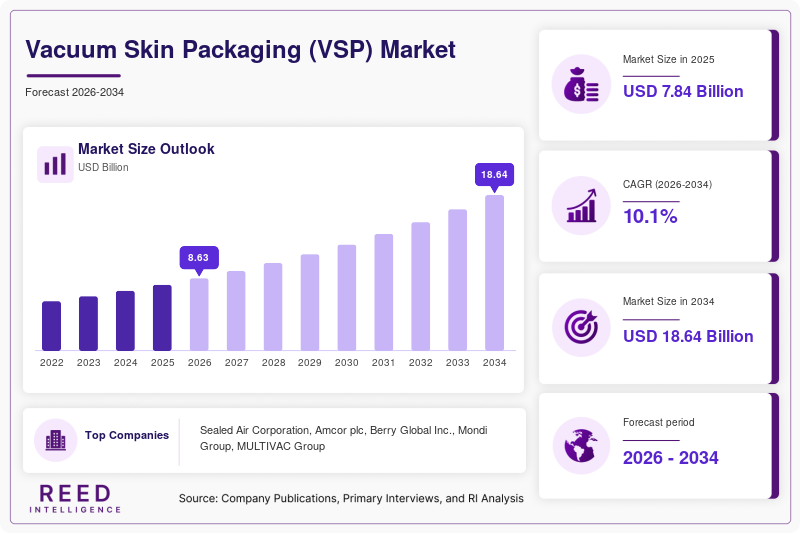
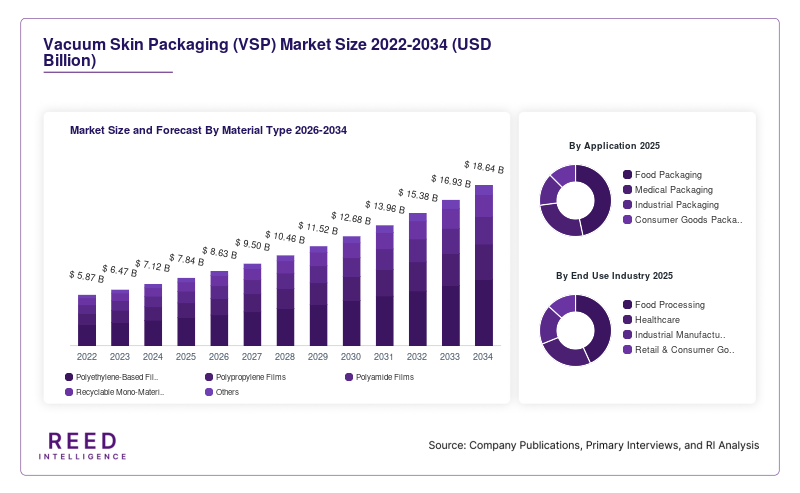
The global Vacuum Skin Packaging (VSP) Market size was valued at USD 7.84 billion in 2026 and is projected to reach USD 16.92 billion by 2034, expanding at a CAGR of 10.1% during the forecast period from 2026 to 2034. Vacuum skin packaging has gained significant traction across food processing, healthcare, industrial goods, and consumer product applications due to its ability to extend shelf life, improve product visibility, and reduce material waste. The increasing preference for high-barrier packaging formats in fresh meat, seafood, poultry, dairy, and ready-to-eat products continues to support market expansion across developed and emerging economies.
A major global factor supporting the growth of the Vacuum Skin Packaging (VSP) Market is the rapid transformation of retail food distribution networks and cold chain infrastructure. Supermarkets, e-commerce grocery platforms, and organized retail chains are increasingly adopting vacuum skin packaging solutions to maintain product freshness during long-distance transportation and storage. The technology reduces oxygen exposure and moisture loss, helping manufacturers minimize food spoilage and operational losses. In addition, rising consumer demand for visually appealing packaging with clear product display and contamination protection has encouraged food brands to invest in advanced vacuum packaging equipment and recyclable barrier films.
Key Highlights
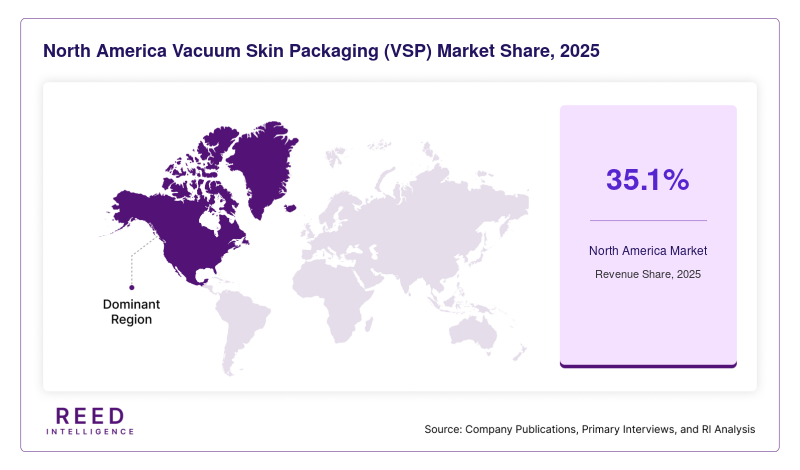
- North America dominated the market with a 35.1% share in 2025.
- Asia Pacific is expected to grow at the fastest CAGR of 11.8% during 2026–2034.
- By material type, polyethylene-based films accounted for the largest share of 39.4%, while recyclable mono-material films are projected to grow at a CAGR of 12.6%.
- By application, food packaging led with a 63.8% share, whereas medical packaging is expected to expand at a CAGR of 11.9%.
- The United States remained the dominant country, with market values of USD 2.14 billion in 2024 and USD 2.33 billion in 2025.
Market Trends
Expansion of Sustainable and Recyclable Packaging Materials
Packaging manufacturers are increasingly introducing recyclable and bio-based materials within the Vacuum Skin Packaging (VSP) Market to align with evolving sustainability goals across the food and healthcare industries. Brand owners are focusing on reducing plastic consumption and improving recyclability without compromising barrier protection or product visibility. Flexible film producers are investing in mono-material polyethylene structures and thinner barrier layers that simplify the recycling process and reduce packaging weight. Food retailers are also promoting environmentally responsible packaging formats as part of broader carbon reduction initiatives. This trend is creating new opportunities for suppliers offering sustainable packaging solutions compatible with automated vacuum skin packaging machinery.
Regulatory authorities across Europe and North America are encouraging the adoption of recyclable packaging through stricter waste management policies and extended producer responsibility frameworks. As a result, manufacturers are redesigning tray and film combinations to meet circular economy standards. The increasing availability of advanced barrier coatings and recyclable polymers is expected to support long-term demand for sustainable vacuum skin packaging systems across retail food chains, seafood exporters, and premium meat processors.
Integration of Automation and Smart Packaging Technologies
Automation is becoming a major trend within the Vacuum Skin Packaging (VSP) Market as manufacturers aim to improve production efficiency, product consistency, and operational scalability. Food processors are increasingly adopting automated sealing systems, robotic tray handling solutions, and intelligent inspection technologies to reduce labor dependency and improve throughput. Modern vacuum skin packaging equipment now includes integrated sensors, digital monitoring systems, and predictive maintenance features that support continuous production operations. These systems help manufacturers minimize downtime while maintaining hygiene standards and packaging precision.
The growing adoption of smart packaging technologies is also influencing market development. Companies are integrating QR codes, freshness indicators, and traceability systems into vacuum skin packaging formats to improve supply chain transparency and consumer engagement. Retailers are using these technologies to provide product origin details, expiration tracking, and temperature monitoring capabilities. As global food distribution networks expand and product safety regulations become stricter, the integration of automated and digitally enabled packaging systems is expected to remain a central market trend.
Market Drivers
Rising Demand for Extended Shelf Life in Food Packaging
The increasing demand for longer shelf life and reduced food waste is one of the primary factors driving the Vacuum Skin Packaging (VSP) Market. Food manufacturers and retailers are under pressure to maintain product freshness while reducing spoilage during transportation and storage. Vacuum skin packaging creates a tight seal around food products, reducing oxygen exposure and slowing bacterial growth. This capability is especially important for fresh meat, poultry, seafood, cheese, and ready-to-cook meals that require controlled preservation conditions.
The expansion of organized retail chains and online grocery delivery services has further strengthened the demand for reliable packaging solutions. Consumers increasingly prefer packaged products with better hygiene, clear visibility, and extended freshness. Vacuum skin packaging supports these preferences while enabling attractive shelf presentation. Food exporters are also adopting the technology to maintain product quality across international supply chains. As global food consumption and refrigerated transportation volumes continue to increase, demand for advanced vacuum skin packaging systems is expected to rise steadily.
Growth of Processed and Convenience Food Consumption
The growing consumption of processed, ready-to-eat, and convenience food products is accelerating growth within the Vacuum Skin Packaging (VSP) Market. Urbanization, changing work patterns, and busy lifestyles are encouraging consumers to purchase packaged meals, portion-controlled food products, and pre-marinated meat items that offer convenience and longer usability. Vacuum skin packaging helps maintain product texture, flavor, and visual quality, making it suitable for premium packaged food applications.
Food manufacturers are increasingly using vacuum skin packaging to differentiate products in competitive retail environments. The packaging format allows improved product presentation by tightly conforming the film around the product surface, creating a premium appearance. In addition, the packaging supports efficient stacking, transportation, and inventory management. The rapid expansion of convenience stores, supermarket chains, and food delivery platforms in emerging economies is also contributing to rising demand for vacuum skin packaging technologies across multiple product categories.
Market Restraint
High Initial Equipment and Material Costs
The relatively high cost of vacuum skin packaging equipment and specialized barrier films remains a significant restraint for the Vacuum Skin Packaging (VSP) Market. Small and medium-sized food processors often face challenges in adopting advanced packaging technologies due to the substantial capital investment required for automated sealing systems, vacuum chambers, and compatible thermoforming equipment. In addition, vacuum skin packaging materials typically require high-barrier films with specific oxygen and moisture resistance properties, increasing overall operational expenses.
Many regional food manufacturers in developing markets continue to rely on traditional modified atmosphere packaging or flexible pouch solutions because of lower upfront costs and easier implementation. The transition toward recyclable and sustainable film structures may also increase material costs during the early stages of adoption. Furthermore, packaging machinery requires skilled operators and regular maintenance to maintain sealing quality and production efficiency. These factors can limit adoption rates among cost-sensitive manufacturers and delay technology upgrades in regions with limited packaging infrastructure.
Market Opportunities
Increasing Adoption in Medical and Healthcare Packaging
The healthcare sector is creating strong opportunities for the Vacuum Skin Packaging (VSP) Market as medical device manufacturers seek sterile and contamination-resistant packaging solutions. Vacuum skin packaging is increasingly used for surgical instruments, diagnostic kits, implantable devices, and pharmaceutical products that require secure sealing and product stability. The packaging format improves product protection during transportation while offering high visibility and tamper resistance.
Healthcare providers are emphasizing infection prevention and safe handling practices, particularly following increased global focus on medical safety standards. This trend is encouraging hospitals and pharmaceutical suppliers to adopt advanced packaging technologies that support sterility and extended storage performance. In addition, the growing demand for single-use medical devices and home healthcare products is expected to create long-term opportunities for vacuum skin packaging manufacturers. Companies investing in medical-grade films and automated sterile packaging systems are likely to benefit from expanding healthcare packaging demand.
Expansion of Premium Retail and E-Commerce Food Distribution
The rapid growth of premium retail chains and online food delivery platforms is creating significant opportunities for the Vacuum Skin Packaging (VSP) Market. Consumers increasingly prefer premium packaged meat, seafood, and ready-to-cook products that maintain freshness and appearance during transportation. Vacuum skin packaging provides leak resistance, compact storage, and strong product visibility, making it suitable for direct-to-consumer food distribution models.
E-commerce grocery platforms require packaging formats capable of protecting products through extended logistics cycles and varying temperature conditions. Vacuum skin packaging supports these requirements by reducing product movement and minimizing contamination risks. Retailers are also using premium packaging designs to improve shelf appeal and strengthen brand positioning. As online grocery shopping continues to expand across Asia Pacific, Europe, and North America, manufacturers are expected to invest in high-capacity vacuum skin packaging systems tailored for automated fulfillment operations and cold chain logistics.
Segmental Analysis
By Material Type
Polyethylene-based films represented the dominant subsegment within the Vacuum Skin Packaging (VSP) Market, accounting for 39.4% of the market share in 2024. These materials are widely used due to their flexibility, sealability, transparency, and cost efficiency across food and industrial packaging applications. Polyethylene films provide strong moisture resistance and compatibility with various thermoforming and sealing systems, making them suitable for high-volume packaging operations. Food processors prefer polyethylene-based structures because they support extended shelf life while maintaining product visibility and package integrity. In addition, the material is commonly used in multilayer barrier film combinations for meat, seafood, and dairy applications.
The strong adoption of polyethylene films is also linked to their compatibility with automated vacuum packaging machinery. Manufacturers continue to optimize film thickness and barrier performance to improve operational efficiency and reduce material consumption. Retail food chains and packaged meat suppliers increasingly rely on polyethylene-based vacuum skin packaging due to its ability to create tight seals and attractive product presentation. The widespread availability of raw materials and relatively stable processing characteristics further support the continued dominance of this material category across developed and emerging markets.
By Application
Food packaging remained the leading application segment within the Vacuum Skin Packaging (VSP) Market, accounting for 63.8% of the market share in 2024. The segment is driven by growing demand for fresh meat, poultry, seafood, cheese, and ready-to-cook products requiring extended shelf life and attractive shelf presentation. Vacuum skin packaging minimizes oxygen exposure and moisture loss, helping maintain product quality during transportation and retail display. Supermarkets and food retailers increasingly prefer vacuum skin packaging because it improves hygiene, reduces leakage risks, and enhances visual appeal.
The dominance of the food packaging segment is also supported by expanding cold chain logistics and rising global trade in refrigerated food products. Food manufacturers are investing in automated vacuum skin packaging systems to improve operational efficiency and reduce product waste. In addition, the packaging format supports portion-controlled packaging and premium branding strategies, which are becoming increasingly important in competitive retail environments. The rapid growth of online grocery delivery platforms is further strengthening demand for reliable food packaging solutions capable of protecting products during distribution.
By End Use Industry
The food processing industry dominated the Vacuum Skin Packaging (VSP) Market by end use, accounting for 58.2% of the market share in 2024. Food processors rely heavily on vacuum skin packaging technologies to preserve freshness, improve product appearance, and extend shelf life across meat, seafood, dairy, and prepared meal categories. The packaging format supports efficient storage and transportation while reducing product spoilage and leakage risks. Large-scale food manufacturers are increasingly integrating automated vacuum packaging systems into production lines to improve packaging consistency and reduce labor costs.
The growth of organized retail chains and rising global demand for premium packaged food products continue to strengthen the position of the food processing industry within the market. Manufacturers are also using vacuum skin packaging to support export operations and comply with food safety standards in international markets. Increasing consumer awareness regarding food hygiene and contamination prevention is further contributing to the widespread adoption of vacuum skin packaging technologies across food manufacturing facilities.
Regional Analysis
North America
North America accounted for 35.1% of the global Vacuum Skin Packaging (VSP) Market in 2025 and is expected to maintain steady growth at a CAGR of 9.4% during the forecast period. The region benefits from advanced food processing infrastructure, widespread cold chain networks, and strong adoption of automated packaging technologies. Large supermarket chains and retail food distributors continue to expand demand for high-barrier packaging formats that improve product shelf life and reduce spoilage. The presence of established packaging equipment manufacturers and stringent food safety regulations further supports regional market expansion.
The United States remains the dominant country within the regional market due to its large packaged food industry and high consumption of refrigerated meat and seafood products. One major growth factor is the increasing adoption of premium retail packaging solutions by food brands seeking stronger shelf differentiation. Companies are investing in recyclable vacuum skin packaging films and automated production systems to improve operational efficiency while meeting sustainability goals. Canada is also witnessing growing demand from processed food manufacturers and healthcare packaging suppliers.
Europe
Europe represented 27.4% of the global Vacuum Skin Packaging (VSP) Market in 2025 and is projected to expand at a CAGR of 9.7% between 2026 and 2034. The region continues to experience stable demand from meat processing, dairy packaging, and seafood export industries. European food manufacturers are increasingly focusing on sustainable packaging formats and reduced plastic usage, encouraging investments in recyclable vacuum skin packaging materials. Government regulations supporting circular economy initiatives are also influencing product innovation and packaging redesign strategies across the region.
Germany remains the leading country in the European market due to its strong food manufacturing base and advanced packaging machinery industry. A unique growth factor supporting the German market is the integration of automation technologies in food processing facilities. Manufacturers are deploying high-speed vacuum skin packaging systems with digital monitoring capabilities to improve production consistency and reduce operational downtime. France, Italy, and the United Kingdom are also contributing to regional growth through rising demand for premium packaged food products and export-oriented seafood packaging.
Asia Pacific
Asia Pacific held 22.8% of the global Vacuum Skin Packaging (VSP) Market in 2025 and is expected to register the fastest CAGR of 11.8% during the forecast period. Rapid urbanization, rising disposable income, and expanding organized retail networks are driving demand for packaged food products across the region. Countries including China, India, Japan, and South Korea are witnessing increasing consumption of ready-to-cook meals, processed meat products, and convenience foods. The development of modern cold chain infrastructure is further supporting market expansion.
China dominates the Asia Pacific market due to its large food processing industry and rapidly expanding supermarket sector. One major growth factor is the increasing penetration of e-commerce grocery platforms that require durable and visually appealing packaging formats. Chinese food manufacturers are investing in automated vacuum skin packaging lines to improve production efficiency and meet rising consumer demand for premium packaged products. India is also emerging as a high-growth market due to increasing investments in food preservation technologies and packaged seafood exports.
Middle East & Africa
The Middle East & Africa region accounted for 7.1% of the global Vacuum Skin Packaging (VSP) Market in 2025 and is anticipated to grow at a CAGR of 8.6% during the forecast period. The market is benefiting from expanding food import activities, rising urban populations, and increasing investments in retail infrastructure. Gulf countries are witnessing higher demand for packaged meat, seafood, and frozen food products that require extended shelf life and reliable transportation conditions. Growing tourism and hospitality industries are also contributing to demand for hygienic food packaging solutions.
Saudi Arabia remains the dominant country in the regional market due to its expanding food retail sector and dependence on imported food products. A unique growth factor supporting the market is the increasing government investment in domestic food processing capabilities as part of broader economic diversification programs. Local manufacturers are adopting advanced vacuum packaging technologies to reduce food waste and improve supply chain efficiency. South Africa and the United Arab Emirates are also witnessing steady growth driven by rising supermarket penetration and increasing consumer preference for packaged food products.
Latin America
Latin America captured 7.6% of the global Vacuum Skin Packaging (VSP) Market in 2025 and is projected to grow at a CAGR of 8.9% from 2026 to 2034. The region is experiencing increasing demand for packaged meat, poultry, and seafood products due to changing dietary patterns and retail modernization. Food exporters across Brazil, Chile, and Argentina are investing in advanced packaging technologies to maintain product quality during international shipments. Growing awareness regarding food hygiene and preservation is also supporting the adoption of vacuum skin packaging solutions.
Brazil continues to dominate the regional market because of its strong meat processing and food export industries. One key growth factor is the expansion of packaged beef and poultry exports to North America, Europe, and Asia. Export-oriented manufacturers are adopting vacuum skin packaging technologies to improve shelf life and maintain product appearance during long transportation cycles. Mexico is also showing rising demand for premium food packaging solutions due to the expansion of organized retail chains and convenience food consumption.
Competitive Landscape
The Vacuum Skin Packaging (VSP) Market is characterized by the presence of global packaging material suppliers, equipment manufacturers, and regional food packaging companies competing through product innovation, automation technologies, and sustainability initiatives. Leading companies are focusing on recyclable barrier films, lightweight packaging materials, and high-speed vacuum packaging machinery to strengthen their market positions. Strategic partnerships with food processors and retail chains are also becoming common as companies seek to expand distribution capabilities and improve customer retention.
Sealed Air Corporation remains one of the leading participants in the market due to its broad product portfolio and strong presence across food packaging applications. The company continues to invest in sustainable packaging technologies and advanced automation systems for meat and seafood packaging operations. In 2025, the company introduced a recyclable vacuum skin packaging film designed to reduce material consumption while maintaining barrier performance.
Key Players
- Sealed Air Corporation
- Amcor plc
- Berry Global Inc.
- Mondi Group
- MULTIVAC Group
- Winpak Ltd.
- Coveris Holdings S.A.
- ULMA Packaging
- G. Mondini S.p.A.
- LINPAC Packaging
- Klöckner Pentaplast
- Flexopack S.A.
- Dow Inc.
- DuPont de Nemours, Inc.
- Schur Flexibles Group
Recent Developments
- In 2025, MULTIVAC Group launched an automated vacuum skin packaging system with integrated digital monitoring technology for high-volume meat processing operations.
- In 2024, Amcor plc introduced a recyclable high-barrier film solution designed for vacuum skin packaging applications in fresh seafood and poultry products.
- In 2025, ULMA Packaging expanded its manufacturing capabilities in Asia Pacific to support growing demand for automated vacuum skin packaging machinery from regional food processors.
- In 2024, Berry Global Inc. partnered with food manufacturers to develop lightweight vacuum skin packaging trays aimed at reducing overall plastic consumption.
Vacuum Skin Packaging (VSP) Market Segments
By Material Type
- Polyethylene-Based Films
- Polypropylene Films
- Polyamide Films
- Recyclable Mono-Material Films
- Others
By Application
- Food Packaging
- Medical Packaging
- Industrial Packaging
- Consumer Goods Packaging
By End Use Industry
- Food Processing
- Healthcare
- Industrial Manufacturing
- Retail & Consumer Goods
By Region
- North America
- Europe
- APAC
- Middle East and Africa
- LATAM