Vacuum Tissue Processor Market Size, Share & Demand Analysis Report By Type (Automated Vacuum Tissue Processors, Semi-Automated Systems, Benchtop Compact Systems), By End-Use (Hospitals, Diagnostic Laboratories, Research & Academic Institutes), By Application (Pathology, Cancer Diagnostics, Infectious Disease Analysis), By Region & Segment Forecasts, 2026–2034
USD 3950
Market Overview
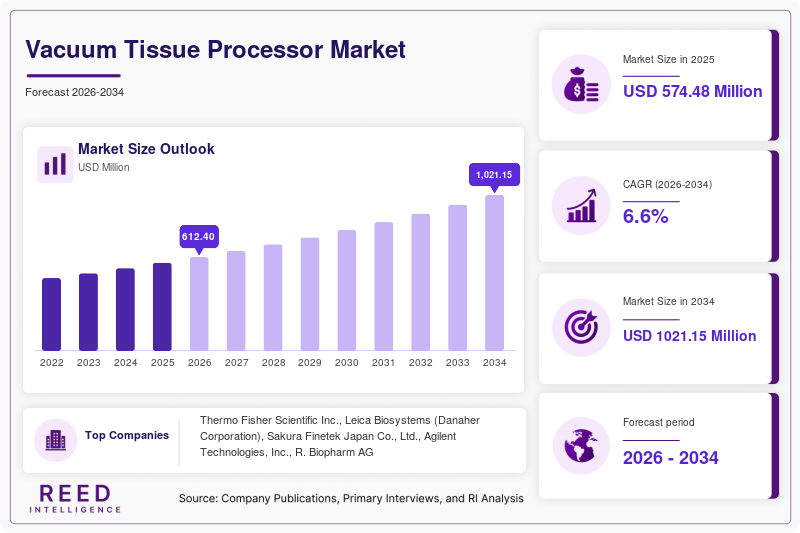
The Vacuum Tissue Processor Market size is estimated at USD 612.4 million, and it is projected to reach USD 1,024.7 million by 2034, registering a CAGR of 6.6% during 2026–2034. A key global factor supporting the growth of the Vacuum Tissue Processor Market is the increasing prevalence of cancer and chronic diseases, which has significantly raised the volume of biopsy and tissue sample testing in pathology laboratories. The adoption of automated and vacuum-based tissue processing systems is improving diagnostic accuracy, reducing turnaround time, and enhancing laboratory efficiency, thereby strengthening market demand.
Growing healthcare infrastructure investments, particularly in emerging economies, and increasing adoption of digital pathology workflows are further contributing to the expansion of the Vacuum Tissue Processor Market. Additionally, advancements in reagent compatibility and programmable automation cycles are improving system flexibility across diverse laboratory environments.
Key Highlights:
- Dominant region share (2025): North America held 36.8% of the global Vacuum Tissue Processor Market.
- Fastest-growing region CAGR (2026–2034): Asia Pacific is expected to grow at 7.8% CAGR.
- Leading subsegment (Type): Automated Vacuum Tissue Processors accounted for 58.2% share in 2025.
- Fastest-growing subsegment: Compact benchtop processors projected to grow at 7.4% CAGR.
- Leading subsegment (End-use): Hospitals dominated with 41.5% share in 2025.
- Fastest-growing subsegment (Application): Cancer diagnostics is expected to grow at 7.1% CAGR.
- Dominant country: United States generated USD 185.6 million in 2024 and USD 198.3 million in 2025 in the Vacuum Tissue Processor Market.
Market Trends
Integration of Digital Pathology with Vacuum Tissue Processors
The Vacuum Tissue Processor Market is experiencing increasing integration with digital pathology systems. Laboratories are adopting fully automated workflows where tissue processors are connected with imaging and data management systems. This integration improves sample tracking, reduces human error, and enhances diagnostic precision. Cloud-based laboratory information systems are also being linked with tissue processing units, enabling remote monitoring and predictive maintenance.
Shift Toward Compact and Energy-Efficient Systems
Another key trend shaping the Vacuum Tissue Processor Market is the growing preference for compact, energy-efficient instruments. Smaller diagnostic labs and research centers are adopting benchtop vacuum tissue processors due to space constraints and cost efficiency. Manufacturers are focusing on reducing reagent consumption and energy usage while maintaining high-throughput performance, aligning with sustainability goals in laboratory operations.
Market Drivers
Rising Burden of Chronic Diseases and Cancer Cases
The increasing global incidence of cancer, neurological disorders, and infectious diseases is a major driver of the Vacuum Tissue Processor Market. These conditions require extensive tissue examination for accurate diagnosis. As biopsy volumes increase, laboratories are shifting toward automated vacuum-based systems that ensure consistent tissue preservation and faster processing cycles.
Technological Advancements in Laboratory Automation
Advancements in automation technology, including programmable protocols, smart vacuum control systems, and real-time monitoring features, are accelerating the adoption of the Vacuum Tissue Processor Market. These innovations reduce manual intervention, improve reproducibility, and enhance laboratory throughput, making them essential in high-volume diagnostic environments.
Market Restraint
High Equipment and Maintenance Costs
A major restraint in the Vacuum Tissue Processor Market is the high initial investment and ongoing maintenance costs associated with advanced automated systems. Smaller laboratories and healthcare facilities in developing regions often face budget constraints, limiting widespread adoption. Additionally, the requirement for skilled personnel to operate and maintain these systems further increases operational expenses.
Market Opportunities
Expansion of Emerging Healthcare Infrastructure
Rapid development of healthcare infrastructure in emerging economies presents a significant opportunity for the Vacuum Tissue Processor Market. Countries in Asia Pacific, Latin America, and parts of Africa are investing heavily in diagnostic laboratories and hospital modernization. This expansion is expected to increase demand for automated tissue processing equipment.
Growing Adoption in Research and Academic Institutes
Research institutions and academic pathology labs are increasingly adopting advanced vacuum tissue processing systems for experimental studies and molecular research. This segment offers strong growth potential for the Vacuum Tissue Processor Market, particularly as funding for biomedical research continues to rise globally.
Segmental Analysis
By Type
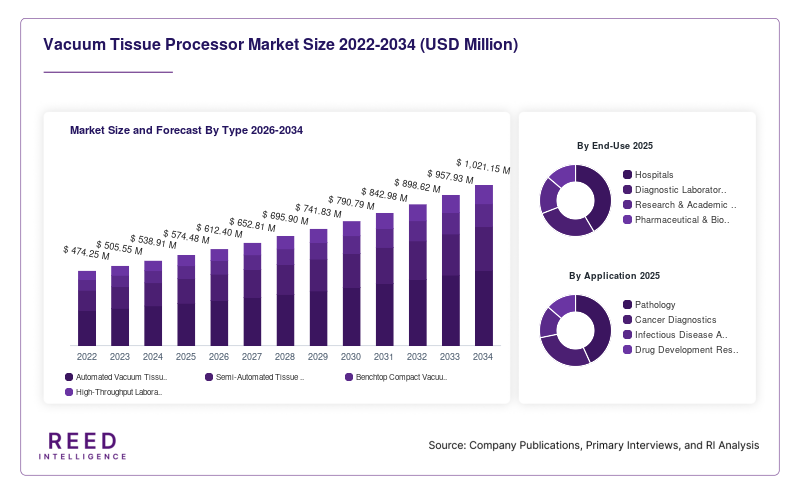
The Vacuum Tissue Processor Market is segmented into automated vacuum tissue processors and semi-automated systems. In 2025, automated vacuum tissue processors dominated with 58.2% share, driven by their ability to streamline workflow and reduce manual handling errors. These systems are widely used in high-throughput diagnostic laboratories.
The fastest-growing subsegment is compact benchtop vacuum tissue processors, expected to grow at a 7.4% CAGR during 2026–2034. Their growth is driven by increasing demand from small and mid-sized laboratories requiring space-efficient and cost-effective solutions.
By End-Use
Hospitals dominated the Vacuum Tissue Processor Market in 2025 with 41.5% share, due to high patient inflow and extensive diagnostic requirements. Hospital laboratories increasingly rely on automated tissue processing for faster diagnostic turnaround.
The fastest-growing subsegment is diagnostic laboratories, projected to grow at a 7.0% CAGR. This growth is driven by outsourcing of pathology services and increasing specialization of independent diagnostic centers.
By Application
Pathology remained the dominant application segment in 2025 with 48.6% share of the Vacuum Tissue Processor Market, driven by routine tissue examination procedures.
Cancer diagnostics is the fastest-growing subsegment, expected to expand at a 7.1% CAGR, supported by increasing cancer screening programs and precision medicine initiatives globally.
Regional Analysis
North America
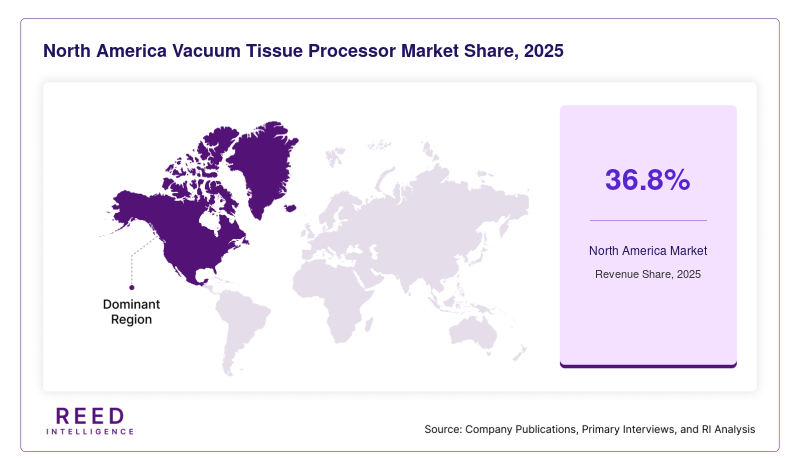
In 2025, North America accounted for 36.8% share of the Vacuum Tissue Processor Market and is projected to grow at a 6.1% CAGR (2026–2034). The region’s growth is driven by advanced healthcare infrastructure, high adoption of automated pathology systems, and strong presence of key diagnostic laboratories. The United States dominates due to widespread cancer screening programs and continuous technological innovation in laboratory automation.
Europe
Europe held 27.4% share in 2025 of the Vacuum Tissue Processor Market and is expected to expand at a 5.9% CAGR. Growth is supported by increasing investments in healthcare modernization and strong regulatory emphasis on diagnostic accuracy. Germany is the leading country due to its advanced medical device manufacturing ecosystem and high volume of pathological testing.
Asia Pacific
Asia Pacific captured 22.1% share in 2025 and is projected to grow at the fastest 7.8% CAGR in the Vacuum Tissue Processor Market. Rising healthcare expenditure, expanding diagnostic laboratories, and increasing cancer prevalence are key drivers. China leads the region due to rapid hospital expansion and government initiatives to improve early disease diagnosis infrastructure.
Middle East & Africa
This region held 7.3% share in 2025 and is expected to grow at a 6.5% CAGR. Growth is supported by improving healthcare infrastructure and increasing investments in laboratory automation in countries like Saudi Arabia and South Africa.
Latin America
Latin America accounted for 6.4% share in 2025 and is projected to grow at a 6.2% CAGR. Brazil leads the region due to rising adoption of diagnostic technologies and expansion of private healthcare laboratories.
Competitive Landscape
The Vacuum Tissue Processor Market is moderately consolidated, with several global and regional manufacturers competing through innovation and product differentiation. Key players include Thermo Fisher Scientific Inc., Leica Biosystems (Danaher Corporation), Sakura Finetek Japan Co., Ltd., Agilent Technologies, Inc., and R. Biopharm AG. These companies focus on automation, workflow integration, and reagent compatibility improvements to strengthen their market position.
Thermo Fisher Scientific Inc. remains a prominent player due to its wide portfolio of pathology automation systems and continuous R&D investments. Leica Biosystems emphasizes integrated digital pathology solutions, enhancing workflow efficiency in clinical laboratories. Sakura Finetek Japan focuses on compact and user-friendly tissue processors tailored for mid-sized laboratories.
Recent developments include product upgrades with enhanced vacuum control systems and AI-enabled workflow monitoring. Strategic collaborations with hospitals and diagnostic chains are also shaping competitive dynamics in the Vacuum Tissue Processor Market.
Key Players List
- Thermo Fisher Scientific Inc.
- Leica Biosystems (Danaher Corporation)
- Sakura Finetek Japan Co., Ltd.
- Agilent Technologies, Inc.
- R. Biopharm AG
- Milestone Medical
- Medite GmbH
- Leica Microsystems
- Bio-Optica Milano S.p.A.
- Electron Microscopy Sciences
- Amos Scientific Pty Ltd
- SLEE medical GmbH
- Jinhua Yidi Medical Appliance Co., Ltd
- Histo-Line Laboratories
- Diapath S.p.A.
Recent Developments
- In 2025, Thermo Fisher Scientific introduced an upgraded vacuum tissue processor with enhanced reagent tracking and automated cycle optimization.
- Leica Biosystems expanded its digital pathology integration suite, improving compatibility between tissue processors and imaging platforms.
- Sakura Finetek launched a compact vacuum tissue processor designed for small laboratories with reduced energy consumption.
- Milestone Medical introduced eco-efficient reagent systems aimed at reducing chemical waste in histopathology workflows.
- Agilent Technologies invested in AI-based monitoring systems for laboratory automation, improving operational efficiency in tissue processing workflows.
Vacuum Tissue Processor Market Segments
By Type
- Automated Vacuum Tissue Processors
- Semi-Automated Tissue Processors
- Benchtop Compact Vacuum Processors
- High-Throughput Laboratory Systems
By End-Use
- Hospitals
- Diagnostic Laboratories
- Research & Academic Institutes
- Pharmaceutical & Biotechnology Companies
By Application
- Pathology
- Cancer Diagnostics
- Infectious Disease Analysis
- Drug Development Research
By Distribution Channel
- Direct Sales
- Distributors
- Online Procurement Platforms
- Tender-Based Institutional Procurement
By Region
- North America
- Europe
- APAC
- Middle East and Africa
- LATAM