Valeronitrile Market Size, Share & Demand Report By Grade (Industrial Grade, Pharmaceutical Grade, Laboratory Grade), By Application (Pharmaceutical Intermediates, Agrochemical Intermediates, Specialty Solvents, Chemical Synthesis), By End-Use (Chemical Manufacturing, Pharmaceutical Companies, Research Laboratories, Agrochemical Industry), By Region & Segment Forecasts, 2026–2034
USD 3950
Market Overview
The global Valeronitrile Market size was valued at USD 428.6 million in 2026 and is projected to reach USD 812.4 million by 2034, expanding at a CAGR of 8.3% during the forecast period from 2026 to 2034. Valeronitrile, a colorless organic nitrile compound widely used as an intermediate in pharmaceuticals, agrochemicals, specialty chemicals, and solvent manufacturing, has gained strong commercial importance due to rising industrial demand for advanced chemical intermediates. The increasing consumption of fine chemicals across emerging economies continues to strengthen market penetration across multiple downstream applications.
Growth in the pharmaceutical manufacturing sector remains one of the primary contributors to market expansion. Valeronitrile is increasingly used in the synthesis of active pharmaceutical ingredients and specialty compounds because of its stable chemical structure and compatibility with complex organic reactions. Rising investment in chemical processing facilities across Asia Pacific and North America has further supported the production capacity of nitrile-based intermediates. In addition, the expansion of agrochemical production to improve agricultural productivity has accelerated demand for high-purity valeronitrile products.
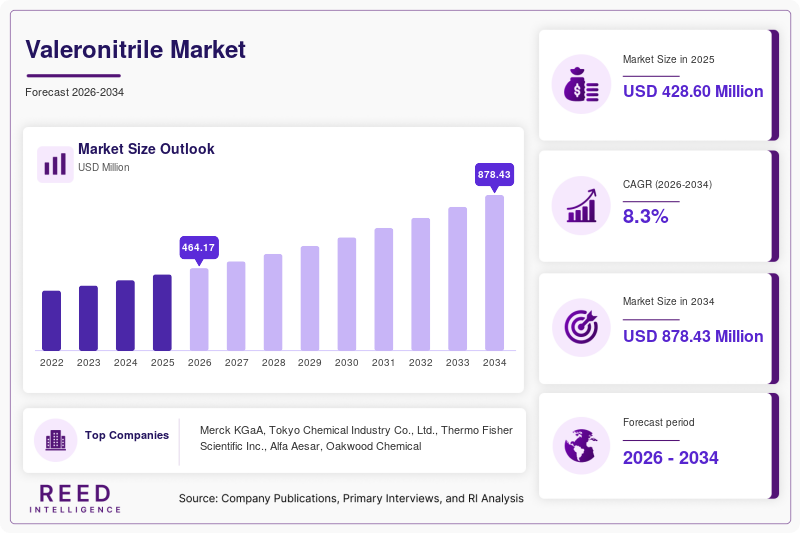
Key Highlights
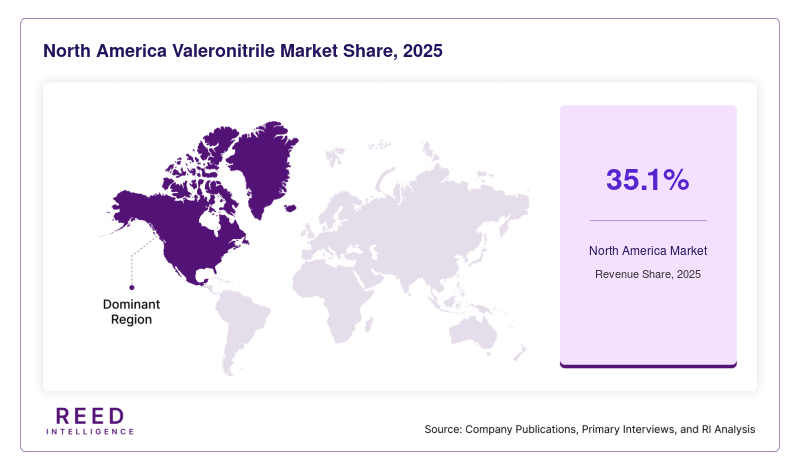
- North America dominated the market with a 35.1% share in 2025.
- Asia Pacific is expected to grow at the fastest CAGR of 10.8% during 2026–2034.
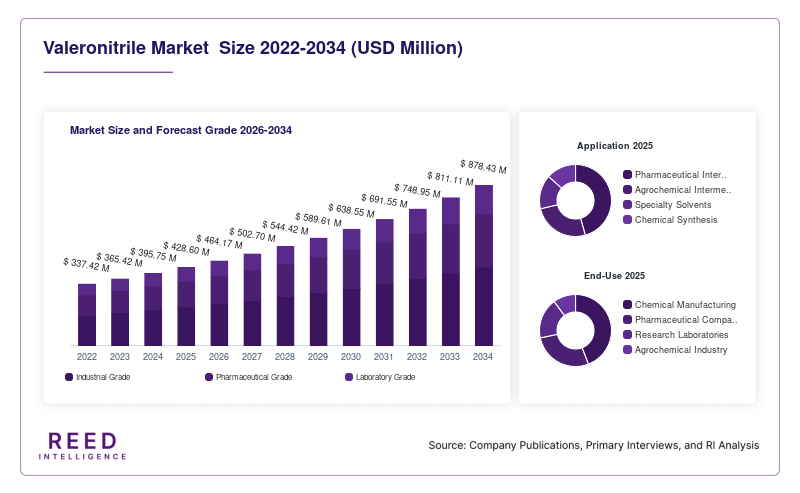
- By grade, industrial grade accounted for the largest share of 46.8%.
- while pharmaceutical grade is projected to grow at a CAGR of 11.4%.
- By application, pharmaceutical intermediates led with a 42.5% share.
- whereas agrochemical intermediates are expected to expand at a CAGR of 10.9%.
- By end-use, chemical manufacturing held the dominant share of 39.6%, while pharmaceutical companies are forecast to grow at a CAGR of 11.1%.
- The United States remained the dominant country, with market values of USD 118 million in 2024 and USD 129 million in 2025.
Market Trends
Expansion of High-Purity Chemical Manufacturing
The Valeronitrile Market is witnessing increased demand for high-purity chemical intermediates across pharmaceutical and specialty chemical manufacturing industries. Companies are investing in purification technologies and advanced distillation systems to produce ultra-high-purity valeronitrile suitable for regulated industrial applications. Pharmaceutical producers require stable and contamination-free intermediates to maintain product consistency and regulatory compliance. This trend has encouraged suppliers to develop customized production methods that improve purity levels while reducing process impurities. In addition, rising investments in contract manufacturing organizations are increasing the consumption of specialty nitriles used in advanced synthesis processes. Manufacturers are also adopting automated monitoring systems and process analytics to ensure quality consistency during large-scale production. The trend is expected to continue as global industries place stronger emphasis on high-performance chemical intermediates and sustainable manufacturing practices.
Growing Shift Toward Sustainable Chemical Processes
Sustainability initiatives are reshaping production strategies within the Valeronitrile Market. Chemical manufacturers are increasingly adopting low-emission synthesis technologies and energy-efficient processing methods to reduce environmental impact. The implementation of green chemistry principles has encouraged producers to minimize solvent waste, lower hazardous byproduct formation, and improve resource utilization during nitrile production. Companies are also investing in bio-based feedstocks and catalytic reaction systems that reduce dependence on traditional petroleum-derived raw materials. Regulatory agencies in Europe and North America are promoting cleaner industrial operations, encouraging manufacturers to modernize production facilities. This shift is creating demand for technologically advanced manufacturing infrastructure capable of supporting environmentally responsible production. As industrial customers prioritize sustainable sourcing and carbon reduction goals, suppliers with environmentally optimized operations are expected to strengthen their competitive position in the market.
Market Drivers
Rising Demand from Pharmaceutical Intermediate Production
The growing pharmaceutical industry is significantly driving the Valeronitrile Market due to the compound’s extensive use in synthesizing active pharmaceutical ingredients and specialty drug compounds. Pharmaceutical manufacturers increasingly rely on nitrile-based intermediates for complex organic synthesis because of their chemical stability and compatibility with multiple reaction pathways. Rising global healthcare expenditure and increasing production of generic drugs are expanding demand for specialty intermediates across developed and emerging economies. In addition, the growth of contract drug manufacturing facilities in countries such as India and China has accelerated procurement of industrial chemicals used in pharmaceutical processing. Companies are also investing in research and development activities focused on advanced therapeutic compounds, which further increases the requirement for high-quality valeronitrile products. The continued expansion of pharmaceutical production capacity is expected to remain a major market growth driver during the forecast period.
Increasing Agrochemical Production Across Emerging Economies
The rapid expansion of agricultural chemical manufacturing is another major factor supporting the growth of the Valeronitrile Market. Valeronitrile is widely used as a precursor in the production of herbicides, pesticides, and specialty crop protection chemicals. Growing pressure to improve agricultural productivity and food security has increased investment in agrochemical development, particularly across Asia Pacific and Latin America. Farmers are increasingly adopting advanced crop protection solutions to reduce yield losses caused by pests and changing climatic conditions. This has strengthened demand for chemical intermediates used in agrochemical synthesis. In addition, government support for modern agricultural practices and rising exports of crop protection products are encouraging chemical manufacturers to expand production facilities. The increasing focus on high-efficiency agrochemical formulations is expected to sustain long-term demand for valeronitrile-based intermediates across global agricultural markets.
Market Restraint
Volatility in Raw Material Prices and Regulatory Compliance Costs
Fluctuations in petrochemical feedstock prices remain a major restraint affecting the Valeronitrile Market. Since valeronitrile production relies heavily on petroleum-derived raw materials and energy-intensive processing systems, sudden changes in crude oil prices can significantly impact manufacturing costs and profit margins. Small and medium-scale manufacturers often face operational challenges when raw material prices increase rapidly, limiting their production flexibility and competitiveness. In addition, stringent environmental and occupational safety regulations governing nitrile production have increased compliance costs for manufacturers. Regulatory agencies in several regions require companies to implement advanced emission control systems, waste management infrastructure, and worker safety measures during chemical processing operations. These compliance requirements can increase capital expenditure and delay production expansion projects. For example, several chemical manufacturers in Europe have faced operational restructuring costs associated with updated industrial emission standards. Such financial pressures may limit production scalability and create pricing challenges across the global market.
Market Opportunities
Expansion of Specialty Chemical Applications
The growing use of specialty chemicals across industrial sectors is creating strong opportunities for the Valeronitrile Market. Valeronitrile is increasingly utilized in specialty solvent formulations, laboratory reagents, and performance chemicals due to its favorable chemical properties and reaction stability. Industries such as electronics, coatings, and advanced materials are expanding their use of specialty intermediates to support the development of high-performance products. This trend is encouraging chemical manufacturers to diversify product portfolios and invest in application-specific formulations. In addition, increasing industrial research activities are generating demand for high-purity nitrile compounds in experimental and pilot-scale production processes. The development of customized chemical solutions for industrial clients is expected to create new revenue streams for market participants. As advanced manufacturing sectors continue to expand globally, the demand for versatile specialty intermediates such as valeronitrile is expected to increase steadily.
Growth Potential in Emerging Asian Manufacturing Hubs
Emerging economies across Asia Pacific present significant growth opportunities for the Valeronitrile Market due to rapid industrialization and expanding chemical production infrastructure. Countries such as India, China, Vietnam, and Indonesia are experiencing strong investment in pharmaceutical, agrochemical, and specialty chemical manufacturing facilities. Lower production costs, favorable government policies, and rising export capabilities are attracting global chemical companies to establish regional operations in these markets. In addition, increasing domestic consumption of industrial chemicals is strengthening local supply chains and encouraging new production capacity development. Several regional manufacturers are also investing in modern processing technologies to improve production quality and operational efficiency. The availability of skilled labor and improving logistics infrastructure further support industrial expansion across these economies. As multinational companies continue to shift manufacturing operations toward Asia Pacific, the region is expected to become a major growth center for valeronitrile production and consumption.
Segmental Analysis
By Grade
Industrial grade valeronitrile accounted for the largest share of the global market in 2024, representing 46.8% of total revenue. The dominance of this segment is primarily attributed to its extensive use across chemical manufacturing, specialty solvent production, and industrial synthesis applications. Industrial grade products are preferred because they offer cost efficiency and suitable purity levels for large-scale manufacturing operations. Demand from agrochemical producers and specialty chemical companies has remained particularly strong due to the compound’s effectiveness as an intermediate in various organic synthesis reactions. In addition, industrial grade valeronitrile is widely used in laboratories and pilot-scale industrial research activities. Manufacturers continue to expand production capacity for industrial-grade variants to meet growing demand from emerging industrial economies. The increasing use of specialty chemicals across multiple industrial sectors is expected to sustain strong demand for this segment.
By Application
Pharmaceutical intermediates represented the dominant application segment in 2024, accounting for 42.5% of the global Valeronitrile Market share. The segment’s leadership is supported by the increasing use of nitrile compounds in the synthesis of active pharmaceutical ingredients and specialty drug formulations. Pharmaceutical companies rely on valeronitrile because of its favorable chemical reactivity and compatibility with complex organic synthesis pathways. Rising healthcare expenditure and growing demand for generic medicines across emerging economies have strengthened consumption of pharmaceutical intermediates. In addition, increased investment in research and development activities for new therapeutic compounds has accelerated demand for high-performance chemical intermediates. Manufacturers are also expanding production capabilities to meet growing global pharmaceutical requirements. The continued expansion of contract pharmaceutical manufacturing services is expected to further support the dominance of this application segment during the forecast period.
By End-Use
Chemical manufacturing emerged as the leading end-use segment in 2024, accounting for 39.6% of the global market share. The segment benefits from extensive use of valeronitrile in specialty chemical synthesis, industrial solvent production, and intermediate manufacturing applications. Chemical manufacturers require versatile nitrile compounds for use in multiple reaction systems and industrial formulations. Rising industrialization and increasing demand for advanced materials have significantly expanded the need for specialty intermediates across global markets. In addition, ongoing investments in downstream chemical processing infrastructure have strengthened production capacity for nitrile-based compounds. Companies are also focusing on operational efficiency and process modernization to improve product quality and reduce manufacturing costs. The growth of industrial research activities and specialty chemical development programs continues to support sustained demand for valeronitrile across the chemical manufacturing sector.
Regional Analysis
North America
North America accounted for 35.1% of the global Valeronitrile Market share in 2025 and maintained its leadership position due to the strong presence of pharmaceutical and specialty chemical manufacturers. The region is projected to grow at a CAGR of 7.6% during the forecast period. Rising demand for advanced organic intermediates across drug synthesis and industrial chemical production continues to support regional growth. In addition, increased investment in chemical process automation and sustainable manufacturing technologies has strengthened production efficiency across the United States and Canada.
Europe
Europe represented a substantial share of the Valeronitrile Market in 2025 and is expected to expand at a CAGR of 7.1% through 2034. The region benefits from a mature chemical manufacturing industry and strong regulatory emphasis on product quality and environmental sustainability. Demand for valeronitrile in Europe is largely driven by pharmaceutical intermediates, specialty solvents, and agrochemical manufacturing applications. Companies across Germany, France, and the United Kingdom are focusing on process optimization and sustainable production methods to comply with regional environmental standards.
Asia Pacific
Asia Pacific emerged as the fastest-growing region in the Valeronitrile Market and is forecast to expand at a CAGR of 10.8% during the assessment period. Rapid industrialization, growing pharmaceutical manufacturing capacity, and increasing agrochemical production are major contributors to regional growth. Countries across the region are investing heavily in chemical processing infrastructure to support rising domestic and export demand. In addition, lower labor costs and favorable industrial policies have encouraged multinational chemical companies to expand manufacturing operations across Asia Pacific.
Middle East & Africa
The Middle East & Africa region accounted for a smaller but steadily expanding share of the Valeronitrile Market in 2025 and is expected to register a CAGR of 6.8% during the forecast period. Growth in the region is supported by increasing investments in petrochemical and specialty chemical industries. Several countries are diversifying their industrial economies by developing downstream chemical manufacturing capabilities. Rising agricultural modernization efforts and growing demand for industrial solvents are also contributing to market expansion across the region.
Latin America
Latin America held a moderate share of the Valeronitrile Market in 2025 and is anticipated to grow at a CAGR of 7.3% through 2034. Increasing agrochemical production and expanding pharmaceutical manufacturing activities are supporting regional market growth. Countries across the region are strengthening industrial capabilities to improve local chemical production and reduce import dependency. In addition, rising investment in agricultural productivity improvement programs has increased demand for crop protection chemicals, indirectly supporting consumption of chemical intermediates such as valeronitrile.
Competitive Landscape
The Valeronitrile Market is moderately consolidated, with several global and regional chemical manufacturers competing through product quality, production efficiency, and supply chain integration strategies. Companies are increasingly investing in high-purity product development, sustainable manufacturing technologies, and production capacity expansion to strengthen their market position. Strategic partnerships with pharmaceutical and agrochemical companies are also becoming common as manufacturers seek long-term supply agreements and broader application reach.
Merck KGaA remains one of the leading participants in the market due to its strong specialty chemical portfolio and advanced production capabilities. The company continues to focus on high-purity nitrile intermediates for pharmaceutical and research applications. A recent development involved the expansion of its specialty chemical manufacturing operations to support increasing demand from pharmaceutical customers.
Key Players
- Merck KGaA
- Tokyo Chemical Industry Co., Ltd.
- Thermo Fisher Scientific Inc.
- Alfa Aesar
- Oakwood Chemical
- Santa Cruz Biotechnology, Inc.
- Central Drug House
- Loba Chemie Pvt. Ltd.
- Sigma-Aldrich Corporation
- Acros Organics
- TCI Chemicals
- Haihang Industry Co., Ltd.
- Toronto Research Chemicals
- Glentham Life Sciences
Recent Developments
- Merck KGaA expanded its specialty nitrile production capabilities in 2025 to support growing pharmaceutical intermediate demand.
- Tokyo Chemical Industry Co., Ltd. introduced a higher-purity valeronitrile product line designed for advanced laboratory applications in 2024.
- Thermo Fisher Scientific Inc. enhanced its chemical distribution network across Asia Pacific to improve specialty intermediate supply efficiency in 2025.
- Sigma-Aldrich Corporation invested in process optimization technologies to improve production efficiency and reduce solvent waste during nitrile manufacturing operations.
Valeronitrile Market Segments
Grade
- Industrial Grade
- Pharmaceutical Grade
- Laboratory Grade
Application
- Pharmaceutical Intermediates
- Agrochemical Intermediates
- Specialty Solvents
- Chemical Synthesis
End-Use
- Chemical Manufacturing
- Pharmaceutical Companies
- Research Laboratories
- Agrochemical Industry
By Region
- North America
- Europe
- APAC
- Middle East and Africa
- LATAM