Vanadio Market Size, Share & Demand Report By Product Type (Vanadium Pentoxide, Ferrovanadium, Vanadium Chemicals, Vanadium Redox Electrolytes), By Application (Steel Alloys, Energy Storage Systems, Chemical Catalysts, Aerospace Alloys, Others), By End-Use Industry (Construction & Infrastructure, Automotive, Aerospace & Defense, Renewable Energy, Industrial Manufacturing, Others), By Region & Segment Forecasts, 2026–2034
USD 3950
Market Overview
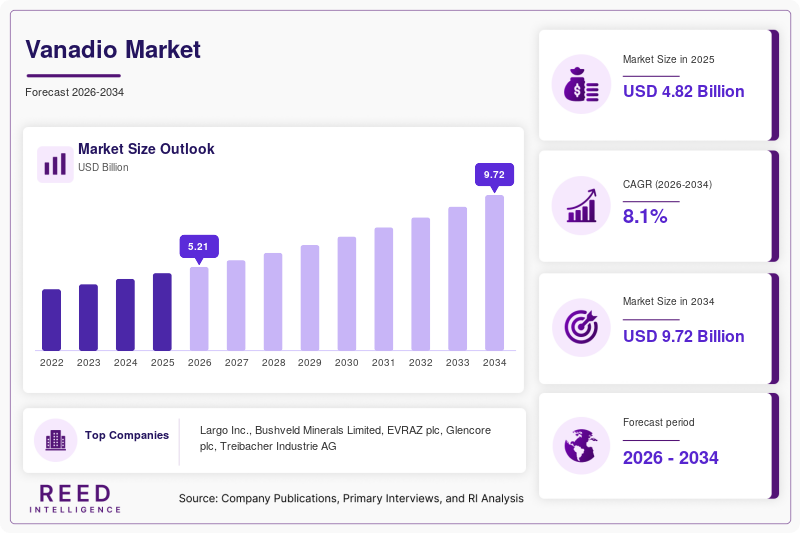
The global Vanadio Market size was valued at approximately USD 4.82 billion in 2026 and is projected to reach USD 8.96 billion by 2034, expanding at a CAGR of 8.1% during 2026–2034. Vanadium, commonly referred to as vanadio in several international markets, remains an essential strategic metal used in steel strengthening applications, aerospace alloys, chemical catalysts, and emerging energy storage technologies. Increasing demand for high-strength low-alloy steel across infrastructure, transportation, and industrial manufacturing sectors continues to support market expansion worldwide.
A major factor driving the market is the growing emphasis on sustainable infrastructure development. Governments and private investors are increasingly funding large-scale transportation networks, renewable energy installations, urban construction projects, and industrial modernization programs. These developments require durable and lightweight steel products that utilize vanadium-based alloys to improve strength, corrosion resistance, and structural performance. In addition, the adoption of vanadium redox flow batteries for grid-scale energy storage is creating a new demand channel beyond traditional metallurgical applications.
Key Highlights
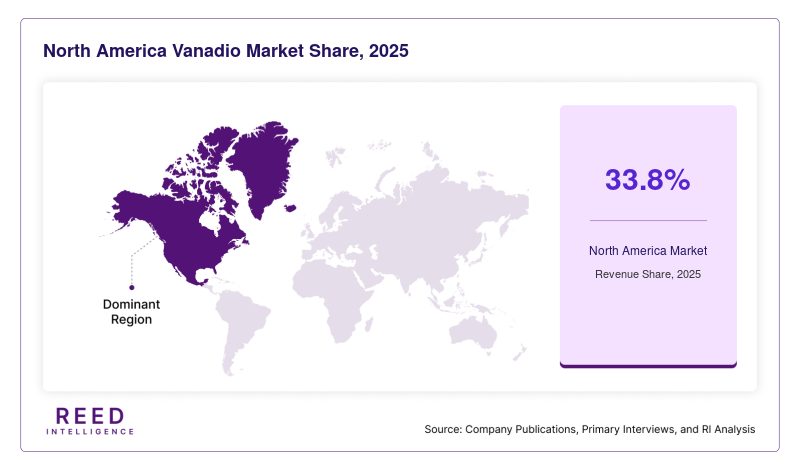
- North America dominated the market with a 33.8% share in 2025, while Asia Pacific is expected to grow at the fastest CAGR of 10.7% during 2026–2034.
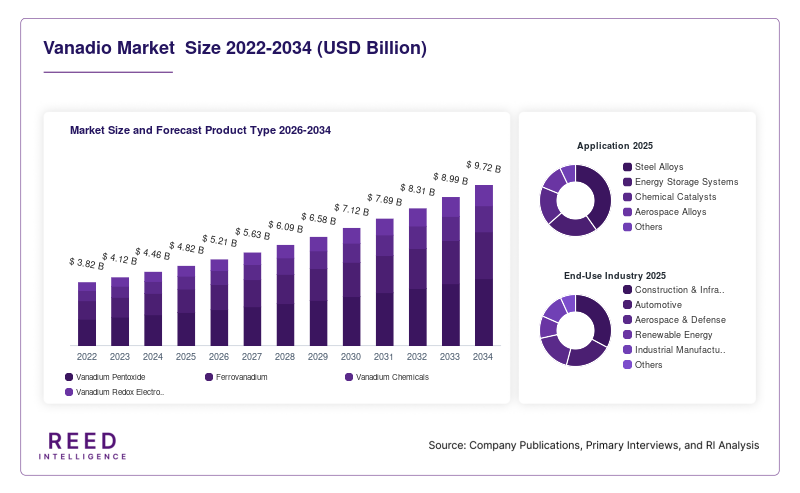
- By product type, Vanadium Pentoxide accounted for the largest share of 42.6%, while Vanadium Redox Electrolytes are projected to grow at a CAGR of 11.9%.
- By application, Steel Alloys led with a 58.4% share, whereas Energy Storage Systems are expected to expand at a CAGR of 12.6%.
- By end-use industry, Construction & Infrastructure accounted for the largest share of 36.9%, while Renewable Energy is anticipated to grow at a CAGR of 13.1%.
- The United States remained the dominant country, with market values of USD 1.42 billion in 2024 and USD 1.56 billion in 2025.
Market Trends
Expansion of Vanadium Redox Flow Battery Deployments
One of the most significant trends shaping the Vanadio Market is the increasing deployment of vanadium redox flow batteries across utility-scale energy storage projects. As renewable power generation continues to expand, grid operators require reliable storage systems capable of balancing fluctuations in solar and wind energy production. Vanadium redox flow batteries offer long operational life, high safety standards, and scalability advantages compared with conventional battery technologies. Energy developers are increasingly evaluating these systems for long-duration storage applications. Investments in renewable infrastructure and government incentives for clean energy projects are supporting the commercialization of vanadium-based storage technologies. This trend is creating additional revenue streams for vanadium producers and reducing the industry's dependence on traditional steel-related demand.
Growing Adoption of High-Strength Steel in Infrastructure Projects
Another notable trend involves the increased use of vanadium-enhanced high-strength steel in infrastructure construction. Urbanization, industrial expansion, and transportation upgrades are generating substantial demand for durable building materials. Vanadium improves steel strength while reducing overall material requirements, enabling cost-efficient and sustainable construction practices. Engineers and contractors are increasingly selecting vanadium-alloyed steel for bridges, railways, commercial buildings, and industrial facilities. Regulatory focus on structural safety and material efficiency further supports adoption. Emerging economies are investing heavily in transportation corridors, smart city developments, and industrial parks, which is contributing to consistent demand growth. This trend continues to reinforce vanadium's role as a critical material within global infrastructure development initiatives.
Market Drivers
Rising Demand from the Global Steel Industry
The steel industry remains the primary growth engine for the Vanadio Market. Vanadium is widely used as an alloying element to enhance steel strength, toughness, and fatigue resistance. High-strength low-alloy steels containing vanadium are increasingly preferred in construction, automotive manufacturing, pipelines, and heavy machinery applications. Infrastructure investments across developed and emerging economies are generating sustained demand for advanced steel products. Governments are allocating substantial budgets toward transportation networks, energy facilities, and urban development projects, all of which require high-performance construction materials. The ability of vanadium to improve structural integrity while reducing material consumption makes it an attractive solution for manufacturers seeking efficiency and sustainability.
Increasing Investments in Renewable Energy Storage
The growing adoption of renewable energy systems is creating substantial demand for vanadium-based energy storage technologies. Utility operators are seeking long-duration storage solutions that can support grid stability and maximize renewable energy utilization. Vanadium redox flow batteries are gaining attention due to their long lifecycle, low degradation rates, and ability to provide large-scale storage capacity. Governments are implementing energy transition policies that encourage investments in advanced storage infrastructure. Private investors and energy developers are also funding pilot projects and commercial installations involving vanadium battery technology. As electricity demand rises and renewable generation capacity expands globally, the role of vanadium in energy storage applications is expected to strengthen significantly throughout the forecast period.
Market Restraint
Supply Concentration and Price Volatility Challenges
A major challenge affecting the Vanadio Market is the concentration of global supply within a limited number of producing countries and mining operations. This concentration exposes the industry to disruptions arising from geopolitical tensions, regulatory changes, environmental restrictions, and operational interruptions. As a result, vanadium prices often experience substantial fluctuations that can impact profitability across the value chain. Manufacturers relying on vanadium-containing materials may face uncertainty regarding raw material costs, making long-term planning more difficult. For example, unexpected production reductions at major mining facilities can rapidly tighten supply and increase prices. Such volatility may discourage adoption in cost-sensitive industries and encourage some buyers to explore alternative alloying materials. Furthermore, developing new vanadium extraction projects requires significant capital investment, environmental approvals, and lengthy development timelines. These factors collectively create challenges for maintaining a stable supply-demand balance and may restrain market expansion despite favorable long-term growth fundamentals.
Market Opportunities
Emerging Demand from Grid Modernization Projects
Grid modernization initiatives represent a substantial opportunity for the Vanadio Market. Countries worldwide are upgrading aging electricity infrastructure to improve efficiency, reliability, and renewable energy integration. Advanced storage systems are becoming essential components of modern power networks, creating favorable conditions for vanadium-based battery technologies. Utility companies increasingly seek solutions capable of providing long-duration storage and frequent charge-discharge cycles without significant performance degradation. Vanadium redox flow batteries meet these requirements and are gaining recognition in large-scale energy projects. As governments continue to allocate funding for smart grids and renewable integration programs, demand for vanadium-based storage materials is expected to increase considerably. This opportunity could diversify industry revenues and support long-term market stability.
Growth Potential in Aerospace and Advanced Manufacturing
Another promising opportunity lies within aerospace and advanced manufacturing applications. Vanadium-based alloys offer excellent strength-to-weight ratios, corrosion resistance, and high-temperature performance characteristics. These properties make them valuable for aircraft components, turbine systems, industrial equipment, and specialized manufacturing processes. Global aerospace production is gradually increasing as passenger traffic, defense spending, and commercial aircraft deliveries expand. Advanced manufacturing industries are also seeking materials that improve product performance while reducing weight and operational costs. Continuous research into high-performance alloys and additive manufacturing technologies is expected to create additional demand for vanadium-containing materials. As technological innovation accelerates, new application areas may emerge and further strengthen market growth prospects.
Segmental Analysis
By Product Type
Vanadium Pentoxide represented the dominant product segment, accounting for approximately 42.6% of market revenue in 2024. This leadership position is attributed to its extensive use in steel production, catalysts, and chemical manufacturing processes. Vanadium pentoxide serves as a critical intermediate material for various downstream applications, making it essential across multiple industrial sectors. Strong demand from metallurgical operations remains the primary contributor to segment growth. Manufacturers continue to invest in production capacity expansion and process optimization to meet rising global requirements. The material's versatility, established supply chain, and broad industrial acceptance support its continued dominance. Growing infrastructure development and industrial production activities further reinforce demand across major regional markets.
Vanadium Redox Electrolytes are projected to register the fastest CAGR of 11.9% during 2026–2034. Rising adoption of vanadium redox flow batteries is the key factor driving growth within this segment. Utility companies and renewable energy developers increasingly recognize the benefits of long-duration storage systems capable of supporting grid reliability. Investments in renewable energy infrastructure and energy transition initiatives are accelerating demand for advanced battery materials. Technological improvements in electrolyte production are also enhancing performance and reducing costs. As governments pursue decarbonization strategies and electricity networks require greater storage capacity, vanadium redox electrolytes are expected to experience substantial growth throughout the forecast period.
By Application
Steel Alloys accounted for the largest application segment with a 58.4% market share in 2024. The widespread use of vanadium in strengthening steel products continues to drive significant demand across construction, transportation, manufacturing, and energy sectors. Vanadium improves mechanical performance while reducing material requirements, enabling cost-effective and durable engineering solutions. Infrastructure development projects worldwide remain major consumers of vanadium-alloyed steel products. Growing urbanization and industrialization trends are further supporting segment expansion. Manufacturers increasingly prefer high-strength steel grades to meet regulatory standards and improve operational efficiency. The established role of vanadium in steel metallurgy ensures continued dominance of this application segment across global markets.
Energy Storage Systems are expected to emerge as the fastest-growing application segment, advancing at a CAGR of 12.6% during the forecast period. The increasing deployment of renewable energy generation facilities is creating demand for scalable and reliable energy storage solutions. Vanadium redox flow batteries offer operational advantages including long service life, high safety performance, and flexible storage capacity. Utility providers are investing in storage technologies to stabilize power grids and enhance renewable energy utilization. Government funding programs and sustainability initiatives further support adoption. As energy storage becomes an increasingly important component of modern electricity networks, vanadium demand from this application segment is expected to rise significantly.
By End-Use Industry
Construction & Infrastructure held the leading position among end-use industries, accounting for 36.9% of total market revenue in 2024. Large-scale investments in transportation systems, commercial buildings, industrial facilities, and urban development projects continue to generate substantial demand for vanadium-enhanced steel products. Infrastructure developers increasingly utilize high-strength materials to improve structural performance and reduce maintenance requirements. Population growth and urban expansion are creating long-term demand for advanced construction materials. Governments worldwide are prioritizing public infrastructure modernization, further supporting segment growth. The ability of vanadium-containing steel to enhance durability and structural efficiency contributes to its widespread adoption across construction and engineering projects.
Renewable Energy is anticipated to be the fastest-growing end-use industry, expanding at a CAGR of 13.1% through 2034. Increasing deployment of solar and wind energy installations is creating demand for advanced energy storage systems that utilize vanadium-based technologies. Grid operators require reliable storage solutions capable of managing intermittent renewable energy generation. Vanadium redox flow batteries are emerging as a viable option for large-scale storage applications due to their long lifespan and operational reliability. Government incentives supporting clean energy adoption and energy security objectives are accelerating market penetration. Continued investment in renewable infrastructure is expected to strengthen vanadium demand from this industry over the coming years.
Regional Analysis
North America
North America accounted for approximately 33.8% of the global Vanadio Market in 2025, making it the largest regional market. The region is anticipated to register a CAGR of 7.8% during the forecast period. Strong demand from infrastructure rehabilitation projects, industrial manufacturing activities, and advanced steel production continues to support regional growth. Increasing investments in energy storage technologies and renewable energy integration are also contributing to vanadium consumption across multiple industries.
The United States remains the dominant country within the region. A key growth factor is the increasing deployment of utility-scale energy storage projects aimed at supporting renewable electricity generation. Federal infrastructure investments and modernization programs are creating sustained demand for high-strength steel products. In addition, growing interest in domestic critical mineral supply chains is encouraging investments in vanadium extraction and processing capabilities.
Europe
Europe represented approximately 25.6% of global market revenue in 2025 and is projected to expand at a CAGR of 7.5% through 2034. Demand is supported by stringent sustainability targets, industrial modernization initiatives, and increasing adoption of advanced materials. The region's focus on reducing carbon emissions is encouraging the use of efficient construction materials and energy storage technologies that incorporate vanadium-based products.
Germany continues to lead the European market due to its strong manufacturing base and engineering expertise. A unique growth factor is the country's emphasis on industrial decarbonization and renewable energy integration. Investments in energy storage systems, green infrastructure projects, and advanced manufacturing technologies are driving demand for vanadium-containing alloys and battery components across multiple sectors.
Asia Pacific
Asia Pacific held nearly 23.4% of the global Vanadio Market in 2025 and is forecast to achieve the fastest CAGR of 10.7% during 2026–2034. Rapid urbanization, industrial development, and infrastructure expansion are creating substantial demand for vanadium-enhanced steel products. Growing manufacturing output and increasing renewable energy investments further contribute to the region's strong growth trajectory.
China dominates the regional market owing to its extensive steel production capacity and large-scale infrastructure investments. A unique growth factor is the country's aggressive deployment of renewable energy projects and grid-scale storage facilities. The combination of industrial expansion, transportation development, and energy transition initiatives is generating diverse demand sources that support long-term vanadium consumption growth.
Middle East & Africa
The Middle East & Africa region accounted for around 9.2% of global market revenue in 2025 and is expected to grow at a CAGR of 8.4% through 2034. Increasing construction activities, industrial diversification programs, and investments in energy infrastructure are driving market expansion. Governments across the region are prioritizing economic development projects that require durable steel materials and advanced industrial inputs.
Saudi Arabia remains the leading market within the region. A unique growth factor is the implementation of large-scale economic diversification initiatives that include smart cities, industrial zones, and transportation infrastructure developments. These projects require high-performance construction materials and create opportunities for vanadium consumption in steel production and emerging energy storage applications.
Latin America
Latin America captured approximately 8.0% of the global Vanadio Market in 2025 and is projected to record a CAGR of 7.9% during the forecast period. Growth is supported by mining activities, industrial development, and infrastructure investments across major economies. The region is also witnessing increasing interest in renewable energy projects, creating potential demand for vanadium-based storage solutions.
Brazil dominates the regional market due to its industrial capacity and natural resource base. A unique growth factor is the country's ongoing investment in transportation networks and industrial modernization projects. Expanding manufacturing activities, combined with renewable energy development and infrastructure upgrades, are supporting consistent demand for vanadium-containing materials across multiple sectors.
Competitive Landscape
The Vanadio Market remains moderately consolidated, with several mining, processing, and specialty materials companies competing across regional and global markets. Industry participants are focusing on production expansion, vertical integration, technology development, and strategic partnerships to strengthen market positions. Companies are also investing in battery-grade vanadium products to capitalize on emerging opportunities within the energy storage sector.
Largo Inc. is widely recognized as a leading participant due to its integrated production capabilities and growing focus on vanadium battery solutions. The company recently expanded initiatives related to energy storage materials, supporting diversification beyond traditional metallurgical applications.
Other prominent companies including Bushveld Minerals, EVRAZ, Glencore, and Treibacher Industrie AG continue to invest in supply chain optimization and product innovation. Market competition is increasingly influenced by sustainability objectives, resource security concerns, and technological advancements in extraction and processing methods. Strategic collaborations between mining companies and energy storage developers are expected to become more common as demand from renewable energy applications continues to expand.
Key Players
- Largo Inc.
- Bushveld Minerals Limited
- EVRAZ plc
- Glencore plc
- Treibacher Industrie AG
- AMG Advanced Metallurgical Group
- Pangang Group Vanadium Titanium & Resources
- HBIS Group
- Chengde Xinxin Vanadium & Titanium
- Australian Vanadium Limited
- VanadiumCorp Resource Inc.
- Energy Fuels Inc.
- Atlantic Vanadium Pty Ltd
- Neometals Ltd
- China Vanadium Titano-Magnetite Mining Company Limited
Recent Developments
- In 2025, a major vanadium producer expanded its vanadium pentoxide processing capacity to meet rising demand from steel manufacturing and energy storage applications across international markets.
- In 2025, a leading energy technology company launched a new utility-scale vanadium redox flow battery solution designed to support long-duration renewable energy storage projects.
- In 2024, several mining operators introduced advanced extraction and recovery technologies to improve vanadium yield rates while reducing environmental impact and operational costs.
- In 2024, a global metals supplier expanded its portfolio of high-purity vanadium products to serve growing demand from aerospace, specialty alloy, and industrial manufacturing sectors.
- In 2025, a large industrial materials company invested in automated vanadium refining and sorting systems to enhance product quality, increase production efficiency, and strengthen supply chain reliability.
Vanadio Market Segments
Product Type
- Vanadium Pentoxide
- Ferrovanadium
- Vanadium Chemicals
- Vanadium Redox Electrolytes
Application
- Steel Alloys
- Energy Storage Systems
- Chemical Catalysts
- Aerospace Alloys
- Others
End-Use Industry
- Construction & Infrastructure
- Automotive
- Aerospace & Defense
- Renewable Energy
- Industrial Manufacturing
- Others
By Region
- North America
- Europe
- APAC
- Middle East and Africa
- LATAM