Vapor Blasting Equipment Market Size, Share & Demand Report By Equipment Type (Manual Vapor Blasting Systems, Automated Vapor Blasting Systems, Portable Vapor Blasting Systems, Cabinet Vapor Blasting Systems), By Application (Automotive Component Refurbishment, Aerospace Surface Preparation, Marine Maintenance, Industrial Machinery Cleaning, Medical Device Finishing), By End-Use Industry (Automotive, Aerospace and Defense, Manufacturing, Marine, Healthcare, Energy and Power) By Region & Segment
USD 3950
Market Overview
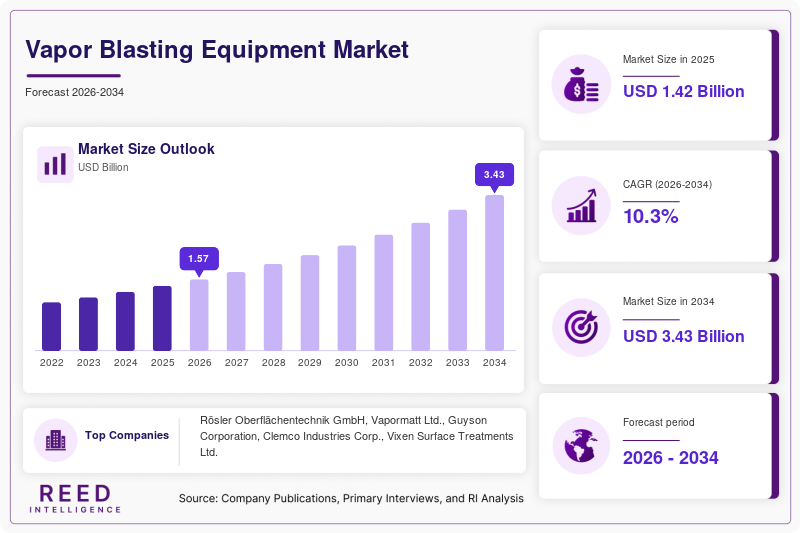
The global Vapor Blasting Equipment Market size was valued at USD 1.42 billion in 2026 and is projected to reach USD 3.12 billion by 2034, expanding at a CAGR of 10.3% during the forecast period from 2026 to 2034. The market continues to gain momentum due to the increasing adoption of precision surface finishing technologies across automotive, aerospace, medical device manufacturing, marine maintenance, and industrial refurbishment applications. Vapor blasting equipment combines water, abrasive media, and compressed air to produce smoother and cleaner surface finishes compared to conventional dry blasting methods. The technology is increasingly preferred in industries that require controlled material removal, reduced dust generation, and improved component durability.
Growing investments in industrial automation and advanced surface treatment solutions have contributed significantly to market expansion. Manufacturers are focusing on environmentally responsible surface preparation methods that reduce airborne contamination and improve workplace safety. Vapor blasting systems are increasingly integrated with closed-loop water recycling systems and automated control interfaces, helping companies comply with evolving environmental and worker safety regulations. In addition, rising demand for lightweight metal components in electric vehicles and aerospace assemblies has accelerated the use of vapor blasting equipment for surface restoration, coating preparation, and precision cleaning.
Key Highlights
- North America dominated the market with a 35.1% share in 2025, while Asia Pacific is expected to grow at the fastest CAGR of 11.8% during 2026–2034.
- By equipment type, manual vapor blasting systems accounted for the largest share of 43.8%, while automated vapor blasting systems are projected to grow at a CAGR of 12.6%.
- By application, automotive component refurbishment led with a 39.4% share, whereas aerospace surface preparation is expected to expand at a CAGR of 12.1%.
- The United States remained the dominant country, with market values of USD 410 million in 2024 and USD 455 million in 2025.
Market Trends
Integration of Automated and Smart Control Technologies
The increasing integration of automation and smart control technologies has become a notable trend in the Vapor Blasting Equipment Market. Industrial manufacturers are adopting automated vapor blasting systems equipped with programmable logic controllers, touchscreen interfaces, robotic arms, and real-time monitoring systems to improve consistency and operational efficiency. Automated equipment enables manufacturers to reduce manual intervention, maintain uniform blasting pressure, and minimize abrasive waste during high-volume production processes. This trend is particularly visible in aerospace and automotive manufacturing environments where precision finishing and repeatability are essential for maintaining product quality standards.
Manufacturers are also integrating Internet of Things connectivity and predictive maintenance capabilities into advanced vapor blasting systems. These technologies help operators monitor machine performance, water usage, abrasive consumption, and maintenance schedules through centralized dashboards. Companies are increasingly investing in digitally connected systems to reduce downtime and improve productivity across industrial operations. As labor costs continue to rise globally, automated vapor blasting equipment is expected to witness stronger demand from large manufacturing facilities seeking scalable and cost-efficient surface treatment solutions.
Rising Preference for Eco-Friendly Surface Preparation Solutions
Sustainability concerns and stricter environmental regulations are influencing purchasing decisions across the industrial equipment sector, creating strong demand for environmentally responsible vapor blasting solutions. Unlike traditional dry blasting methods that generate large quantities of airborne dust, vapor blasting systems use water-based abrasive mixtures that significantly reduce dust emissions and improve workplace safety. Industrial operators are increasingly transitioning toward cleaner surface preparation technologies to comply with occupational safety standards and environmental compliance requirements.
Equipment manufacturers are responding by introducing water recycling systems, low-consumption abrasive technologies, and energy-efficient compressors that reduce operational costs and environmental impact. Demand for eco-friendly vapor blasting equipment is particularly strong in marine maintenance, metal restoration, and medical device manufacturing applications where contamination control and environmental performance are important operational priorities. The growing adoption of sustainable industrial practices among manufacturers is expected to strengthen long-term demand for vapor blasting systems with lower emissions, reduced waste generation, and improved resource efficiency.
Market Drivers
Expansion of Automotive Restoration and Engine Rebuilding Activities
The expansion of automotive restoration, engine rebuilding, and aftermarket refurbishment activities is driving substantial demand for vapor blasting equipment globally. Automotive workshops and restoration facilities increasingly use vapor blasting systems to clean engine components, transmission housings, aluminum parts, and motorcycle assemblies without causing surface damage. The process provides smoother finishes and preserves metal integrity, making it highly suitable for restoring vintage and high-performance automotive components. Rising consumer spending on vehicle customization and restoration projects has accelerated the adoption of advanced surface treatment equipment among independent repair facilities and automotive service providers.
Electric vehicle manufacturing is also contributing to market growth as manufacturers require precise surface preparation processes for lightweight aluminum and magnesium components. Vapor blasting technology supports improved coating adhesion and corrosion resistance, making it valuable for battery enclosures and structural components. The growing global vehicle parc and increasing demand for component refurbishment services are expected to sustain long-term growth opportunities for vapor blasting equipment manufacturers.
Growing Demand from Aerospace and Precision Manufacturing Industries
The aerospace and precision manufacturing industries are increasingly relying on vapor blasting equipment for controlled surface preparation and maintenance operations. Aerospace manufacturers require advanced cleaning technologies to remove oxidation, corrosion, coatings, and contaminants from sensitive components without altering dimensional tolerances. Vapor blasting systems provide consistent finishing quality while minimizing abrasive aggression, making them suitable for turbine blades, landing gear components, and aircraft engine parts.
Precision manufacturing industries such as medical device production, electronics fabrication, and industrial tooling are also adopting vapor blasting systems for delicate cleaning and finishing applications. The technology supports superior surface quality and contamination control, which are essential in high-performance manufacturing environments. Rising global aircraft production, increasing aircraft maintenance activities, and growing investments in advanced manufacturing technologies are expected to strengthen demand for high-precision vapor blasting systems throughout the forecast period.
Market Restraint
High Initial Equipment Costs and Maintenance Requirements
The high initial investment associated with advanced vapor blasting equipment remains a significant restraint for market growth, particularly among small and medium-sized enterprises. Industrial-grade vapor blasting systems often require substantial capital expenditure due to the integration of water circulation units, abrasive recovery systems, high-pressure pumps, and automated control technologies. Smaller workshops and maintenance providers may hesitate to replace conventional dry blasting equipment because of budget limitations and uncertain return on investment timelines. The cost challenge becomes more pronounced in price-sensitive developing markets where industrial modernization remains gradual.
In addition to acquisition costs, ongoing maintenance requirements can create operational challenges for end users. Vapor blasting equipment requires regular maintenance of pumps, filtration systems, nozzles, seals, and water treatment units to ensure consistent performance and prevent system failures. Improper maintenance can lead to abrasive contamination, nozzle wear, and equipment downtime, affecting production efficiency. Industries operating in remote regions may also face limited access to skilled technicians and replacement components, increasing maintenance expenses and operational complexity. These cost-related concerns may restrict broader adoption among smaller industrial facilities despite the long-term efficiency benefits offered by vapor blasting technology.
Market Opportunities
Increasing Adoption Across Marine and Ship Maintenance Applications
The growing use of vapor blasting equipment in marine maintenance and ship refurbishment operations presents significant growth opportunities for industry participants. Shipyards and marine service providers increasingly require efficient surface preparation technologies for removing corrosion, salt deposits, marine coatings, and contaminants from metal surfaces. Vapor blasting systems provide controlled cleaning performance while reducing airborne dust and abrasive contamination, making them suitable for enclosed marine maintenance environments. Rising investments in commercial shipping fleet modernization and offshore infrastructure maintenance are creating favorable conditions for market expansion.
Marine operators are also prioritizing environmentally responsible maintenance technologies to comply with stricter environmental regulations governing shipyard operations and coastal industrial activities. Vapor blasting systems with water recycling capabilities and low-emission designs are gaining popularity among marine service providers seeking sustainable maintenance solutions. As global maritime trade volumes continue to increase, demand for efficient vessel maintenance and corrosion control technologies is expected to generate long-term opportunities for vapor blasting equipment manufacturers.
Growth Potential in Emerging Industrial Economies
Emerging industrial economies across Asia, Latin America, and the Middle East are creating substantial opportunities for the Vapor Blasting Equipment Market. Rapid industrialization, infrastructure development, and expansion of manufacturing activities are increasing demand for advanced surface treatment technologies in these regions. Governments are supporting domestic manufacturing growth through industrial modernization programs, encouraging manufacturers to adopt higher-quality production and finishing processes. This trend is expected to increase the adoption of vapor blasting equipment across automotive, machinery, aerospace, and fabrication industries.
The expansion of industrial maintenance services and metal restoration businesses in developing economies is also contributing to market potential. Local manufacturers are increasingly investing in cost-efficient and environmentally safer equipment to improve operational productivity and product quality. International equipment suppliers are expanding regional distribution networks and introducing compact, lower-cost systems tailored to small and mid-sized industrial facilities. The growing availability of affordable automated systems and rising awareness regarding worker safety standards are expected to support broader market penetration across emerging economies during the forecast period.
Segmental Analysis
By Equipment Type
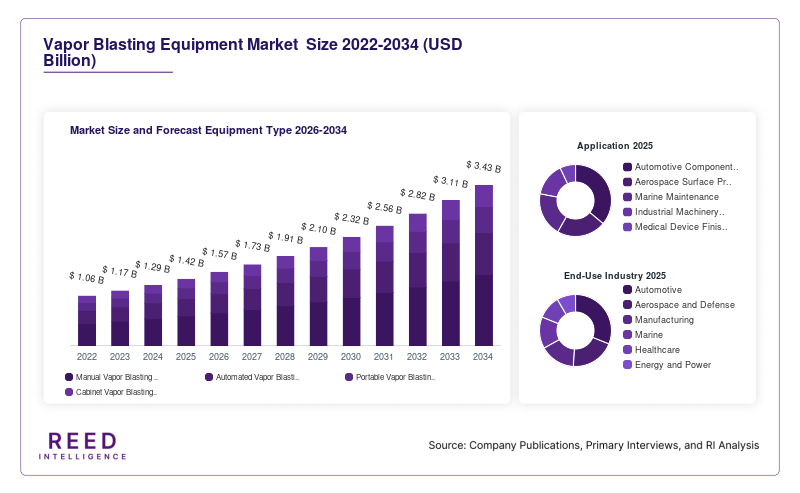
Manual vapor blasting systems accounted for the largest market share of 43.8% in 2024 due to their affordability, operational flexibility, and widespread adoption among small and medium-sized workshops. These systems are commonly used in automotive restoration, motorcycle refurbishment, metal fabrication, and industrial maintenance applications where operators require precise manual control over blasting intensity and surface finishing. Manual systems are particularly popular among independent service providers because they require lower upfront investment compared to fully automated solutions. Their compact design and ease of operation also make them suitable for workshops with limited production space.
By Application
Automotive component refurbishment emerged as the dominant application segment with a 39.4% market share in 2024. Vapor blasting equipment is extensively used for cleaning engine blocks, carburetors, transmission components, alloy wheels, and motorcycle parts without damaging delicate surfaces. Automotive workshops and restoration specialists increasingly prefer vapor blasting technology because it delivers smoother finishes while preserving material integrity. The rising popularity of vintage vehicle restoration and performance vehicle customization has significantly contributed to segment growth. In addition, expanding automotive aftermarket services and rising vehicle ownership levels are supporting consistent demand for surface restoration equipment.
By End-Use Industry
The automotive industry held the largest share of 36.7% in 2024 due to increasing demand for advanced surface finishing and component restoration technologies. Automotive manufacturers and aftermarket service providers rely on vapor blasting equipment for cleaning and preparing metal components before coating, painting, or assembly operations. The technology helps improve corrosion resistance and surface quality while reducing abrasive damage to lightweight metals. Growing production of electric vehicles and rising demand for refurbishment services are contributing significantly to segment growth. Automotive repair centers are also investing in compact vapor blasting systems to expand premium restoration service offerings.
Regional Analysis
North America
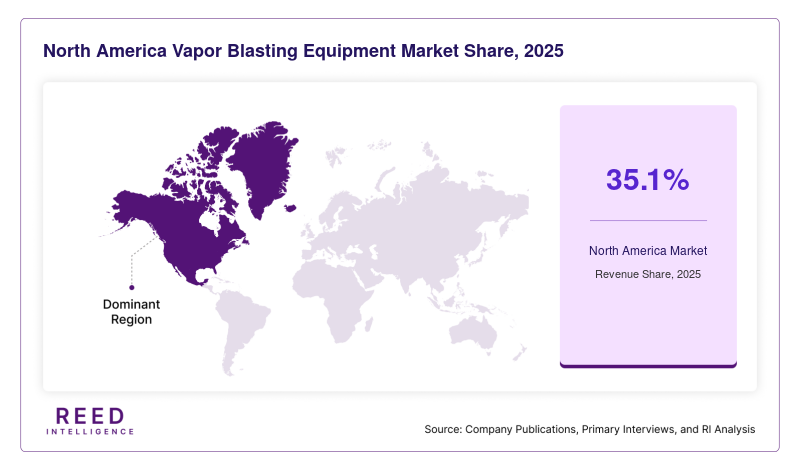
North America accounted for 35.1% of the global Vapor Blasting Equipment Market in 2025 and is expected to maintain a stable growth trajectory with a CAGR of 9.4% during the forecast period. The region benefits from the presence of advanced manufacturing industries, well-established aerospace production facilities, and strong automotive restoration markets. Industrial operators across the United States and Canada are increasingly investing in automated vapor blasting systems to improve production efficiency and comply with workplace safety regulations. The growing adoption of sustainable industrial cleaning technologies is also supporting market growth throughout the region.
Europe
Europe represented 27.3% of the global market in 2025 and is projected to grow at a CAGR of 9.8% during 2026–2034. The region benefits from strong industrial manufacturing capabilities and stringent environmental regulations that encourage the adoption of cleaner surface treatment technologies. Countries across Western Europe are replacing traditional abrasive blasting systems with water-based alternatives to reduce dust emissions and improve workplace safety standards. Automotive component manufacturing and industrial equipment refurbishment activities continue to support stable market demand.
Asia Pacific
Asia Pacific held a 22.6% market share in 2025 and is expected to record the fastest CAGR of 11.8% during the forecast period. Rapid industrialization, increasing manufacturing investments, and growing automotive production are major factors driving market expansion across the region. Countries such as China, India, Japan, and South Korea are witnessing increased adoption of vapor blasting systems within metal fabrication, automotive maintenance, and industrial restoration sectors. The growing shift toward automated production technologies is further contributing to regional demand growth.
Middle East & Africa
The Middle East & Africa region accounted for 7.4% of the global market in 2025 and is forecast to expand at a CAGR of 8.9% during 2026–2034. Demand for vapor blasting equipment in the region is supported by infrastructure development, oil and gas maintenance activities, and marine refurbishment operations. Industrial operators are increasingly adopting vapor blasting technologies to improve equipment durability and corrosion resistance in harsh environmental conditions. Investments in industrial diversification programs are also creating new opportunities for advanced surface treatment equipment suppliers.
Latin America
Latin America captured 7.6% of the global Vapor Blasting Equipment Market in 2025 and is projected to grow at a CAGR of 8.7% throughout the forecast period. The region is experiencing rising demand for industrial maintenance equipment across automotive repair, mining machinery refurbishment, and marine maintenance applications. Manufacturers and service providers are increasingly adopting vapor blasting systems to improve cleaning efficiency and reduce abrasive contamination. Growing awareness regarding workplace safety standards is also encouraging industries to shift away from traditional dry blasting methods.
Competitive Landscape
The Vapor Blasting Equipment Market is moderately fragmented, with several regional and international manufacturers competing through product innovation, distribution expansion, and strategic partnerships. Companies are increasingly focusing on automated blasting technologies, energy-efficient systems, and environmentally responsible equipment designs to strengthen their market positions. The competitive environment is influenced by growing industrial demand for precision surface preparation solutions and rising investment in advanced manufacturing technologies.
Rösler Oberflächentechnik GmbH remains one of the leading participants in the global market due to its broad product portfolio and strong presence across industrial finishing applications. The company continues to invest in automation technologies and integrated blasting solutions designed for aerospace and automotive industries. Vapormatt Ltd., another prominent market participant, recently introduced an upgraded automated vapor blasting system featuring advanced water recycling capabilities and digital process monitoring functions to improve operational efficiency.
Key Players
- Rösler Oberflächentechnik GmbH
- Vapormatt Ltd.
- Guyson Corporation
- Clemco Industries Corp.
- Vixen Surface Treatments Ltd.
- Graco Inc.
- Airblast B.V.
- Empire Abrasive Equipment Company
- Surface Blasting Systems LLC
- Norton Sandblasting Equipment
- ACF France
- FerroECOBlast Europe
- Hodge Clemco Ltd.
- IST International Surface Technologies
- Blastline Group
Recent Developments
- In February 2026, Vapormatt Ltd. launched a new automated vapor blasting platform equipped with smart monitoring software for aerospace component finishing applications.
- In September 2025, Rösler Oberflächentechnik GmbH expanded its manufacturing facility in Germany to increase production capacity for automated surface treatment systems.
- In April 2025, Guyson Corporation introduced a compact vapor blasting cabinet designed for automotive restoration workshops and small industrial maintenance facilities.
- In November 2025, Vixen Surface Treatments Ltd. announced the integration of advanced water recycling technology into its industrial vapor blasting product line to improve environmental performance.
- In January 2026, Clemco Industries Corp. partnered with regional distributors in Southeast Asia to strengthen its presence in emerging industrial markets.
Vapor Blasting Equipment Market Segments
Equipment Type
- Manual Vapor Blasting Systems
- Automated Vapor Blasting Systems
- Portable Vapor Blasting Systems
- Cabinet Vapor Blasting Systems
Application
- Automotive Component Refurbishment
- Aerospace Surface Preparation
- Marine Maintenance
- Industrial Machinery Cleaning
- Medical Device Finishing
End-Use Industry
- Automotive
- Aerospace and Defense
- Manufacturing
- Marine
- Healthcare
- Energy and Power
By Region
- North America
- Europe
- APAC
- Middle East and Africa
- LATAM