Vascular Snare Market Size, Share & Demand Report By Product Type (Single-Loop Snares, Triple-Loop Snares, Multi-Loop Snares), By Material (Nitinol, Stainless Steel, Platinum-Coated Materials), By Application (Foreign Body Retrieval, Thrombus Management, Embolization Support, Catheter Repositioning), By End User (Hospitals, Ambulatory Surgical Centers, Specialty Clinics) By Region & Segment Forecasts, 2026–2034
USD 3950
Market Overview
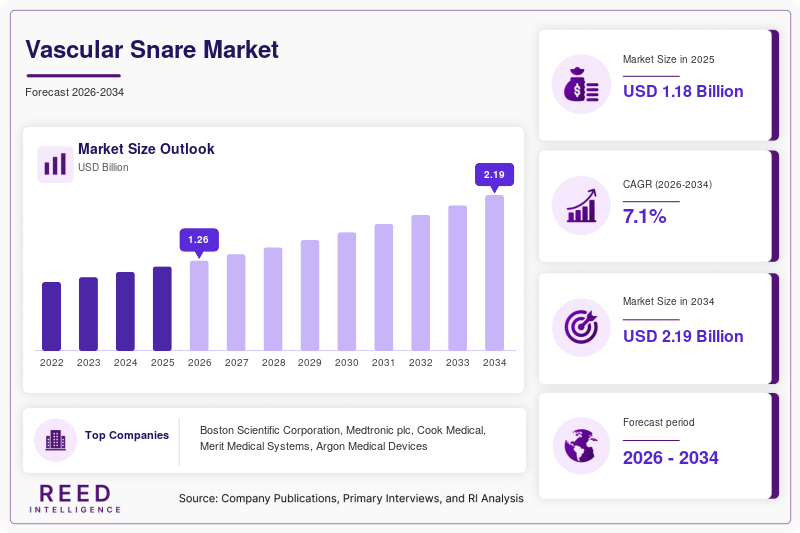
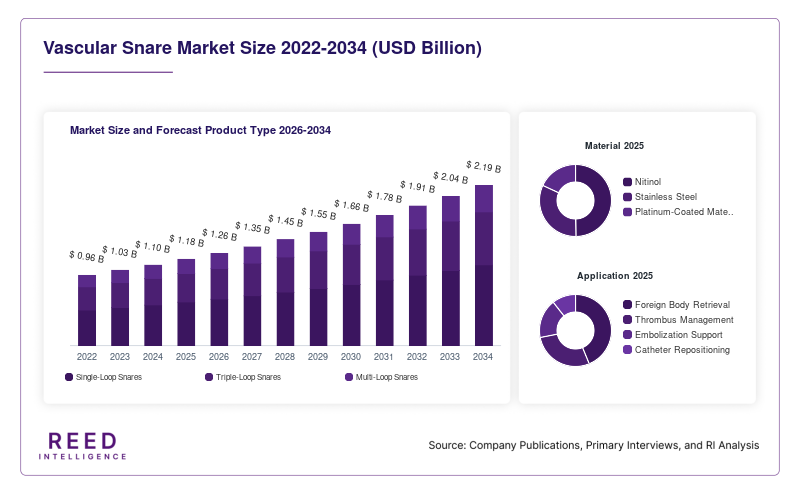
The Vascular Snare Market size was valued at USD 1.18 billion in 2026 and is projected to reach USD 2.04 billion by 2034, expanding at a CAGR of 7.1% during the forecast period of 2026–2034. The market growth has been supported by the increasing volume of minimally invasive vascular procedures across hospitals, specialty cardiac centers, and ambulatory surgical facilities. The rising preference for catheter-based interventions and foreign body retrieval procedures has strengthened demand for vascular snares in interventional radiology and cardiovascular applications worldwide.
The growing prevalence of cardiovascular diseases, venous disorders, and complex vascular complications has accelerated the use of vascular retrieval devices. Physicians increasingly rely on vascular snares during thrombectomy support procedures, catheter fragment retrieval, guidewire extraction, and embolization support. Technological developments in nitinol-based loop systems and improved catheter maneuverability have further contributed to market expansion.
Key Highlights
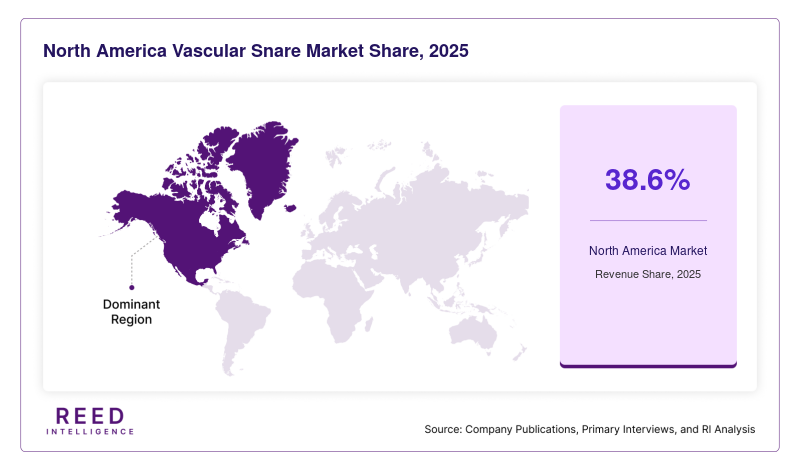
- North America accounted for 38.6% of the global Vascular Snare Market share in 2025, while Asia Pacific is projected to register the fastest CAGR of 8.4% during 2026–2034.
- By product type, single-loop vascular snares held the dominant share of 46.2% in 2025, while triple-loop vascular snares are anticipated to witness the fastest CAGR of 8.1%.
- By material, nitinol-based snares dominated with a 61.5% share in 2025, whereas platinum-coated snares are forecast to expand at a CAGR of 7.9%.
- By application, foreign body retrieval represented the leading segment with 41.8% market share in 2025, while thrombus management applications are expected to grow at a CAGR of 8.3%.
- By end user, hospitals captured 57.4% of the Vascular Snare Market share in 2025, whereas ambulatory surgical centers are projected to expand at a CAGR of 8.0%.
- The United States remained the dominant country market and was valued at USD 341.2 million in 2024 and USD 364.9 million in 2025.
Market Trends
Increasing Adoption of Nitinol-Based Snare Systems
Manufacturers are increasingly focusing on nitinol-based vascular snares due to their flexibility, shape memory properties, and enhanced procedural control. Healthcare professionals prefer nitinol loops for complex retrieval procedures involving fragmented catheters, vena cava filter components, and migrated stents. The improved torque response and navigation capabilities of nitinol devices have strengthened their adoption in interventional cardiology and radiology procedures.
The trend has also encouraged product differentiation through enhanced loop stability and low-profile catheter compatibility. Companies are introducing multi-loop systems designed for difficult vascular anatomies, supporting procedural efficiency and reducing retrieval time.
Expansion of Minimally Invasive Vascular Procedures
The growing use of minimally invasive interventions has emerged as a major trend influencing the Vascular Snare Market. Hospitals and specialty clinics are increasingly adopting catheter-based vascular procedures due to shorter recovery times, reduced hospital stays, and lower procedural risks compared to open surgeries.
This transition has increased demand for vascular access support tools and retrieval devices. Interventional specialists are incorporating vascular snares into procedures involving embolization, electrophysiology, dialysis access management, and peripheral vascular repair. The trend is expected to remain strong as healthcare systems prioritize procedural efficiency and patient recovery outcomes.
Market Drivers
Rising Incidence of Cardiovascular and Vascular Disorders
The increasing burden of cardiovascular diseases and vascular complications has significantly driven the Vascular Snare Market. Growing cases of peripheral artery disease, venous thromboembolism, and catheter-related complications have increased the number of vascular interventions worldwide.
Patients undergoing prolonged catheterization procedures often experience device migration or fractured guidewire complications, creating demand for retrieval systems. Healthcare providers are expanding interventional treatment capacities to manage these cases efficiently, contributing to market growth.
Growing Demand for Image-Guided Interventional Procedures
The rapid adoption of fluoroscopy-guided and angiography-assisted procedures has accelerated demand for vascular snares. Interventional radiologists and cardiologists increasingly require precise retrieval tools for navigating complex vascular pathways.
Advancements in imaging technologies have improved procedural accuracy and increased physician confidence in minimally invasive retrieval techniques. The integration of advanced imaging with vascular snare systems has strengthened procedural success rates and supported broader product utilization across healthcare facilities.
Market Restraint
High Cost of Advanced Interventional Devices
The high cost associated with advanced vascular retrieval devices remains a key restraint for the Vascular Snare Market. Premium nitinol-based snares and specialized multi-loop systems increase procedural expenses for healthcare facilities operating under budget constraints.
Smaller hospitals and healthcare centers in emerging economies often face limitations in adopting advanced retrieval technologies due to cost pressures. In addition, reimbursement variations across countries may restrict widespread product penetration.
Market Opportunities
Expansion of Ambulatory Surgical Centers
The growing number of ambulatory surgical centers presents significant opportunities for the Vascular Snare Market. These facilities increasingly perform minimally invasive vascular procedures due to lower operational costs and faster patient throughput.
Manufacturers are developing compact and easy-to-use snare systems tailored for outpatient settings. The shift toward same-day vascular interventions is expected to create additional product demand across ambulatory environments.
Increasing Healthcare Investments in Emerging Economies
Developing healthcare infrastructure in emerging economies offers strong opportunities for market participants. Governments and private healthcare organizations in Asia Pacific, Latin America, and the Middle East are investing in interventional radiology capabilities and advanced cardiovascular treatment facilities.
The expansion of tertiary care hospitals and catheterization laboratories is expected to increase procurement of vascular retrieval devices. Rising physician training programs in minimally invasive procedures will further support market penetration.
Segmental Analysis
By Product Type
Based on product type, the Vascular Snare Market is segmented into single-loop snares, triple-loop snares, and multi-loop snares.
Single-loop snares dominated the market with a 46.2% share in 2025 due to their broad usage in standard foreign body retrieval procedures. Their simple structure, procedural familiarity, and compatibility with multiple catheter systems supported strong adoption across hospitals and specialty clinics.
Triple-loop snares are expected to witness the fastest CAGR of 8.1% during the forecast period. Their enhanced grasping capability and improved stability during complex retrieval procedures will drive demand. Physicians are increasingly utilizing triple-loop systems for retrieving migrated stents and fractured catheter fragments in difficult vascular anatomies.
By Material
Based on material, the market is categorized into nitinol, stainless steel, and platinum-coated materials.
Nitinol-based vascular snares accounted for the largest market share of 61.5% in 2025 due to superior flexibility and shape-memory functionality. The material’s resistance to deformation and ability to maintain loop integrity improved procedural outcomes in minimally invasive interventions.
Platinum-coated snares are anticipated to grow at a CAGR of 7.9% during 2026–2034. Enhanced radiopacity and improved visualization under fluoroscopy will support their increasing use in precision-guided retrieval procedures. The demand for highly visible devices in complex vascular pathways is expected to accelerate segment growth.
By Application
Based on application, the Vascular Snare Market is segmented into foreign body retrieval, thrombus management, embolization support, and catheter repositioning.
Foreign body retrieval held the dominant share of 41.8% in 2025 due to the rising incidence of catheter fragment migration and guidewire retrieval procedures. Hospitals increasingly utilized vascular snares to manage procedural complications involving intravascular foreign objects.
Thrombus management applications are projected to expand at the fastest CAGR of 8.3% through 2034. The increasing use of thrombectomy-assisted procedures and rising prevalence of venous thromboembolic conditions will contribute to segment growth. Healthcare providers are expected to integrate vascular snares into advanced clot retrieval procedures for enhanced procedural control.
By End User
Based on end user, the market is divided into hospitals, ambulatory surgical centers, and specialty clinics.
Hospitals accounted for 57.4% of the Vascular Snare Market share in 2025 owing to the availability of advanced imaging systems, hybrid operating rooms, and skilled interventional specialists. Large patient inflow for cardiovascular and radiology procedures supported strong procurement levels.
Ambulatory surgical centers are forecast to register the fastest CAGR of 8.0% during the study period. Increasing preference for outpatient vascular procedures and reduced treatment costs will support segment expansion. These facilities are expected to adopt compact and procedure-efficient retrieval devices to improve operational workflow.
Regional Analysis
North America
North America accounted for 38.6% of the global Vascular Snare Market share in 2025 and is expected to grow at a CAGR of 6.8% during 2026–2034. The region maintained a strong position due to high procedural volumes involving cardiovascular interventions and advanced hospital infrastructure.
The United States remained the dominant country within the region due to the growing adoption of interventional radiology procedures. Increasing utilization of hybrid operating rooms and advanced imaging systems supported demand for vascular retrieval products across major healthcare facilities.
Europe
Europe represented 27.4% of the global Vascular Snare Market share in 2025 and is projected to expand at a CAGR of 6.7% through 2034. The region benefited from rising demand for minimally invasive vascular treatment approaches and increasing healthcare modernization programs.
Germany led the European market due to strong investments in catheterization laboratories and interventional cardiology services. The country’s emphasis on procedural efficiency and technological integration supported product adoption across public and private hospitals.
Asia Pacific
Asia Pacific captured 21.8% of the global Vascular Snare Market share in 2025 and is forecast to witness the fastest CAGR of 8.4% during 2026–2034. Rapid expansion of healthcare infrastructure and increasing awareness regarding minimally invasive vascular procedures contributed to regional growth.
China dominated the regional market owing to expanding cardiovascular treatment capacity and increasing hospital investments in interventional radiology equipment. The country also experienced growing patient volumes requiring vascular access management and retrieval procedures.
Middle East & Africa
Middle East & Africa accounted for 6.4% of the global Vascular Snare Market share in 2025 and is anticipated to grow at a CAGR of 6.3% during the forecast period. Healthcare diversification initiatives and rising investments in specialty care facilities supported regional demand.
Saudi Arabia emerged as the leading country market due to increasing expansion of tertiary healthcare centers and growing adoption of image-guided procedures. National healthcare modernization strategies contributed to the installation of advanced interventional systems.
Latin America
Latin America held 5.8% of the global Vascular Snare Market share in 2025 and is projected to expand at a CAGR of 6.1% during 2026–2034. The region witnessed rising demand for minimally invasive vascular treatments across urban healthcare centers.
Brazil remained the dominant country due to the increasing number of interventional cardiology procedures and gradual improvements in healthcare access. Expanding private hospital networks supported the adoption of vascular retrieval technologies.
Competitive Landscape
The Vascular Snare Market remains moderately consolidated with established medical device companies focusing on product innovation, geographic expansion, and strategic collaborations. Leading players continue to invest in advanced nitinol technologies and low-profile catheter-compatible retrieval systems to strengthen market presence.
Boston Scientific Corporation remained a leading market participant due to its diversified interventional portfolio and strong global distribution network. The company recently expanded its vascular intervention product line with enhanced retrieval solutions designed for complex catheter-based procedures.
Merit Medical Systems focused on expanding physician training initiatives and improving product accessibility across emerging healthcare markets. Argon Medical Devices emphasized product customization for interventional radiology applications, while Cook Medical strengthened its minimally invasive vascular product portfolio through technological enhancements. Medtronic plc continued to invest in advanced imaging-integrated vascular intervention solutions.
Key Players List
- Boston Scientific Corporation
- Medtronic plc
- Cook Medical
- Merit Medical Systems
- Argon Medical Devices
- Becton, Dickinson and Company
- Terumo Corporation
- Teleflex Incorporated
- Cardinal Health
- Integer Holdings Corporation
- Stryker Corporation
- Abbott Laboratories
- Penumbra Inc.
- B. Braun Melsungen AG
- AngioDynamics Inc.
Recent Developments
- In 2025, Boston Scientific Corporation introduced an upgraded vascular retrieval system featuring enhanced loop stability for complex interventional procedures.
- In 2024, Merit Medical Systems expanded its distribution partnerships in Asia Pacific to strengthen access to minimally invasive vascular devices.
- In 2025, Cook Medical launched a low-profile snare catheter designed for challenging peripheral vascular anatomies.
- In 2024, Argon Medical Devices announced investments in advanced manufacturing technologies for nitinol-based vascular retrieval products.
- In 2025, Terumo Corporation increased research initiatives focused on fluoroscopy-compatible vascular intervention devices.
Vascular Snare Market Segments
Product Type
- Single-Loop Snares
- Triple-Loop Snares
- Multi-Loop Snares
Material
- Nitinol
- Stainless Steel
- Platinum-Coated Materials
Application
- Foreign Body Retrieval
- Thrombus Management
- Embolization Support
- Catheter Repositioning
End User
- Hospitals
- Ambulatory Surgical Centers
- Specialty Clinics
By Region
- North America
- Europe
- APAC
- Middle East and Africa
- LATAM