VAT Photopolymerization 3D Printing Technology Market Size, Share & Demand Report By Technology Type (Stereolithography (SLA), Digital Light Processing (DLP), Continuous Liquid Interface Production (CLIP)), By Application (Prototyping, Dental, Jewelry, Engineering Components), By End-Use Industry (Healthcare, Automotive, Aerospace, Consumer Goods) & Segment Forecasts, 2026–2034
USD 3950
Market Overview
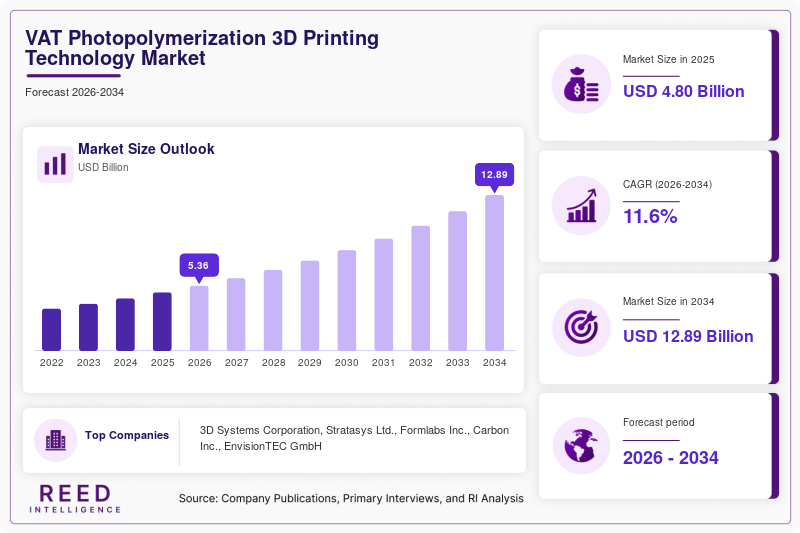
The global VAT Photopolymerization 3D Printing Technology Market size was valued at approximately USD 4.8 billion in 2026 and is projected to reach USD 11.6 billion by 2034, expanding at a compound annual growth rate (CAGR) of 11.6% during the forecast period. This growth reflects increasing adoption across industries such as healthcare, automotive, aerospace, and consumer goods, where high precision and surface quality are critical. The technology’s ability to produce complex geometries with fine resolution has positioned it as a preferred solution for prototyping and end-use manufacturing.
One key global factor supporting market expansion is the accelerating shift toward digital manufacturing ecosystems. Organizations are integrating additive manufacturing technologies into their production workflows to reduce lead times, enable customization, and optimize material usage. VAT photopolymerization processes, including stereolithography (SLA) and digital light processing (DLP), offer high accuracy and smooth finishes, making them suitable for dental, medical, and jewelry applications. As industries pursue efficiency and sustainability, demand for these technologies continues to rise.
Key Highlights
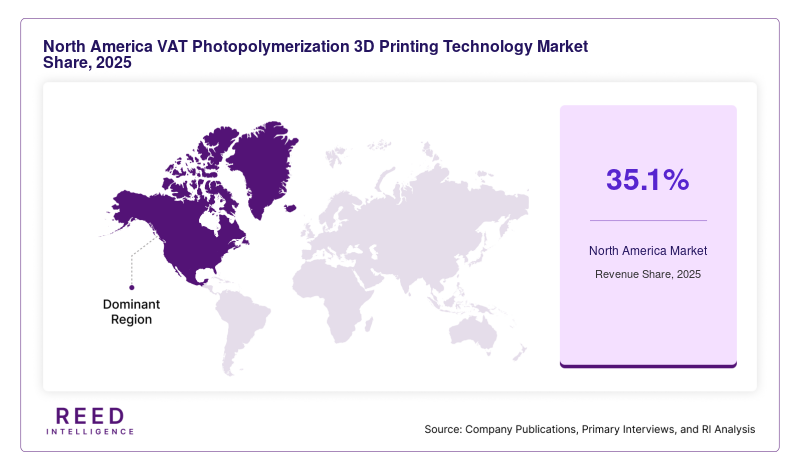
- North America dominated the market with a 35.1% share in 2025.
- Asia Pacific is expected to grow at the fastest CAGR of 12.3% during 2026–2034.
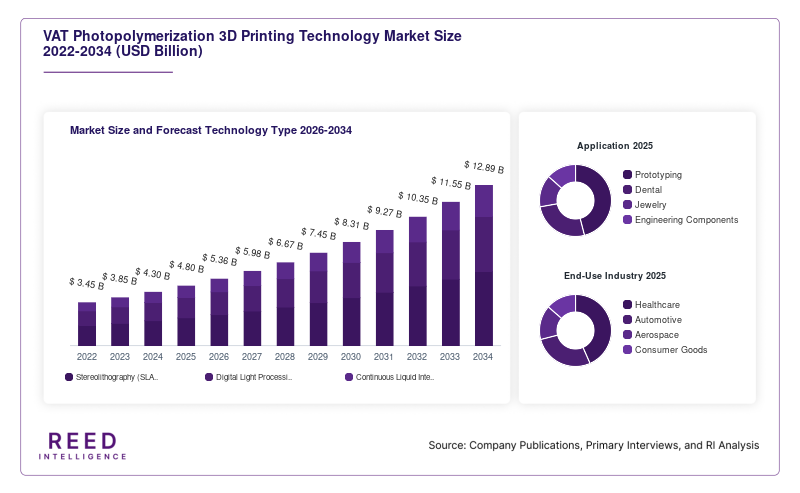
- By technology type, stereolithography (SLA) accounted for the largest share of 42.8%, while digital light processing (DLP) is projected to grow at a CAGR of 12.9%.
- By application, prototyping led with a 44.6% share, whereas dental applications are expected to expand at a CAGR of 13.1%.
- The United States remained the dominant country, with market values of USD 1.2 billion in 2024 and USD 1.3 billion in 2025.
Market Trends
Increasing adoption in dental and healthcare applications
The healthcare sector is witnessing growing adoption of VAT photopolymerization technologies, particularly in dental and medical device manufacturing. Dental laboratories increasingly rely on stereolithography and digital light processing systems for producing crowns, bridges, aligners, and surgical guides with high precision. The ability to achieve micron-level accuracy and smooth surface finishes reduces post-processing requirements and improves patient outcomes. Additionally, biocompatible photopolymer resins are gaining traction, enabling the production of customized implants and prosthetics. As patient-specific solutions become more important, healthcare providers are integrating these technologies into routine workflows. The trend is further supported by regulatory approvals for medical-grade materials and advancements in resin formulations that enhance durability and safety.
Advancements in material science and resin innovation
Material innovation is playing a crucial role in shaping the VAT photopolymerization 3D printing technology market. Manufacturers are developing advanced photopolymers with improved mechanical properties, thermal resistance, and chemical stability. These materials expand the application scope beyond prototyping into functional end-use parts. Engineering-grade resins are now capable of mimicking properties of traditional plastics and even metals in certain use cases. Furthermore, research into sustainable and bio-based resins is gaining momentum as industries seek environmentally responsible alternatives. Enhanced material performance combined with reduced costs is encouraging adoption across sectors such as automotive and electronics, where durability and precision are essential.
Market Drivers
Rising demand for high-precision manufacturing solutions
The growing need for high-precision manufacturing is a primary driver for the VAT photopolymerization 3D printing technology market. Industries such as aerospace, medical devices, and electronics require components with tight tolerances and intricate geometries that traditional manufacturing methods struggle to achieve. VAT photopolymerization technologies provide superior resolution and accuracy, making them ideal for such applications. The ability to produce complex designs without tooling also reduces production costs and lead times. As companies aim to enhance product performance and reduce waste, these technologies are becoming integral to advanced manufacturing strategies. The demand is further fueled by the increasing complexity of modern products, which require innovative fabrication methods.
Growth of customized and on-demand production
Customization is becoming a key requirement across industries, driving the adoption of VAT photopolymerization technologies. Consumers and businesses alike are seeking personalized products, from dental aligners to customized consumer goods. These technologies enable efficient production of small batches and unique designs without significant cost increases. On-demand manufacturing reduces inventory costs and allows companies to respond quickly to changing market demands. Additionally, the integration of digital design tools with 3D printing systems streamlines the production process. As e-commerce and digital platforms expand, the need for flexible and responsive manufacturing solutions continues to grow, supporting market expansion.
Market Restraint
High material costs and limited durability of photopolymers
Despite its advantages, the VAT photopolymerization 3D printing technology market faces challenges related to material costs and performance limitations. Photopolymer resins used in these systems are generally more expensive than conventional materials, which can increase overall production costs. This factor limits adoption among small and medium-sized enterprises that operate under tight budgets. Additionally, some photopolymer materials lack the durability and long-term stability required for certain industrial applications. Exposure to UV light and environmental conditions can degrade material properties over time, reducing product lifespan. These limitations restrict the use of VAT photopolymerization in applications requiring high mechanical strength or outdoor durability.
The industry is actively addressing these challenges through research and development, focusing on improving material performance and reducing costs. However, the pace of innovation must accelerate to meet the growing demand for cost-effective and durable solutions. Until these issues are resolved, they may hinder widespread adoption in specific sectors such as heavy manufacturing and construction.
Market Opportunities
Expansion in industrial manufacturing applications
The expansion of VAT photopolymerization technologies into industrial manufacturing presents significant growth opportunities. Traditionally used for prototyping, these technologies are increasingly being adopted for producing functional parts in sectors such as automotive and aerospace. Advances in material properties and printing speed are enabling manufacturers to use these systems for low-volume production and specialized components. This shift is driven by the need for lightweight, high-performance parts and the ability to reduce material waste. As industries move toward digital manufacturing, VAT photopolymerization is expected to play a critical role in enabling efficient and flexible production processes.
Integration with Industry 4.0 and automation systems
The integration of VAT photopolymerization technologies with Industry 4.0 frameworks offers substantial opportunities for market growth. Smart manufacturing systems that incorporate automation, data analytics, and connectivity can enhance the efficiency and scalability of 3D printing operations. Real-time monitoring and predictive maintenance improve system reliability and reduce downtime. Additionally, cloud-based platforms enable remote operation and collaboration, expanding the reach of these technologies. As companies invest in digital transformation, the adoption of advanced additive manufacturing solutions is expected to increase, creating new revenue streams and innovation opportunities for market players.
Segmental Analysis
By Technology Type
Stereolithography (SLA) dominated the VAT photopolymerization 3D printing technology market in 2024, accounting for a 42.8% share. SLA systems are widely used due to their high precision, smooth surface finish, and ability to produce complex geometries. These systems are particularly popular in industries such as healthcare and jewelry, where detail and accuracy are critical. The availability of a wide range of photopolymer resins further enhances their versatility. Additionally, SLA technology is well-established, with a strong ecosystem of manufacturers and service providers supporting its adoption.
Digital Light Processing (DLP) is the fastest-growing subsegment, projected to expand at a CAGR of 12.9%. DLP systems offer faster printing speeds compared to SLA, making them suitable for high-volume production. The technology’s ability to cure entire layers simultaneously improves efficiency and reduces production time. Growth is driven by increasing demand for rapid manufacturing solutions and advancements in projector technology, which enhance resolution and reliability.
By Application
Prototyping accounted for the largest share of 44.6% in 2024, reflecting the widespread use of VAT photopolymerization technologies in product development. Companies across industries rely on these systems to create accurate prototypes quickly and cost-effectively. The ability to test and iterate designs rapidly accelerates innovation and reduces time-to-market. Prototyping remains a critical application as businesses continue to prioritize agility and efficiency in product development processes.
Dental applications represent the fastest-growing segment, with a CAGR of 13.1%. The increasing adoption of digital dentistry and demand for customized dental solutions drive this growth. VAT photopolymerization technologies enable precise fabrication of dental models, aligners, and prosthetics. Advances in biocompatible materials further support the expansion of this segment, making it a key growth area for the market.
By End-Use Industry
The healthcare sector dominated the market in 2024, accounting for a 36.9% share. The use of VAT photopolymerization technologies in medical and dental applications has increased significantly due to their precision and customization capabilities. Hospitals and laboratories use these systems for producing surgical guides, implants, and prosthetics. The growing focus on personalized medicine further drives adoption in this sector.
The automotive industry is the fastest-growing end-use segment, with a CAGR of 12.5%. Automakers are increasingly adopting 3D printing technologies for prototyping and manufacturing lightweight components. The ability to reduce material waste and improve design flexibility makes VAT photopolymerization an attractive option. As the industry moves toward electric vehicles and advanced designs, the demand for innovative manufacturing solutions continues to grow.
Regional Analysis
North America
North America accounted for a 35.1% share of the VAT photopolymerization 3D printing technology market in 2025 and is expected to grow at a CAGR of 10.8% through 2034. The region benefits from strong adoption of advanced manufacturing technologies and significant investment in research and development. The presence of established industry players and a robust technological infrastructure further supports market growth.
The United States dominates the regional market, driven by high demand from healthcare and aerospace sectors. A unique growth factor is the strong collaboration between academic institutions and industry, which accelerates innovation in materials and printing techniques. Government funding for additive manufacturing initiatives also contributes to market expansion.
Europe
Europe held a 27.4% market share in 2025 and is projected to grow at a CAGR of 10.5% during the forecast period. The region’s focus on sustainability and advanced manufacturing drives the adoption of VAT photopolymerization technologies. Strict environmental regulations encourage the development of eco-friendly materials and processes.
Germany leads the European market, supported by its strong industrial base and emphasis on precision engineering. A unique growth factor is the integration of 3D printing technologies into automotive manufacturing, enabling efficient prototyping and production of lightweight components.
Asia Pacific
Asia Pacific is the fastest-growing region, with a CAGR of 12.3% from 2026 to 2034 and a 24.6% share in 2025. Rapid industrialization and increasing adoption of digital manufacturing technologies are key drivers. The region’s expanding manufacturing sector creates significant demand for high-precision production solutions.
China dominates the regional market due to its large manufacturing base and government support for additive manufacturing technologies. A unique growth factor is the rapid expansion of consumer electronics production, which requires precise and efficient manufacturing methods.
Middle East & Africa
The Middle East & Africa region held a 6.2% share in 2025 and is expected to grow at a CAGR of 9.4%. The adoption of VAT photopolymerization technologies is driven by increasing investment in industrial diversification and technological innovation.
The United Arab Emirates is a leading country in the region, with a focus on adopting advanced manufacturing technologies. A unique growth factor is government initiatives promoting 3D printing in construction and healthcare sectors, which support market growth.
Latin America
Latin America accounted for a 6.7% market share in 2025 and is projected to grow at a CAGR of 9.8% through 2034. The region is gradually adopting additive manufacturing technologies to improve industrial efficiency and competitiveness.
Brazil leads the regional market, driven by growing demand from automotive and healthcare industries. A unique growth factor is the increasing use of 3D printing for educational and research purposes, which supports technological advancement and workforce development.
Competitive Landscape
The VAT photopolymerization 3D printing technology market is characterized by intense competition and continuous innovation. Leading companies focus on developing advanced materials, improving printing speed, and expanding application areas. The market includes both established players and emerging startups, creating a dynamic competitive environment. Strategic partnerships, mergers, and acquisitions are common as companies seek to strengthen their market position.
One of the leading players is 3D Systems Corporation, which has a strong presence in stereolithography technology. The company recently introduced a new range of high-performance resins designed for industrial applications, enhancing its product portfolio. Other key players are investing in research and development to improve material properties and system capabilities. The competitive landscape is expected to remain dynamic as technological advancements and market demand continue to evolve.
Key Players
- 3D Systems Corporation
- Stratasys Ltd.
- Formlabs Inc.
- EnvisionTEC GmbH
- Carbon Inc.
- Prodways Group
- DWS Systems
- Asiga
- Photocentric Ltd.
- XYZprinting Inc.
- FlashForge Corporation
- Anycubic Technology
- Peopoly
- SprintRay Inc.
- Ackuretta Technologies
Recent Developments
- In 2025, Formlabs introduced a new high-speed SLA printer aimed at industrial users, improving productivity and efficiency.
- In 2024, Carbon Inc. expanded its material portfolio with advanced engineering resins designed for automotive applications.
- In 2025, Stratasys Ltd. partnered with a healthcare provider to develop customized medical solutions using VAT photopolymerization technology.
VAT Photopolymerization 3D Printing Technology Market Segments
Technology Type
- Stereolithography (SLA)
- Digital Light Processing (DLP)
- Continuous Liquid Interface Production (CLIP)
Application
- Prototyping
- Dental
- Jewelry
- Engineering Components
End-Use Industry
- Healthcare
- Automotive
- Aerospace
- Consumer Goods
By Region
- North America
- Europe
- APAC
- Middle East and Africa
- LATAM