VCSEL Sensor Market Size, Share & Demand Report By Type (Single-Mode VCSEL, Multi-Mode VCSEL), By Application (Consumer Electronics, Automotive LiDAR, Industrial Automation, Healthcare), By End-Use (Consumer Electronics, Automotive, Industrial, Healthcare), By Region & Segment Forecasts, 2026–2034
USD 3950
Market Overview
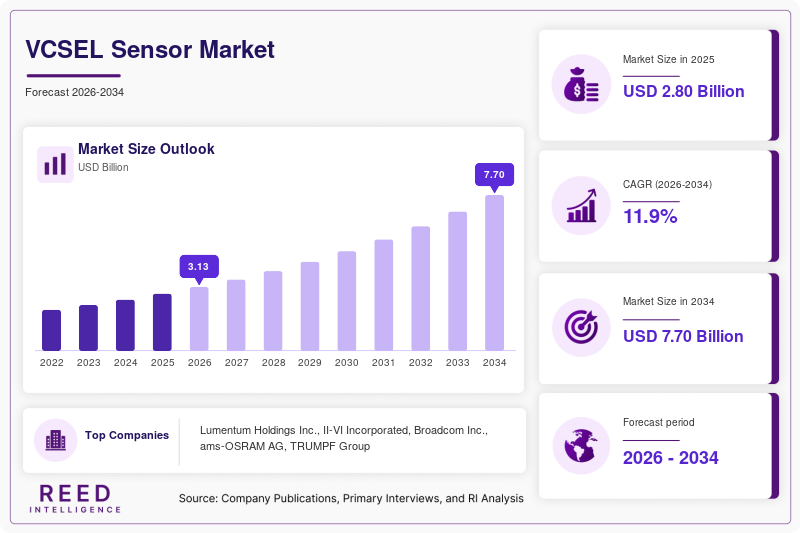
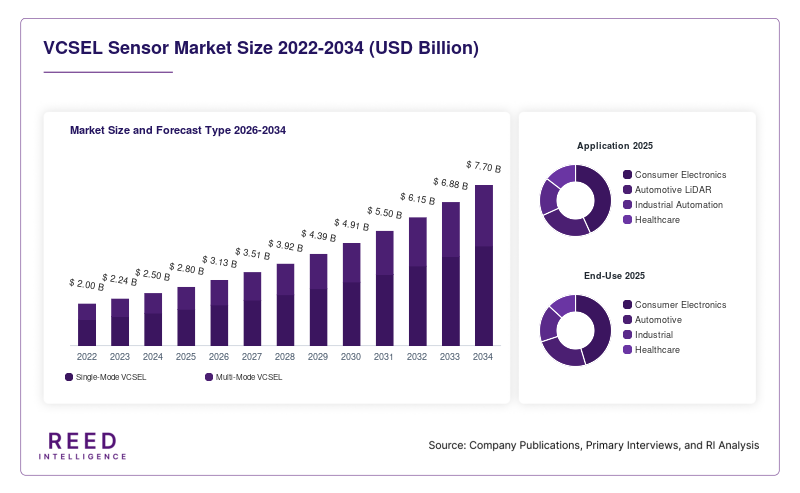
The VCSEL Sensor Market size was valued at approximately USD 2.8 billion in 2026 and is projected to reach USD 6.9 billion by 2034, expanding at a compound annual growth rate (CAGR) of 11.9% during 2026–2034. The market demonstrates steady expansion due to increasing integration of vertical-cavity surface-emitting laser (VCSEL) sensors in consumer electronics, automotive safety systems, and industrial automation. These sensors offer advantages such as low power consumption, compact size, and high precision, making them suitable for applications including facial recognition, LiDAR, and proximity sensing.
A key global factor supporting market growth is the rapid adoption of 3D sensing technologies across smartphones and wearable devices. Manufacturers are increasingly incorporating VCSEL-based solutions to enhance biometric authentication and augmented reality features. Additionally, advancements in optical communication and the transition toward autonomous systems are further accelerating adoption. The growing demand for efficient sensing technologies in smart infrastructure and Industry 4.0 ecosystems also contributes to market expansion.
Key Highlights
- North America dominated the market with a 36.1% share in 2025.
- Asia Pacific is expected to grow at the fastest CAGR of 12.8% during 2026–2034.
- By type, single-mode VCSEL sensors accounted for the largest share of 42.3%.
- while multi-mode VCSEL sensors are projected to grow at a CAGR of 13.2%.
- By application, consumer electronics led with a 45.6% share, whereas automotive LiDAR applications are expected to expand at a CAGR of 13.5%.
- The United States remained the dominant country, with market values of USD 620 million in 2024 and USD 690 million in 2025.
Market Trends
Rising Integration of 3D Sensing in Consumer Electronics
The growing demand for advanced biometric and imaging technologies is driving the integration of 3D sensing solutions in consumer electronics. VCSEL sensors are increasingly used in smartphones, tablets, and wearable devices to enable features such as facial recognition, gesture control, and depth mapping. Manufacturers are focusing on improving accuracy and reducing power consumption, which aligns with the inherent advantages of VCSEL technology. The proliferation of augmented reality (AR) and virtual reality (VR) applications further strengthens this trend, as these technologies require precise depth sensing and real-time data processing. Continuous innovation in compact sensor design and cost optimization is making VCSEL solutions more accessible across mid-range devices, thereby expanding the addressable market.
Expansion of Automotive LiDAR and ADAS Applications
The automotive industry is witnessing increased adoption of VCSEL sensors in LiDAR systems and advanced driver-assistance systems (ADAS). These sensors provide high-speed data transmission and accurate distance measurement, which are critical for autonomous driving technologies. Automakers are investing in solid-state LiDAR solutions that rely on VCSEL arrays for improved reliability and scalability. The transition toward electric and autonomous vehicles is accelerating demand for high-performance sensing components. Additionally, regulatory emphasis on vehicle safety and collision avoidance systems is encouraging integration of VCSEL-based solutions. This trend is expected to gain momentum as manufacturers prioritize sensor fusion technologies for enhanced environmental perception.
Market Drivers
Increasing Demand for Biometric Authentication Technologies
The rising adoption of biometric authentication systems across consumer electronics and security applications is a key driver of the VCSEL sensor market. Devices such as smartphones and laptops increasingly rely on facial recognition and iris scanning, which require precise and reliable sensing technologies. VCSEL sensors enable high-resolution 3D mapping and efficient light emission, making them suitable for these applications. The growing emphasis on data security and user convenience is pushing manufacturers to integrate advanced biometric features. Additionally, the expansion of digital payment systems and secure access solutions further strengthens demand for VCSEL-based sensors, supporting sustained market growth.
Growth of Industrial Automation and Smart Manufacturing
The rapid development of industrial automation and smart manufacturing systems is contributing significantly to the demand for VCSEL sensors. These sensors are used in machine vision, robotics, and process monitoring applications to improve efficiency and accuracy. The adoption of Industry 4.0 practices has increased the need for real-time data collection and precise measurement technologies. VCSEL sensors offer advantages such as high-speed operation and durability, making them suitable for harsh industrial environments. As manufacturers continue to invest in automation to enhance productivity and reduce operational costs, the demand for advanced sensing technologies is expected to rise steadily.
Market Restraint
High Manufacturing Costs and Technical Complexity
One of the primary restraints affecting the VCSEL sensor market is the high cost associated with manufacturing and integration. VCSEL devices require advanced fabrication processes, including precise layer deposition and alignment, which increase production expenses. This cost factor can limit adoption, particularly in price-sensitive markets and low-cost consumer devices. Additionally, the technical complexity involved in designing and integrating VCSEL sensors into systems poses challenges for manufacturers. Ensuring compatibility with existing components and maintaining performance consistency requires significant investment in research and development.
The impact of this restraint is particularly evident in emerging markets, where budget constraints and limited technological infrastructure hinder adoption. Small and medium-sized enterprises may face difficulties in implementing VCSEL-based solutions due to high initial costs. Furthermore, supply chain disruptions and fluctuations in raw material prices can exacerbate cost challenges. While ongoing advancements aim to reduce production costs, the need for specialized expertise and infrastructure continues to act as a barrier to widespread adoption. Addressing these challenges will be crucial for sustaining long-term market growth.
Market Opportunities
Expansion in Healthcare and Medical Imaging Applications
The healthcare sector presents significant growth opportunities for the VCSEL sensor market. These sensors are increasingly used in medical imaging, diagnostics, and patient monitoring systems. Their ability to provide accurate depth sensing and non-invasive measurements makes them suitable for applications such as 3D scanning and surgical guidance. The growing adoption of telemedicine and remote healthcare solutions further enhances demand for advanced sensing technologies. As healthcare providers focus on improving diagnostic accuracy and patient outcomes, the integration of VCSEL sensors is expected to increase, creating new avenues for market expansion.
Development of Smart Infrastructure and IoT Ecosystems
The development of smart cities and Internet of Things (IoT) ecosystems offers substantial opportunities for VCSEL sensor adoption. These sensors can be used in applications such as traffic management, security systems, and environmental monitoring. The increasing deployment of connected devices requires efficient sensing solutions capable of handling large volumes of data. VCSEL sensors provide high-speed performance and energy efficiency, making them suitable for IoT applications. Governments and private organizations are investing in smart infrastructure projects, which is expected to drive demand for advanced sensing technologies. This trend creates a favorable environment for market growth.
Segmental Analysis
By Type
Single-mode VCSEL sensors dominated the market, accounting for approximately 42.3% of the share in 2024. These sensors are widely used due to their ability to provide precise and focused light emission, which is essential for applications requiring high accuracy. Single-mode VCSELs are commonly used in data communication and sensing applications where signal integrity is critical. Their compact size and energy efficiency make them suitable for integration into various devices, including smartphones and industrial equipment. The growing demand for high-performance sensing solutions continues to support the dominance of this segment.
Multi-mode VCSEL sensors are expected to be the fastest-growing subsegment, with a projected CAGR of 13.2% during the forecast period. The growth of this segment is driven by increasing adoption in applications requiring higher power output and broader beam coverage. Multi-mode VCSELs are used in LiDAR systems and industrial automation, where wide-area sensing is required. The expansion of autonomous vehicle technologies and smart manufacturing systems further supports the growth of this segment.
By Application
Consumer electronics emerged as the dominant application segment, holding a share of 45.6% in 2024. The widespread use of VCSEL sensors in smartphones, tablets, and wearable devices drives this dominance. These sensors enable features such as facial recognition, gesture control, and augmented reality, which are increasingly in demand among consumers. The continuous innovation in consumer electronics and the introduction of new features further support the growth of this segment.
Automotive LiDAR applications are expected to be the fastest-growing subsegment, with a CAGR of 13.5% during the forecast period. The increasing adoption of autonomous driving technologies and advanced driver-assistance systems is driving demand for high-performance sensing solutions. VCSEL sensors provide accurate distance measurement and high-speed data processing, making them suitable for LiDAR systems. The growing focus on vehicle safety and automation further supports the expansion of this segment.
By End-Use
The consumer electronics sector dominated the end-use segment, accounting for a significant share in 2024. The high demand for smartphones and wearable devices with advanced features drives this dominance. VCSEL sensors are widely used in these devices to enable 3D sensing and biometric authentication. The increasing adoption of smart devices and the growing demand for enhanced user experience contribute to the growth of this segment.
The automotive sector is projected to be the fastest-growing end-use segment, with a CAGR of 13.1% during the forecast period. The growth is driven by the increasing adoption of electric and autonomous vehicles. VCSEL sensors are used in various automotive applications, including LiDAR systems and driver-assistance technologies. The focus on improving vehicle safety and performance further supports the growth of this segment.
Regional Analysis
North America
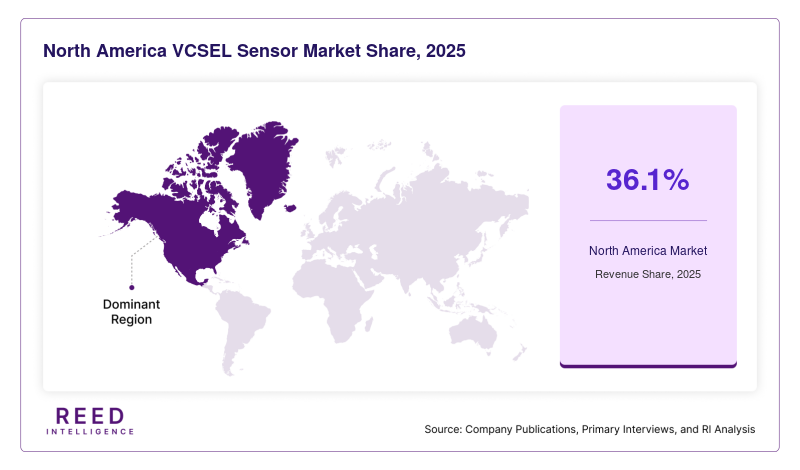
North America accounted for approximately 36.1% of the VCSEL sensor market share in 2025 and is expected to maintain steady growth with a CAGR of 10.9% during the forecast period. The region benefits from strong technological infrastructure and high adoption of advanced sensing solutions across industries such as consumer electronics, automotive, and healthcare. The presence of major technology companies and continuous investment in research and development contribute to market expansion. Additionally, the increasing demand for biometric authentication and LiDAR technologies supports growth in this region.
The United States dominates the North American market due to its advanced semiconductor industry and strong focus on innovation. A unique growth factor in the country is the increasing deployment of autonomous vehicle technologies, which rely heavily on VCSEL-based LiDAR systems. Government support for technological advancements and the presence of leading manufacturers further strengthen the market position of the United States.
Europe
Europe held a market share of around 24.7% in 2025 and is projected to grow at a CAGR of 10.5% during the forecast period. The region’s growth is driven by increasing adoption of VCSEL sensors in automotive and industrial applications. European countries are focusing on enhancing vehicle safety and promoting electric mobility, which supports demand for advanced sensing technologies. Additionally, the presence of established automotive manufacturers contributes to steady market growth.
Germany leads the European market due to its strong automotive industry and emphasis on innovation. A key growth factor in Germany is the integration of advanced driver-assistance systems in vehicles, which require high-performance sensors. The country’s focus on industrial automation and smart manufacturing further supports the adoption of VCSEL technologies.
Asia Pacific
Asia Pacific is the fastest-growing region, with a CAGR of 12.8% during 2026–2034 and a market share of 28.3% in 2025. The region benefits from rapid industrialization, expanding consumer electronics manufacturing, and increasing investments in technology development. Countries in this region are adopting VCSEL sensors for applications such as smartphones, wearables, and automotive systems. The growing demand for affordable and efficient sensing solutions further drives market growth.
China dominates the Asia Pacific market due to its large manufacturing base and strong presence in the consumer electronics sector. A unique growth factor in China is the rapid expansion of smartphone production, which heavily utilizes VCSEL sensors for facial recognition and 3D sensing applications. Government initiatives to promote technological innovation also contribute to market growth.
Middle East & Africa
The Middle East & Africa region accounted for a smaller market share of 5.2% in 2025 but is expected to grow at a CAGR of 9.3% during the forecast period. The region’s growth is supported by increasing adoption of smart technologies and infrastructure development. Investments in smart city projects and security systems are driving demand for advanced sensing solutions, including VCSEL sensors.
The United Arab Emirates leads the market in this region due to its focus on smart city initiatives and technological advancement. A key growth factor is the deployment of advanced surveillance and security systems, which require precise sensing technologies. The government’s emphasis on digital transformation further supports market growth.
Latin America
Latin America held a market share of 5.7% in 2025 and is projected to grow at a CAGR of 9.8% during the forecast period. The region is experiencing gradual adoption of VCSEL sensors in industries such as automotive and consumer electronics. Economic development and increasing investment in technology infrastructure contribute to market expansion.
Brazil dominates the Latin American market due to its growing industrial sector and increasing adoption of advanced technologies. A unique growth factor in Brazil is the expansion of automotive manufacturing, which drives demand for sensing solutions used in safety and navigation systems. The country’s focus on modernization and technological integration further supports market growth.
Competitive Landscape
The VCSEL sensor market is characterized by the presence of several established players competing based on technology innovation, product quality, and strategic partnerships. Leading companies are focusing on expanding their product portfolios and investing in research and development to enhance performance and efficiency. The market is moderately consolidated, with a few major players holding significant market shares.
A leading company in the market is Lumentum Holdings Inc., which has established a strong presence through continuous innovation and strategic collaborations. The company focuses on developing advanced VCSEL solutions for applications in consumer electronics and automotive sectors. A recent development includes the expansion of its production capacity to meet growing demand for 3D sensing technologies. Other key players are also investing in technological advancements and forming partnerships to strengthen their market positions.
Key Players List
- Lumentum Holdings Inc.
- II-VI Incorporated
- Broadcom Inc.
- ams-OSRAM AG
- TRUMPF Group
- Philips Photonics
- Vixar Inc.
- Vertilite Co., Ltd.
- Alight Technologies
- Ushio Inc.
- Sony Semiconductor Solutions
- Hamamatsu Photonics
- Santec Corporation
- ROHM Semiconductor
- TT Electronics
Recent Developments
- A major semiconductor company expanded its VCSEL production facility in 2025 to meet rising demand for 3D sensing applications.
- A leading automotive manufacturer partnered with a sensor technology provider to develop advanced LiDAR systems using VCSEL arrays.
- A technology firm introduced a new generation of energy-efficient VCSEL sensors designed for wearable devices and IoT applications
VCSEL Sensor Market Segments
Type
- Single-Mode VCSEL
- Multi-Mode VCSEL
Application
- Consumer Electronics
- Automotive LiDAR
- Industrial Automation
- Healthcare
End-Use
- Consumer Electronics
- Automotive
- Industrial
- Healthcare
By Region
- North America
- Europe
- APAC
- Middle East and Africa
- LATAM