Vegetal Concrete Market Size, Share & Demand Report By Material Type (Bamboo-Based Vegetal Concrete, Wood Fiber-Based Vegetal Concrete, Flax-Based Vegetal Concrete, Agricultural Waste-Based Vegetal Concrete), By Application (Residential Construction, Commercial Green Buildings, Industrial Facilities, Institutional Buildings, Infrastructure Projects), By End-Use (New Construction, Renovation and Retrofitting) By Region & Segment Forecasts, 2026–2034
USD 3950
Market Overview
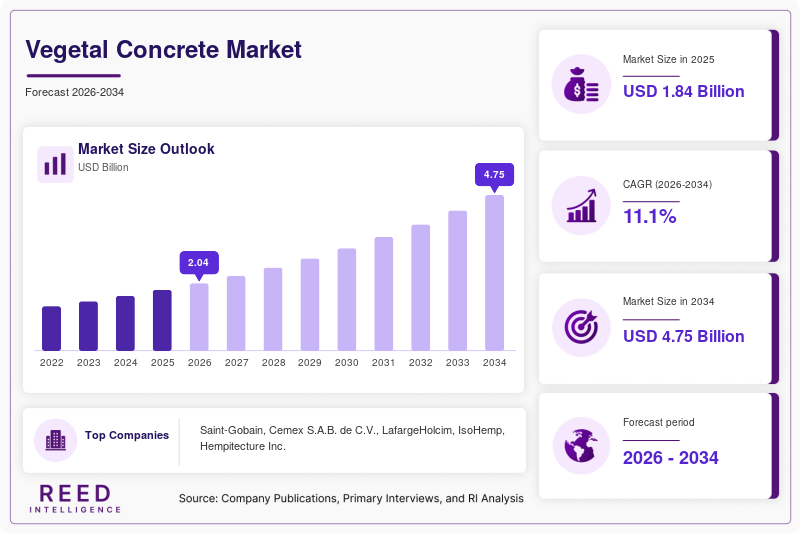
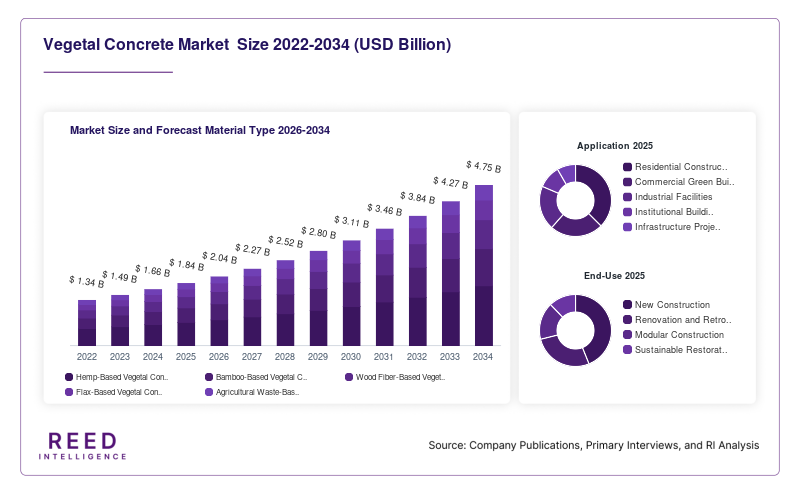
The global Vegetal Concrete Market size was valued at USD 1.84 billion in 2026 and is projected to reach USD 4.27 billion by 2034, expanding at a CAGR of 11.1% during the forecast period from 2026 to 2034. Vegetal concrete, also referred to as bio-based concrete or plant-based concrete, is gaining wider adoption across residential, commercial, and infrastructure projects due to the rising focus on low-carbon construction materials. The material combines mineral binders with plant aggregates such as hemp shiv, flax, wood fibers, bamboo particles, and agricultural waste, creating lightweight and thermally efficient construction solutions. Increasing regulations related to carbon emissions from conventional cement manufacturing have encouraged construction companies and developers to invest in sustainable alternatives.
Rapid urbanization and green building initiatives across developed and developing economies have significantly supported market growth. Governments are introducing energy-efficiency standards for buildings, while construction firms are prioritizing environmentally responsible materials to meet sustainability targets. Vegetal concrete provides improved insulation, moisture regulation, and reduced embodied carbon compared to traditional concrete products, making it suitable for energy-efficient buildings. Demand has also increased due to rising investments in eco-friendly residential developments and smart city projects. Furthermore, advancements in bio-composite manufacturing technologies and increasing awareness regarding circular economy practices continue to strengthen industry expansion across global markets.
Key Highlights
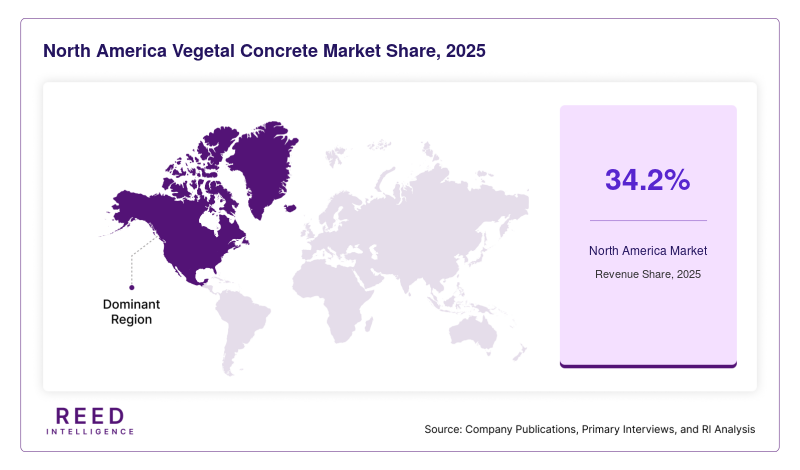
- North America dominated the market with a 34.2% share in 2025.
- Asia Pacific is expected to grow at the fastest CAGR of 12.1% during 2026–2034.
- By material type, hemp-based vegetal concrete accounted for the largest share of 39.4%.
- while bamboo-based vegetal concrete is projected to grow at a CAGR of 13.2%.
- By application, residential construction led with a 43.7% share.
- whereas commercial green buildings are expected to expand at a CAGR of 12.8%.
- By end-use, new construction accounted for the largest share of 58.6%.
- while renovation and retrofitting projects are projected to grow at a CAGR of 11.9%.
- France remained the dominant country, with market values of USD 218 million in 2024 and USD 243 million in 2025.
Market Trends
Rising Integration of Hemp-Based Building Materials in Sustainable Construction
The increasing adoption of hemp-based building products has emerged as a major trend in the Vegetal Concrete Market. Construction firms are actively integrating hemp shiv aggregates into walls, roofing systems, insulation blocks, and prefabricated panels to improve thermal efficiency and reduce lifecycle carbon emissions. Hemp-based vegetal concrete offers lightweight properties, moisture control, acoustic insulation, and enhanced indoor air quality, making it suitable for energy-efficient residential and commercial projects. Growing consumer preference for sustainable homes and net-zero buildings has encouraged developers to incorporate bio-based materials into modern architectural designs. The trend is particularly visible in Europe and North America, where regulatory frameworks support low-carbon building materials. Manufacturers are also increasing production capacities and improving processing methods to meet rising demand from green construction projects.
Expansion of Prefabricated Bio-Composite Construction Solutions
Prefabricated vegetal concrete components are gaining traction as construction companies seek faster project execution and lower labor costs. Manufacturers are developing modular wall systems, lightweight blocks, and bio-composite panels that can be assembled quickly on-site while maintaining structural efficiency and environmental performance. The use of prefabricated vegetal concrete supports reduced construction waste, lower transportation emissions, and improved consistency in building quality. Demand for these solutions is increasing across urban residential projects, educational buildings, and commercial facilities focused on sustainability certifications. Asia Pacific countries are witnessing increased investments in modular construction technologies due to rapid urbanization and infrastructure expansion. The trend is further supported by advancements in automated manufacturing systems and rising interest in industrialized construction methods that improve operational efficiency while meeting green building standards.
Market Drivers
Increasing Government Regulations Supporting Low-Carbon Construction Materials
Government regulations promoting carbon reduction and sustainable construction practices are significantly driving the Vegetal Concrete Market. Construction activities contribute substantially to global carbon emissions, particularly through cement production and energy-intensive building processes. Regulatory agencies across Europe, North America, and Asia Pacific are introducing strict environmental standards that encourage the use of eco-friendly building materials. Vegetal concrete helps reduce embodied carbon due to its plant-based composition and lower energy consumption during production. Incentives for green buildings, tax benefits for sustainable infrastructure projects, and energy-efficiency certifications are supporting broader product adoption. Public sector investments in climate-resilient housing and eco-friendly infrastructure are also accelerating market demand. As sustainability regulations continue to strengthen globally, developers and contractors are increasingly shifting toward plant-based concrete alternatives to achieve compliance and improve environmental performance.
Growing Demand for Energy-Efficient and Thermally Insulated Buildings
The rising focus on energy-efficient buildings is another major factor contributing to market growth. Vegetal concrete offers superior thermal insulation and humidity regulation compared to conventional concrete materials, helping reduce heating and cooling energy requirements in buildings. Increasing energy costs and rising awareness regarding environmental sustainability have encouraged homeowners, architects, and developers to adopt materials that improve energy performance. The material is widely used in residential housing, educational facilities, and commercial green buildings seeking long-term operational efficiency. Urban expansion and the growing need for climate-responsive construction methods are also strengthening adoption. In regions with extreme weather conditions, vegetal concrete provides additional benefits such as improved indoor comfort and lower energy consumption. As demand for net-zero and passive buildings continues to increase, manufacturers are investing in advanced formulations that enhance durability, insulation, and structural compatibility.
Market Restraint
Limited Structural Strength and Higher Production Costs Compared to Conventional Concrete
Despite increasing adoption, the Vegetal Concrete Market faces challenges related to limited structural strength and relatively high production costs. Plant-based concrete materials are primarily used for insulation and non-load-bearing applications because they do not yet provide the same compressive strength as traditional reinforced concrete. This limitation restricts adoption in large-scale infrastructure projects and high-rise commercial developments where structural performance is critical. Additionally, the production process for vegetal concrete often involves specialized binders, treated plant aggregates, and controlled manufacturing methods, resulting in higher costs compared to conventional concrete products.
The limited availability of standardized manufacturing practices and technical expertise in emerging economies also affects market penetration. Small and medium-sized construction companies may hesitate to adopt vegetal concrete due to concerns regarding long-term durability, moisture resistance, and regulatory approvals. Transportation and storage requirements for bio-based materials can further increase operational costs. For example, several construction developers in developing regions continue to prioritize lower-cost cement-based materials for affordable housing projects despite rising sustainability awareness. Although technological advancements are improving product performance, cost competitiveness remains a key challenge influencing widespread adoption across global construction markets.
Market Opportunities
Expansion of Green Affordable Housing Projects Across Emerging Economies
The growing development of green affordable housing projects presents a major opportunity for the Vegetal Concrete Market. Governments and urban development agencies in Asia Pacific, Latin America, and Africa are increasingly investing in sustainable housing initiatives to address rising urban populations and housing shortages. Vegetal concrete offers thermal insulation, reduced energy costs, and lower environmental impact, making it suitable for affordable residential projects focused on long-term sustainability. Public-private partnerships aimed at developing eco-friendly housing communities are creating demand for cost-effective plant-based construction materials. Manufacturers are also exploring locally available agricultural waste and plant fibers to reduce production costs and improve regional supply chains. As affordable housing programs continue to integrate energy-efficiency standards, vegetal concrete producers are expected to benefit from increasing procurement opportunities and long-term infrastructure investments.
Advancements in Bio-Based Material Engineering and Circular Economy Practices
Technological advancements in bio-based material engineering are creating new growth opportunities across the market. Research institutions and manufacturers are developing innovative formulations that improve the mechanical strength, fire resistance, and durability of vegetal concrete products. The integration of recycled biomass, industrial by-products, and agricultural residues supports circular economy strategies while reducing construction waste. Increasing investment in sustainable material research is encouraging the commercialization of advanced bio-composite solutions for structural and semi-structural applications. Companies are also collaborating with universities and green building organizations to develop next-generation construction materials with enhanced performance characteristics.
Growing interest in carbon-neutral infrastructure and regenerative construction methods is expected to accelerate product innovation over the forecast period. Smart manufacturing technologies and automated production systems are helping improve scalability and cost efficiency. As more countries adopt carbon reduction targets and circular construction policies, the use of engineered vegetal concrete products is likely to expand across residential, commercial, and institutional projects.
Segmental Analysis
By Material Type
Hemp-based vegetal concrete accounted for the largest market share of 39.4% in 2024 due to its superior insulation performance, lightweight properties, and low environmental impact. Hemp aggregates are widely used in walls, roofing systems, and insulation panels for residential and commercial buildings focused on sustainability. The material provides excellent thermal regulation and moisture control, helping reduce energy consumption and improve indoor air quality. European countries have been early adopters of hemp-based construction materials because of supportive agricultural and environmental policies. Increasing investments in green housing projects and low-carbon infrastructure have further strengthened demand for hemp-based vegetal concrete products. Manufacturers are also improving processing technologies to enhance durability and compatibility with modern construction methods. The growing preference for natural building materials among architects and developers continues to support the segment’s market leadership across global construction industries.
Bamboo-based vegetal concrete is projected to register the fastest CAGR of 13.2% during the forecast period due to rising availability of renewable bamboo resources and increasing demand for lightweight construction materials. Bamboo fibers offer strong tensile properties and rapid renewability, making them attractive for sustainable building applications. Asia Pacific countries are witnessing increased adoption of bamboo-based bio-composites in affordable housing and modular construction projects. Governments and environmental organizations are encouraging bamboo cultivation as part of carbon reduction and land restoration programs. Manufacturers are investing in advanced treatment and reinforcement technologies to improve moisture resistance and structural performance. The segment is also benefiting from growing awareness regarding biodegradable construction materials and circular economy practices. As bamboo processing infrastructure expands globally, the segment is expected to gain wider commercial acceptance across residential and institutional construction projects.
By Application
Residential construction held the largest market share of 43.7% in 2024 due to rising consumer demand for energy-efficient and environmentally responsible housing solutions. Homeowners and developers are increasingly adopting vegetal concrete materials to improve insulation performance and reduce long-term energy costs. The segment benefits from expanding green housing initiatives, urban redevelopment projects, and increasing awareness regarding indoor environmental quality. Vegetal concrete is widely used in wall systems, insulation blocks, flooring layers, and prefabricated panels for eco-friendly homes. Governments in Europe and North America continue to promote sustainable residential construction through energy-efficiency standards and financial incentives. The material’s moisture regulation and acoustic insulation properties also support its use in modern urban housing developments. As net-zero housing concepts continue to gain popularity, residential construction is expected to remain a major revenue contributor for the global market.
Commercial green buildings are anticipated to expand at the fastest CAGR of 12.8% during 2026–2034 owing to increasing corporate sustainability commitments and green certification requirements. Office complexes, educational facilities, hospitality projects, and retail developments are adopting vegetal concrete to improve environmental performance and reduce operational energy consumption. Developers are prioritizing bio-based construction materials to achieve certifications related to carbon reduction and sustainable design. Rapid growth in smart city projects and sustainable urban infrastructure is also creating favorable market opportunities for commercial applications. The integration of prefabricated vegetal concrete components allows faster project completion while reducing construction waste and transportation emissions. Large corporations and institutional investors are increasingly supporting sustainable building practices as part of environmental governance strategies. As commercial developers continue to focus on long-term operational efficiency and environmental compliance, demand for vegetal concrete products is expected to increase steadily.
By End-Use
New construction accounted for the largest share of 58.6% in 2024 as developers increasingly integrated sustainable building materials into newly planned residential, commercial, and institutional projects. Growing investments in greenfield infrastructure development and smart urban communities have accelerated the adoption of vegetal concrete across multiple construction applications. Architects and engineers are incorporating plant-based concrete products during the initial design phase to improve thermal performance and reduce building carbon footprints. The segment also benefits from increasing implementation of green building regulations and energy-efficiency standards in newly constructed properties. Governments across developed economies are offering incentives for low-carbon infrastructure projects, further supporting demand. Technological advancements in prefabricated bio-composite systems and modular construction methods have improved construction efficiency and encouraged wider adoption of vegetal concrete materials in new developments.
Renovation and retrofitting projects are projected to grow at the fastest CAGR of 11.9% during the forecast period due to increasing efforts to improve the energy performance of aging buildings. Many countries are implementing renovation programs aimed at reducing emissions from existing residential and commercial infrastructure. Vegetal concrete materials are increasingly used in wall insulation upgrades, roofing improvements, and sustainable restoration projects because of their lightweight and breathable properties. Historic building restoration initiatives in Europe are also supporting demand for bio-based materials that maintain structural compatibility while improving energy efficiency. Rising utility costs and stricter environmental regulations are encouraging property owners to invest in sustainable retrofitting solutions. Construction companies are developing specialized vegetal concrete products tailored for renovation applications, including sprayable insulation systems and modular retrofit panels. These developments are expected to strengthen long-term market growth across retrofit construction activities.
Regional Analysis
North America
North America accounted for 34.2% of the global Vegetal Concrete Market in 2025 and is expected to maintain a stable growth trajectory with a CAGR of 10.4% during the forecast period. The regional market is supported by increasing investments in green infrastructure, sustainable residential developments, and energy-efficient commercial buildings. Construction firms across the United States and Canada are adopting low-carbon building materials to meet environmental standards and green certification requirements. Growing awareness regarding embodied carbon reduction and lifecycle sustainability is further strengthening demand for vegetal concrete products across modern construction projects.
The United States remained the dominant country in North America due to strong investments in sustainable housing and green public infrastructure. The country benefits from increasing adoption of net-zero building standards and energy-efficiency regulations in urban construction projects. Universities, commercial developers, and municipal authorities are increasingly using plant-based concrete materials to improve insulation performance and reduce operational energy costs. Rising consumer preference for environmentally responsible housing solutions has also encouraged manufacturers to expand production facilities and distribution networks across major metropolitan areas.
Europe
Europe represented 30.8% of the global Vegetal Concrete Market in 2025 and continues to be a major hub for sustainable construction innovation. The region is anticipated to expand at a CAGR of 10.8% during 2026–2034 due to strict carbon reduction regulations and strong government support for green building practices. European countries have established advanced environmental frameworks encouraging the use of bio-based construction materials in residential and commercial projects. The growing adoption of circular economy principles and energy-efficient building standards continues to support regional market growth.
France emerged as the leading country in the European market due to its long-standing adoption of hemp-based construction materials and favorable sustainability policies. The country has witnessed increasing use of vegetal concrete in eco-friendly residential housing, educational facilities, and restoration projects. Local manufacturers and research organizations are actively developing advanced hemp concrete technologies to improve product durability and thermal performance. Strong collaboration between agricultural producers and construction companies has created an efficient supply chain for bio-based building materials, supporting long-term industry development.
Asia Pacific
Asia Pacific held a 22.7% share of the global Vegetal Concrete Market in 2025 and is projected to register the fastest CAGR of 12.1% during the forecast period. Rapid urbanization, infrastructure development, and increasing environmental awareness are contributing to strong regional growth. Governments across China, India, Japan, and Southeast Asia are implementing sustainable construction policies aimed at reducing carbon emissions from the building sector. Rising demand for energy-efficient residential projects and commercial green buildings is accelerating adoption of plant-based concrete materials across major urban centers.
China dominated the Asia Pacific market due to large-scale urban infrastructure investments and increasing emphasis on sustainable development. The country is actively promoting low-carbon construction materials as part of its environmental transition strategies. Growing investment in prefabricated construction methods and green smart cities has increased demand for lightweight and thermally efficient building materials. Local manufacturers are also focusing on agricultural waste utilization and bio-composite innovation to improve production efficiency and reduce dependence on traditional cement-based construction materials.
Middle East & Africa
The Middle East & Africa region accounted for 6.1% of the global Vegetal Concrete Market in 2025 and is expected to grow at a CAGR of 9.5% through 2034. Increasing investments in sustainable urban development and climate-resilient infrastructure are supporting regional demand for eco-friendly construction materials. Governments in the Gulf region are emphasizing energy-efficient buildings to reduce electricity consumption associated with cooling systems. Vegetal concrete products are gaining attention for their insulation performance and ability to improve indoor environmental conditions in hot climates.
The United Arab Emirates emerged as the dominant country in the regional market due to ongoing smart city developments and sustainable infrastructure initiatives. The country has introduced green building regulations encouraging the adoption of environmentally responsible materials in commercial and residential projects. Luxury hospitality developments and mixed-use urban projects are increasingly integrating bio-based construction materials to achieve sustainability targets. Rising investment in research partnerships and innovative construction technologies is expected to further support market expansion across the region.
Latin America
Latin America captured 6.2% of the global Vegetal Concrete Market in 2025 and is projected to grow at a CAGR of 9.8% during the forecast period. The market is benefiting from increasing awareness regarding sustainable housing and environmentally friendly infrastructure development. Countries across the region are investing in affordable housing programs and climate-responsive construction methods that support energy efficiency. The availability of agricultural residues and natural fibers also creates opportunities for local production of vegetal concrete materials, improving supply chain accessibility and reducing production costs.
Brazil remained the leading country in Latin America due to growing construction activities and rising adoption of eco-friendly building materials. The country benefits from a strong agricultural sector that provides raw materials such as sugarcane fibers and bamboo for bio-composite production. Increasing investments in green residential communities and public infrastructure projects are contributing to market expansion. Local developers are also integrating sustainable construction practices to align with international environmental standards and attract environmentally conscious investors.
Competitive Landscape
The Vegetal Concrete Market is moderately fragmented, with established construction material manufacturers and specialized bio-composite companies competing through product innovation, sustainability initiatives, and regional expansion strategies. Leading market participants are investing in research and development activities to improve the mechanical strength, fire resistance, and thermal performance of vegetal concrete products. Companies are also focusing on strategic partnerships with agricultural suppliers, construction firms, and green building organizations to strengthen raw material availability and market penetration.
Saint-Gobain remains one of the leading companies in the market due to its extensive sustainable construction portfolio and strong global distribution network. The company continues to expand its bio-based building material offerings through acquisitions and innovation programs focused on low-carbon infrastructure solutions. Other major players are emphasizing modular construction systems, prefabricated bio-composite panels, and advanced insulation technologies to meet increasing demand from residential and commercial construction sectors.
A recent industry development involved several European manufacturers launching next-generation hemp-based concrete products with enhanced thermal insulation and reduced curing times for prefabricated applications. Companies are also increasing investments in automated production facilities and circular economy initiatives to improve operational efficiency and reduce environmental impact. Competitive intensity is expected to increase as sustainability regulations and green construction investments continue to expand globally.
Key Players
- Saint-Gobain
- Cemex S.A.B. de C.V.
- LafargeHolcim
- IsoHemp
- Hempitecture Inc.
- Lime Technology Ltd
- Biohm
- JustBioFiber Structural Solutions
- BASF SE
- Sika AG
- Heidelberg Materials
- American Lime Technology
- Vicat Group
- GreenBuild Technologies
Recent Developments
- In March 2025, Saint-Gobain expanded its sustainable construction solutions portfolio by introducing advanced hemp-based insulation concrete panels for commercial green buildings.
- In July 2025, IsoHemp announced the expansion of its production facility in Europe to increase manufacturing capacity for bio-based construction blocks and wall systems.
- In November 2024, Cemex partnered with sustainable material technology firms to develop low-carbon vegetal concrete formulations using agricultural waste fibers.
- In February 2026, BASF SE launched new binder technologies designed to improve the durability and moisture resistance of plant-based concrete materials.
- In August 2025, Sika AG introduced innovative additive solutions aimed at enhancing the structural performance and curing efficiency of vegetal concrete products.
Vegetal Concrete Market Segments
Material Type
- Hemp-Based Vegetal Concrete
- Bamboo-Based Vegetal Concrete
- Wood Fiber-Based Vegetal Concrete
- Flax-Based Vegetal Concrete
- Agricultural Waste-Based Vegetal Concrete
Application
- Residential Construction
- Commercial Green Buildings
- Industrial Facilities
- Institutional Buildings
- Infrastructure Projects
End-Use
- New Construction
- Renovation and Retrofitting
- Modular Construction
- Sustainable Restoration Projects
By Region
- North America
- Europe
- APAC
- Middle East and Africa
- LATAM