Vehicle Leasing Market Size, Share & Demand Report By Lease Type (Operating Lease, Finance Lease, Electric Vehicle Lease, Subscription-Based Lease), By Vehicle Type (Passenger Vehicles, Light Commercial Vehicles, Heavy Commercial Vehicles, Luxury Vehicles), By End User (Corporate Fleets, Individual Consumers, Ride-Sharing Providers, Government Organizations), By Region & Segment Forecasts, 2026–2034
USD 3950
Market Overview
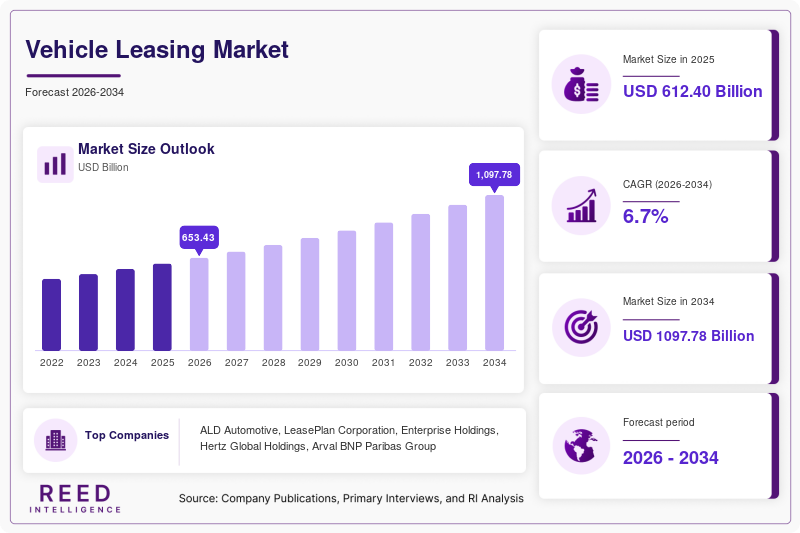
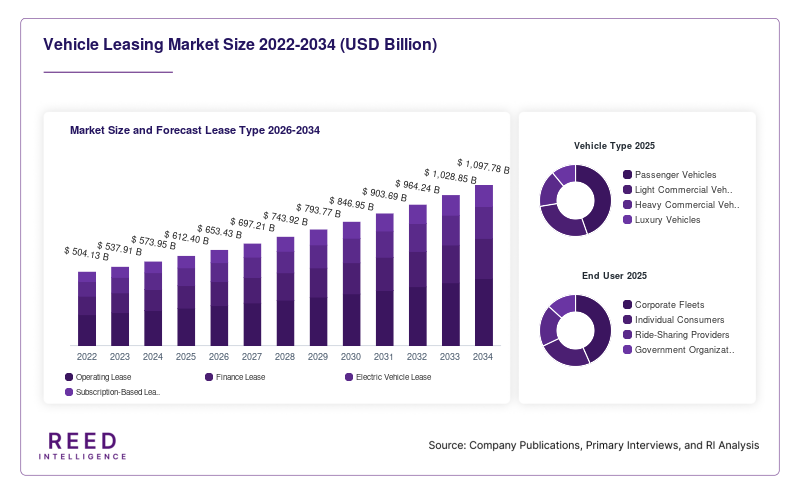
The global Vehicle Leasing Market size was valued at USD 612.4 billion in 2026 and is projected to reach USD 1,028.7 billion by 2034, expanding at a CAGR of 6.7% during the forecast period from 2026 to 2034. The market continues to gain traction as businesses and consumers increasingly prioritize cost efficiency, fleet flexibility, and reduced ownership burdens. Leasing models are becoming an integral part of mobility ecosystems across developed and emerging economies due to rising urbanization, corporate mobility requirements, and changing consumer attitudes toward vehicle ownership.
One of the major global factors supporting market growth is the rapid transition toward subscription-based and usage-based mobility services. Enterprises across logistics, healthcare, construction, retail, and IT sectors are adopting leased fleets to improve capital allocation and operational flexibility. In addition, rising electric vehicle adoption is accelerating leasing demand because consumers and businesses prefer avoiding long-term ownership risks associated with battery depreciation and technology obsolescence. Financial institutions and automotive manufacturers are also expanding leasing portfolios through flexible contract structures, digital onboarding platforms, and integrated maintenance solutions.
Key Highlights
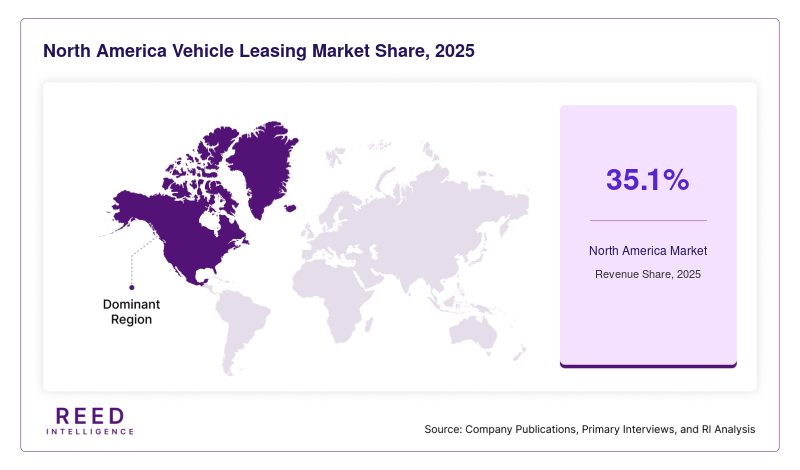
- North America dominated the market with a 35.1% share in 2025.
- Asia Pacific is expected to grow at the fastest CAGR of 8.9% during 2026–2034.
- By lease type, operating lease accounted for the largest share of 57.6%, while electric vehicle leasing is projected to grow at a CAGR of 10.8%.
- By vehicle type, passenger vehicles led with a 63.4% share, whereas light commercial vehicles are expected to expand at a CAGR of 8.2%.
- The United States remained the dominant country, with market values of USD 184.2 billion in 2024 and USD 196.8 billion in 2025.
Market Trends
Digital fleet management platforms transforming leasing operations
Digitalization is reshaping the Vehicle Leasing Market as leasing providers increasingly deploy cloud-based fleet management systems, AI-powered analytics, and mobile-first customer platforms. Fleet operators are seeking integrated solutions that provide real-time monitoring of fuel consumption, vehicle utilization, maintenance schedules, and driver behavior. Leasing companies are responding by offering connected mobility ecosystems that combine telematics, insurance integration, route optimization, and predictive maintenance. This trend is improving operational efficiency for businesses that manage large vehicle fleets across logistics, construction, and transportation industries. In addition, digital contract management and automated approval systems are reducing administrative delays and improving customer experience. The adoption of digital tools is particularly strong among multinational enterprises that require centralized visibility across regional fleets.
Growing demand for electric vehicle leasing services
Electric vehicle leasing is becoming one of the most influential trends within the Vehicle Leasing Market due to changing environmental regulations and growing interest in low-emission transportation. Consumers and fleet operators are increasingly choosing leased electric vehicles to avoid high upfront costs and concerns related to battery performance. Governments across Europe, Asia Pacific, and North America are supporting EV adoption through subsidies, tax incentives, and charging infrastructure investments, which is positively influencing leasing penetration. Leasing providers are also partnering with automakers to introduce flexible EV leasing contracts that include battery warranties, charging services, and maintenance packages. The trend is especially prominent among urban fleet operators, corporate mobility programs, and ride-sharing companies seeking to meet sustainability goals while managing transportation costs efficiently.
Market Drivers
Rising corporate fleet outsourcing across multiple industries
The growing preference for outsourced fleet management is driving expansion in the Vehicle Leasing Market. Businesses are increasingly shifting from vehicle ownership to leasing models to improve cash flow management and reduce capital expenditure. Leasing agreements enable organizations to access newer vehicles without bearing depreciation risks or maintenance liabilities. Industries such as logistics, pharmaceuticals, telecommunications, and e-commerce are adopting leased fleets to improve operational flexibility and optimize transportation efficiency. Companies with seasonal or project-based transportation needs are particularly attracted to short-term and flexible leasing contracts. In addition, leasing providers are offering bundled services that include insurance, maintenance, roadside assistance, and fleet analytics, which simplifies fleet administration for businesses and improves cost predictability.
Expansion of urban mobility and shared transportation services
The rapid growth of ride-hailing platforms, corporate mobility services, and urban transportation networks is accelerating demand within the Vehicle Leasing Market. Urban consumers increasingly prefer access-based mobility solutions instead of long-term vehicle ownership due to rising parking costs, traffic congestion, and fuel expenses. Mobility operators rely heavily on leased vehicles to scale operations quickly while maintaining financial flexibility. Leasing allows ride-sharing companies and delivery service providers to frequently upgrade vehicle fleets and comply with emission regulations. The expansion of app-based transportation services in emerging economies is also generating new leasing opportunities for local and international providers. Furthermore, urban governments are encouraging sustainable mobility initiatives, creating additional demand for leased electric and hybrid vehicle fleets.
Market Restraint
Residual value uncertainty and economic volatility limiting long-term leasing adoption
Residual value fluctuations remain a major restraint affecting the Vehicle Leasing Market, particularly in regions experiencing unstable economic conditions and changing automotive technologies. Leasing providers face financial risk when the resale value of returned vehicles declines below projected estimates. This challenge has intensified with the transition toward electric vehicles, where battery degradation concerns and rapid technological upgrades can reduce resale demand. Inflationary pressure, rising interest rates, and supply chain disruptions also impact vehicle pricing and leasing affordability. Smaller leasing companies often struggle to maintain profitability during periods of economic slowdown because vehicle remarketing becomes more difficult.
The restraint is particularly visible in developing economies where used vehicle markets lack transparency and financing infrastructure remains limited. Businesses may delay leasing decisions during uncertain economic cycles, reducing fleet replacement activity. In addition, sudden regulatory changes related to emissions standards can accelerate depreciation for older fleets, forcing leasing companies to absorb higher asset losses. These factors collectively increase operational complexity and reduce margin stability for market participants operating across diverse vehicle categories and regional markets.
Market Opportunities
Increasing penetration of subscription-based mobility services
The emergence of subscription-based mobility models is creating strong growth opportunities within the Vehicle Leasing Market. Consumers increasingly seek flexible transportation arrangements that eliminate long-term ownership obligations and provide access to multiple vehicle options under a single payment structure. Subscription-based leasing services combine insurance, maintenance, roadside assistance, and vehicle replacement into integrated monthly plans. Younger consumers and urban professionals are particularly attracted to these models because they prioritize convenience and financial flexibility over traditional ownership.
Automotive manufacturers and leasing providers are launching digital subscription platforms that enable customers to switch vehicles based on changing lifestyle or business requirements. This opportunity is expanding rapidly in metropolitan regions where mobility preferences continue to evolve. Subscription leasing is also gaining popularity among startups and small enterprises that require scalable transportation solutions without significant upfront investment. As digital payment systems and online vehicle delivery services become more advanced, subscription-based leasing is expected to become an increasingly important revenue stream for leasing providers.
Growth potential in emerging economies and rural mobility markets
Emerging economies across Asia Pacific, Latin America, and Africa are presenting substantial opportunities for the Vehicle Leasing Market due to rising vehicle demand, expanding infrastructure development, and improving financial accessibility. Governments are investing heavily in transportation networks, logistics corridors, and industrial development projects, increasing the need for commercial and passenger vehicle fleets. Small businesses and regional transportation operators are increasingly turning toward leasing arrangements to reduce financial barriers associated with vehicle ownership.
The opportunity is further supported by rising internet penetration and digital banking adoption, which simplify leasing approvals and customer onboarding processes. Leasing companies are introducing customized financing programs for rural transportation operators, agricultural businesses, and local delivery providers. In addition, expanding e-commerce activity in developing economies is increasing demand for leased commercial vehicles used in distribution and last-mile logistics operations. As financial institutions strengthen partnerships with automotive manufacturers, leasing penetration across emerging markets is expected to rise steadily during the forecast period.
Segmental Analysis
By Lease Type
Operating lease emerged as the dominant subsegment within the Vehicle Leasing Market and accounted for 57.6% of the global share in 2024. The popularity of operating leases is largely attributed to their flexibility and lower financial burden compared to direct ownership models. Businesses prefer operating leases because they allow access to modern vehicle fleets without requiring substantial upfront capital investment. These agreements typically include maintenance, insurance, and fleet support services, which simplify operational management for enterprises. Industries such as logistics, construction, retail, and healthcare continue to rely heavily on operating lease structures to maintain transportation efficiency while preserving cash flow. The segment also benefits from increasing demand for outsourced fleet management services among multinational corporations.
Electric vehicle leasing is expected to witness the fastest CAGR of 10.8% during the forecast period due to rising sustainability initiatives and government support for low-emission transportation. Consumers and businesses increasingly prefer leasing electric vehicles to avoid uncertainties related to battery depreciation and rapid technological advancements. Leasing agreements provide flexibility for upgrading to newer EV models with improved range and charging capabilities. Fleet operators are particularly adopting leased electric vehicles to comply with environmental regulations and reduce fuel costs. Automotive manufacturers are also partnering with leasing providers to launch integrated EV packages that include charging services, maintenance support, and battery warranties. Growing investments in charging infrastructure across developed and emerging economies are expected to further accelerate segment expansion.
By Vehicle Type
Passenger vehicles represented the largest subsegment in the Vehicle Leasing Market and captured 63.4% of the total market share in 2024. The dominance of this segment is linked to rising consumer demand for flexible transportation options and growing adoption of personal leasing contracts. Urban consumers increasingly choose leased passenger vehicles to avoid long-term ownership costs, depreciation risks, and maintenance obligations. Leasing providers are expanding offerings across compact cars, SUVs, and luxury vehicles to attract diverse customer groups. Corporate mobility programs and executive transportation services also contribute significantly to passenger vehicle leasing demand. In addition, advancements in digital leasing platforms are simplifying customer onboarding, contract management, and vehicle delivery processes, improving the overall customer experience.
Light commercial vehicles are projected to register the fastest CAGR of 8.2% during the forecast period due to the rapid expansion of e-commerce, logistics, and last-mile delivery operations. Businesses increasingly rely on leased vans and delivery vehicles to support flexible transportation requirements while minimizing operational costs. The growth of app-based delivery services and urban distribution networks is significantly increasing demand for leased commercial fleets. Leasing companies are responding by introducing customized fleet solutions that include telematics integration, route optimization tools, and predictive maintenance services. Small and medium-sized enterprises are particularly adopting leasing models because they provide access to modern commercial vehicles without substantial upfront investment. The rising use of electric delivery vans is also expected to strengthen future segment growth.
By End User
Corporate fleets accounted for the largest share of the Vehicle Leasing Market in 2024 with a market contribution of 52.1%. Large enterprises increasingly depend on leased fleets to improve transportation efficiency and reduce administrative burdens associated with vehicle ownership. Corporate leasing contracts provide predictable operational costs, tax advantages, and easier fleet replacement cycles, making them attractive across industries such as pharmaceuticals, telecommunications, manufacturing, and logistics. Companies operating across multiple regions also benefit from centralized fleet management and integrated maintenance support offered by leasing providers. The segment continues to expand as organizations focus on optimizing capital allocation and improving operational scalability. Increasing adoption of connected fleet technologies and telematics systems further strengthens demand among corporate customers.
Ride-sharing and mobility service providers are anticipated to witness the fastest CAGR of 9.6% during the forecast period due to the rapid growth of app-based transportation and urban mobility services. Leasing allows mobility operators to expand vehicle fleets quickly while maintaining financial flexibility and reducing depreciation risks. Ride-hailing companies increasingly prefer short-term and subscription-based leasing agreements to accommodate fluctuating transportation demand and evolving regulatory requirements. Electric vehicle adoption among mobility service providers is also increasing as cities introduce stricter emission policies and sustainability initiatives. Leasing providers are introducing specialized contracts tailored for ride-sharing businesses, including high-mileage support packages and maintenance programs. Expanding urban populations and rising demand for affordable transportation services are expected to support long-term segment growth.
Regional Analysis
North America
North America accounted for 35.1% of the global Vehicle Leasing Market in 2025 and continues to maintain a leading position due to strong corporate fleet demand and mature automotive financing infrastructure. The regional market is expected to expand at a CAGR of 5.8% between 2026 and 2034. High adoption of operating leases among enterprises and growing consumer preference for flexible mobility solutions continue to support market expansion. Leasing penetration remains particularly strong across logistics, construction, and technology sectors where companies prioritize capital preservation and frequent fleet upgrades.
The United States remains the dominant country in the North American market due to strong demand from corporate fleets and ride-sharing operators. One of the unique growth factors supporting the market is the rapid expansion of electric commercial vehicle leasing programs. Major leasing companies are collaborating with automotive manufacturers to provide bundled EV financing, charging infrastructure access, and maintenance services. The presence of advanced telematics infrastructure and digital fleet management platforms also contributes to high customer retention and operational efficiency across the country.
Europe
Europe represented 27.4% of the global Vehicle Leasing Market in 2025 and is projected to witness a CAGR of 6.3% during the forecast period. The regional market benefits from strict environmental regulations, strong automotive manufacturing capabilities, and widespread adoption of fleet outsourcing solutions. Businesses across Western Europe increasingly prefer leasing arrangements to manage sustainability targets and reduce operational risks associated with vehicle ownership. Demand for electric vehicle leasing is particularly strong due to government incentives, urban emission zones, and corporate sustainability commitments.
Germany remains the leading country within the European market because of its extensive automotive ecosystem and strong commercial vehicle demand. A unique growth factor driving the German market is the rapid integration of green fleet policies among manufacturing and logistics companies. Enterprises are increasingly transitioning toward leased electric and hybrid fleets to comply with environmental standards while controlling transportation expenses. The availability of advanced charging infrastructure and strong banking partnerships further strengthens leasing penetration across the country.
Asia Pacific
Asia Pacific held 22.6% of the global Vehicle Leasing Market in 2025 and is anticipated to record the fastest CAGR of 8.9% from 2026 to 2034. Rapid urbanization, increasing vehicle demand, and expanding logistics networks are supporting market growth across the region. Businesses in emerging economies are adopting leasing models to reduce capital expenditure and improve fleet flexibility. Rising digitalization and smartphone penetration are also enabling easier access to leasing platforms and mobility subscription services. The market is further benefiting from government initiatives aimed at strengthening transportation infrastructure and electric mobility adoption.
China remains the dominant country within Asia Pacific due to its large automotive industry and strong commercial transportation sector. One of the unique growth factors supporting the Chinese market is the expansion of e-commerce logistics networks requiring scalable leased fleets for last-mile delivery operations. Fleet operators increasingly rely on leased electric vans and commercial vehicles to meet urban emission standards and improve delivery efficiency. Government subsidies supporting EV adoption and domestic battery manufacturing capabilities are also accelerating electric vehicle leasing demand.
Middle East & Africa
The Middle East & Africa accounted for 7.2% of the global Vehicle Leasing Market in 2025 and is expected to expand at a CAGR of 6.1% during the forecast period. The regional market is gradually gaining momentum due to infrastructure development projects, rising tourism activity, and increasing corporate transportation requirements. Leasing adoption is particularly strong among construction, oil and gas, and hospitality sectors where organizations require flexible fleet solutions for project-based operations. The growth of airport transportation services and commercial logistics networks is also contributing to regional market expansion.
The United Arab Emirates remains the dominant country in the region because of its advanced transportation infrastructure and growing corporate mobility sector. A unique growth factor driving the UAE market is the increasing adoption of luxury vehicle leasing among tourism operators and business travelers. Leasing providers are introducing premium mobility packages with flexible terms and integrated concierge services to cater to expatriates and international visitors. Strong digital banking infrastructure and expanding smart city initiatives further support leasing growth across the country.
Latin America
Latin America captured 7.7% of the global Vehicle Leasing Market in 2025 and is projected to register a CAGR of 6.5% through 2034. Economic recovery across several countries and the expansion of regional logistics activities are supporting leasing adoption. Businesses increasingly prefer leasing arrangements to manage financial uncertainty and avoid large upfront investments associated with vehicle ownership. The regional market is also benefiting from the growth of urban delivery services and transportation outsourcing across retail and e-commerce sectors.
Brazil remains the dominant country within the Latin American market due to its extensive transportation industry and growing commercial fleet requirements. One unique growth factor supporting the Brazilian market is the rising demand for agricultural vehicle leasing in rural regions. Farming cooperatives and agribusiness operators are increasingly leasing pickup trucks and light commercial vehicles to improve distribution efficiency and reduce maintenance responsibilities. Expanding digital financing platforms and improving road connectivity are also strengthening vehicle leasing penetration across the country.
Competitive Landscape
The Vehicle Leasing Market remains moderately consolidated with the presence of international leasing providers, automotive financing companies, and regional fleet management firms competing through pricing strategies, digital platforms, and service innovation. Leading companies are focusing on expanding electric vehicle leasing portfolios, improving telematics integration, and strengthening subscription-based mobility offerings. Market participants are also investing in AI-driven fleet analytics and automated contract management systems to enhance customer retention and operational efficiency.
ALD Automotive continues to hold a strong leadership position due to its extensive global fleet network and advanced mobility management capabilities. The company recently expanded its electric vehicle leasing services across Europe through strategic partnerships with charging infrastructure providers. LeasePlan, Enterprise Holdings, Hertz, and Arval are also strengthening market presence through acquisitions, digital transformation initiatives, and corporate fleet partnerships. Several companies are introducing flexible leasing models designed for ride-sharing operators and e-commerce logistics providers. Competitive intensity is expected to increase further as automotive manufacturers expand direct leasing operations and technology companies enter the mobility services ecosystem.
Key Players
- ALD Automotive
- LeasePlan Corporation
- Enterprise Holdings
- Hertz Global Holdings
- Arval BNP Paribas Group
- Avis Budget Group
- Sixt SE
- Merchants Fleet
- Donlen Corporation
- Wheels Inc.
- Athlon International
- Element Fleet Management
- Ryder System Inc.
- Daimler Mobility AG
- Toyota Financial Services
Recent Developments
- ALD Automotive expanded its electric vehicle leasing portfolio in 2025 by partnering with regional charging infrastructure providers across Europe.
- LeasePlan introduced AI-enabled fleet analytics tools in 2024 to improve predictive maintenance and fleet utilization efficiency for enterprise customers.
- Enterprise Holdings launched flexible vehicle subscription leasing programs for urban consumers and ride-sharing operators in North America during 2025.
- Arval BNP Paribas Group strengthened its commercial vehicle leasing network in Asia Pacific through strategic partnerships with logistics operators in 2024.
- Hertz Global Holdings increased investments in electric vehicle fleet expansion and digital leasing platforms to improve customer onboarding efficiency in 2025.
Vehicle Leasing Market Segments
Lease Type
- Operating Lease
- Finance Lease
- Electric Vehicle Lease
- Subscription-Based Lease
Vehicle Type
- Passenger Vehicles
- Light Commercial Vehicles
- Heavy Commercial Vehicles
- Luxury Vehicles
End User
- Corporate Fleets
- Individual Consumers
- Ride-Sharing Providers
- Government Organizations
By Region
- North America
- Europe
- APAC
- Middle East and Africa
- LATAM